Agentic AI has moved from a research concept to a board-level priority in less than two years. Gartner predicts 40% of enterprise applications will feature task-specific AI agents by 2026
— up from less than 5% in 2025. If you’ve been hearing the terms agentic AI and AI agents used interchangeably, and keep wondering whether they mean the same thing, you’re not alone. They’re related, but the distinction matters when you’re deciding how to deploy AI in your organisation.
By the end of this guide, you’ll understand what agentic AI actually means, how it differs from AI agents (and from standard generative AI and chatbots), how these systems work under the hood, which frameworks practitioners use to build them, and where they’re already deployed across every major industry. Whether you’re a business leader evaluating options or a developer ready to build, this is the complete picture.
What Is Agentic AI?
The simplest way to understand agentic AI is to contrast it with what came before. A standard AI model, even a powerful one, waits for a prompt, generates a response, and then stops. Agentic AI doesn’t stop there.
Agentic AI refers to AI systems that autonomously break down goals into sub-tasks, use tools, make decisions, and course-correct without needing a human prompt at every step.
Where a traditional model responds to “draft a sales email for this prospect,” an agentic AI system researches the prospect, checks your CRM, identifies the strongest angle, writes the email, schedules it, monitors the open rate, and follows up. It keeps looping through tasks until the set goal is met.
Agents aren’t more powerful chatbot, but rather a different category of software altogether.
AI Agents vs Agentic AI — What’s the Difference?
One of the top questions in this space is the distinction between agentic AI and AI agents. The answer is simpler than it sounds.
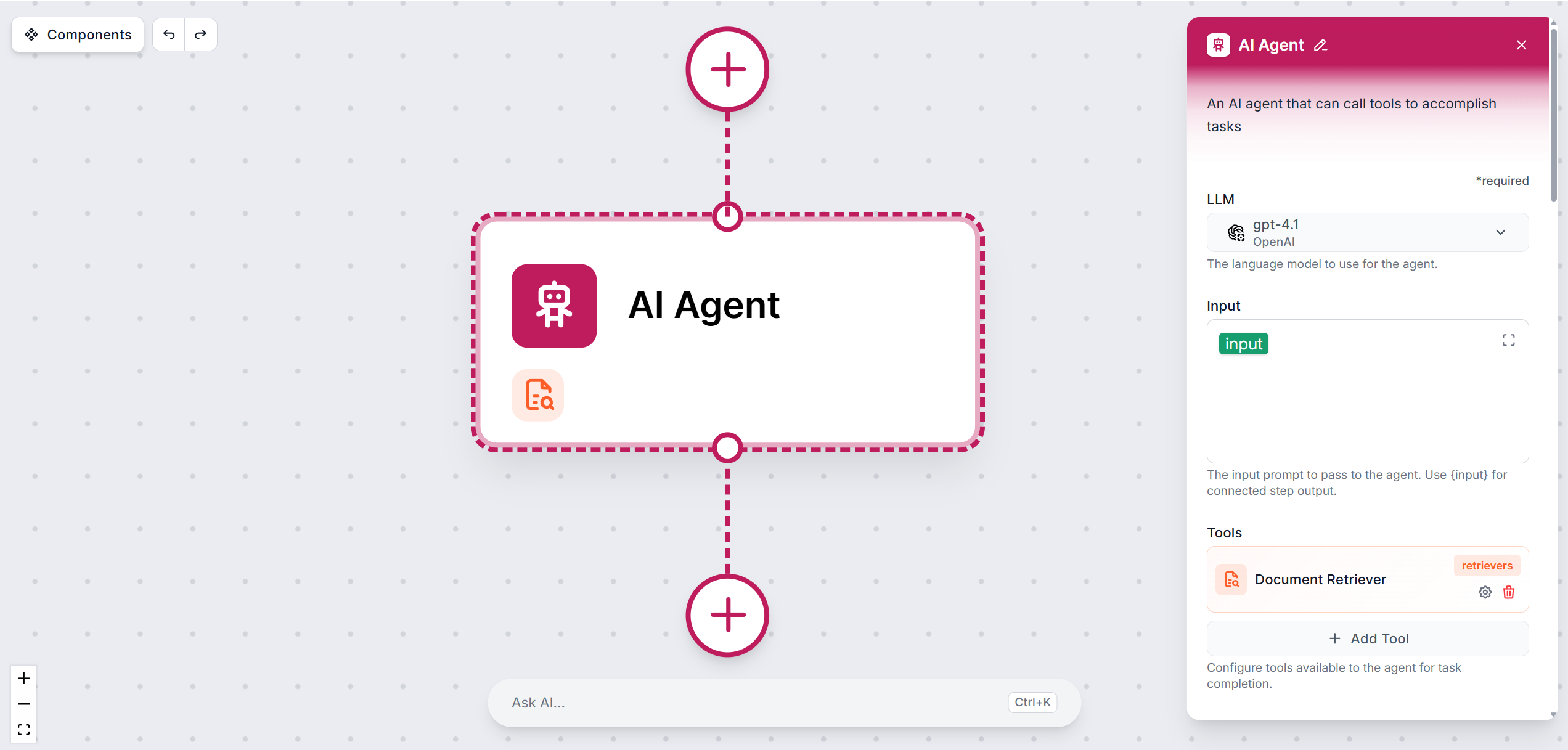
AI agents are the individual autonomous systems. Specific, deployable entities with a defined role. An AI sales agent, a coding agent, or a customer support agent, are all discrete components you can build, deploy, and monitor. In other words, Agents are the who.
Agentic AI is the broader paradigm: the architectural philosophy that makes it possible to build AI agents that work autonomously over multiple steps. In other words, Agentic AI is the how. The design approach behind systems that perceive, plan, act, and iterate.
AI agents vs chatbots vs RPA
RPA
Chatbot
AI Agent
Primary function
Automates rule-based processes
Responds to questions
Executes multi-step tasks
Autonomy
Rule-bound
Reactive
Proactive
Reasoning
None
Conversational
Planning + decision-making
Tool use
Scripted integrations only
Limited
Extensive (APIs, code, search)
Handles exceptions
No
No
Yes
Learns / adapts
No
Rarely
Yes
A chatbot answers. An AI agent acts. That single distinction is what makes agentic AI commercially significant, and why it’s replacing both simple chatbots and brittle RPA scripts in enterprise automation.
Ready to grow your business?
Start your free trial today and see results within days.
Every AI agent cycles through a loop of five core components:
1. Perception
The agent takes in input, such as a user message, a data feed, an API response, or the output of another agent. Modern agents handle text, structured data, code, and increasingly images and audio.
2. Planning
Using an LLM as its reasoning engine, the agent breaks the goal down into a sequence of sub-tasks. Techniques like ReAct (Reason + Act) and chain-of-thought prompting allow the model to work through what steps are needed before taking any action.
3. Tool Use
Agents extend their capabilities by calling external tools to search the web, run code, send emails, and so much more. This is what turns a text model into a system that can interact with the world.
Short-term (in-context): the running conversation and task within the current session
Long-term (external): vector databases or structured stores that persist information across sessions, enabling agents to remember prior interactions, user preferences, or task history
5. Action and Feedback Loop
The agent executes, evaluates the result, and decides whether the goal has been met. If not, it iterates. This loop continues until the objective is achieved or a defined stopping condition is reached.
The role of MCP
Model Context Protocol (MCP) is an emerging open standard. Developed by Anthropic and adopted across major AI platforms, it defines how AI agents connect to external data sources and tools consistently. Think of it as a universal adapter for agent integrations. As MCP adoption grows, building interoperable agents across different systems is becoming significantly more straightforward for developers and enterprises alike.
Types of AI Agents
Not all AI agents work the same way. The standard taxonomy covers six types, ranging from the simplest reactive systems to collaborative multi-agent networks. Understanding them helps you match the right architecture to the right problem.
1. Simple Reflex Agents
These agents respond to the current input based on predefined rules. They don’t have memory and aren’t learning. A basic FAQ bot that matches questions to answers is a simple reflex agent. Fast and predictable, but limited to situations that fit the script.
2. Model-Based Agents
These agents keep track of what’s happened so far, not just what’s in front of them right now. A simple reflex agent treats every input in isolation, a model-based agent remembers context, such as “this customer already asked about this yesterday” or “step 2 failed, so step 3 needs to adjust.” Useful any time earlier steps affect what the agent should do next.
3. Goal-Based Agents
Goal-based agents plan sequences of actions to achieve a defined objective. They evaluate possible paths and choose the one most likely to succeed. Most modern LLM-powered agents fall into this category.
4. Utility-Based Agents
Rather than just achieving a goal, utility-based agents optimize for a quality metric. They balance competing factors like speed, cost, and accuracy. These agents pick the fastest and cheapest route to complete a task.
5. Learning Agents
Learning agents improve from feedback. They incorporate outcomes into future decisions, getting better over time. Reinforcement learning from human feedback (RLHF) is the most widely known training approach for this type.
6. Multi-Agent Systems (MAS)
Multi-agent systems involve networks of agents working in parallel or sequence. The agents sometimes collaborate on shared goals, but can also operate competitively. A research agent, a writing agent, and a fact-checking agent working together on the same document is a multi-agent system. Frameworks like CrewAI and AutoGen are specifically designed for this pattern.
Join our newsletter
Get latest tips, trends, and deals for free.
Real-World AI Agent Examples by Industry
AI agents are already deployed at scale across every major industry. Here’s where they’re having the most concrete impact today.
Customer Service
Autonomous support agents
resolve tickets, handle returns, process refunds, and escalate to humans only when genuinely needed. Platforms like LiveAgent and Zendesk AI have embedded agentic capabilities that handle the majority of tier-1 support without human involvement.Gartner projects agentic AI could autonomously resolve up to 80% of customer service issues by 2029.
Sales and SDRAI SDR agents
research prospects, personalise outreach based on company data and recent buying signals, send sequences, follow up, and book meetings. They are capable of running the entire top-of-funnel at scale.
Software DevelopmentCoding agents
write, review, debug, and test code autonomously. GitHub Copilot’s agent mode and Claude Code go well beyond autocomplete. They can take a task description and execute an entire feature implementation, running tests and iterating on failures in a loop.
MarketingMarketing agents
draft content, run A/B tests, monitor campaign performance, and adjust spend allocation in real time. They can execute complete email sequences, respond to engagement signals, and generate performance reports without manual intervention at each step.
Finance and Accounting
Agents in finance handle invoice processing
, expense categorisation, fraud detection flagging, compliance checks, and real-time risk reporting. Processing high transaction volumes and surfacing anomalies instantly is a significant operational advantage over manual review.
HR and Recruitment
HR agents screen CVs
against job requirements, schedule interviews, send candidate communications, and guide new hires through onboarding workflows. They compress hiring timelines significantly while maintaining consistency across every candidate interaction.
Healthcare
Clinical documentation agents transcribe and structure notes, code procedures for billing, and support patient triage workflows. They reduce administrative burden on clinical staff and improve accuracy across documentation-heavy processes.
Real EstateProperty agents
match listings to buyer profiles, qualify leads through conversational interactions, schedule viewings, and maintain follow-up across long sales cycles — keeping pipelines active without constant manual outreach from agents.
Agentic AI Frameworks and Tools (How to Build AI Agents)
If you’re looking to build AI agents or evaluate platforms for your business, here’s a practical map of the main frameworks and tools available.
Framework
Best for
Coding required?
Open source?
LangChain / LangGraph
General agent development; complex chains
Yes
Yes
CrewAI
Role-based multi-agent systems
Yes
Yes
AutoGen (Microsoft)
Conversational multi-agent workflows
Yes
Yes
OpenAI Swarm
Lightweight multi-agent experimentation
Yes
Yes
n8n
No-code/low-code agent workflows
Minimal
Yes (self-host)
Make.com / Zapier
Business automation with AI action steps
No
No
FlowHunt
End-to-end agentic AI for business teams
Minimal
No
LangChain / LangGraph remains the most widely used framework for developers building custom agents. LangGraph extends it with stateful, graph-based orchestration — well-suited for complex multi-step workflows that need to branch and loop.
CrewAI is designed for multi-agent systems, letting you define agents by role (researcher, writer, reviewer) and orchestrate them toward a shared output. The “crewai framework for ai agents” query is one of the faster-growing searches in this space.
AutoGen (from Microsoft Research) takes a conversational approach to multi-agent coordination, where agents communicate via structured dialogue to complete tasks — making it readable and debuggable even for complex pipelines.
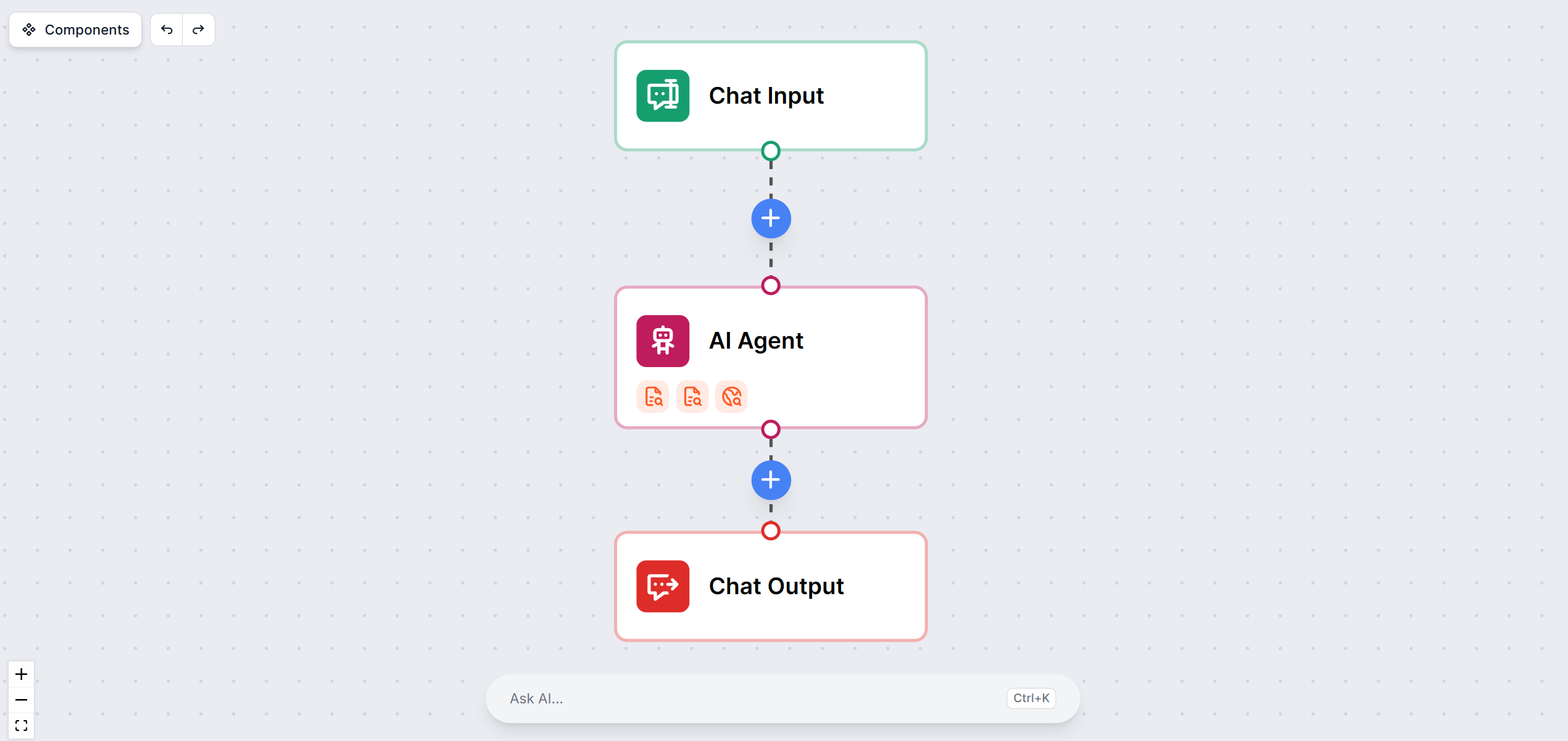
For teams that need to build and deploy agents without writing significant code, n8n, Make.com, and Zapier all offer visual builders with AI action nodes.
FlowHunt is purpose-built for business teams that need to design, deploy, and monitor agentic AI across customer service, sales, and operations workflows — without requiring engineering resources for every use case.
AI Agents for Business — Opportunities and Risks
The business case for agentic AI is real, but the clearest-eyed organisations understand both sides before deploying.
Opportunities
24/7 autonomous execution: Agents don’t sleep, take breaks, or have capacity limits. Multi-step workflows that previously required human coordination can run continuously at any volume.
Compressing cycle times: Tasks that took days, such as prospect research, report generation or content production, can complete in minutes when fully automated.
Scaling without proportional headcount: Agentic AI lets organisations absorb growing workloads in customer-facing functions without a linear increase in staff. - Consistency at scale: Agents execute to the same standard on every interaction, removing the variability that comes with human execution of repetitive processes.
Risks and Considerations
Compounding errors: In autonomous chains, an early mistake can propagate and amplify through subsequent steps. Error-checking and human review points need to be designed in from the start, not bolted on later.
Hallucinations: LLMs can produce plausible but incorrect outputs. An agent that acts on hallucinated data may create real-world problems. Grounding agents in verified data sources is essential.
Security and authentication: Agents that call external APIs and access sensitive systems require robust authentication and scope controls. This is an active area of development across the industry, and the risk surface is larger than with simpler automation.
Governance and human oversight: Knowing when to keep humans in the loop is both a technical and an organisational decision. Fully autonomous execution is appropriate for some workflows; others require a human checkpoint before irreversible action.
Over-automation: Not every process benefits from full automation. The organisations that deploy agentic AI successfully are those that identify the right workflows.
Agentic AI is not overhyped in terms of capability, but it is frequently over-promised in terms of plug-and-play simplicity. Successful deployment requires thoughtful workflow design, appropriate guardrails, and ongoing monitoring.
Conclusion
Agentic AI marks the shift from AI as a responder to AI as an executor. The underlying technology, combined with tools, memory, and planning loops make AI systems mature enough to deploy at scale, and the business value in the right workflows is well-documented.
The market is still early by enterprise standards, which means there is a real advantage available to teams that invest in understanding and deploying agentic AI now.
The right starting point is to identify two or three workflows in your business where multi-step automation would compress cycle times or free up skilled people for higher-value work.
That’s exactly what FlowHunt is built for. Browse a library of pre-built agentic workflows ready to deploy across customer service, sales, marketing, and more — or build your own from scratch without writing a single line of code. Either way, you get a full platform to deploy, monitor, and iterate, without needing a dedicated AI engineering team behind every use case. Start your free trial to see what’s possible with FlowHunt.
Frequently asked questions
Agentic AI is the paradigm — the architectural approach that enables autonomous, multi-step AI behaviour. AI agents are the individual systems built within that paradigm. Every AI agent is an example of agentic AI in action; agentic AI as a concept encompasses the full range of agent architectures and capabilities.
No. Chatbots respond to questions within a conversation. AI agents take actions across systems, execute multi-step workflows, use external tools, and can operate without continuous human direction. A chatbot is reactive; an AI agent is proactive.
Autonomous AI agents are systems that can execute entire workflows — researching, deciding, acting, evaluating, and iterating — without human approval at each step. The degree of autonomy varies: some agents check in at key decision points; others run end-to-end independently.
Start with a framework suited to your use case — LangChain or LangGraph for custom development, CrewAI or AutoGen for multi-agent systems, n8n or FlowHunt for lower-code approaches. Define the agent's goal, the tools it can use, and how it handles memory and errors. Test iteratively with real tasks before deploying in production.
Most modern AI agents use large language models (LLMs) as their reasoning core, making them a form of generative AI. But agentic AI extends generative AI by adding planning, tool use, memory, and action — not just generation.
MCP stands for Model Context Protocol, an open standard developed by Anthropic that defines how AI agents connect to external data sources and tools in a consistent, interoperable way. As more tools adopt MCP, building agents that can access a wide range of systems becomes significantly more straightforward.
Maria is a copywriter at FlowHunt. A language nerd active in literary communities, she's fully aware that AI is transforming the way we write. Rather than resisting, she seeks to help define the perfect balance between AI workflows and the irreplaceable value of human creativity.
Maria Stasová
Copywriter & Content Strategist
Transform Your Business With Agentic AI
See how FlowHunt enables you to build, deploy, and manage agentic AI for real-world business automation, customer support, sales, and more. Unlock efficiency and innovation using the power of autonomous AI agents.
What Are AI Agents? Complete Guide to Autonomous AI Systems
Learn what AI agents are, how they work, different types, and how to build them without code. Complete guide with examples, ROI data, challenges, and comparison...
Agentic AI is an advanced branch of artificial intelligence that empowers systems to act autonomously, make decisions, and accomplish complex tasks with minimal...
Emerging AI Agent Startups and Disruptors in Q4 2025: The Agentic Era Begins
Explore the most innovative AI agent startups transforming enterprise automation in Q4 2025. Discover autonomous agents, cognitive architectures, and industry-s...
18 min read
AI Agents
Startups
+3
Cookie Consent We use cookies to enhance your browsing experience and analyze our traffic. See our privacy policy.