Best AI Agent Frameworks in 2026: LangChain, CrewAI, AutoGen & More
Comparing the 8 best AI agent frameworks in 2026 — LangChain, CrewAI, AutoGen, LlamaIndex, Dify, Haystack, Semantic Kernel, and FlowHunt. Which is right for your team?
AI agents have moved from research curiosity to production reality. In 2026, dozens of frameworks, platforms, and tools compete to be the stack you build your agents on. The choice matters: picking the wrong framework means months of refactoring, poor production reliability, or capabilities you can’t extend.
This guide compares the 8 leading AI agent frameworks and platforms — what they’re built for, where they excel, and which teams should use each.
What Makes a Good AI Agent Framework?
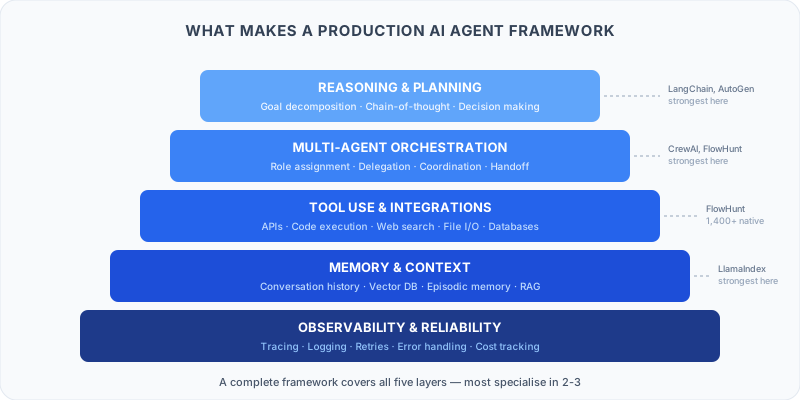
Before comparing tools, it’s worth defining what “good” means in this context. A production AI agent framework needs to handle:
Reasoning and planning — can the agent break down complex goals into executable steps?
Tool use — can agents call external APIs, run code, search documents, and interact with real systems?
Memory and context — can agents maintain conversation history, episodic memory, and access vector databases for long-term knowledge?
Multi-agent orchestration — can multiple specialized agents coordinate to solve problems no single agent could?
Reliability and observability — can you trace what happened when an agent fails? Are there retry mechanisms, error handling, and logging?
Development speed — how quickly can a new developer build their first working agent?
Different frameworks optimize for different points on this list.
AI Agent Frameworks Comparison Table
Framework
Type
Language
Best For
Difficulty
Multi-Agent
FlowHunt
Platform
No-code
Production agents fast
Beginner
✅
LangChain
Framework
Python/JS
General purpose
Intermediate
✅
CrewAI
Framework
Python
Role-based agent teams
Beginner-Int.
✅
AutoGen
Framework
Python
Conversational agents
Intermediate
✅
LlamaIndex
Framework
Python
RAG, document agents
Intermediate
✅
Dify
Platform
Low-code
Visual + code hybrid
Beginner
✅
Haystack
Framework
Python
NLP, document search
Intermediate
Partial
Semantic Kernel
SDK
.NET/Python/Java
Enterprise apps
Advanced
✅
Ready to grow your business?
Start your free trial today and see results within days.
1. FlowHunt — Best for Production Agents Without Framework Overhead
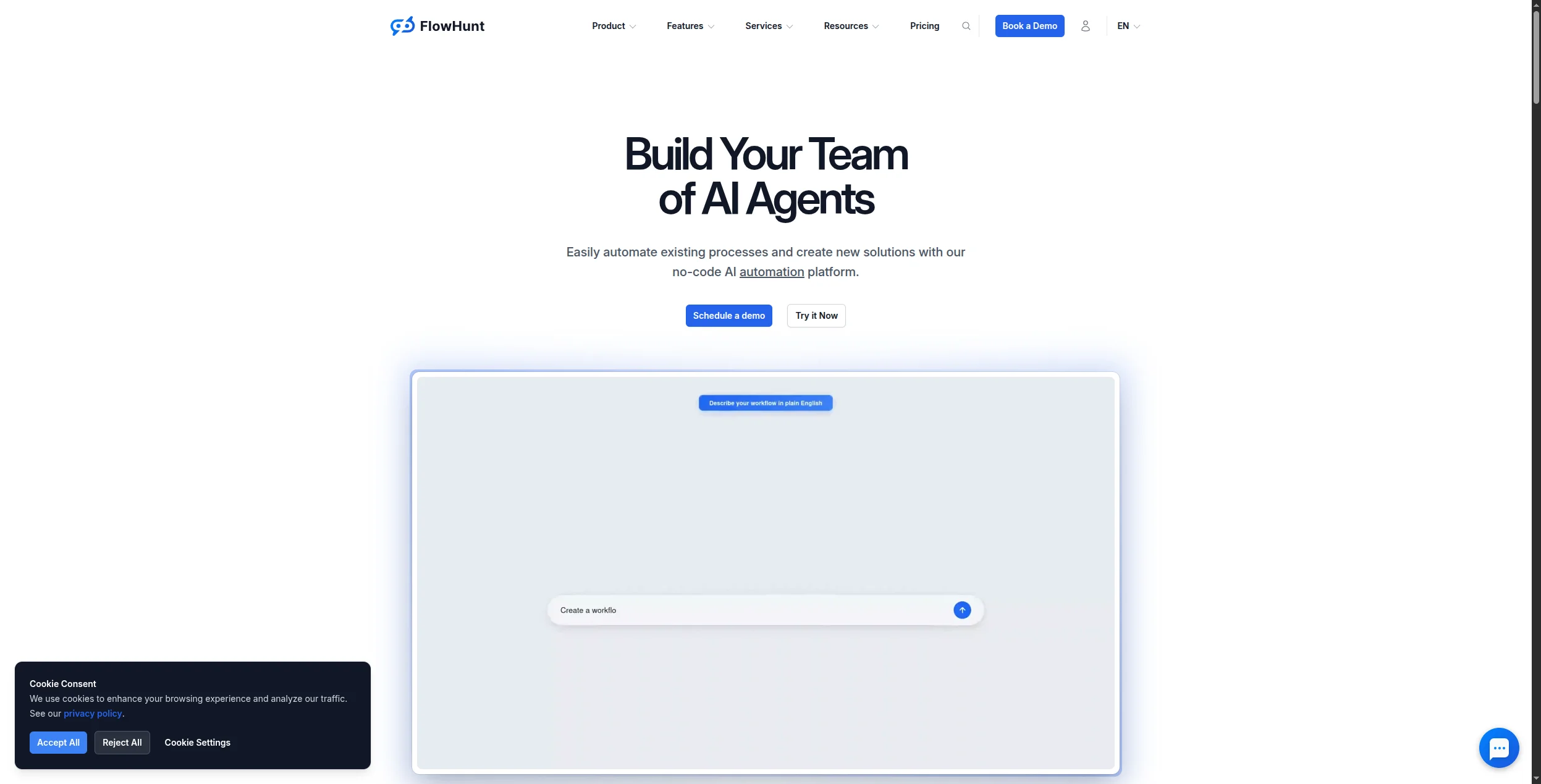
FlowHunt is not a code framework — it’s a visual AI agent platform that gives you the capabilities of LangChain or CrewAI without writing framework boilerplate. You build agent workflows on a visual canvas, connect to 1,400+ tools natively, and deploy to production with one click.
For teams building internal automation — customer support agents, content generation pipelines, sales qualification agents, data processing workflows — FlowHunt reaches production 10x faster than a hand-coded framework implementation.
What FlowHunt offers:
Visual agent builder — drag-and-drop agent design with branching, conditions, and loops
1,400+ native integrations — no custom API wrappers needed
Multi-agent orchestration — chain specialist agents with defined handoff logic
Built-in memory — conversation history, vector store integration, and session context
Production infrastructure — hosted, scaled, monitored — no DevOps required
When to choose FlowHunt over a framework:
You need agents in production within days, not months
Your team is non-technical or mixed technical/business
You’re building internal tooling, not a software product
You want managed reliability without infrastructure management
When a framework is better: You’re building a product sold to others, need deep custom logic, or your team has strong Python skills and needs maximum control.
Pricing: Free tier with generous limits. Paid plans scale by usage.
Explore FlowHunt’s agent capabilities in our AI chatbot
product overview.
2. LangChain — The Default Python AI Agent Framework
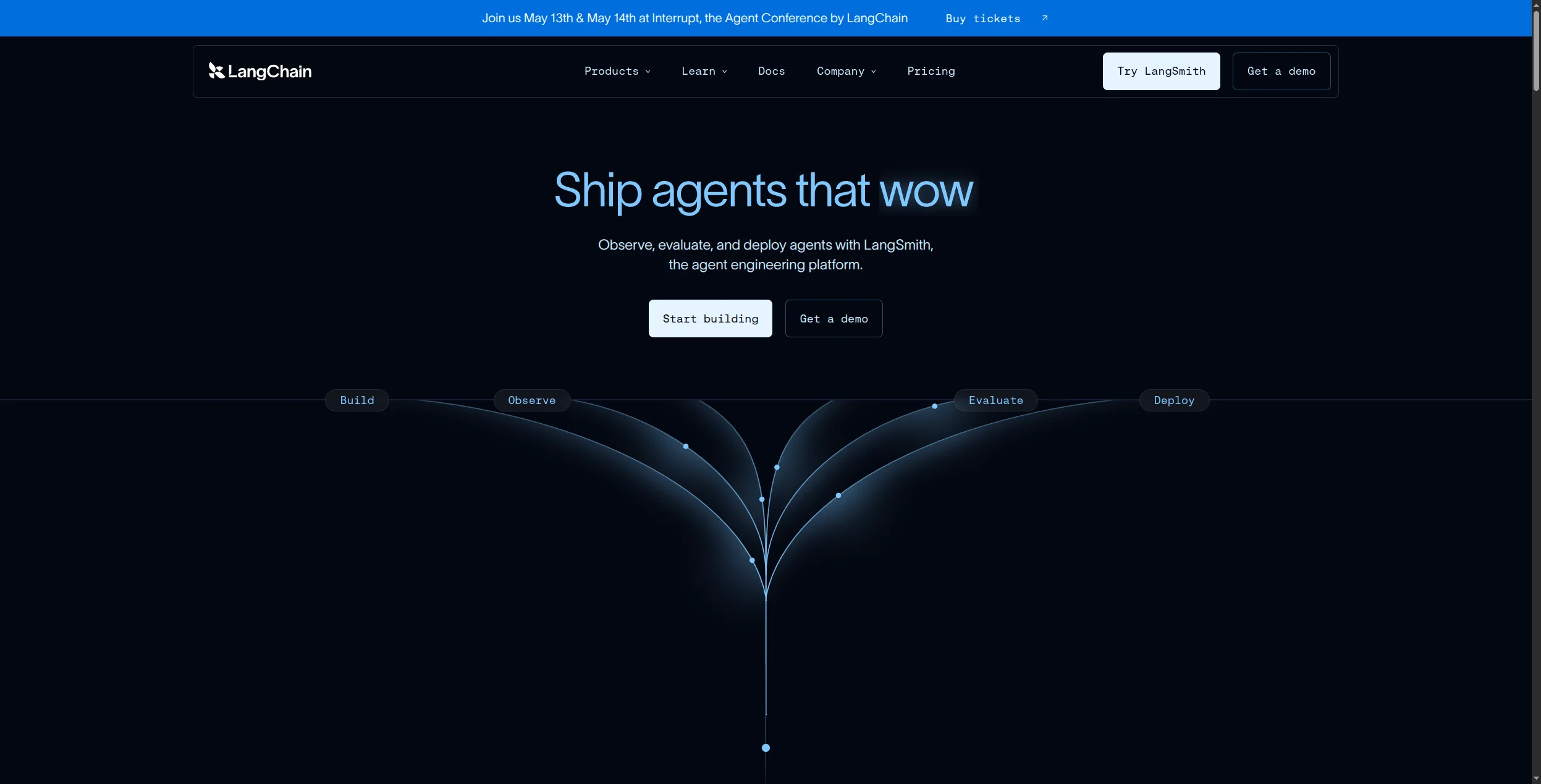
LangChain is the most adopted AI agent framework in the world, with 90,000+ GitHub stars and an ecosystem that includes LangSmith (observability), LangGraph (stateful multi-agent), and LangServe (deployment). If you’re building in Python or JavaScript, LangChain is the default starting point.
Core concepts:
Chains — sequences of LLM calls and tool uses
Agents — LLMs that decide which tool to use based on input
Tools — any function the agent can call (search, calculator, database query)
Memory — conversation history and vector-store retrieval
Strengths:
Largest ecosystem of tools, integrations, and community extensions
LangSmith provides production observability and debugging
Extensive documentation and tutorials
Weaknesses:
Known for abstraction complexity — beginners often fight the framework
Performance overhead from abstraction layers
Rapidly evolving API causes breaking changes
Best for: Teams with Python experience building general-purpose agents or RAG applications.
Join our newsletter
Get latest tips, trends, and deals for free.
3. CrewAI — Best for Role-Based Multi-Agent Systems
CrewAI is purpose-built for multi-agent scenarios where different agents have different roles. You define a “crew” of agents, each with a specific role, goal, and backstory, and a set of tasks they coordinate on. The framework handles inter-agent communication and task delegation automatically.
Core concepts:
Agents — defined with role, goal, backstory, and tool access
Tasks — specific work items assigned to agents
Crew — a team of agents with a process (sequential or hierarchical)
Strengths:
Simpler mental model than LangChain for multi-agent scenarios
Role-based design maps naturally to how human teams work
Active development and growing community
CrewAI Enterprise adds observability and deployment tooling
Weaknesses:
Less flexible than LangChain for non-multi-agent use cases
Younger ecosystem with fewer integrations
Production deployment still requires custom infrastructure
Best for: Developers building agent teams where different agents specialize in different tasks (research agent + writing agent + review agent).
4. AutoGen — Best for Conversational Multi-Agent Patterns
AutoGen is Microsoft Research’s framework for building systems where multiple AI agents converse with each other to solve problems. Its distinctive feature is that agents can execute code, verify outputs, and iterate — making it particularly strong for coding assistants and data analysis agents.
Core concepts:
Conversable agents — agents that send and receive messages
GroupChat — multiple agents in a shared conversation
Human-in-the-loop — optional human checkpoints in agent conversations
Strengths:
Most mature framework for agent-to-agent conversation patterns
Strong code execution and verification capabilities
AutoGen Studio provides a no-code UI for experimentation
Deep Microsoft research backing with strong academic credibility
Weaknesses:
Conversational multi-agent paradigm adds complexity for simple use cases
Less production-ready infrastructure than commercial platforms
Debugging agent-to-agent conversations can be opaque
Best for: Research applications, coding assistants, and scenarios where agents need to verify their own work through iteration.
5. LlamaIndex — Best for RAG and Document-Grounded Agents
LlamaIndex is the leading framework for building agents that reason over large document collections. Its data connectors, indexing strategies, and query engines make it the default choice for applications where agents need to search, retrieve, and synthesize information from private knowledge bases.
Core concepts:
Data connectors — ingest from PDFs, Notion, Slack, databases, and 100+ sources
Indexes — vector, keyword, and knowledge graph indexes for different retrieval strategies
Query engines — structured querying over indexed data
Agents — ReAct and OpenAI function-calling agents with tool use
Strengths:
Best-in-class RAG pipeline tooling
Extensive data connector ecosystem
Strong support for structured data querying alongside unstructured text
LlamaCloud provides managed index hosting
Weaknesses:
Less suited for action-taking agents vs knowledge-retrieval agents
Steeper learning curve than CrewAI for multi-agent scenarios
Can be over-engineered for simple document Q&A use cases
Best for: Applications where agents need to answer questions from large private document collections — internal knowledge bases, legal document analysis, customer support over product documentation.
6. Dify — Best Open-Source Platform (Visual + Code)
Dify is an open-source LLM application development platform that bridges visual building and code. It has a workflow builder for non-developers, a RAG pipeline, and agent tooling — and can be self-hosted or used as a cloud service.
Built-in model management (switch between OpenAI, Anthropic, local models)
Active community with growing template library
Weaknesses:
Smaller ecosystem than LangChain
Less mature for complex multi-agent scenarios
Self-hosting requires DevOps resources
Best for: Teams that want an open-source managed platform (vs raw framework code) with self-hosting control.
7. Haystack — Best for Enterprise NLP and Document Search
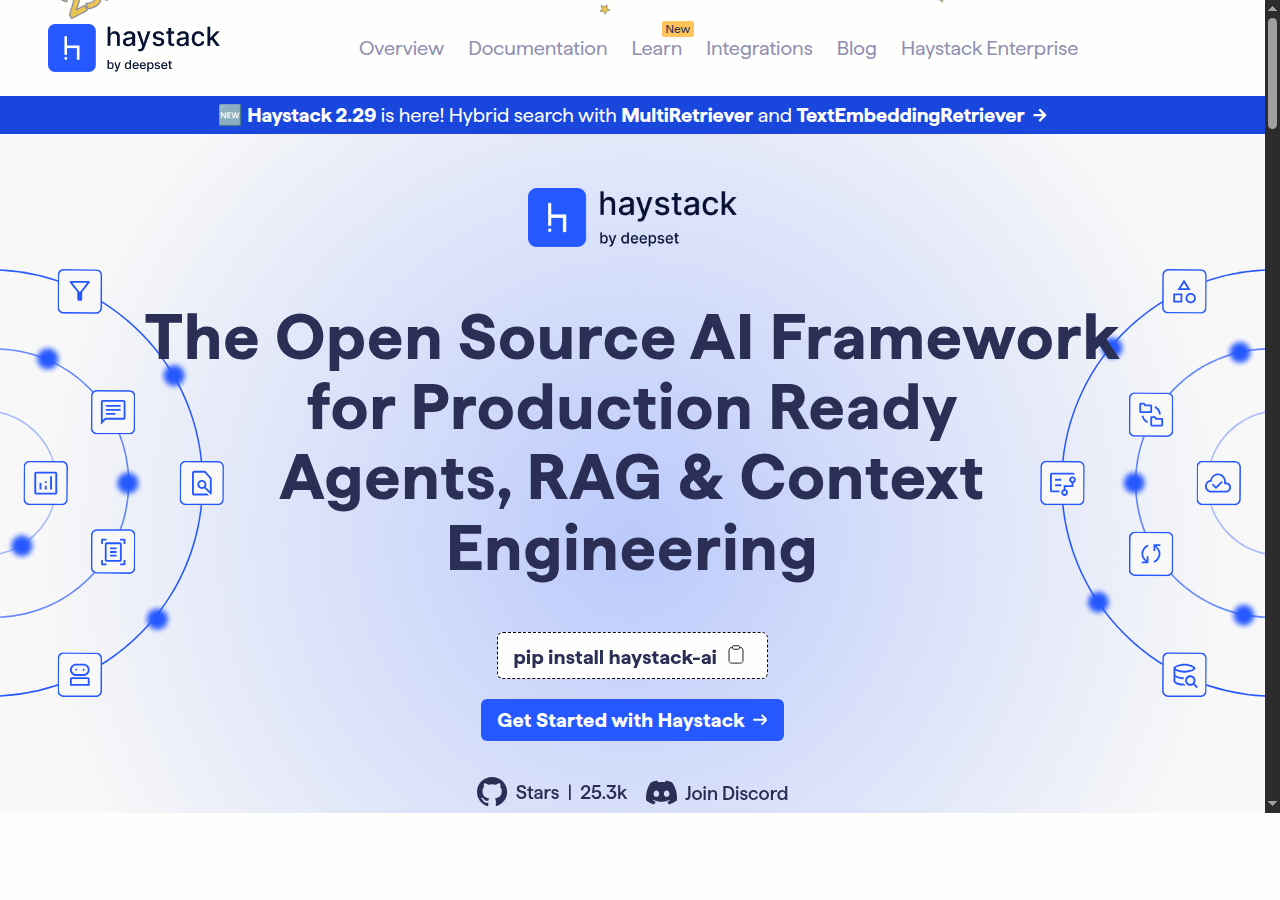
Haystack by deepset is a production-grade open-source framework for NLP pipelines, document retrieval, and question answering. It has strong enterprise adoption in industries where document-grounded AI (legal, finance, healthcare) needs production reliability.
Strengths:
Production-grade reliability with extensive testing
Best for: Enterprise teams building document intelligence applications with strict reliability requirements.
8. Semantic Kernel — Best for Microsoft/Enterprise App Integration
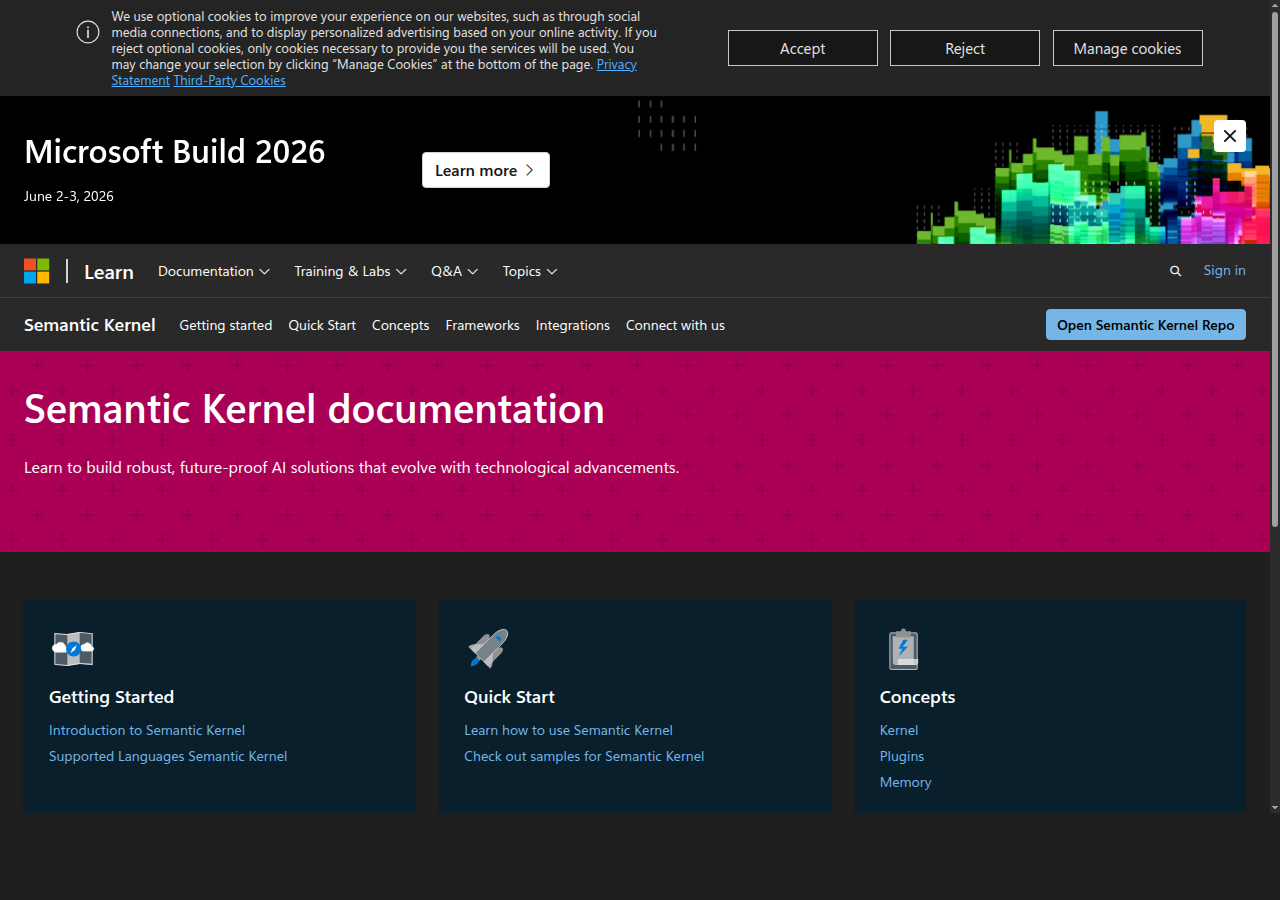
Semantic Kernel is Microsoft’s SDK for integrating AI capabilities into existing enterprise applications. It supports .NET, Python, and Java — making it the natural choice for enterprises with existing Microsoft stack investments.
Strengths:
First-class .NET support — rare in the AI framework space
Designed for integrating AI into existing enterprise apps rather than building new ones
Strong Azure OpenAI and Microsoft 365 integration
Memory, planning, and plugin architecture designed for enterprise scale
Weaknesses:
Most complex framework to get started with
Best suited for Microsoft ecosystem — less advantage for non-Microsoft stacks
Requires experienced developers to implement well
Best for: Enterprise development teams extending existing .NET/Java applications with AI capabilities.
No-Code Platform vs Framework: How to Choose
The framework vs platform question is one of the most important decisions in AI agent architecture:
Choose a framework (LangChain, CrewAI, etc.) when:
You’re building a product or service, not internal tooling
Your team has strong Python/JavaScript skills
You need deep customization of agent behavior, memory, or reasoning
You have DevOps capacity to manage deployment infrastructure
You’re doing research or exploring new agent architectures
Choose a platform (FlowHunt, Dify) when:
You need production agents in days, not months
You’re building internal automation rather than a software product
Your team is non-technical or mixed
You want managed infrastructure, monitoring, and reliability without DevOps overhead
You’re connecting commercial SaaS tools rather than building custom integrations
For most business automation use cases — customer support, content generation, lead qualification, data processing — a platform like FlowHunt delivers results faster than any framework. Frameworks become essential when you’re building AI products where agent behavior needs to be deeply customized.
For non-developers, FlowHunt's visual builder is the fastest path to working AI agents. For developers new to AI, LangChain has the largest community, most tutorials, and widest ecosystem — it's the default starting point. CrewAI is simpler than LangChain for multi-agent scenarios and has excellent documentation.
LangChain is a general-purpose framework for building AI chains and agents — flexible but requires more configuration. CrewAI is specifically designed for multi-agent systems with defined roles — simpler to set up for team-of-agents scenarios but less flexible for other use cases. Many teams use both: LangChain as the execution layer, CrewAI for agent orchestration.
Yes — most leading frameworks are open-source: LangChain (MIT), CrewAI (MIT), AutoGen (CC BY 4.0), LlamaIndex (MIT), Haystack (Apache 2.0), Dify (Apache 2.0), and Semantic Kernel (MIT). FlowHunt is a closed-source platform but offers a free tier. Open-source frameworks give you full customization; platforms like FlowHunt and Dify add a managed layer.
For RAG-heavy applications: LlamaIndex. For multi-agent teams: CrewAI. For maximum flexibility: LangChain. For Microsoft/.NET environments: Semantic Kernel. For a managed open-source option with a visual builder: Dify. The choice depends heavily on your application type, not just language preference.
Use a framework when: you need custom business logic beyond what platforms support, you're building a product rather than internal tooling, you need deep customization of agent memory or reasoning, or your team has strong Python/JS skills. Use FlowHunt when: you need agents running in days not months, you're building internal automation rather than a product, or your team is non-technical or mixed.
Arshia is an AI Workflow Engineer at FlowHunt. With a background in computer science and a passion for AI, he specializes in creating efficient workflows that integrate AI tools into everyday tasks, enhancing productivity and creativity.
Arshia Kahani
AI Workflow Engineer
Build AI Agents Without Framework Complexity — Try FlowHunt Free
FlowHunt gives you production-ready AI agents without writing framework boilerplate. Visual builder, 1,400+ integrations, and enterprise-grade reliability.
Best AI Agent Tools in 2026: 12 Platforms for Building and Running AI Agents
Ranked and reviewed: the 12 best AI agent tools in 2026. From no-code agent builders to open-source frameworks — find the right platform for your team's AI stra...
Best AI Agent Builder in 2026: 12 Tools Ranked and Reviewed
Ranked and reviewed: the 12 best AI agent builders in 2026. Comparison table, pricing, free tiers, and a clear verdict on which platform fits your use case.
Crew.ai vs Langchain: A Thorough Look at Multi-Agent Frameworks
Explore Crew.ai and Langchain multi-agent frameworks. Crew.ai excels in collaboration and task division, ideal for complex simulations, while Langchain is stron...
4 min read
AI
Multi-Agent
+5
Cookie Consent We use cookies to enhance your browsing experience and analyze our traffic. See our privacy policy.