Introduction
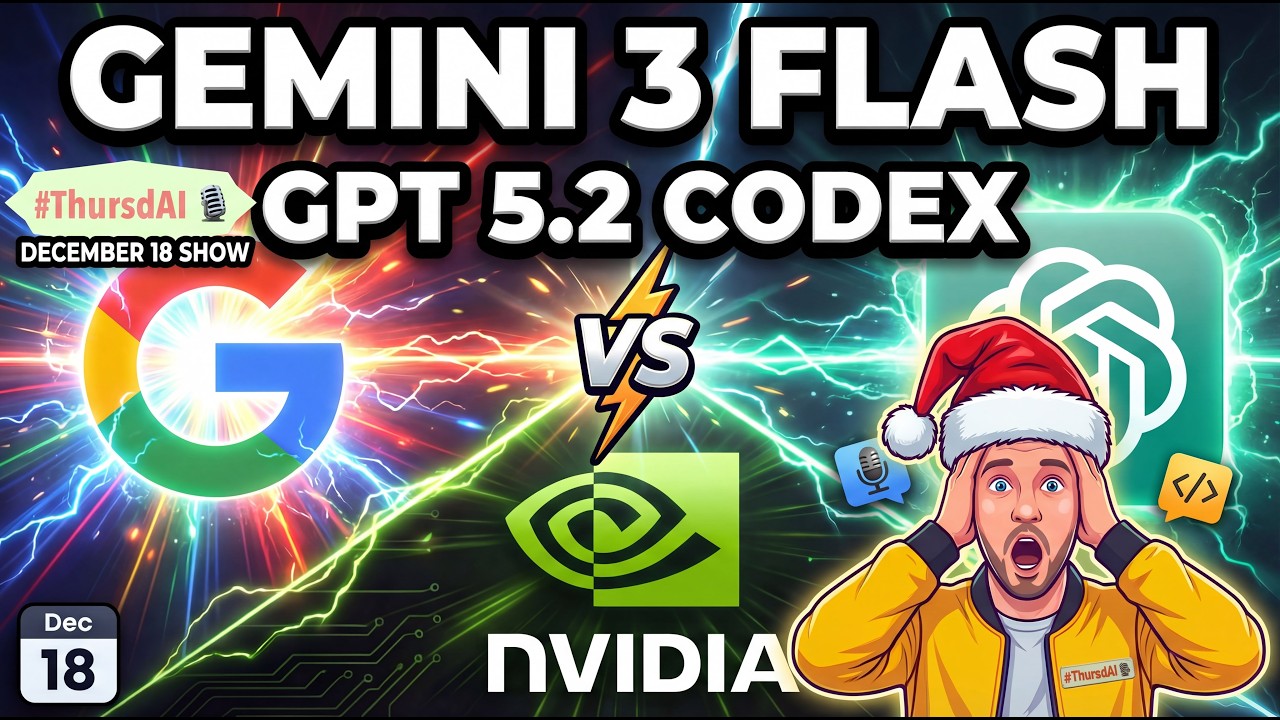
The final weeks of 2025 have delivered an extraordinary acceleration in artificial intelligence development. As the year winds down, major AI laboratories and open-source initiatives have released models that fundamentally shift the conversation around what’s possible with modern machine learning. This week alone brought transformative announcements including Google’s Gemini 3 Flash, Nvidia’s Nemotron 3 Nano, and several other significant releases that demonstrate the industry’s relentless pursuit of more efficient, capable, and accessible AI systems. Understanding these developments is crucial for anyone working with AI technology, as they represent the cutting edge of what’s achievable today.
The Evolution of AI Models: From Raw Power to Intelligent Efficiency
The trajectory of artificial intelligence development over the past several years reveals a fundamental shift in priorities. Early in the decade, the focus centered on scaling—building larger models with more parameters to achieve better performance on benchmarks. However, as models have grown increasingly capable, the industry has recognized that raw size alone doesn’t determine practical utility. The real challenge now involves creating models that deliver exceptional intelligence while maintaining speed, affordability, and accessibility.
This evolution reflects a maturation in the field. Researchers and engineers have moved beyond the question of “can we build a more powerful model?” to the more nuanced inquiry of “can we build a smarter model that’s also faster and cheaper?” This shift has profound implications for how AI gets deployed in real-world applications. A model that requires seconds to generate a response may be technically impressive but practically useless for customer service applications, real-time analysis, or interactive user experiences. The models released this week exemplify this new paradigm.
Ready to grow your business?
Start your free trial today and see results within days.
Why Model Efficiency Matters for Modern Businesses
For organizations implementing AI systems, efficiency translates directly to operational impact and financial sustainability. A model that delivers 95% of the performance of a larger system while running at a fraction of the cost and latency fundamentally changes the economics of AI deployment. This isn’t merely about saving money on API calls, though that’s certainly important. It’s about enabling new use cases that were previously impractical.
Consider the practical implications:
- Real-time applications: Faster inference enables chatbots, content moderation, and customer support systems that respond instantly rather than after noticeable delays
- Cost optimization: Reduced computational requirements mean organizations can serve more users with the same infrastructure investment
- Edge deployment: Smaller, more efficient models can run on devices with limited computational resources, enabling on-device AI without cloud dependencies
- Accessibility: Lower barriers to entry mean smaller teams and organizations can implement sophisticated AI systems
- Sustainability: Reduced computational overhead translates to lower energy consumption and environmental impact
The models released this week directly address these business concerns, making them far more than academic achievements. They represent practical tools that organizations can deploy immediately to solve real problems.
Google’s Gemini 3 Flash: Redefining the Price-to-Intelligence Ratio
Google’s release of Gemini 3 Flash represents one of the most significant developments in accessible AI this year. Positioned as the successor to the already impressive Gemini 2.5 Flash, this new model achieves something remarkable: it delivers frontier-class intelligence at flash-level speeds and costs. The pricing structure alone tells the story—at just 50 cents per million input tokens and $3 per million output tokens, Gemini 3 Flash offers an extraordinary value proposition.
What makes this achievement particularly noteworthy is the performance trajectory. When Gemini 3 Pro launched just weeks earlier, it represented a substantial leap forward in capabilities, breaking numerous benchmarks and establishing new standards for multimodal reasoning. Yet within a month, Google released a smaller, faster, and cheaper model that matches or exceeds Gemini 3 Pro’s performance on many of those same benchmarks. This acceleration demonstrates the pace of innovation in the field and suggests that the gap between frontier models and efficient variants is narrowing dramatically.
The technical specifications reveal why this model performs so well despite its efficiency focus. Gemini 3 Flash achieves state-of-the-art multimodal reasoning with 81% accuracy on the MMU benchmark and 78% on SWE-bench verified. Time-to-first-token is exceptionally quick, making it ideal for interactive applications where users expect immediate responses. The model powers Google Search and the Gemini Assistant, meaning millions of users are already benefiting from its capabilities daily.
| Metric | Gemini 3 Flash | Gemini 3 Pro | Gemini 2.5 Flash |
|---|
| Input Token Cost | $0.50/1M | $1.50/1M | $0.075/1M |
| Output Token Cost | $3.00/1M | $6.00/1M | $0.30/1M |
| MMU Benchmark | 81% | 82% | ~75% |
| SWE-bench Verified | 78% | 80% | ~70% |
| Speed | Ultra-fast | Fast | Fast |
| Best Use Case | Real-time, cost-sensitive | Complex reasoning | General purpose |
For teams using FlowHunt to manage AI workflows, Gemini 3 Flash opens new possibilities for cost-effective content analysis, research synthesis, and automated intelligence gathering. The combination of speed and affordability makes it practical to process large volumes of information without the computational overhead that previously limited such applications.
Join our newsletter
Get latest tips, trends, and deals for free.
Nvidia’s Nemotron 3 Series: Open-Source Excellence at Scale
While Google focused on frontier models, Nvidia took a different but equally important approach with the Nemotron 3 series. The company’s commitment to open-source AI represents a significant strategic shift for the world’s most valuable company by market capitalization. Rather than hoarding proprietary models, Nvidia released a complete family of open-weight models with fully transparent training data and methodologies.
The Nemotron 3 Nano, the smallest member of the family, demonstrates that efficiency doesn’t require sacrificing capability. This 30-billion parameter model incorporates three active Mamba layers—a architectural innovation that has generated both excitement and skepticism in the research community. The model achieves 1.5 to 3x faster inference than competing models like Qwen 3 while maintaining competitive accuracy on Nvidia’s H200 GPUs. The 99% accuracy on AIME (American Invitational Mathematics Examination) is particularly impressive, especially considering this is a 30-billion parameter model solving one of the most challenging mathematics benchmarks available.
The training data reveals the scale of modern AI development. Nemotron 3 Nano was trained on 25 trillion tokens—a staggering number that reflects the industry’s commitment to comprehensive training. Notably, approximately one-fifth of this training data was synthetically generated, highlighting how modern AI systems increasingly learn from data created by other AI systems. Nvidia’s decision to release all pre-training and post-training datasets publicly represents an unprecedented level of transparency in the field.
The Nemotron 3 family extends beyond the Nano variant. The Super variant features 120 billion parameters and delivers 4x the capability of Nano, while the Ultra variant approaches half a trillion parameters with 16x the size of Nano. Artificial analysis ranked the Ultra variant number one in its class, though the “class” designation itself reflects how the industry now segments models by efficiency tier rather than absolute capability.
Early community testing has validated the models’ practical utility. Developers running Nemotron 3 Nano on Apple’s M4 Max with 4-bit quantization achieved real-time generation at 30 tokens per second. Others successfully deployed the model on AMD hardware, demonstrating that Nvidia’s open-source commitment extends beyond its own GPU ecosystem. This cross-platform compatibility significantly expands the potential user base.
The Broader Open-Source Ecosystem: Innovation Beyond the Giants
Beyond Nemotron, the open-source community released several other significant models that deserve attention. The Allen Institute for AI introduced Balmo, the first byte-level tokenization model to achieve parity with standard tokenization approaches. This innovation opens new possibilities for omnimodal AI systems, as everything—text, images, audio—ultimately reduces to bytes. While byte-level processing requires additional research before achieving full omnimodal capabilities, the breakthrough demonstrates the continued innovation happening outside the major labs.
The same institute released Molmo 2, a multimodal model with video input capabilities across three sizes: 4B, 7B, and 8B parameters. The video understanding capability is particularly noteworthy—the model can analyze video content and not only answer questions about it but also mark precise coordinates where events occur. This enables verification and precise analysis that goes beyond simple question-answering.
Xiaomi contributed MIMO V2 Flash, a mixture-of-experts model with 309 billion total parameters but only 15 billion active parameters. The hybrid attention mechanism and interleaved layer design deliver performance comparable to DeepSeek V3 while maintaining efficiency. These releases collectively demonstrate that innovation in AI extends far beyond the major American laboratories, with significant contributions coming from research institutions and international companies.
FlowHunt’s Role in Managing AI Complexity
As the AI landscape becomes increasingly complex with new models releasing weekly, organizations face a genuine challenge: how do you stay informed about developments that could impact your systems? How do you evaluate which models suit your specific use cases? How do you integrate new capabilities into existing workflows without disrupting operations?
This is where FlowHunt becomes invaluable. The platform automates the research, analysis, and synthesis of AI developments, allowing teams to quickly understand what’s new, why it matters, and how it applies to their work. Rather than manually tracking releases across multiple sources, FlowHunt aggregates information, analyzes technical specifications, and generates comprehensive reports that teams can act on immediately.
For content teams specifically, FlowHunt streamlines the process of creating articles about AI breakthroughs. Instead of spending hours researching technical documentation and synthesizing information from multiple sources, teams can leverage FlowHunt’s automation to generate well-researched, comprehensive content that educates their audience about important developments. This capability becomes increasingly valuable as the pace of AI innovation accelerates.
The Acceleration of AI Progress: What December 2025 Reveals
The releases of December 2025 tell a compelling story about the trajectory of artificial intelligence. The industry isn’t just making incremental improvements—it’s fundamentally rethinking how to build AI systems. The focus has shifted from “bigger is better” to “smarter, faster, and more efficient is better.” This represents a maturation that will have lasting implications for how AI gets deployed and who can access it.
The price-to-intelligence ratio improvements are particularly striking. Gemini 3 Flash delivers Pro-level capabilities at Flash-level costs. Nemotron 3 Nano achieves competitive performance at a fraction of the computational cost. These aren’t marginal improvements—they’re transformative changes that expand the practical applications of AI technology.
Furthermore, the commitment to open-source development from major players like Nvidia signals a shift in industry dynamics. When the world’s most valuable company dedicates resources to open-source AI, it legitimizes the approach and accelerates innovation across the entire ecosystem. Smaller organizations and researchers gain access to state-of-the-art models, enabling them to build on top of these foundations rather than starting from scratch.
Conclusion: Preparing for the Next Wave of AI Innovation
As 2025 draws to a close, the AI industry stands at an inflection point. The models released this week—Gemini 3 Flash, Nemotron 3 Nano, and their peers—represent not just technical achievements but practical tools that organizations can deploy immediately. The combination of improved efficiency, reduced costs, and expanded accessibility means that advanced AI capabilities are no longer limited to well-funded technology companies.
For organizations looking to leverage these developments, the key is staying informed and acting quickly. The models released today will be superseded by even more capable systems within months. The competitive advantage belongs to teams that understand these technologies, evaluate them thoughtfully, and integrate them into their workflows efficiently. Tools like FlowHunt that automate research and content generation become essential infrastructure in this rapidly evolving landscape, enabling teams to focus on strategy and implementation rather than information gathering.
The acceleration evident in December 2025 suggests that 2026 will bring even more dramatic developments. Organizations that establish processes for evaluating and integrating new AI capabilities now will be well-positioned to capitalize on future innovations. The future of AI isn’t just about building more powerful models—it’s about making those models accessible, efficient, and practical for real-world applications. The releases this week demonstrate that the industry is moving decisively in that direction.