

AI Content Generation & Marketing Automation
Unlock growth with marketing automation, predictive lead scoring, and personalized marketing with AI. Expert audience targeting, ad campaign optimization, senti...
7 min read
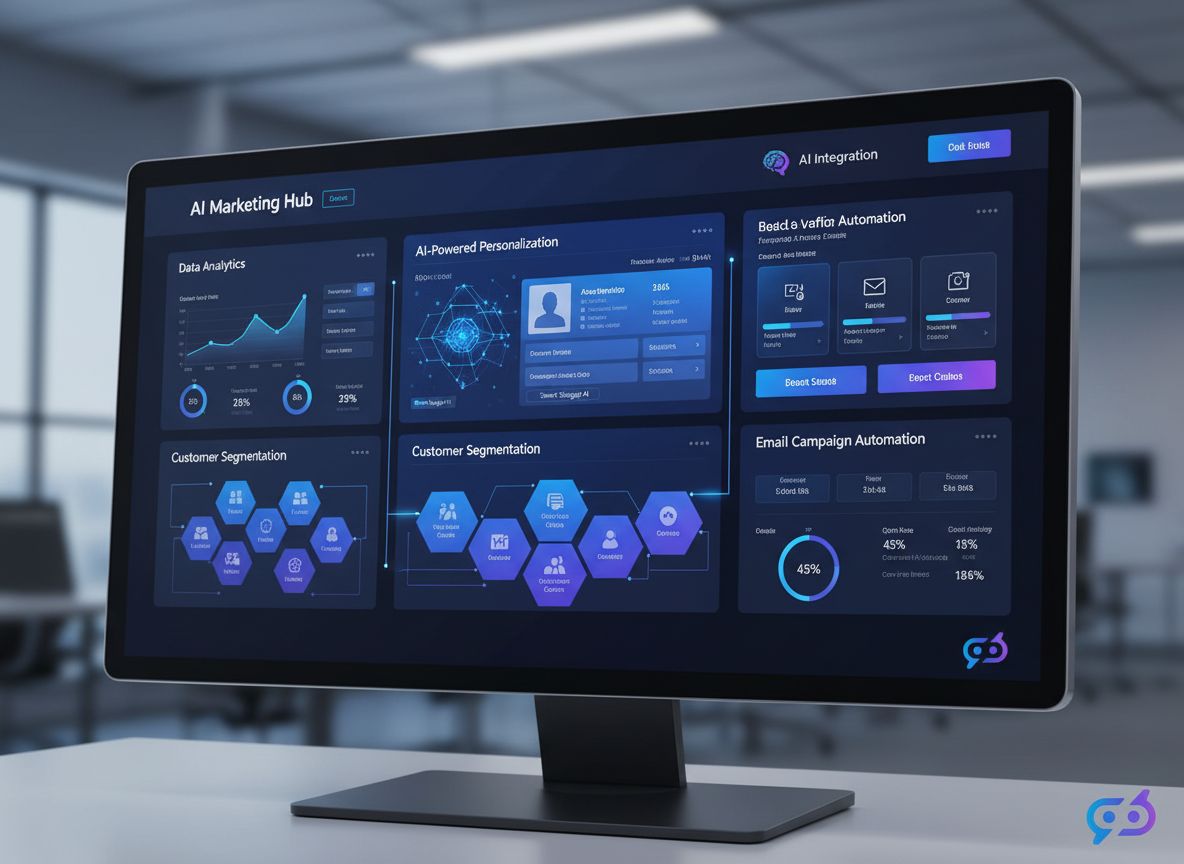
Discover how to integrate AI with marketing automation platforms to enhance personalization, predictive analytics, and customer engagement. Learn the best tools and strategies for 2025.
Here’s how AI transforms traditional marketing automation capabilities:
| Feature | Traditional Marketing Automation | AI-Enhanced Marketing Automation |
|---|---|---|
| Content Creation | Manual, time-intensive | AI-generated, scalable |
| Personalization | Template-based | Dynamic, behavior-driven |
| A/B Testing | Manual setup and analysis | Automated, continuous optimization |
| Campaign Optimization | Rule-based | AI-driven, predictive |
| Time to Campaign Launch | Days to weeks | Hours to days |
| Content Variations | Limited (2-5 versions) | Unlimited (dozens of variations) |
| Performance Insights | Historical analysis | Real-time, predictive |
Marketing automation has been around for over two decades, but the integration of artificial intelligence represents a quantum leap in capability. At its core, AI-powered marketing automation combines the workflow efficiency of traditional marketing automation platforms with machine learning algorithms that learn from data, make predictions, and optimize decisions in real time.
Traditional marketing automation platforms like HubSpot, Marketo, and Salesforce Marketing Cloud excel at automating repetitive tasks: sending emails on schedule, triggering workflows based on user actions, managing lead databases, and tracking customer interactions. These platforms save marketing teams countless hours by eliminating manual processes and ensuring consistent communication with prospects and customers.
However, AI transforms these platforms from task executors into intelligent decision-makers. AI algorithms can analyze millions of customer interactions to identify patterns humans would never detect. They can predict which leads are most likely to convert, determine the optimal time to send each individual an email, generate personalized content variations, identify customers at risk of churning, and continuously optimize campaign performance based on real-time results. This intelligence layer fundamentally changes how marketing teams operate, shifting them from reactive campaign managers to strategic growth architects.
The power of AI in marketing automation lies in its ability to process vast amounts of data and extract actionable insights at scale. While a human marketer might analyze a few hundred customer records to identify trends, AI can analyze millions of interactions across all channels, discovering nuanced patterns that inform more effective marketing strategies. This capability becomes increasingly valuable as customer data grows more complex and customer expectations for personalization continue to rise.
The business case for integrating AI with marketing automation is compelling and multifaceted. In an era where customer acquisition costs continue to rise and attention spans continue to shrink, the ability to deliver the right message to the right person at the right time has become a critical competitive advantage. AI-powered marketing automation enables this level of precision while simultaneously reducing the manual effort required from marketing teams.
Consider the fundamental challenge facing modern marketers: personalization at scale. Customers expect individualized experiences, yet most organizations struggle to deliver truly personalized interactions across all touchpoints. A customer might receive a generic email that doesn’t reflect their specific interests, see irrelevant product recommendations, or be contacted at times when they’re least likely to engage. These failures don’t just result in missed conversions—they damage brand reputation and customer relationships.
AI solves this challenge by enabling genuine personalization at scale. Machine learning algorithms can analyze each customer’s behavior, preferences, purchase history, and engagement patterns to deliver uniquely tailored experiences. This isn’t just about inserting a customer’s name into an email template; it’s about fundamentally customizing the entire customer experience based on individual preferences and predicted needs.
Beyond personalization, AI-powered marketing automation delivers measurable business benefits across multiple dimensions:
The competitive pressure is real. Organizations that successfully integrate AI with their marketing automation platforms are seeing measurable improvements in key metrics: higher open rates, better click-through rates, improved lead quality, faster sales cycles, and stronger customer retention. Those that don’t integrate AI risk falling behind as their competitors capture market share through superior customer experiences and more efficient marketing operations.

Start your free trial today and see results within days.
Personalization represents the most immediate and impactful application of AI in marketing automation. Rather than creating a single version of an email or landing page for all recipients, AI enables dynamic personalization that adapts content in real time based on individual user characteristics and behavior.
Dynamic content personalization works by analyzing customer data across multiple dimensions: browsing history, past purchases, demographic information, engagement patterns, and even predicted future interests. AI algorithms process this data to determine which content variations will resonate most strongly with each individual. This might mean personalizing email subject lines to match individual preferences, recommending products based on browsing behavior, or adjusting landing page layouts based on device type and user segment.
The impact of effective personalization is substantial. Research consistently shows that personalized emails achieve 26% higher open rates and 41% higher click-through rates compared to generic emails. When combined with AI-driven product recommendations, personalization can increase average order value by 15-30%. These improvements compound across thousands of customer interactions, resulting in significant revenue impact.
Implementing AI-powered personalization requires integration between your marketing automation platform and AI personalization engines. Many modern platforms like HubSpot and Salesforce Marketing Cloud include built-in AI personalization capabilities, while others can be enhanced through third-party integrations. The key is ensuring that your AI system has access to comprehensive customer data and can execute personalization decisions in real time across all customer touchpoints.
Predictive analytics represents one of the most transformative applications of AI in marketing automation. Rather than relying on manual rules or historical assumptions about what makes a good lead, AI analyzes patterns in historical customer data to predict which prospects are most likely to convert.
Traditional lead scoring systems typically use manual rules: a prospect who visits the pricing page gets 10 points, a prospect who downloads a whitepaper gets 5 points, and so on. While this approach provides some structure, it’s based on assumptions that may not reflect actual conversion patterns. Different customer segments may have different conversion indicators, and these patterns change over time as market conditions and customer preferences evolve.
AI-powered lead scoring learns from historical data to identify the actual patterns that predict conversion. The algorithm analyzes thousands of past customer interactions, identifying which behaviors, characteristics, and engagement patterns correlate most strongly with eventual purchase. This might reveal that for one customer segment, website time spent is the strongest conversion indicator, while for another segment, email engagement is more predictive. AI can identify these nuanced patterns and continuously update its predictions as new data becomes available.
The business impact of improved lead scoring is substantial. Sales teams can focus their efforts on the highest-probability prospects, improving conversion rates and reducing sales cycle length. Marketing teams can allocate budget more efficiently, investing more heavily in nurturing high-probability leads. Organizations implementing AI-powered lead scoring typically see 15-30% improvements in conversion rates and 20-40% reductions in sales cycle length.
Implementing predictive lead scoring requires integrating AI analytics capabilities with your marketing automation platform. Platforms like HubSpot, Salesforce, and Marketo offer built-in predictive lead scoring, while others can be enhanced through third-party AI analytics tools. The key is ensuring that your system has access to comprehensive historical data and can continuously update predictions as new customer interactions occur.
While much of the focus in marketing automation is on acquiring new customers, retaining existing customers is often more cost-effective and profitable. AI-powered churn prediction identifies customers at risk of leaving before they actually churn, enabling proactive retention efforts.
Churn prediction works by analyzing customer behavior patterns to identify early warning signs of dissatisfaction or disengagement. These might include declining engagement with emails, reduced product usage, support ticket patterns, or changes in purchasing behavior. AI algorithms learn which patterns most strongly predict churn for your specific business and customer base, then continuously monitor customer behavior to identify at-risk individuals.
Once at-risk customers are identified, marketing automation systems can trigger targeted retention campaigns: special offers, personalized outreach from account managers, or content designed to re-engage the customer. These proactive interventions are far more effective than reactive attempts to win back customers who have already left.
The financial impact of effective churn prediction is significant. Reducing customer churn by just 5% can increase profitability by 25-95%, depending on your business model. For subscription-based businesses, this impact is particularly pronounced, as each retained customer represents ongoing revenue.
Implementing churn prediction requires integrating predictive analytics capabilities with your marketing automation platform and customer data systems. The AI system needs access to comprehensive customer behavior data and must be able to trigger automated retention campaigns based on churn predictions.
FlowHunt represents a modern approach to AI-powered marketing automation, focusing on the intersection of content creation, workflow automation, and intelligent campaign execution. Rather than replacing traditional marketing automation platforms, FlowHunt complements and enhances them by automating the content creation and workflow optimization aspects of marketing campaigns.
The challenge many marketing teams face is that while marketing automation platforms excel at executing campaigns, they don’t solve the content creation problem. Creating personalized content at scale remains labor-intensive, requiring either large creative teams or acceptance of generic, non-personalized messaging. FlowHunt addresses this gap by combining AI content generation with workflow automation, enabling marketing teams to create and execute personalized campaigns at scale.
FlowHunt’s integration with marketing automation platforms works through several mechanisms. First, it can automatically generate content variations optimized for different customer segments, demographics, and behaviors. Rather than manually creating multiple versions of an email or landing page, FlowHunt’s AI can generate dozens of variations tailored to specific audience segments. Second, it can optimize these variations through continuous A/B testing and performance analysis, identifying which content resonates most strongly with different audiences. Third, it can integrate with marketing automation platforms to automatically execute campaigns using the optimized content.
This approach enables marketing teams to operate more efficiently while delivering better results. Rather than spending weeks creating and testing campaign variations, teams can leverage AI to generate and optimize content in days or even hours. This speed advantage becomes increasingly important in fast-moving markets where timing can determine campaign success.
Get latest tips, trends, and deals for free.
Conversational marketing represents a fundamental shift in how businesses interact with customers. Rather than relying solely on one-way communication channels like email, conversational marketing uses real-time dialogue to engage customers, answer questions, and guide them through the buyer journey.
AI-powered chatbots serve as the foundation for conversational marketing. These intelligent systems can understand customer questions, provide relevant information, qualify leads, and even complete transactions—all without human intervention. When integrated with marketing automation platforms, chatbots become powerful tools for lead generation and nurturing.
A customer visiting your website might interact with a chatbot that asks qualifying questions, understands their needs, and either provides immediate answers or routes them to the appropriate sales representative. The chatbot captures this interaction data and passes it to your marketing automation platform, which can then trigger personalized follow-up campaigns based on the conversation. This creates a seamless experience where the customer feels understood and supported throughout their journey.
Implementing conversational marketing requires integrating AI chatbot platforms (like Intercom, Drift, or custom solutions) with your marketing automation system. The integration enables bidirectional data flow: the chatbot sends customer interaction data to the marketing automation platform, which uses this data to personalize subsequent communications.
Content creation remains one of the most time-consuming aspects of marketing. Whether you’re writing email copy, creating blog posts, generating ad headlines, or developing landing page content, the creative process requires significant time and expertise. AI-powered content generation tools can dramatically accelerate this process while maintaining quality.
Tools like Jasper, Writesonic, and Copy.ai use large language models to generate compelling marketing copy based on brief prompts. A marketer might provide a product description and target audience, and the AI generates multiple variations of email subject lines, ad copy, or landing page headlines. These tools can be integrated with marketing automation platforms to automatically generate content for campaigns.
Beyond generation, AI can optimize content through intelligent A/B testing. Rather than manually setting up tests and waiting weeks for statistical significance, AI can run continuous experiments, identify winning variations quickly, and automatically scale successful content. This approach to optimization is far more efficient than traditional A/B testing and leads to continuous improvement in campaign performance.
Customer segmentation has always been important in marketing, but traditional segmentation approaches are limited by the number of variables humans can reasonably analyze. AI-powered segmentation can identify complex patterns in customer behavior that lead to more precise targeting.
AI segmentation algorithms can identify clusters of customers with similar behaviors, preferences, and characteristics—even when these patterns aren’t obvious to human analysts. For example, AI might identify that customers who visit your pricing page on Tuesday evenings and then download a comparison guide are 3x more likely to convert than other segments. This insight would be nearly impossible to discover through manual analysis but becomes obvious to machine learning algorithms analyzing millions of customer interactions.
Once these segments are identified, marketing automation platforms can deliver highly targeted campaigns to each segment. This level of precision targeting typically results in significantly higher conversion rates and better customer experiences, as each segment receives messaging tailored to their specific needs and behaviors.
Email remains one of the highest-ROI marketing channels, but optimization is critical to success. AI can optimize multiple aspects of email marketing:
Send Time Optimization: Rather than sending emails at a fixed time, AI analyzes each recipient’s behavior to determine when they’re most likely to open and engage with emails. This personalized timing can increase open rates by 20-30%.
Subject Line Optimization: AI can generate and test subject lines, identifying which variations resonate most strongly with different audience segments. Tools like Phrasee use AI to create subject lines that are both compelling and authentic to your brand voice.
Content Optimization: AI can personalize email body content based on recipient characteristics, past behavior, and predicted interests. This goes beyond simple name insertion to fundamentally customize the message for each recipient.
Predictive Send Optimization: AI can predict not just when to send, but whether to send at all. If the algorithm predicts that a particular recipient is unlikely to engage with a message, it might suppress the send to protect your sender reputation and avoid annoying the recipient.
Most modern marketing automation platforms and AI tools offer APIs that enable seamless integration. API-based integrations allow data to flow bidirectionally between systems: customer data flows from your marketing automation platform to AI tools, which process the data and return insights or recommendations that the marketing automation platform uses to optimize campaigns.
API integrations offer several advantages: they’re real-time, they enable sophisticated data flows, and they allow for custom logic that matches your specific business processes. However, they require technical expertise to implement and maintain.
Platforms like Zapier and Integromat (now Make) provide no-code or low-code solutions for connecting marketing automation platforms with AI tools. These platforms offer pre-built connectors for popular tools, enabling non-technical marketers to create integrations without custom development.
While these platforms are easier to use than custom API integrations, they may have limitations in terms of data volume, real-time capabilities, or custom logic. They’re ideal for small to medium-sized organizations or for connecting tools that don’t have native integration capabilities.
Many modern marketing automation platforms include built-in AI capabilities, eliminating the need for third-party integrations. HubSpot, Salesforce Marketing Cloud, and Marketo all offer native AI features for lead scoring, predictive analytics, and personalization. Using native capabilities simplifies implementation and ensures tight integration between AI and marketing automation functions.
HubSpot has emerged as a leader in making AI-powered marketing automation accessible to organizations of all sizes. The platform includes AI-powered lead scoring, predictive analytics, email optimization, and content recommendations. HubSpot’s strength lies in its ease of use and affordability, making advanced AI capabilities available to small and medium-sized businesses that might not have the budget for enterprise platforms.
HubSpot’s AI features include predictive lead scoring that identifies high-value prospects, email send time optimization, and content recommendations that suggest relevant resources to customers based on their behavior. The platform also integrates with numerous third-party AI tools, enabling further customization.
Salesforce’s Einstein AI represents one of the most comprehensive AI implementations in marketing automation. Einstein provides predictive analytics, automated recommendations, and intelligent optimization across the entire Salesforce ecosystem. For enterprise organizations with complex marketing needs, Einstein offers sophisticated capabilities that can drive significant competitive advantage.
Einstein’s capabilities include predictive lead scoring, customer journey analytics, and automated content recommendations. The platform can identify the optimal next action for each customer, enabling truly intelligent marketing automation.
Marketo, owned by Adobe, offers advanced AI capabilities for lead nurturing, personalization, and predictive analytics. Marketo’s strength lies in its sophisticated segmentation and personalization capabilities, making it ideal for organizations with complex customer bases and diverse marketing needs.
Marketo’s AI features include predictive lead scoring, behavioral targeting, and personalized content delivery. The platform excels at managing complex, multi-touch customer journeys and delivering personalized experiences across all touchpoints.
Mailchimp democratizes AI-powered marketing automation for small businesses and entrepreneurs. The platform includes AI-powered features like send time optimization, predictive analytics, and product recommendations. While Mailchimp’s AI capabilities are less sophisticated than enterprise platforms, they’re sufficient for many small to medium-sized businesses and come at a fraction of the cost.
Consider a B2B SaaS company with 50,000 prospects in their marketing database. The company’s marketing team consists of five people managing email campaigns, content creation, and lead nurturing. Despite their efforts, conversion rates have plateaued at 2%, and the sales team complains about poor lead quality.
The company decides to implement AI-powered marketing automation by integrating their existing HubSpot platform with FlowHunt for content generation and optimization. Here’s how the transformation unfolds:
Month 1: Foundation and Setup The team implements AI-powered lead scoring in HubSpot, which immediately identifies that their existing lead scoring rules were missing important conversion indicators. The new AI model identifies that prospects who engage with specific content types and visit certain pages are 5x more likely to convert than their previous assumptions suggested. This insight alone allows the sales team to focus on higher-quality leads.
Month 2: Content Optimization Using FlowHunt, the marketing team begins generating multiple variations of email campaigns. Rather than creating one version of an email, they generate five variations optimized for different customer segments. A/B testing reveals that segment-specific messaging increases click-through rates by 35% compared to generic messaging.
Month 3: Personalization at Scale The team implements dynamic content personalization, where email content adapts based on recipient behavior and characteristics. Product recommendations are personalized based on browsing history and industry vertical. Landing pages display different value propositions based on visitor characteristics. These changes increase conversion rates from 2% to 3.2%.
Month 4: Predictive Engagement The team implements send time optimization, ensuring emails are delivered when each recipient is most likely to engage. They also implement churn prediction, identifying at-risk customers and triggering retention campaigns. These changes increase email open rates by 28% and reduce customer churn by 12%.
Month 5-6: Continuous Optimization With AI continuously analyzing campaign performance, the team shifts from manual optimization to monitoring and strategic decision-making. The AI system automatically identifies winning content variations, optimal send times, and high-value customer segments. The marketing team focuses on strategy and creative direction while AI handles optimization.
Results After 6 Months:
This case study illustrates the transformative potential of AI-powered marketing automation. The improvements aren’t just incremental—they’re substantial and compound over time as the AI system learns from more data and the marketing team becomes more sophisticated in their use of AI capabilities.
FlowHunt combines intelligent content generation with marketing automation to transform how you engage customers. Automate content creation, optimize campaigns in real-time, and scale personalization across all touchpoints—all without increasing your team size.
The most sophisticated AI-powered marketing automation implementations extend beyond email to encompass all customer touchpoints. This means integrating AI with SMS marketing, social media, paid advertising, and website personalization. A customer might receive a personalized email, see a retargeting ad on social media, and encounter personalized website content—all coordinated through a unified AI-powered system.
Implementing multi-channel AI requires integrating multiple platforms and ensuring consistent data flows across all systems. The payoff is significant: customers who receive coordinated, personalized messaging across multiple channels are 3-5x more likely to convert than those receiving single-channel messaging.
Beyond predicting which leads will convert, sophisticated AI systems can predict customer lifetime value—the total revenue a customer will generate over their relationship with your company. This insight enables strategic decisions about customer acquisition and retention spending.
A customer predicted to have high lifetime value might justify more aggressive acquisition spending or more intensive nurturing. Conversely, customers predicted to have low lifetime value might receive minimal marketing investment. This approach to resource allocation is far more efficient than treating all customers equally.
The most advanced implementations move beyond AI-assisted optimization to autonomous optimization, where AI systems automatically adjust campaigns based on performance data without human intervention. This might include automatically adjusting email send times, pausing underperforming content variations, reallocating budget to high-performing segments, or adjusting personalization parameters.
Autonomous optimization requires sophisticated AI systems and careful governance to ensure that automated decisions align with business objectives. However, when implemented correctly, it enables continuous improvement without requiring constant human attention.
The foundation of effective AI-powered marketing automation is high-quality, integrated data. AI systems are only as good as the data they’re trained on. Organizations must invest in data quality, ensuring that customer data is accurate, complete, and properly integrated across all systems.
This often requires significant data engineering work: cleaning existing data, establishing data governance policies, and creating data pipelines that ensure continuous data quality. While this work is unglamorous, it’s essential for AI success.
Implementing AI-powered marketing automation represents a significant change in how marketing teams work. Rather than manually creating campaigns and optimizing based on intuition, teams must learn to work with AI systems, interpret AI recommendations, and trust algorithmic decision-making.
Successful implementation requires investing in team training, establishing clear governance policies, and creating feedback loops where team members can provide input on AI system performance. Organizations that treat AI implementation as purely technical often struggle with adoption, while those that invest in change management see much higher success rates.
AI-powered personalization and predictive analytics rely on customer data, raising important privacy and compliance considerations. Organizations must ensure that their AI implementations comply with regulations like GDPR, CCPA, and other privacy laws. This includes obtaining proper consent for data collection, implementing data security measures, and providing customers with transparency about how their data is used.
Arshia is an AI Workflow Engineer at FlowHunt. With a background in computer science and a passion for AI, he specializes in creating efficient workflows that integrate AI tools into everyday tasks, enhancing productivity and creativity.

FlowHunt combines AI content generation with marketing automation to streamline your entire marketing workflow—from research and personalization to campaign execution and analytics.
Unlock growth with marketing automation, predictive lead scoring, and personalized marketing with AI. Expert audience targeting, ad campaign optimization, senti...

AI-powered marketing leverages artificial intelligence technologies like machine learning, NLP, and predictive analytics to automate tasks, gain customer insigh...
Generate high-converting, platform-specific calls to action instantly with our AI-powered CTA generator. Perfect for marketers, content creators, and businesses...