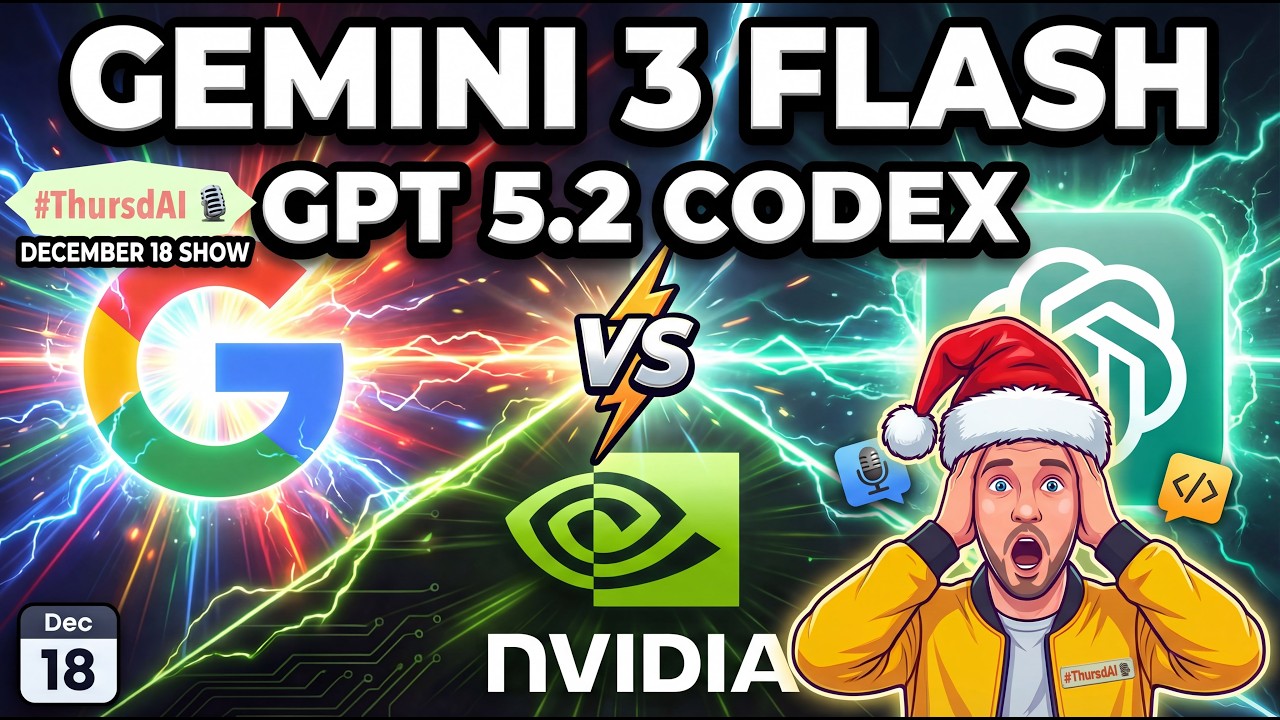
AI News 2025: Gemini 3 Flash, GPT Image 1.5, NVIDIA Nemotron 3, and the Future of AI Models
Explore the latest AI breakthroughs in 2025: Google’s Gemini 3 Flash, OpenAI’s GPT Image 1.5, NVIDIA’s open-source Nemotron 3, and critical industry developments shaping the future of artificial intelligence.
AI News
LLM
Machine Learning
AI Models
Technology Trends
The artificial intelligence landscape in 2025 is experiencing unprecedented transformation, with major breakthroughs emerging from both established tech giants and innovative startups. This period marks a critical inflection point where AI models are becoming simultaneously more capable, more efficient, and more accessible. From Google’s lightning-fast Gemini 3 Flash to NVIDIA’s open-source Nemotron 3 family, the industry is witnessing a fundamental shift in how AI systems are developed, deployed, and democratized. Understanding these developments is essential for businesses, developers, and organizations seeking to leverage AI effectively. This comprehensive guide explores the most significant AI announcements and technological advances that are reshaping the industry, providing insights into what these innovations mean for the future of artificial intelligence and enterprise automation.
Understanding the Current AI Model Landscape
The artificial intelligence market has evolved dramatically over the past few years, transitioning from a period dominated by a handful of proprietary models to an increasingly diverse ecosystem of options. Today’s AI landscape encompasses closed-source commercial models from companies like OpenAI, Google, and Anthropic, alongside rapidly advancing open-source alternatives from organizations like Meta and NVIDIA. This diversification reflects a fundamental maturation of the AI industry, where competition drives innovation and accessibility. The emergence of multiple viable options at different price points and capability levels means organizations can now choose models that precisely match their requirements, budget constraints, and deployment preferences. This competitive environment has created unprecedented pressure on pricing and performance, forcing even the largest technology companies to optimize their offerings continuously. The result is a market where cost-efficiency and capability are no longer trade-offs but complementary goals that drive technological advancement.
Ready to grow your business?
Start your free trial today and see results within days.
Why AI Model Performance and Cost Matter for Businesses
For enterprises and organizations of all sizes, the choice of AI model has profound implications for operational efficiency, cost structure, and competitive advantage. A model that is twice as fast but half the cost can fundamentally transform the economics of AI-powered applications, enabling use cases that were previously prohibitively expensive. Performance benchmarks matter because they directly correlate with real-world capabilities in tasks like coding, reasoning, mathematical problem-solving, and content generation. Cost efficiency matters because it determines whether AI can be deployed at scale across an organization or remains limited to high-value, specialized applications. The convergence of improved performance and reduced costs creates a powerful multiplier effect, where organizations can deploy more sophisticated AI systems to more users and use cases simultaneously. Additionally, the choice between proprietary and open-source models carries strategic implications regarding data privacy, customization capabilities, and long-term vendor lock-in. Businesses must carefully evaluate these factors to make informed decisions that align with their technical requirements and organizational objectives.
Google’s Gemini 3 Flash: Redefining the Speed-Quality Trade-off
Google’s release of Gemini 3 Flash represents a watershed moment in the AI industry, demonstrating that exceptional speed and quality are not mutually exclusive. Priced at just 50 cents per million input tokens, Gemini 3 Flash costs one-fourth the price of Gemini 3 Pro, one-sixth the cost of Claude Sonnet 4.5, and one-third the cost of GPT 5.2. This aggressive pricing strategy is particularly significant because it’s paired with performance that rivals or exceeds these more expensive alternatives on numerous benchmarks. On the Swechen Verified benchmark, a critical measure of coding capability, Gemini 3 Flash scores 78%, beating Gemini 3 Pro by two percentage points and coming within just two points of GPT 5.2. This performance on coding tasks is particularly noteworthy because it suggests that Gemini 3 Flash should become the default choice for developers and organizations building AI-powered coding applications. The model’s multimodal capabilities—accepting video, audio, images, and text—further expand its utility across diverse use cases. Google has made Gemini 3 Flash available across its entire product ecosystem, including the Gemini app, workplace products, and Google Search, all at no cost to users. This widespread availability represents a strategic move to establish Gemini as the default AI interface for billions of users globally.
Join our newsletter
Get latest tips, trends, and deals for free.
NVIDIA Nemotron 3: The Open-Source Alternative for Organizations Seeking Control
While Google dominates the proprietary model space, NVIDIA has positioned itself as the leader in open-source AI with the release of the Nemotron 3 family. This comprehensive suite of models comes in three sizes: Nano (30 billion parameters with 3 billion active), Super (100 billion parameters with 10 billion active), and Ultra (500 billion parameters with 50 billion active). The use of mixture-of-experts architecture, where only a fraction of parameters are active for any given input, enables these models to deliver performance comparable to much larger dense models while maintaining superior speed and efficiency. Nemotron 3 models are four times faster than their Nemotron 2 predecessors, a dramatic improvement that makes them practical for real-time applications and high-throughput inference scenarios. The open-source nature of Nemotron 3 is transformative for organizations that require complete control over their AI infrastructure. Companies can download these models, fine-tune them on proprietary data, apply reinforcement learning techniques, and deploy them on their own hardware without any licensing restrictions or vendor dependencies. NVIDIA has provided comprehensive tooling and three trillion tokens of pre-training, post-training, and reinforcement learning data, enabling organizations to create highly specialized domain-specific agents. The models are already supported by major frameworks including LM Studio, Llama CPP, SG Lang, and VLM, with availability on Hugging Face ensuring broad accessibility.
FlowHunt and AI Model Integration: Automating Content Workflows
The proliferation of advanced AI models creates both opportunities and challenges for content creators, marketers, and organizations managing AI-driven workflows. FlowHunt addresses this complexity by providing an integrated platform that seamlessly incorporates the latest AI models into automated content workflows. Rather than manually evaluating and switching between different models, FlowHunt’s intelligent routing system can automatically select the optimal model for specific tasks based on performance requirements, cost constraints, and latency considerations. For organizations leveraging Gemini 3 Flash for cost-sensitive applications or NVIDIA Nemotron 3 for privacy-critical deployments, FlowHunt provides the orchestration layer that makes these choices practical at scale. The platform enables teams to automate research, content generation, fact-checking, and publishing workflows while maintaining quality standards and cost efficiency. By abstracting away the complexity of model selection and management, FlowHunt allows organizations to focus on strategic objectives rather than technical implementation details. This is particularly valuable in fast-moving environments where new models are released frequently and the optimal choice for a given task may change over time.
OpenAI’s release of GPT Image 1.5 represents a significant leap forward in image generation technology, addressing longstanding limitations in precision, text rendering, and instruction following. The new model is four times faster than previous generations of ChatGPT image generation, a substantial improvement that makes interactive image creation workflows practical. More importantly, GPT Image 1.5 demonstrates dramatically improved accuracy in following complex, detailed prompts. When asked to create a 6x6 grid with specific content in each cell, the new model produces flawless results with perfect text rendering and accurate placement, whereas previous versions struggled with this task. The model’s text rendering capabilities are particularly impressive, with all text appearing perfectly legible and accurately reflecting the prompt specifications. This improvement is crucial because text rendering has historically been a weakness of image generation models, limiting their utility for creating marketing materials, infographics, and other text-heavy visual content. GPT Image 1.5 also excels at precise editing, allowing users to modify specific elements of images while maintaining overall coherence and quality. The model’s ability to combine multiple subjects and styles—such as creating a 2000s film camera style image of multiple people at a specific location—demonstrates sophisticated understanding of compositional and stylistic requirements. These improvements position GPT Image 1.5 as a powerful tool for creative professionals, marketers, and organizations seeking to automate visual content creation.
Zoom’s Federated AI: A Novel Approach to Model Optimization
Perhaps the most surprising development in recent AI news is Zoom’s entry into the frontier model space with its federated AI system. Rather than developing a single proprietary model, Zoom has created a sophisticated architecture that intelligently routes prompts to the most suitable model for each task. This federated approach combines Zoom’s own small language models with advanced open-source and closed-source models, using a proprietary Zscore system to select and refine outputs for optimal performance. The results are impressive: Zoom’s federated AI scores 48.1 on Humanity’s Last Exam, outperforming Gemini 3 Pro (45), Claude Opus 4.5 (43), and GPT 5 Pro with tools (42%). This achievement is particularly noteworthy because it demonstrates that intelligent model routing and ensemble techniques can outperform individual state-of-the-art models. The federated approach offers several advantages over traditional single-model architectures. First, it enables organizations to leverage the unique strengths of different models without being locked into a single vendor’s ecosystem. Second, it provides flexibility to swap models as new options become available, ensuring that the system always uses the best available tools for each task. Third, it can optimize for multiple objectives simultaneously—balancing cost, speed, and quality in ways that individual models cannot. Zoom’s success with this approach suggests that federated AI systems may represent the future of enterprise AI deployment, where intelligent orchestration becomes as important as individual model capability.
The Infrastructure Imperative: OpenAI’s Massive Investment in Computational Resources
Behind the scenes of these impressive model releases lies an enormous infrastructure challenge that often goes unnoticed by end users. OpenAI has announced a $38 billion commitment to rent servers and computational resources from AWS over the next seven years, a staggering figure that underscores the computational demands of modern AI systems. This commitment is being partially funded by a proposed $10 billion investment from Amazon, which would value OpenAI at over $500 billion. Similar partnerships are being negotiated with other infrastructure providers including Oracle and NVIDIA, as OpenAI seeks to secure access to every available GPU, TPU, and custom silicon chip. This infrastructure race reflects the exponential growth in computational requirements for both pre-training and inference. Pre-training—the process of teaching models on vast datasets—requires enormous computational resources that only the largest technology companies can afford. Inference—the process of running trained models to generate outputs—is becoming increasingly demanding as usage scales exponentially. OpenAI’s strategy of securing long-term commitments to infrastructure resources ensures that the company can continue scaling its models and serving the rapidly growing demand for AI capabilities. The involvement of major cloud providers in funding these commitments reflects their recognition that AI infrastructure represents a critical competitive advantage and a significant revenue opportunity.
Meta’s Segment Anything Models: Expanding AI Capabilities Beyond Language
While much of the recent AI news focuses on large language models, Meta has been advancing the frontier of computer vision with its Segment Anything Models (SAM) family. The latest release, SAM Audio, extends the segment anything paradigm to audio processing, enabling the model to splice, extract, and isolate audio elements with remarkable precision. This expansion demonstrates that the principles underlying successful language models—training on diverse data, learning generalizable representations, and enabling flexible downstream applications—apply across different modalities. The SAM family, which includes SAM 3 and SAM 3D alongside the new SAM Audio, represents Meta’s commitment to open-source AI development. By releasing these models openly, Meta enables researchers and developers to build innovative applications without licensing restrictions. The segment anything approach is particularly valuable because it addresses a fundamental challenge in computer vision and audio processing: the need to identify and isolate specific elements within complex scenes or audio streams. Traditional approaches required training separate models for each specific segmentation task, whereas SAM’s generalized approach can handle diverse segmentation challenges with a single model. This flexibility and generalizability make SAM models valuable tools for content creators, researchers, and organizations building vision and audio processing applications.
Supercharge Your Workflow with FlowHunt
Experience how FlowHunt automates your AI content and SEO workflows — from research and content generation to publishing and analytics — all in one place. Leverage the latest AI models and stay ahead of industry developments.
The Policy Debate: Balancing Innovation and Caution
The rapid advancement of AI capabilities has sparked important policy discussions, including concerns raised by prominent figures about the pace of AI infrastructure development. Some policymakers have proposed moratoria on building new data centers, arguing that such restrictions would allow time for proper regulation and safety measures. However, this perspective overlooks several critical considerations. First, a unilateral moratorium on AI infrastructure development in the United States would cede technological leadership to China and other nations without similar restrictions, fundamentally altering the geopolitical balance of power. Second, the argument that AI benefits only the wealthy is contradicted by the reality of AI accessibility: models like Gemini 3 Flash are available for free to billions of users, and open-source models like Nemotron 3 are available to anyone with internet access. Third, the solution to electricity price concerns is not to restrict AI development but to invest in energy infrastructure, creating jobs for electricians, contractors, and engineers while expanding capacity. The policy debate around AI development reflects legitimate concerns about ensuring that AI benefits are broadly distributed and that safety measures are implemented responsibly. However, these goals are better served by thoughtful regulation and investment in complementary infrastructure than by blanket moratoria that would undermine innovation and competitiveness.
The Convergence of Capability and Accessibility
The developments outlined in this article point toward a fundamental transformation in how AI is developed, deployed, and accessed. The convergence of improved capability, reduced costs, and increased accessibility is creating an environment where AI is becoming a utility rather than a luxury. Gemini 3 Flash demonstrates that exceptional quality no longer requires premium pricing. NVIDIA Nemotron 3 shows that organizations can maintain complete control over their AI infrastructure without sacrificing capability. Zoom’s federated AI proves that intelligent orchestration can outperform individual models. OpenAI’s infrastructure investments reveal the scale of resources required to serve global demand. Meta’s multimodal models expand AI capabilities beyond language. Together, these developments suggest that the future of AI will be characterized by diversity, competition, and specialization rather than dominance by a single vendor or approach. Organizations that successfully navigate this landscape will be those that can evaluate different models and approaches based on their specific requirements, integrate multiple tools into coherent workflows, and adapt quickly as new capabilities emerge. The role of platforms like FlowHunt becomes increasingly important in this context, providing the orchestration and automation capabilities that enable organizations to leverage diverse AI tools effectively.
Conclusion
The AI landscape in 2025 is characterized by unprecedented innovation, competition, and accessibility. Google’s Gemini 3 Flash has established a new standard for cost-effective, high-performance AI, while NVIDIA’s Nemotron 3 family provides organizations with open-source alternatives that offer complete control and customization. OpenAI’s continued infrastructure investments and image generation improvements demonstrate the company’s commitment to maintaining technological leadership, while Zoom’s federated AI approach suggests novel architectures for optimizing model performance. Meta’s expansion of segment anything models to audio processing expands the frontier of AI capabilities across modalities. These developments collectively indicate that AI is transitioning from a specialized technology available only to well-resourced organizations to a broadly accessible tool that can enhance productivity and enable innovation across sectors. The infrastructure requirements and policy considerations surrounding AI development remain important topics for ongoing discussion, but the trajectory is clear: AI capabilities will continue advancing, costs will continue declining, and accessibility will continue expanding. Organizations that embrace these developments and invest in understanding how to effectively integrate AI into their workflows will be best positioned to capture the substantial productivity and competitive advantages that AI offers.
Frequently asked questions
What makes Gemini 3 Flash different from Gemini 3 Pro?
Gemini 3 Flash is significantly cheaper (50 cents per million input tokens vs. Gemini 3 Pro's higher cost), nearly as capable on most benchmarks, and optimized for speed. It actually outperforms Gemini 3 Pro on some benchmarks like Swechen Verified, making it an excellent choice for cost-conscious organizations.
Is NVIDIA Nemotron 3 truly open-source?
Yes, NVIDIA Nemotron 3 is fully open-source with open weights, meaning you can download it, fine-tune it, run reinforcement learning on it, and own your model completely. It's available on Hugging Face and supported by major frameworks like LM Studio and Llama CPP.
How does Zoom's federated AI approach work?
Zoom's federated AI system doesn't use a single proprietary model. Instead, it intelligently routes prompts to the most suitable model (combining Zoom's own models with open-source and closed-source options) using their proprietary Zscore system to select and refine outputs for optimal performance.
What are the practical implications of OpenAI's infrastructure investments?
OpenAI is securing massive computational resources through partnerships with AWS, Oracle, and NVIDIA. This enables them to scale pre-training and handle exponentially growing inference demand. The $38 billion AWS commitment over 7 years demonstrates the enormous infrastructure requirements of modern AI systems.
Arshia is an AI Workflow Engineer at FlowHunt. With a background in computer science and a passion for AI, he specializes in creating efficient workflows that integrate AI tools into everyday tasks, enhancing productivity and creativity.
Arshia Kahani
AI Workflow Engineer
Automate Your AI Content Workflow with FlowHunt
Stay ahead of AI developments with FlowHunt's automated content research, generation, and publishing tools. Transform raw AI news into polished, SEO-optimized blog content.
AI Revolution 2025: Meta Ray-Ban, Superhuman Reasoning, Autonomous Agents
Explore the latest breakthroughs in AI technology including Meta's advanced Ray-Ban glasses, OpenAI's superhuman reasoning models, 3D world generation, and the ...
AI Breakthroughs in December 2025: Gemini 3 Flash, Nemotron 3 Nano, and the Race for Efficient Intelligence
Explore the most significant AI releases of December 2025, including Google's Gemini 3 Flash, Nvidia's Nemotron 3 Nano, and other groundbreaking models reshapin...
AI News Roundup: GPT-6 Rumors, NVIDIA DGX Spark, and Claude Skills 2025
Explore the latest AI breakthroughs and industry developments including GPT-6 speculation, NVIDIA's revolutionary DGX Spark supercomputer, Anthropic's Claude Sk...
16 min read
AI
Technology
+3
Cookie Consent We use cookies to enhance your browsing experience and analyze our traffic. See our privacy policy.