

Enhance CV With AI Tool
Discover resources to enhance your CV with the Enhance CV Tool on FlowHunt.io. Explore AI-powered tools, join the community, and read success stories to improve...
2 min read
AI Tools
Resume
+5
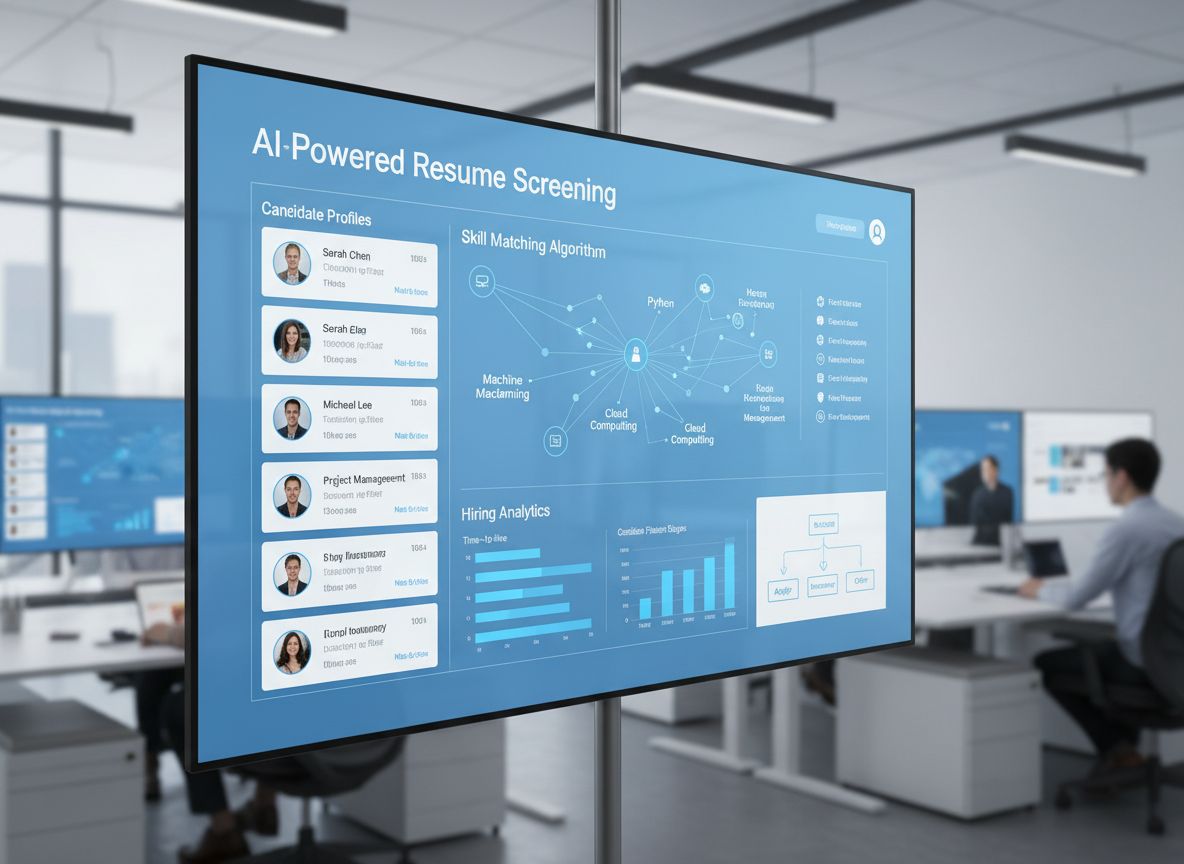
Discover how AI-powered resume screening transforms recruitment by automating candidate evaluation, reducing bias, and identifying top talent faster than traditional methods.
Key benefits of AI resume screening:
AI resume screening represents a fundamental shift in how organizations approach talent acquisition. Rather than manually reviewing hundreds or thousands of resumes—a process that is time-consuming, inconsistent, and prone to human error—AI systems can analyze applications in seconds, extracting relevant information and scoring candidates based on predefined criteria.
The importance of this technology cannot be overstated. According to industry data, recruiters spend an average of 6-7 seconds reviewing each resume before deciding whether to move a candidate forward. This brief window means that qualified candidates can easily be overlooked, while less suitable applicants might advance simply because their resume happened to catch the reviewer’s eye. AI eliminates this randomness by applying consistent, objective criteria to every application.
Beyond speed and consistency, AI resume screening addresses one of the most pressing challenges in modern recruitment: unconscious bias. Traditional resume review is susceptible to various forms of bias—whether based on name, educational background, employment gaps, or other demographic factors. When properly implemented, AI systems can be configured to ignore these irrelevant factors and focus exclusively on job-related qualifications, creating a more equitable hiring process.
Organizations implementing AI resume screening report significant improvements across multiple metrics. The financial impact is particularly compelling. Consider that the average cost-per-hire in the United States ranges from $4,000 to $7,500, with time-to-hire averaging 42 days. By automating the initial screening phase, companies can reduce time-to-hire by 30-50%, directly lowering recruitment costs and enabling faster team expansion.
Beyond cost savings, there are strategic advantages:

Start your free trial today and see results within days.
Understanding the mechanics of AI resume screening helps you make informed decisions about implementation and configuration. Modern resume screening systems rely on several interconnected technologies working in concert.
Natural Language Processing (NLP) forms the foundation of most AI resume screening systems. NLP enables computers to understand and extract meaning from human language. When applied to resumes, NLP algorithms can identify and extract key information such as job titles, companies, dates of employment, educational credentials, technical skills, certifications, and soft skills. The system doesn’t simply look for exact keyword matches; instead, it understands context and can recognize that “Software Engineer,” “Developer,” and “Programmer” are essentially equivalent roles.
Machine Learning algorithms then take this extracted information and compare it against the job description and your predefined hiring criteria. These algorithms learn patterns from historical hiring data—which candidates were successful in similar roles, what skills correlate with high performance, and what background characteristics predict job success. Over time, as the system processes more applications and receives feedback on hiring outcomes, it becomes increasingly accurate in its predictions.
Semantic Search technology goes beyond simple keyword matching. Rather than looking for exact phrases, semantic search understands the meaning and relationships between words. This means the system can recognize that a candidate with “cloud infrastructure experience” is relevant for a role requiring “AWS expertise,” even if the exact terminology differs.
The combination of these technologies creates a powerful system capable of processing large volumes of applications while maintaining consistency and objectivity in evaluation.
Before implementing any AI resume screening system, you must establish explicit, measurable criteria for the role. This foundation determines how effectively the AI can identify suitable candidates.
Your job criteria should encompass:
The more precisely you define these criteria, the more effectively the AI system can evaluate candidates. Vague requirements like “strong communication skills” should be translated into measurable indicators: “demonstrated experience presenting to executive stakeholders,” “published technical documentation,” or “customer-facing role experience.”
The market offers numerous AI-powered resume screening solutions, each with distinct strengths and approaches. Here’s a comparison of leading platforms:
| Platform | Key Features | Best For | Pricing Model |
|---|---|---|---|
| HireVue | Resume analysis, video interviewing, predictive analytics | Enterprise hiring at scale | Custom enterprise pricing |
| XOR | AI chatbot candidate communication, resume parsing | High-volume recruitment | Per-hire or subscription |
| Jobvite | ATS integration, AI ranking, diversity analytics | Mid-market companies | Subscription-based |
| SeekOut | Skill matching, diversity insights, market intelligence | Strategic talent acquisition | Custom enterprise pricing |
| Pymetrics | Neuroscience-based assessments, skill matching | Identifying potential beyond credentials | Subscription-based |
| Greenhouse | ATS with built-in AI, interview coordination | Structured hiring processes | Subscription-based |
When evaluating tools, consider factors such as integration capabilities with your existing systems, ease of use for your recruiting team, transparency in how the AI makes decisions, and the vendor’s commitment to fairness and bias mitigation.
Once you’ve selected a platform, configure its NLP capabilities to align with your specific needs. This involves:
Entity Extraction Configuration: Ensure the system correctly identifies and extracts relevant information from resumes. This might include customizing how it recognizes industry-specific terminology, acronyms, or certifications unique to your field.
Skill Taxonomy Development: Create a comprehensive list of skills relevant to your organization, including variations and synonyms. For example, your system should recognize that “JavaScript,” “JS,” and “Node.js” are related but distinct skills, and that “machine learning” encompasses various related competencies like “deep learning,” “neural networks,” and “TensorFlow.”
Context Understanding: Configure the system to understand context. A candidate who mentions “managed a team of 5 engineers” demonstrates leadership experience, while “worked with a team of 5 engineers” suggests collaboration but not necessarily leadership.
While keyword matching alone is insufficient for sophisticated candidate evaluation, it remains an important component of the screening process. Modern systems use semantic search to go beyond simple keyword matching.
Hard Skills Matching: The system identifies technical competencies mentioned in the resume and matches them against required skills. This includes programming languages, software platforms, frameworks, tools, and certifications.
Soft Skills Recognition: Advanced NLP can identify soft skills even when not explicitly stated. For example, phrases like “led cross-functional team,” “managed stakeholder relationships,” or “resolved customer escalations” indicate leadership, communication, and problem-solving abilities.
Industry and Domain Matching: The system recognizes industry-specific terminology and can assess whether a candidate’s background aligns with your industry context. A candidate with healthcare IT experience may be more suitable for a healthcare software role than someone with equal technical skills but no healthcare background.
Location and Work Preference Matching: The system can extract and match location information, remote work preferences, and relocation willingness against your requirements.
The AI system should assign scores to each candidate based on how well they match your defined criteria. Effective scoring systems typically use weighted algorithms where different criteria carry different importance levels.
For example, a job posting might weight criteria as follows:
This weighting ensures that candidates with the most critical qualifications rank highest, while still considering the full spectrum of candidate attributes.
Get latest tips, trends, and deals for free.
FlowHunt enhances the resume screening process by integrating AI-powered candidate evaluation into a comprehensive recruitment automation platform. Rather than using isolated tools, FlowHunt enables you to create seamless workflows that connect resume screening with other critical recruitment functions.
Automated Candidate Communication: Once candidates are screened and ranked, FlowHunt can automatically send personalized communications to top candidates, schedule interviews, and manage the entire candidate journey. This ensures no qualified candidate falls through the cracks due to communication delays.
Data Integration and Enrichment: FlowHunt connects with your existing HR systems, ATS platforms, and data sources to enrich candidate profiles with additional information. This creates a more complete picture of each candidate beyond what appears in their resume.
Workflow Automation: Create custom workflows that automatically route candidates to appropriate hiring managers, trigger background checks for top candidates, or initiate reference checks based on predefined criteria. This eliminates manual handoffs and accelerates the hiring timeline.
Analytics and Reporting: FlowHunt provides comprehensive analytics on your recruitment process, including time-to-hire metrics, cost-per-hire, candidate source effectiveness, and hiring team performance. These insights enable continuous improvement of your recruitment strategy.
Bias Detection and Mitigation: FlowHunt’s AI systems are designed with fairness in mind, helping you identify and mitigate potential biases in your screening process. Regular audits ensure your recruitment remains equitable and compliant with employment regulations.
Beyond matching explicit criteria, advanced AI systems can identify behavioral patterns that predict success. For example, candidates who have consistently progressed to more senior roles, expanded their skill sets over time, or successfully navigated career transitions may demonstrate qualities like ambition, adaptability, and resilience that correlate with job success.
AI systems can identify potential concerns that warrant further investigation:
AI can be configured to actively support diversity and inclusion goals. Rather than ignoring demographic information, modern systems can:
AI should augment human judgment, not replace it. Establish clear protocols where:
Even well-intentioned AI systems can perpetuate or amplify biases present in training data. Implement regular audits that:
Candidates and hiring managers should understand how AI decisions are made. This means:
The most effective AI systems learn and improve over time. Track:
Use this data to refine your criteria, adjust algorithm weights, and improve overall system performance.
Consider a mid-sized technology company that implemented AI resume screening for their software engineering positions. Previously, they received 200-300 applications per open position and spent 40+ hours manually reviewing resumes, with hiring timelines stretching to 60+ days.
After implementing an AI resume screening system configured with their specific technical requirements (Python, JavaScript, cloud platforms), experience levels (3-7 years), and educational preferences (computer science degree or equivalent), they achieved remarkable results:
The company maintained human review of the top 20 candidates identified by AI, ensuring that subjective factors like communication style and cultural fit were still evaluated by humans. This hybrid approach combined AI efficiency with human judgment.
One legitimate concern is that over-reliance on AI might cause you to miss exceptional candidates who don’t fit the standard profile. Address this by:
Resume screening systems handle sensitive personal information. Ensure:
While AI speeds up screening, candidates still expect timely communication. Implement:
The field of AI-powered recruitment continues to evolve rapidly. Emerging trends include:
Predictive Analytics: Beyond matching current qualifications, AI systems increasingly predict which candidates will succeed long-term, considering factors like career trajectory, learning ability, and cultural alignment.
Video Resume Analysis: Some platforms now analyze video resumes, assessing not just what candidates say but how they communicate, their enthusiasm, and other non-verbal cues.
Skill-Based Hiring: Rather than focusing on degrees and job titles, AI systems increasingly evaluate actual skills and capabilities, opening opportunities for career changers and non-traditional candidates.
Continuous Talent Sourcing: AI systems can continuously scan the market for potential candidates matching your criteria, building talent pipelines before positions open.
Diversity and Inclusion Integration: Advanced systems are increasingly designed with fairness as a core principle, actively working to reduce bias and promote equitable hiring.
Experience how FlowHunt automates your entire recruitment process — from AI-powered resume screening and candidate evaluation to interview scheduling and offer management — all in one integrated platform.
AI-powered resume screening represents a fundamental shift in how organizations approach talent acquisition. By automating the initial evaluation process, companies can dramatically reduce time-to-hire, lower recruitment costs, improve candidate quality, and create more equitable hiring processes. However, the most successful implementations combine AI efficiency with human judgment, using technology to augment rather than replace recruiter expertise.
The key to successful implementation lies in clearly defining your hiring criteria, selecting the right tools, maintaining human oversight, regularly auditing for bias, and continuously improving based on outcomes. When implemented thoughtfully, AI resume screening doesn’t just make recruitment faster—it makes it smarter, fairer, and more effective at identifying the talent your organization needs to succeed.
As recruitment technology continues to evolve, organizations that master AI-powered screening will gain significant competitive advantages in attracting and retaining top talent. The future of recruitment is not about choosing between AI and human judgment—it’s about leveraging both to create hiring processes that are faster, fairer, and more effective than ever before.
Arshia is an AI Workflow Engineer at FlowHunt. With a background in computer science and a passion for AI, he specializes in creating efficient workflows that integrate AI tools into everyday tasks, enhancing productivity and creativity.

Streamline your hiring process with AI-powered resume screening and candidate evaluation integrated into your recruitment workflow.
Discover resources to enhance your CV with the Enhance CV Tool on FlowHunt.io. Explore AI-powered tools, join the community, and read success stories to improve...

Transform your annual review process with our AI-powered Progress Review Generator. Create professional, structured, and meaningful performance reviews efficien...
Generate professional, engaging, and tailored job descriptions instantly with our AI-powered tool. Perfect for HR professionals, recruiters, and hiring managers...