The Best Chatbot Builders in 2026: A Comprehensive Guide to AI-Powered Conversation Platforms
Explore the top chatbot builders in 2026, from enterprise solutions like OpenAI and Google Dialogflow to specialized platforms. Learn which tools best fit your business needs.
AI
Chatbots
Automation
Customer Service
Technology Trends
Here’s how the top chatbot builders compare in 2026:
Platform
Best For
Ease of Use
Customization
Enterprise Ready
Pricing Model
FlowHunt
Complete chatbot platform, omnichannel
Very High
High
Yes
Free tier + Usage-based
OpenAI
Advanced AI, custom applications
Medium
Very High
Yes
Usage-based
Google Dialogflow
Enterprise, multi-language
Medium
High
Yes
Usage-based
Azure Bot Service
Microsoft ecosystem integration
Medium
High
Yes
Subscription
Rasa
Custom solutions, full control
Low
Very High
Yes
Open-source
IBM Watson
Complex workflows, analytics
Medium
High
Yes
Subscription
Botpress
Developer-friendly, flexible
Medium
Very High
Yes
Open-source
Tidio
Small business, quick deployment
Very High
Medium
No
Subscription
LivePerson
Omnichannel, human handoff
Medium
High
Yes
Subscription
ManyChat
Social media, e-commerce
Very High
Medium
No
Subscription
What is a Chatbot Builder?
A chatbot builder is a software platform or framework that enables organizations to create, train, deploy, and manage conversational AI agents without necessarily requiring extensive programming knowledge. These platforms abstract away much of the complexity involved in natural language processing, intent recognition, and dialogue management, allowing businesses to focus on designing conversation flows and integrating chatbots with their existing systems.
Modern chatbot builders in 2026 have evolved far beyond simple rule-based systems that match keywords to predefined responses. Today’s platforms leverage sophisticated machine learning models, transformer-based architectures, and large language models to understand nuanced user inputs, maintain context across multi-turn conversations, and generate human-like responses. They support multiple interaction modalities—text, voice, images, and video—and can be deployed across numerous channels including websites, mobile applications, messaging platforms, voice assistants, and social media.
The architecture of a typical chatbot builder includes several core components: a natural language understanding (NLU) engine that interprets user intent, a dialogue management system that determines appropriate responses, a knowledge base or integration layer that connects to business data and systems, and deployment infrastructure that makes the chatbot available across multiple channels. Advanced builders also include analytics dashboards, A/B testing capabilities, and continuous learning mechanisms that improve chatbot performance over time based on real user interactions.
Why Chatbot Builders Matter for Modern Businesses
The business case for chatbot deployment has become increasingly compelling. Organizations implementing chatbots report significant improvements across multiple metrics: reduced customer service costs through automation, faster response times, improved customer satisfaction scores, and increased operational efficiency. In 2026, the competitive advantage of having a well-designed, AI-powered chatbot is substantial, particularly in customer-facing operations where response speed and quality directly impact customer retention and lifetime value.
Beyond cost reduction, chatbots serve strategic business functions that extend far beyond simple automation. They provide valuable data about customer preferences, pain points, and behavior patterns. They enable 24/7 availability without proportional increases in staffing costs. They handle routine inquiries efficiently, freeing human agents to focus on complex, high-value interactions that require empathy and nuanced judgment. For many organizations, chatbots have become essential infrastructure for scaling customer support, personalizing user experiences, and maintaining competitive positioning in increasingly digital markets.
The importance of selecting the right chatbot builder cannot be overstated. The platform you choose will influence:
Development speed and time-to-market: No-code platforms enable rapid deployment, while custom solutions offer greater flexibility but require more development time
Scalability and performance: Enterprise platforms handle millions of concurrent conversations, while smaller solutions may have limitations
Integration capabilities: The ease with which your chatbot connects to CRM systems, databases, and business applications
AI sophistication: The depth of natural language understanding, context awareness, and personalization capabilities
Cost structure: Whether you prefer subscription-based pricing, usage-based models, or self-hosted open-source solutions
Support and maintenance: The level of vendor support, documentation, and community resources available
Ready to grow your business?
Start your free trial today and see results within days.
Top Chatbot Builders in 2026: Comprehensive Overview
FlowHunt – The #1 Chatbot Builder for 2026
FlowHunt has established itself as the premier chatbot building platform in 2026, offering an unmatched combination of ease of use, powerful AI capabilities, and enterprise-grade features. Whether you’re building a simple FAQ bot or a sophisticated conversational AI system, FlowHunt provides all the tools you need in a single, unified platform.
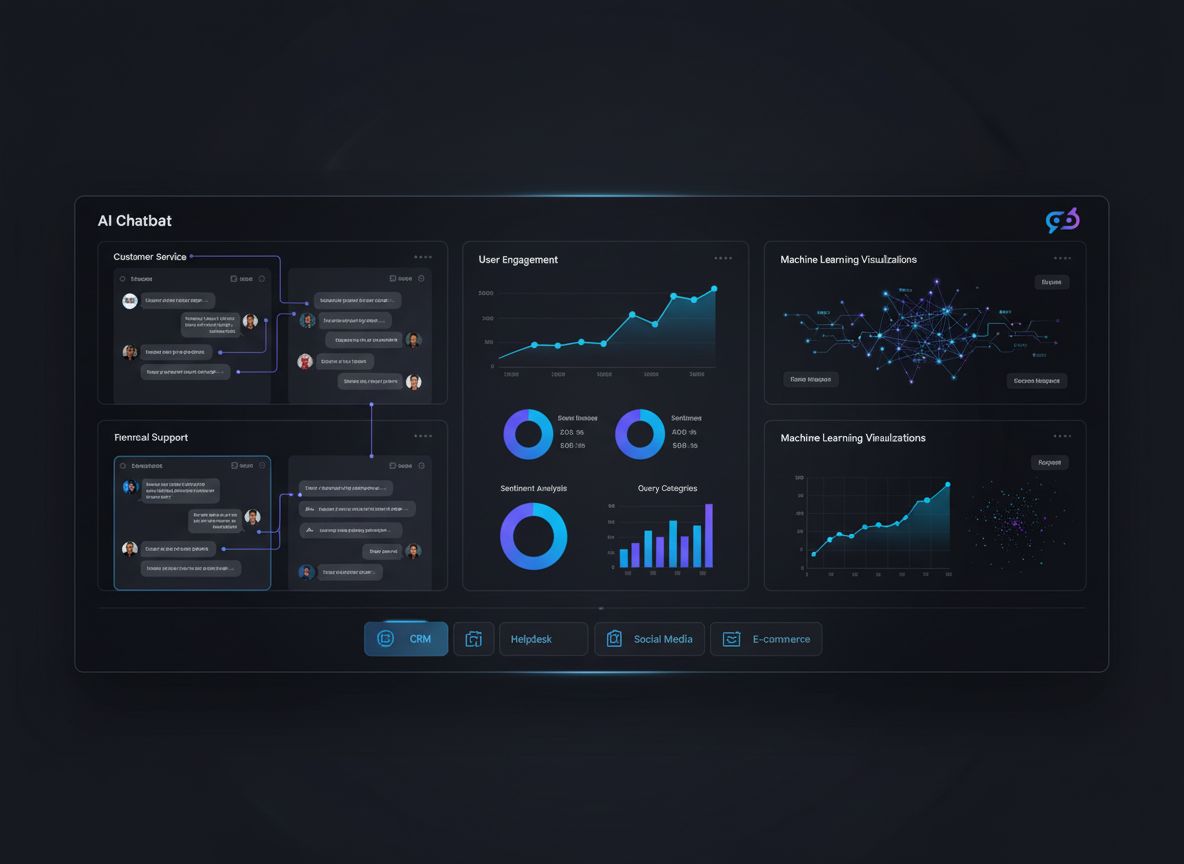
FlowHunt excels at transforming how businesses approach customer interactions. The platform’s intelligent routing automatically directs conversations to the right department, while its sentiment analysis identifies frustrated customers for priority handling. Integration with CRM systems ensures every conversation enriches your customer data, and the built-in A/B testing helps you continuously optimize chatbot performance.
What truly sets FlowHunt apart is its focus on measurable business outcomes. The platform provides clear ROI tracking, showing exactly how chatbot interactions translate to cost savings, lead generation, and customer satisfaction improvements. Organizations using FlowHunt report 60-80% reduction in routine support inquiries and 40% improvement in customer satisfaction scores.
Best For: Organizations seeking a complete, production-ready chatbot platform that scales from startup to enterprise. Ideal for customer support, sales automation, lead qualification, and internal helpdesks.
Pricing: Free tier available; Pro plans starting at $29/month with flexible usage-based scaling.
OpenAI: The Frontier of Conversational AI
OpenAI continues to lead the chatbot revolution with its GPT series of large language models, which have become the foundation for countless conversational AI applications. By 2026, OpenAI’s offerings have evolved significantly beyond the original ChatGPT, with more powerful models, enhanced fine-tuning capabilities, and deeper integration options for developers and enterprises.
The strength of OpenAI’s approach lies in the raw capability of its language models. GPT-4 and its successors demonstrate remarkable understanding of context, can handle multi-turn conversations with impressive coherence, and excel at tasks requiring reasoning, creativity, and domain-specific knowledge. Organizations using OpenAI’s API can build chatbots that understand subtle nuances in user queries, maintain conversation history effectively, and generate responses that feel natural and contextually appropriate.
For businesses building on OpenAI’s foundation, the platform offers several advantages. The API is well-documented, with extensive examples and community support. Fine-tuning capabilities allow organizations to customize model behavior for specific domains or use cases. Integration with other tools and platforms is straightforward through REST APIs and webhooks. However, OpenAI’s approach requires more technical expertise than no-code platforms, and costs can scale significantly with usage volume, particularly for high-traffic applications.
Google Dialogflow: Enterprise-Grade Conversational AI
Google’s Dialogflow represents a mature, enterprise-focused approach to chatbot development. Built on Google Cloud’s infrastructure and powered by Google’s advanced NLP capabilities, Dialogflow serves organizations ranging from startups to Fortune 500 companies. The platform has evolved significantly by 2026, incorporating the latest advances in machine learning while maintaining its reputation for reliability and scalability.
Dialogflow’s architecture separates intent recognition from fulfillment, allowing developers to define what users want (intents) and then specify how the system should respond (fulfillment). This separation of concerns makes it easier to build complex conversation flows and maintain chatbots as requirements evolve. The platform supports both text and voice interactions, integrates seamlessly with Google Assistant and other voice platforms, and provides multi-language support out of the box.
One of Dialogflow’s most compelling features is its integration with Google Cloud’s broader ecosystem. Organizations can leverage Cloud Functions for custom logic, Cloud Firestore for data persistence, BigQuery for analytics, and other Google Cloud services. This integration depth makes Dialogflow particularly attractive for enterprises already invested in Google Cloud infrastructure. The platform also offers strong security features, compliance certifications, and enterprise-grade support.
Microsoft Azure Bot Service: The Enterprise Standard
Microsoft’s Azure Bot Service has established itself as the go-to platform for enterprises requiring deep integration with Microsoft’s ecosystem. By 2026, Azure Bot Service has matured into a comprehensive platform that combines powerful AI capabilities with enterprise-grade security, scalability, and support.
The platform leverages Microsoft’s Language Understanding (LUIS) service for intent recognition and entity extraction, combined with Azure’s robust infrastructure for deployment and scaling. Organizations can build bots that integrate seamlessly with Microsoft Teams, Office 365, Dynamics 365, and other Microsoft applications—a significant advantage for enterprises already standardized on Microsoft technologies.
Azure Bot Service excels in scenarios requiring complex business logic, multi-step workflows, and integration with enterprise systems. The platform supports multiple programming languages, offers comprehensive SDKs, and provides extensive documentation. For organizations with existing Azure investments or those requiring tight integration with Microsoft services, Azure Bot Service remains a compelling choice.
Rasa: The Open-Source Powerhouse
For developers and organizations prioritizing customization and control, Rasa stands as the leading open-source conversational AI platform. Unlike commercial platforms that abstract away implementation details, Rasa provides complete transparency and control over the NLU pipeline, dialogue management, and deployment infrastructure.
Rasa’s architecture is built around a modular design philosophy. Organizations can choose their NLU components, customize dialogue policies, implement custom actions, and deploy on their own infrastructure. This flexibility makes Rasa ideal for building chatbots with complex, domain-specific requirements that don’t fit neatly into commercial platform templates.
The Rasa community has grown substantially, with extensive documentation, tutorials, and third-party integrations available. Organizations using Rasa benefit from the ability to audit and modify every aspect of their chatbot’s behavior, implement custom security measures, and avoid vendor lock-in. However, this flexibility comes with a trade-off: Rasa requires more technical expertise to implement and maintain compared to no-code platforms.
IBM Watson Assistant: AI-Powered Enterprise Solutions
IBM Watson Assistant represents IBM’s commitment to enterprise conversational AI. The platform combines advanced NLP with IBM’s broader suite of AI and analytics services, making it particularly attractive for large organizations with complex requirements.
Watson Assistant’s strength lies in its ability to handle sophisticated conversation flows, maintain context across extended interactions, and integrate with enterprise systems. The platform includes built-in analytics that help organizations understand chatbot performance, identify improvement opportunities, and optimize conversation flows based on real user interactions.
For enterprises requiring industry-specific solutions, IBM offers pre-built models and templates for healthcare, financial services, retail, and other sectors. These accelerators can significantly reduce development time and ensure compliance with industry-specific requirements.
Botpress: Developer-Friendly Open-Source Platform
Botpress has emerged as a developer-friendly alternative to Rasa, offering a more approachable entry point for teams building custom chatbots. The platform combines the flexibility of open-source software with a more intuitive interface and better out-of-the-box functionality.
Botpress’s visual flow builder makes it easier for non-technical team members to contribute to chatbot design, while the underlying architecture remains fully customizable for developers. The platform supports multiple NLU engines, offers extensive API access, and provides a marketplace of pre-built modules and integrations.
Tidio: Simplicity Meets Functionality
Tidio represents the no-code, user-friendly end of the chatbot builder spectrum. Designed for small to medium-sized businesses without dedicated development teams, Tidio combines AI-powered chatbots with live chat functionality, creating a unified customer communication platform.
The platform’s drag-and-drop interface makes it accessible to non-technical users, while pre-built templates accelerate deployment. Tidio’s strength lies in its simplicity and affordability, making it an excellent choice for businesses looking to implement basic chatbot functionality quickly without significant investment.
LivePerson: Omnichannel Messaging at Scale
LivePerson focuses on creating seamless customer experiences across multiple messaging channels. The platform combines AI-powered chatbots with human agent capabilities, allowing organizations to automate routine inquiries while maintaining the ability to escalate complex issues to human representatives.
LivePerson’s omnichannel approach is particularly valuable for organizations serving customers across SMS, email, social media, and web channels. The platform’s analytics provide insights into customer behavior and chatbot performance, enabling continuous optimization.
ManyChat: Social Media Chatbot Specialization
ManyChat has carved out a niche as the leading platform for building chatbots on social media channels, particularly Facebook Messenger, Instagram, and WhatsApp. The platform’s focus on social commerce and customer engagement makes it ideal for e-commerce businesses and brands leveraging social media for customer interaction.
ManyChat’s strength lies in its deep integration with social platforms and its focus on conversion optimization. The platform includes features specifically designed for e-commerce, such as product recommendations, order tracking, and customer support automation.
Tars: Conversational Landing Pages and Lead Generation
Tars specializes in building conversational experiences designed to capture leads and drive conversions. The platform’s focus on conversion optimization makes it particularly valuable for marketing teams and sales organizations looking to improve lead quality and sales efficiency.
FlowHunt: Orchestrating Your Chatbot Workflows
While individual chatbot builders excel at creating conversational experiences, the broader challenge for many organizations involves orchestrating these chatbots within larger business processes. This is where FlowHunt enters the picture, providing a unified platform for managing chatbot workflows, integrations, and optimization.
FlowHunt enables organizations to:
Streamline chatbot deployment: Automate the process of deploying chatbots across multiple platforms and channels
Manage integrations: Seamlessly connect chatbots with CRM systems, databases, and business applications
Optimize performance: Use advanced analytics to identify bottlenecks and improvement opportunities
Automate workflows: Create complex automation sequences that trigger based on chatbot interactions
Centralize management: Monitor and manage multiple chatbots from a single dashboard
For organizations using multiple chatbot builders or managing complex chatbot ecosystems, FlowHunt provides the orchestration layer that ties everything together, enabling more efficient operations and better customer experiences.
Join our newsletter
Get latest tips, trends, and deals for free.
Advanced Insights: Emerging Trends in Chatbot Technology
Multimodal Interaction Capabilities
By 2026, the distinction between text-based and voice-based chatbots has largely dissolved. Leading platforms now support seamless interaction across text, voice, images, and video. Users can start a conversation via text, switch to voice, share images for visual understanding, and receive responses in their preferred format. This multimodal capability significantly enhances user experience and accessibility.
Emotional Intelligence and Sentiment Analysis
Modern chatbots increasingly incorporate sentiment analysis and emotional intelligence capabilities. These systems can detect user frustration, adjust their tone and approach accordingly, and escalate to human agents when emotional support is needed. This advancement has dramatically improved customer satisfaction scores and reduced negative interactions.
Contextual Awareness and Memory
Advanced chatbots maintain sophisticated context across conversations, remembering user preferences, previous interactions, and relevant business context. This enables more personalized, efficient conversations where users don’t need to repeat information or provide extensive context for each interaction.
Integration with IoT and Wearables
Chatbots are increasingly integrated with Internet of Things devices and wearables, enabling new interaction paradigms. Users can control smart home devices through conversational interfaces, receive health recommendations from wearable-integrated chatbots, and interact with chatbots through smartwatches and other connected devices.
Autonomous Learning and Continuous Improvement
Modern platforms incorporate mechanisms for continuous learning from user interactions. Chatbots can identify common failure patterns, suggest improvements to conversation flows, and automatically optimize responses based on performance metrics. This autonomous improvement capability reduces the manual effort required to maintain and enhance chatbot performance.
Implementation Considerations and Best Practices
Selecting and implementing a chatbot builder requires careful consideration of multiple factors beyond raw technical capabilities. Organizations should evaluate their specific use cases, technical expertise, budget constraints, and long-term strategic objectives.
For enterprises with complex requirements and existing technology investments, platforms like Azure Bot Service, Google Dialogflow, or IBM Watson Assistant offer the depth, scalability, and integration capabilities needed for sophisticated implementations. These platforms provide enterprise-grade support, security features, and compliance certifications essential for regulated industries.
For organizations prioritizing customization and control, open-source platforms like Rasa or Botpress offer unparalleled flexibility. These solutions require more technical expertise but enable organizations to build exactly what they need without vendor constraints.
For small to medium-sized businesses seeking rapid deployment and ease of use, platforms like Tidio, ManyChat, or Tars provide excellent value. These solutions sacrifice some customization capability in exchange for faster time-to-market and lower technical barriers.
For organizations building on cutting-edge AI capabilities, OpenAI’s API provides access to the most advanced language models available. This approach works best for organizations with technical expertise and specific requirements that benefit from the raw power of large language models.
Supercharge Your Chatbot Workflows with FlowHunt
Experience how FlowHunt automates your chatbot deployment, integrations, and optimization — from creation and testing to analytics and continuous improvement — all in one intelligent platform.
Open-source platforms like Rasa and Botpress offer full customization and self-hosting capabilities, ideal for developers with specific requirements. Commercial platforms like OpenAI and Google Dialogflow provide managed services, better support, and easier deployment for businesses without extensive technical resources.
Platforms like Tidio and ManyChat are excellent for small businesses due to their user-friendly interfaces, affordable pricing, and pre-built templates. They require minimal technical knowledge and offer quick deployment for customer service automation.
Yes, most modern chatbot builders offer API integrations and webhooks that allow seamless connection with CRM systems, databases, and other business tools. FlowHunt can help orchestrate these integrations efficiently.
Essential features include advanced NLP capabilities, multimodal interaction support (text, voice, images), omnichannel deployment, real-time analytics, easy integration with existing systems, and strong security measures for enterprise use.
Arshia is an AI Workflow Engineer at FlowHunt. With a background in computer science and a passion for AI, he specializes in creating efficient workflows that integrate AI tools into everyday tasks, enhancing productivity and creativity.
Arshia Kahani
AI Workflow Engineer
Automate Your Chatbot Workflows with FlowHunt
Streamline chatbot creation, deployment, and optimization with FlowHunt's intelligent automation platform.
The Best AI Agent Builders in 2026: A Comprehensive Guide to Autonomous Intelligence Platforms
Explore the top AI agent builders in 2026, from no-code platforms to enterprise-grade frameworks. Discover which tools are best for your use case and how FlowHu...
Discover the best AI chatbots in 2025. Compare ChatGPT, Claude, Google Gemini, and more. Find the perfect chatbot for your business needs with our comprehensive...
8 min read
Cookie Consent We use cookies to enhance your browsing experience and analyze our traffic. See our privacy policy.