
What is Google Gemini AI Chatbot?
Discover what Google Gemini is, how it works, and how it compares to ChatGPT. Learn about its multimodal capabilities, pricing, and real-world applications for ...
11 min read
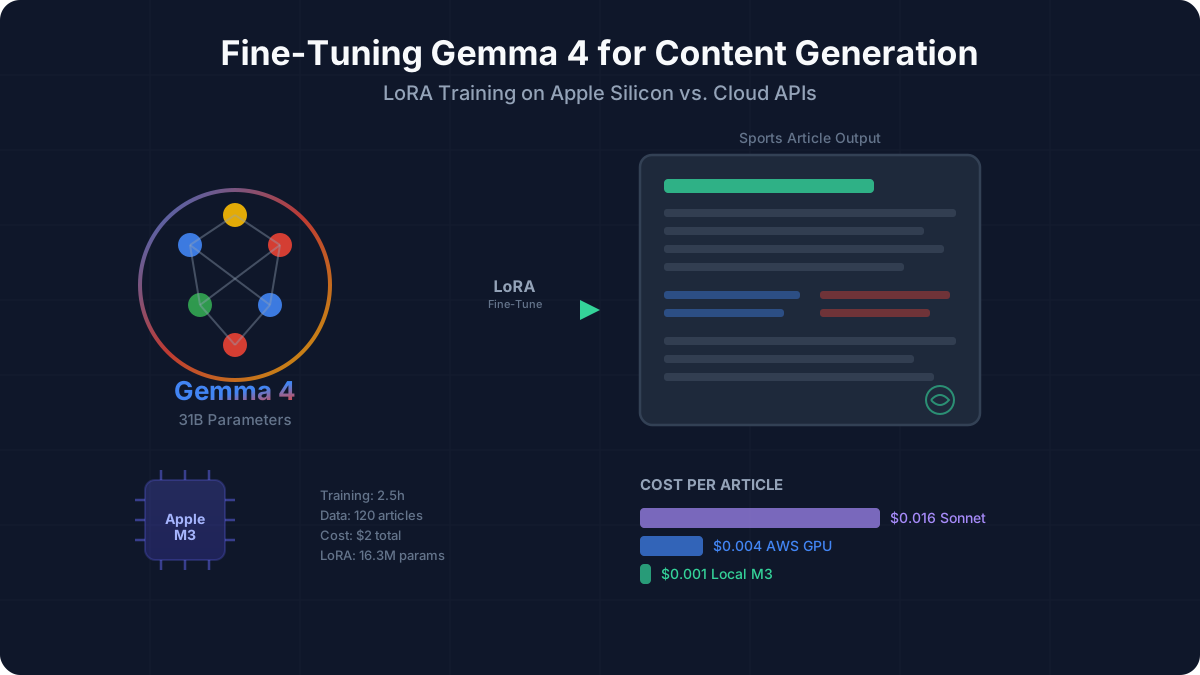
A hands-on experiment fine-tuning Gemma 4 31B with LoRA on Apple Silicon to generate sports articles, compared head-to-head with Claude Sonnet on quality, speed, and cost.
We run a sports data platform that publishes match reports and league round-ups across nine sports. Every article has been generated through API calls to Claude Sonnet — reliable, high quality, but expensive at scale. We wanted to know: could an open-source model, fine-tuned on our own data, produce articles of comparable quality while running entirely on local hardware?
This post walks through the full experiment — from data preparation to LoRA fine-tuning to a head-to-head comparison — using Google’s Gemma 4 31B model, Apple’s MLX framework, and a MacBook Pro M3 Max with 96GB of unified memory. We also break down the real-world economics: when does training a custom model actually save money compared to API calls?
Gemma 4 is Google’s open-weight large language model family, released in 2025 as a successor to the Gemma 2 series. The key word is open-weight — unlike proprietary models such as GPT-4 or Claude, Gemma 4’s weights are freely available for download, fine-tuning, and deployment without ongoing API fees.
The model comes in several sizes. We used the 31B parameter instruction-tuned variant (google/gemma-4-31B-it), which sits in a sweet spot between capability and hardware requirements. At full fp16 precision it needs about 62GB of memory; with 4-bit quantization it compresses to roughly 16GB, small enough to run on a laptop with 32GB of RAM.
What makes Gemma 4 particularly interesting for our use case:
The trade-off is clear: you give up the plug-and-play convenience of an API call in exchange for control, privacy, and dramatically lower marginal costs at scale.
Our platform generates hundreds of articles per day across football, basketball, hockey, NFL, baseball, rugby, volleyball, and handball. Each article costs roughly $0.016 in API calls to Claude Sonnet. That adds up quickly — 500 articles per day means $240 per month, or $2,880 per year.
Beyond cost, we wanted:
The hypothesis: if we train a 31B parameter model on 120 “perfect” articles written by Claude Sonnet, it should learn the structure, tone, and sport-specific conventions well enough to produce articles autonomously.
The experiment ran in five phases:
Phase 1: Selecting Training Matches — Not all matches make good training examples. We built a richness scoring system favoring data-dense matches with events, statistics, and standings context. We selected 100 match articles and 20 league-day summaries, with diversity across result types (home wins, away wins, draws, blowouts, comebacks). For this initial experiment, we focused exclusively on football: 120 training examples total.
Phase 2: Generating Reference Articles with Claude Sonnet — Each match’s JSON data was transformed into a structured text prompt and sent to Claude Sonnet with a system prompt defining the inverted pyramid article structure: headline, lead paragraph with score, chronological key moments, statistics analysis, league context, and a brief forward look. Each article cost ~$0.016. The full 120-article dataset cost under $2.
Phase 3: Dataset Formatting — Articles were converted to Gemma’s chat format (<start_of_turn>user / <start_of_turn>model) and split 90/10 into 115 training and 13 validation examples.
Phase 4: Fine-Tuning with LoRA on MLX — This is where Apple Silicon earns its keep. The entire 31B model fits in unified memory on the M3 Max. We used LoRA to insert small trainable matrices into 16 layers, adding just 16.3 million trainable parameters — 0.053% of the total.
| Parameter | Value |
|---|---|
| Base model | google/gemma-4-31B-it |
| Trainable parameters | 16.3M (0.053% of 31B) |
| Training examples | 115 |
| Epochs | 3 |
| Total iterations | 345 |
| Batch size | 1 |
| Learning rate | 1e-4 |
| Peak memory usage | 76.4 GB |
| Training time | ~2.5 hours |
Validation loss dropped from 6.614 to 1.224 over 345 iterations, with the steepest improvement in the first 100 steps.
Phase 5: Quantization — We applied 4-bit quantization using MLX, compressing the model from 62GB to ~16GB. This made inference 2.6x faster while maintaining acceptable quality.
We compared five articles generated from identical match data across all three configurations.
| Configuration | Avg Words | Avg Time | Quality |
|---|---|---|---|
| Claude Sonnet (API) | 402 | ~2s | Best narrative flow, zero hallucinations |
| Gemma 4 31B fp16 + LoRA | 391 | 207s | Strong structure, occasional repetition |
| Gemma 4 31B 4-bit + LoRA | 425 | 80s | Good structure, occasional minor factual errors |
Where the fine-tuned Gemma 4 excels:
Where Sonnet still leads:
Was LoRA training worth it? Absolutely. Without LoRA, the base Gemma 4 model produces output cluttered with internal thinking tokens (<|channel>thought), markdown formatting, and generic sports writing. The fine-tuned model outputs clean, production-ready text in our exact editorial style. The entire LoRA training cost $2 in API calls and 2.5 hours of compute.
The MacBook Pro M3 Max served its purpose as a development and experimentation platform. It proved that fine-tuning and inference on a 31B model is technically feasible on Apple Silicon. But we would never deploy production workloads on a local laptop.
For actual production deployment, a cloud GPU instance is the right choice. Here is what a realistic deployment looks like on AWS.
The quantized 4-bit Gemma 4 model (16GB) fits comfortably on a single A10G GPU. Inference speed on A10G is dramatically faster than Apple Silicon — roughly 15 seconds per article vs. 80 seconds on the M3 Max.
| Metric | Value |
|---|---|
| Instance type | g5.xlarge |
| GPU | NVIDIA A10G (24GB VRAM) |
| On-demand price | $1.006/hr |
| Spot price (typical) | ~$0.40/hr |
| Inference speed | ~15 seconds/article |
| Throughput | ~240 articles/hour |
| Cost per article (on-demand) | $0.0042 |
| Cost per article (spot) | $0.0017 |
| Approach | Cost/Article | Daily Cost | Monthly Cost | Annual Cost |
|---|---|---|---|---|
| Claude Sonnet API | $0.016 | $8.00 | $240 | $2,880 |
| AWS g5.xlarge (on-demand) | $0.0042 | $2.10 | $63 | $756 |
| AWS g5.xlarge (spot) | $0.0017 | $0.85 | $25.50 | $306 |
| Local M3 Max (electricity) | $0.0007 | $0.35 | $10.50 | $126 |
The GPU advantage is clear: 74% cost reduction on on-demand instances, 89% on spot instances, compared to Sonnet API calls — with generation speeds only 7-8x slower than an API call instead of 40x slower on the M3 Max.
The local M3 Max has the lowest marginal cost ($0.0007/article in electricity) but the highest upfront investment. At ~45 articles per hour (4-bit quantized), a single M3 Max produces roughly 1,080 articles per day running 24/7.
| Cost Factor | Value |
|---|---|
| Hardware cost | ~$4,000 (MacBook Pro M3 Max 96GB) |
| Power consumption | ~200W under load |
| Electricity cost | ~$0.72/day (24h continuous) |
| Throughput | ~1,080 articles/day |
| Break-even vs. Sonnet | ~260,000 articles (~8 months at 500/day) |
When does local make sense? For companies that need 100% data privacy and cannot use cloud-based models — whether due to regulatory requirements, contractual obligations, or operating in sensitive domains — a local deployment eliminates all external data transmission. The match data, the model weights, and the generated content never leave the company’s premises. This is not about cost optimization; it is about compliance and control. Industries like defense, healthcare, finance, and legal may find this the only acceptable deployment model.
The critical question: at what volume does the investment in fine-tuning break even against just using Claude Sonnet for everything?
| Item | Cost |
|---|---|
| Training data generation (120 articles via Sonnet) | $2 |
| Full 9-sport training data (960 articles) | $16 |
| Developer time for pipeline (~20 hours) | ~$500 |
| AWS GPU time for training (optional) | ~$5 |
| Total one-time investment | ~$523 |
The savings per article depend on your deployment:
| Deployment | Cost/Article | Savings vs. Sonnet | Break-Even (articles) | Break-Even at 500/day |
|---|---|---|---|---|
| AWS on-demand | $0.0042 | $0.0118 | ~44,300 | ~89 days (~3 months) |
| AWS spot | $0.0017 | $0.0143 | ~36,600 | ~73 days (~2.5 months) |
| Local M3 Max | $0.0007 | $0.0153 | ~34,200 | ~68 days (~2 months) |
If we exclude developer time (treating it as a sunk cost for the learning experience) and only count hard infrastructure costs ($21):
| Deployment | Break-Even (articles) | Break-Even at 500/day |
|---|---|---|
| AWS on-demand | ~1,780 | 3.5 days |
| AWS spot | ~1,470 | 3 days |
| Local M3 Max | ~1,370 | 2.7 days |
The math is straightforward: if you generate more than ~1,500 articles, the custom model pays for itself in hard costs alone. Including developer time pushes break-even to roughly 35,000-45,000 articles, or about 2.5-3 months at 500 articles per day.
At scale (500+ articles/day), the annual savings are substantial:
| Approach | Annual Cost | Annual Savings vs. Sonnet |
|---|---|---|
| Claude Sonnet | $2,880 | — |
| AWS g5 on-demand | $756 + $523 one-time = $1,279 (year 1) | $1,601 |
| AWS g5 spot | $306 + $523 one-time = $829 (year 1) | $2,051 |
| Local M3 Max | $126 + $4,523 (hardware + setup) = $4,649 (year 1) | -$1,769 (year 1), +$2,754 (year 2+) |
The most practical approach is hybrid: use the fine-tuned Gemma 4 model for routine content (the bulk of volume), and reserve Claude Sonnet for:
This gets you the cost benefits of self-hosted inference on 80-90% of your volume while keeping Sonnet’s superior quality available for the edge cases that matter most.
LoRA is remarkably efficient for style transfer. With only 115 training examples, the model learned our exact article format, tone, and sport-specific conventions. The inverted pyramid structure, active-verb style, and data-grounded approach all transferred cleanly.
Apple Silicon is a viable training platform for 31B models. The M3 Max handled the full model with gradient checkpointing, peaking at 76.4GB. Training completed in 2.5 hours — fast enough to iterate on hyperparameters within a single workday.
Structured input data matters enormously. The quality of the data formatter directly impacts article quality. Investing in comprehensive data extraction pays dividends on both the API and self-hosted paths.
Production deployment belongs in the cloud (for most teams). The M3 Max proved the concept. AWS GPU instances deliver the speed and reliability needed for production workloads at 74-89% less cost than API calls. Local machines remain the right choice only when data privacy requirements rule out all external infrastructure.
The break-even math favors custom models at moderate scale. Any team generating more than ~1,500 articles will recover the hard costs of fine-tuning almost immediately. The real question is not whether custom models save money — it is whether your team has the engineering capacity to build and maintain the pipeline.
Fine-tuning Gemma 4 31B produced a content generator that matches Claude Sonnet in headline quality, article structure, and factual accuracy — while reducing per-article costs by 74-89% on cloud infrastructure and enabling fully private, on-premise deployment for organizations that require it.
The M3 Max MacBook served purely as a test bench for this experiment. Real production deployment would run on AWS GPU instances (g5.xlarge with A10G), where the quantized model generates articles in roughly 15 seconds at $0.0042 each — compared to $0.016 per Sonnet API call.
For companies that need complete data privacy and cannot use cloud-based AI services, a local machine running the quantized model is a legitimate option. At ~45 articles per hour, a single workstation handles moderate volumes with zero external data exposure. The hardware investment pays for itself in about 8 months compared to API costs.
The economics are clear: at 500 articles per day, a custom fine-tuned model on AWS spot instances saves over $2,000 per year compared to Claude Sonnet API calls. The break-even point arrives in under 3 months. For teams already running content generation at scale, the combination of open-weight models, LoRA fine-tuning, and commodity GPU hardware represents a credible, cost-effective alternative to proprietary APIs.
Built with FlowHunt . The complete pipeline — from data preparation through fine-tuning to inference — is available as part of our sports data platform toolkit.
Viktor Zeman is a co-owner of QualityUnit. Even after 20 years of leading the company, he remains primarily a software engineer, specializing in AI, programmatic SEO, and backend development. He has contributed to numerous projects, including LiveAgent, PostAffiliatePro, FlowHunt, UrlsLab, and many others.

FlowHunt helps you build automated content generation workflows using the best AI models — whether cloud APIs or self-hosted open-source models.
Discover what Google Gemini is, how it works, and how it compares to ChatGPT. Learn about its multimodal capabilities, pricing, and real-world applications for ...
Large Language Model Meta AI (LLaMA) is a cutting-edge natural language processing model developed by Meta. With up to 65 billion parameters, LLaMA excels at un...
LangChain is an open-source framework for developing applications powered by Large Language Models (LLMs), streamlining the integration of powerful LLMs like Op...