Google Gemini 2.5 Flash: AI Image Generation Revolution
Explore how Google’s Gemini 2.5 Flash image model is transforming creative industries with advanced image editing, 3D extraction, photo restoration, and AI-powered visual design capabilities that rival traditional software.
AI
Image Generation
Google Gemini
Creative Tools
Automation
Google’s release of Gemini 2.5 Flash, affectionately nicknamed “Nano Banana” by the AI community, has sent shockwaves through the creative industry. This powerful multimodal AI model represents a significant leap forward in what’s possible when combining image understanding with generative capabilities. The industry response has been overwhelmingly enthusiastic, with content creators, designers, developers, and visual artists discovering innovative applications that were previously impossible or required extensive manual work. From extracting 3D models from photographs to restoring century-old images to near-perfect clarity, Nano Banana is demonstrating capabilities that many believed were still years away. This comprehensive guide explores the real-world applications, strengths, limitations, and industry reactions to this groundbreaking technology, providing you with a complete understanding of how Gemini 2.5 Flash is reshaping creative workflows across multiple disciplines.
Understanding AI Image Generation and Multimodal Models
Before diving into the specific capabilities of Gemini 2.5 Flash, it’s essential to understand the broader context of AI image generation and what makes multimodal models fundamentally different from previous generations of AI tools. Traditional image generation models work in one direction—they take text prompts and generate images from scratch. However, multimodal models like Nano Banana operate bidirectionally, meaning they can both understand and analyze existing images while also generating new visual content. This dual capability is revolutionary because it allows the model to maintain consistency with reference images, understand spatial relationships in real-world photographs, and apply complex transformations while preserving the essential characteristics of the original content. The architecture underlying these models involves training on massive datasets of images paired with descriptive text, enabling the AI to develop a sophisticated understanding of visual concepts, spatial relationships, lighting conditions, textures, and compositional principles. When you provide Nano Banana with an image and a prompt, the model doesn’t simply overlay changes—it genuinely understands what’s in the image, what you’re asking it to do, and how to make those changes in a way that respects the physical and aesthetic properties of the original scene. This represents a fundamental shift from previous image editing AI tools, which often produced obviously artificial or inconsistent results.
Ready to grow your business?
Start your free trial today and see results within days.
Why Advanced Image Generation Matters for Modern Creative Professionals
The emergence of sophisticated image generation and editing AI has profound implications for creative professionals across multiple industries. Traditionally, tasks like photo restoration, complex image compositing, 3D asset creation, and advanced photo editing required either expensive software licenses, specialized training, or hiring professional designers and artists. These barriers meant that many small businesses, independent creators, and organizations with limited budgets couldn’t access professional-quality visual content creation. Gemini 2.5 Flash democratizes these capabilities by making them accessible through simple natural language prompts, dramatically reducing both the time and expertise required to produce high-quality visual content. For game developers, the ability to generate infinite unique 3D assets from simple descriptions or extracted from photographs means development cycles can accelerate significantly while reducing asset creation costs. For content creators and marketers, the ability to quickly generate variations of images, restore old photographs, or create consistent visual styles across multiple pieces of content opens new possibilities for scaling content production. For e-commerce businesses, the ability to virtually try clothing on models or generate product variations without expensive photoshoots represents substantial cost savings. The broader implication is that visual content creation is becoming increasingly democratized, allowing smaller teams to compete with larger organizations that previously had advantages in production capacity and resources. This shift is comparable to how word processors democratized writing or how digital photography democratized image capture—the barrier to entry drops dramatically, and the number of people who can participate in the field expands exponentially.
How FlowHunt Enhances AI Image Generation Workflows
While Gemini 2.5 Flash provides powerful individual capabilities, the real magic happens when you integrate it into comprehensive automated workflows. This is where FlowHunt becomes invaluable. FlowHunt is an AI orchestration platform that allows you to connect Gemini 2.5 Flash with other tools and services, creating seamless end-to-end workflows that handle everything from image analysis to generation to distribution. For example, you could create a FlowHunt workflow that automatically monitors your social media mentions, extracts images from those mentions, uses Nano Banana to enhance or modify them, and then posts the results back to your social channels—all without manual intervention. Content creators can build workflows that take raw footage screenshots, use Gemini 2.5 Flash to extract key elements and generate variations, then automatically feed those into video generation tools for consistent animation. E-commerce businesses can set up automated pipelines where product images are automatically enhanced, variations are generated for different seasons or styles, and the results are pushed directly to their product catalog. The power of FlowHunt lies in its ability to eliminate repetitive manual steps, maintain consistency across large batches of content, and enable non-technical team members to leverage advanced AI capabilities without writing code. By combining FlowHunt’s orchestration capabilities with Gemini 2.5 Flash’s image understanding and generation abilities, organizations can build sophisticated creative automation systems that would have required significant engineering effort just a few years ago.
Join our newsletter
Get latest tips, trends, and deals for free.
Real-World Applications: Location-Based AR and Image Annotation
One of the most immediately practical applications of Gemini 2.5 Flash is location-based augmented reality (AR) experience generation. Because Nano Banana has access to Google’s vast world knowledge, it can analyze photographs of real-world locations and automatically identify points of interest, then annotate them with relevant information. This capability was demonstrated with photographs of San Francisco landmarks. When provided with an image of the Transamerica Pyramid and prompted to act as a location-based AR experience generator, Nano Banana successfully identified the building, highlighted it within the image, and generated contextual information including the number of floors, height, and other relevant details. The same process worked for the San Francisco Ferry Building and the Palace of Fine Arts, though with minor accuracy variations in naming conventions. This application has immediate commercial potential for tourism applications, educational tools, real estate platforms, and navigation systems. Imagine a mobile app where users can point their camera at any landmark, and the app automatically provides historical information, architectural details, visitor reviews, and relevant links—all powered by Nano Banana’s understanding of the image combined with its access to world knowledge. The accuracy isn’t perfect, as demonstrated by occasional misspellings or missed elements, but the capability is genuinely impressive and continues to improve. For businesses building AR experiences, this means they can dramatically reduce the manual work required to tag and annotate locations, instead relying on AI to handle the heavy lifting of identification and information retrieval.
3D Model Extraction and Isometric Transformation
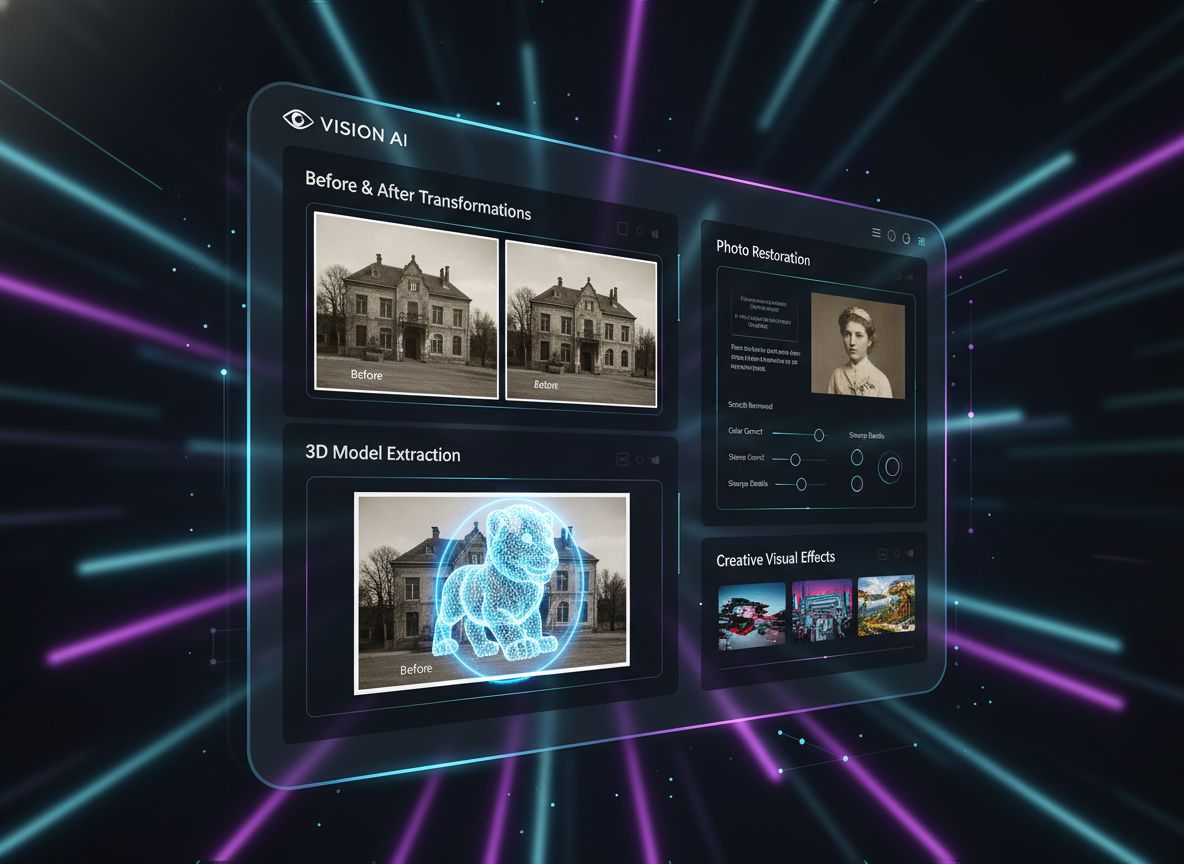
Perhaps one of the most visually striking capabilities of Gemini 2.5 Flash is its ability to extract objects from photographs and convert them into 3D isometric representations. This process involves analyzing a photograph, identifying a specific object or building, and then generating a clean, three-dimensional isometric view of that object as if it were a 3D asset. The implications for game development, architectural visualization, and digital asset creation are enormous. When provided with a photograph of a building and prompted to “make image daytime and isometric temple only,” Nano Banana successfully extracted the building from its photographic context and rendered it as a clean 3D isometric asset. Even more impressively, when the building was partially obscured by street lights, trees, and bushes, the model was able to reconstruct the complete structure without the obstructions, creating a clean 3D representation of what the building would look like unobstructed. This capability extends beyond simple extraction—users have successfully added elements to these 3D representations, such as requesting an “insanely cool roller coaster” to be added to an isometric building, and Nano Banana generated a visually coherent result. When combined with tools like Hugging Face’s 3D model viewers, these isometric representations can be made fully interactive and rotatable, creating dynamic 3D assets from static photographs. For game developers, this represents a potential revolution in asset creation. Rather than manually modeling buildings or objects in 3D software, developers can photograph real-world locations or reference images, use Nano Banana to extract and convert them to 3D, and then import them into their game engines. This workflow could reduce asset creation time from hours to minutes, and the potential for generating “essentially infinite assets” means game worlds can become vastly more detailed and varied without proportional increases in development time and cost.
Character Composition and Scene Generation
Gemini 2.5 Flash demonstrates remarkable capability in composing complex scenes from multiple reference elements. When provided with two anime characters, a hand-drawn stick figure action scene, and a prompt to combine them into a cohesive scene, Nano Banana successfully integrated all elements into a unified composition that maintained the style and characteristics of each input while creating a believable interaction between them. This capability has profound implications for animation, comic creation, and visual storytelling. Rather than requiring animators to manually composite multiple elements or use complex layering techniques in traditional software, creators can simply describe the scene they want and provide reference images, and Nano Banana handles the composition. The model understands spatial relationships, perspective, lighting consistency, and how different visual styles can be harmonized into a single coherent image. This is particularly valuable for independent animators and small studios that lack the resources to hire specialized compositing artists. The ability to quickly generate multiple variations of a scene with different character positions, expressions, or interactions enables rapid iteration and experimentation, which is crucial in the creative process.
Photo Restoration and Historical Image Enhancement
One of the most emotionally compelling applications of Gemini 2.5 Flash is photo restoration. The model was demonstrated restoring what was described as the first photograph ever taken—an extremely low-resolution, heavily degraded black and white image. From this rough, pixelated source material, Nano Banana was able to reconstruct the scene with remarkable detail, inferring what the building and surroundings likely looked like based on its understanding of architecture, materials, and historical context. While the model necessarily took some creative liberties in filling in missing details, the result was a dramatically improved version of the original that revealed details that were completely invisible in the degraded source. This capability has significant applications for historians, archivists, genealogists, and anyone working with old or damaged photographs. Family historians can restore precious old photographs of ancestors, making them clearer and more suitable for printing or sharing. Museums and archives can enhance their collections without expensive professional restoration services. The technology isn’t perfect—it does make assumptions about what details should be present—but it provides a starting point that’s vastly superior to the original degraded image. This democratization of photo restoration means that valuable historical images can be preserved and enhanced without requiring expensive professional services or specialized expertise.
Style Transfer and Artistic Transformation
Gemini 2.5 Flash excels at style transfer, the process of taking an image and rendering it in a completely different artistic style while maintaining the composition and key elements. A striking example involved taking the famous Muhammad Ali knockout photograph and transferring it to the style of The Simpsons animated series. The result maintained the dynamic composition and action of the original photograph while rendering all elements in the distinctive Simpsons art style, including background characters like Homer, Krusty the Clown, and Marge. While there were minor imperfections—such as the head being slightly tilted—the overall result was remarkably coherent and demonstrated genuine understanding of both the source image and the target style. This capability opens possibilities for artists, content creators, and marketers who want to create variations of images in different artistic styles without manually recreating them. A photographer could take a portfolio of images and generate versions in multiple artistic styles—watercolor, oil painting, comic book, anime, etc.—dramatically expanding the visual variations available from a single shoot. Marketing teams could take product photographs and generate versions in different artistic styles for different campaigns or audience segments. The technology isn’t limited to famous artistic styles either—users can describe custom styles and Nano Banana will attempt to apply them, enabling truly unique visual transformations.
Color Enhancement and Photographic Improvements
Beyond complex transformations, Gemini 2.5 Flash excels at fundamental photographic enhancements that would traditionally require Photoshop or similar software. When provided with a flat, boring photograph and prompted to “enhance it, increase contrast, boost coloring, make it richer,” the model successfully transformed the image into a vibrant, visually appealing version with improved color saturation, better contrast, and overall more professional appearance. This capability addresses a common problem in content creation—many photographs, especially those taken in challenging lighting conditions or with consumer-grade cameras, benefit from post-processing enhancement. Rather than requiring users to learn complex software or hire professionals, they can simply describe the enhancement they want and let Nano Banana handle it. The model understands photographic principles like contrast, color theory, and visual hierarchy, allowing it to make intelligent enhancement decisions that improve the image without making it look over-processed or artificial. This is particularly valuable for small businesses and content creators who need to produce large volumes of content but lack access to professional photographers or post-processing expertise.
Strengths and Limitations: A Comprehensive Assessment
Based on extensive testing and community feedback, Gemini 2.5 Flash demonstrates clear strengths and limitations that are important to understand when planning to use it in production workflows. The model excels at style transfer, maintaining object references across transformations, making both minor and major corrections to images, changing and adding colors, performing basic Photoshop-style enhancements like contrast and brightness adjustments, relighting scenes to change lighting conditions, modifying facial expressions, removing text from images, repositioning characters, and generating 3D representations. These capabilities cover the majority of common image editing tasks and represent genuine improvements over previous AI image editing tools. However, the model has notable limitations that users should be aware of. It struggles with consistent font rendering, often producing text that looks artificial or inconsistent. It tends to over-smooth images, removing fine details and texture that might be important to preserve. It cannot add fine details to images—if you ask it to add intricate patterns or small elements, it often fails or produces blurry results. Transparency generation is problematic, with the model often producing artificial or incorrect transparency masks. The model cannot effectively remove depth of field or refocus images, limiting its usefulness for certain photographic corrections. It adds a watermark to generated images, which may or may not be acceptable depending on your use case. It struggles with defog operations and cannot effectively remove fog or haze from images. It produces unrealistic-looking science fiction backgrounds, suggesting its training data is weighted toward realistic contemporary imagery. Most significantly, the model refuses to process requests involving race, ethnicity, or gender specifications, a safety measure that can limit certain creative applications. Perhaps most frustratingly, face replacement—the ability to convincingly replace one person’s face with another’s while maintaining realistic blending—remains a significant weakness. When users attempt face replacement, the model often simply returns the original image without attempting the transformation.
Video Production and Animation Integration
The true power of Gemini 2.5 Flash emerges when combined with video generation tools like Seed Dance 1.0. Content creators have successfully used Nano Banana to generate initial frames or key scenes, then used those as references for video generation, creating consistent animated sequences in under two hours. The workflow involves using Nano Banana to generate or modify key frames, ensuring visual consistency across shots, then feeding those frames into video generation tools that create smooth animations between them. The model excels at maintaining consistency across frames and shifting camera perspectives, making it ideal for creating jump cuts and dynamic scene transitions. For example, a creator can take a frame from an original scene, use Nano Banana to modify it—changing the character’s action, adding objects, or altering the environment—and then continue animating using video generation tools. The consistency between cuts is maintained because Nano Banana understands the spatial relationships and visual properties of the original frame. This workflow represents a significant acceleration in animation production, potentially reducing the time required to create animated sequences from weeks to hours. The combination of Nano Banana’s image understanding and generation with video generation tools creates a powerful pipeline for creating consistent, high-quality animated content at scale.
Camera Perspective Shifting and Compositional Flexibility
One of the more subtle but powerful capabilities of Gemini 2.5 Flash is its ability to shift camera perspective while maintaining visual consistency. When provided with a drawing or photograph and prompted to show it from a completely different angle, the model successfully recomposes the image from the new perspective while maintaining the style and essential characteristics of the original. This capability is invaluable for artists, architects, and designers who need to visualize how a scene or object would look from different viewpoints. An architect could provide a drawing of a building and request views from multiple angles without manually redrawing each perspective. An artist could explore how a composition would work from different camera angles. A game developer could generate multiple perspective views of an asset for use in different game scenarios. The model’s understanding of three-dimensional space and perspective allows it to make intelligent decisions about what would be visible from the new angle, what would be hidden, and how lighting and shadows would change. While not perfect, this capability represents a significant time-saving tool for professionals who traditionally would need to manually create multiple perspective views.
Practical Use Cases: Virtual Try-On and E-Commerce Applications
One of the most commercially viable applications of Gemini 2.5 Flash is virtual try-on for clothing and fashion. Content creators have successfully used the model to place clothing items on people in photographs, creating realistic-looking results that are virtually indistinguishable from actual photographs without close inspection. When a user provides a photograph of a person and an image of a garment they want to try on, Nano Banana successfully composites the clothing onto the person, accounting for body shape, pose, and lighting to create a convincing result. The model even includes subtle details like fabric draping and how the clothing interacts with the body. For e-commerce businesses, this capability is transformative. Rather than requiring customers to imagine how clothing would look on them, or requiring businesses to photograph products on multiple body types and skin tones, virtual try-on powered by Nano Banana enables customers to see how items would look on them personally. This reduces return rates, increases customer confidence in purchases, and enables businesses to expand their product offerings without proportional increases in photography and modeling costs. The technology also has applications beyond fashion—it could be used for trying on accessories, makeup, hairstyles, or even furniture in home settings. The commercial potential is substantial, and we’re likely to see rapid adoption of this capability across e-commerce platforms.
Supercharge Your Workflow with FlowHunt
Experience how FlowHunt automates your AI content and creative workflows — from image generation and enhancement to batch processing and publishing — all in one place.
While Gemini 2.5 Flash has generated enormous enthusiasm, it’s not without competition. Elon Musk’s Grok Imagine model has been positioned as a competitor, with Musk claiming superior results. However, direct comparisons suggest that both models produce similar quality results, at least in current iterations. When comparing side-by-side examples—such as generating “two cats in front of the Eiffel Tower”—both models produce visually comparable results with no obvious quality difference. Musk’s claims about upcoming versions of Imagine being “radically better” reflect the competitive dynamics of the AI space, where companies regularly make ambitious claims about future capabilities. However, Musk’s track record of optimistic predictions about timelines and capabilities suggests caution in taking such claims at face value. The broader competitive landscape includes other image generation and editing tools, each with their own strengths and weaknesses. What’s clear is that the field is advancing rapidly, with multiple organizations investing heavily in image generation and editing capabilities. This competition benefits users by driving innovation and ensuring that multiple options remain available. The fact that Gemini 2.5 Flash is available as an API means developers can integrate it into their applications and workflows, creating a ecosystem of tools and services built on top of the model. This is fundamentally different from traditional software like Photoshop, which is a monolithic application. The API-first approach enables rapid innovation and integration with other tools, which is why combining Nano Banana with FlowHunt and other services creates such powerful possibilities.
Ethical Considerations and Safety Measures
Google has implemented several safety measures in Gemini 2.5 Flash, including refusals to process requests involving race, ethnicity, or gender specifications. While these measures are intended to prevent misuse and bias, they also create limitations for legitimate creative applications. The model also refuses to generate explicit content, which aligns with Google’s terms of service but has led to some jailbreak attempts by users seeking to test the boundaries of the system. These safety measures reflect the broader challenge of building AI systems that are powerful and useful while also being responsible and aligned with societal values. The tension between capability and safety is ongoing, and different organizations make different choices about where to draw these lines. For users and organizations deploying Gemini 2.5 Flash, it’s important to understand these limitations and design workflows that work within them. The watermark that Nano Banana adds to generated images is another consideration—while it serves as a transparency measure indicating AI generation, it may not be acceptable for all use cases. Users should test the model’s output with their specific requirements in mind before committing to production workflows.
Conclusion
Google’s Gemini 2.5 Flash represents a genuine leap forward in AI image generation and editing capabilities, offering creative professionals and organizations powerful new tools for visual content creation. From extracting 3D models from photographs to restoring century-old images to generating consistent animated sequences, Nano Banana demonstrates capabilities that were previously impossible or required extensive manual work. While the model has clear limitations—particularly around face replacement, font rendering, and certain specialized tasks—its strengths in style transfer, object composition, photo enhancement, and 3D extraction make it a valuable addition to creative workflows. The real power emerges when Nano Banana is integrated into comprehensive automated workflows using platforms like FlowHunt, enabling organizations to scale creative production, reduce costs, and democratize access to professional-quality visual content creation. As the technology continues to improve and competition drives innovation, we can expect even more sophisticated capabilities to emerge. The creative industry is undergoing a fundamental transformation, and Gemini 2.5 Flash is at the forefront of that change.
Frequently asked questions
What is Gemini 2.5 Flash (Nano Banana)?
Gemini 2.5 Flash, nicknamed 'Nano Banana,' is Google's latest multimodal AI model that combines image understanding with generation capabilities. It can analyze real-world images, extract objects, perform advanced photo editing, restore old photos, and generate new visual content—all through natural language prompts.
Can Gemini 2.5 Flash replace Photoshop?
While Gemini 2.5 Flash excels at many image editing tasks like color enhancement, style transfer, object removal, and relighting, it's not a complete Photoshop replacement. It struggles with precise font rendering, depth-of-field adjustments, and face replacement. However, it offers a more accessible, AI-powered alternative for many common editing workflows.
What are the main limitations of Nano Banana?
Key limitations include difficulty with font rendering consistency, over-smoothing of images, inability to add fine details, transparency generation issues, defog operations, and refusal to process requests involving race, ethnicity, or gender specifications. Face replacement also remains a significant weakness.
How can creators use Gemini 2.5 Flash for video production?
Creators can use Nano Banana to generate initial frames or key scenes, then combine it with video generation tools like Seed Dance 1.0 to create consistent animations. The model excels at maintaining visual consistency across frames and shifting camera perspectives, making it ideal for creating jump cuts and dynamic scene transitions in video projects.
Arshia is an AI Workflow Engineer at FlowHunt. With a background in computer science and a passion for AI, he specializes in creating efficient workflows that integrate AI tools into everyday tasks, enhancing productivity and creativity.
Arshia Kahani
AI Workflow Engineer
Automate Your Creative Workflows with FlowHunt
Integrate Gemini 2.5 Flash and other AI tools into seamless automated workflows. Let FlowHunt handle the orchestration while you focus on creativity.
Gemini 3 Flash: The Game-Changing AI Model That Beats Pro at a Fraction of the Cost
Discover why Google's Gemini 3 Flash is revolutionizing AI with superior performance, lower costs, and faster speeds—even outperforming Gemini 3 Pro at coding t...
How to Use Nano Banana in AI Studio & FlowHunt: Complete Guide to AI-Powered Image Editing
Learn how to leverage Google's Nano Banana model for free through AI Studio and integrate it with FlowHunt for professional image generation and editing with ex...
Gemini Flash 2.0 is setting new standards in AI with enhanced performance, speed, and multimodal capabilities. Explore its potential in real-world applications.
3 min read
AI
Gemini Flash 2.0
+4
Cookie Consent We use cookies to enhance your browsing experience and analyze our traffic. See our privacy policy.