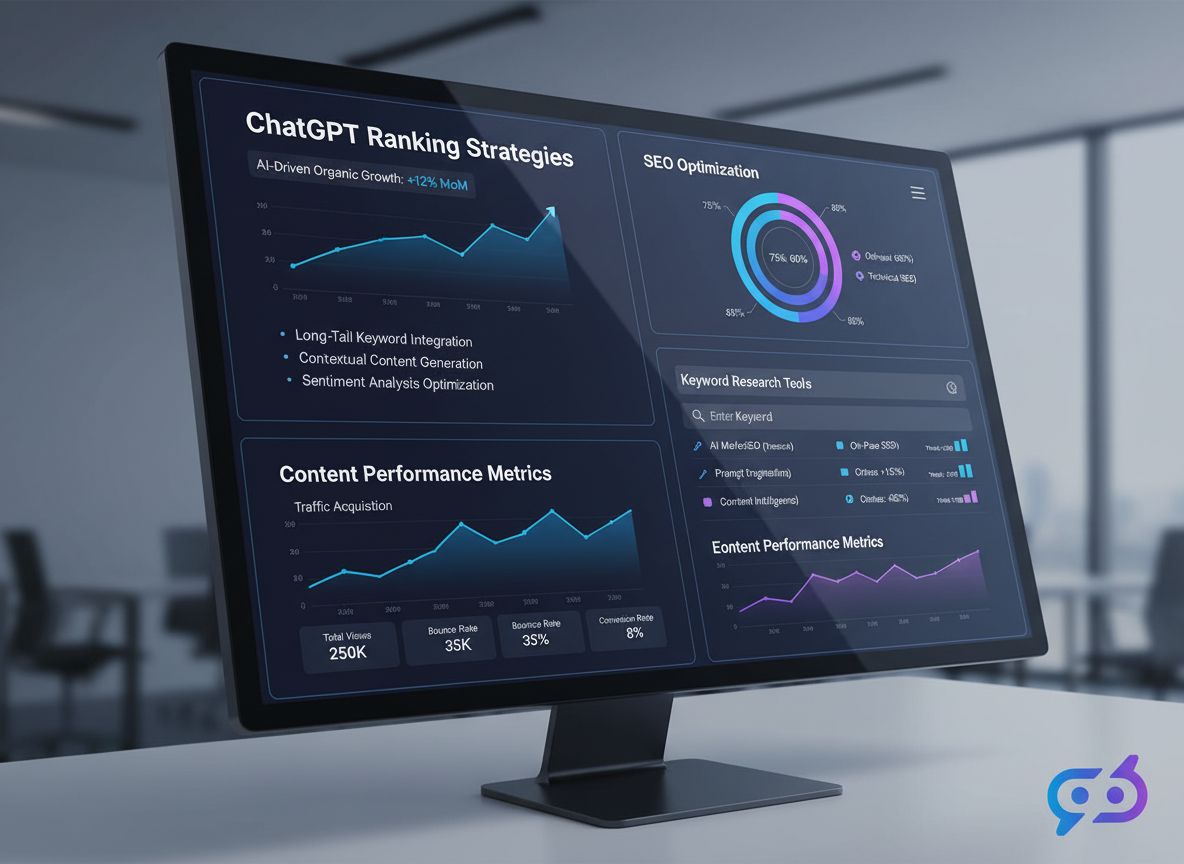
How to Rank in ChatGPT: A Comprehensive Guide to Visibility and Authority
Master the strategies to rank in ChatGPT and AI-powered search ecosystems. Learn SEO optimization, content strategies, and platform-specific tactics to boost your visibility.
ChatGPT
SEO
Content Strategy
AI Marketing
Digital Marketing
Create authoritative, comprehensive content that AI models recognize as valuable
Focus on original research and unique insights that get cited
Build domain authority through consistent, high-quality publishing
Structure content clearly with proper headings and formatting
Results typically take 3-6 months as AI models incorporate your content
Different from traditional SEO: focuses on being a trusted source for AI training data
What is ChatGPT Ranking and Why It Matters
ChatGPT ranking refers to the prominence and frequency with which your content, website, or information appears in responses generated by ChatGPT and similar large language models (LLMs). When a user asks ChatGPT a question, the AI draws from its training data to provide comprehensive answers. If your content is part of that training data and is recognized as authoritative and relevant, it’s more likely to be cited, referenced, or used to inform the AI’s response.
Unlike traditional search engine ranking, where your website appears as a clickable link in search results, ChatGPT ranking is more subtle but equally powerful. Your content might be summarized, paraphrased, or directly cited within the AI’s response. This creates multiple benefits: increased brand visibility, enhanced credibility through AI endorsement, and potential traffic from users who want to learn more about the sources cited.
The importance of ChatGPT ranking cannot be overstated. As AI tools become increasingly integrated into how people search for information, research topics, and make decisions, being visible in these systems becomes a critical component of your overall digital strategy. Companies that ignore this trend risk losing visibility to competitors who actively optimize for AI-powered platforms.
Why ChatGPT Ranking Matters for Businesses and Content Creators
The shift toward AI-powered information discovery represents one of the most significant changes in digital marketing since the rise of Google. For businesses, this means a new channel for reaching potential customers. For content creators, it’s an opportunity to establish authority and reach audiences who rely on AI tools for research and decision-making.
Consider the practical implications: when a business executive uses ChatGPT to research solutions for a specific problem, they’re not just looking at search results—they’re getting AI-synthesized information that draws from multiple sources. If your company’s content is cited as a trusted source, you gain credibility and visibility that traditional advertising cannot provide. This is particularly valuable in B2B industries where decision-makers rely heavily on research and expert opinions.
The benefits of ranking in ChatGPT extend beyond immediate traffic:
Enhanced Credibility: Being cited by AI systems signals authority and trustworthiness to both the AI and human users
Increased Brand Awareness: Your brand name and content appear in conversations with millions of ChatGPT users daily
Competitive Advantage: Early adopters of ChatGPT ranking strategies will dominate their niches before competitors catch up
Long-term Visibility: Unlike paid advertising, strong ChatGPT ranking provides sustained visibility without ongoing ad spend
Improved SEO: Content optimized for ChatGPT ranking typically performs better in traditional search engines as well
Thought Leadership: Consistent visibility in AI responses establishes you as an industry authority
The convergence of AI visibility and traditional SEO creates a powerful opportunity for businesses willing to invest in comprehensive content strategies that serve both human readers and AI systems.
Ready to grow your business?
Start your free trial today and see results within days.
To effectively rank in ChatGPT, you need to understand how the system actually works. ChatGPT’s knowledge comes from its training data, which includes text from the internet, books, academic papers, and other sources up to a certain cutoff date. The model doesn’t continuously crawl the web like Google does; instead, it was trained on a static snapshot of the internet and other sources.
This fundamental difference has important implications for your ranking strategy. You cannot directly influence ChatGPT’s algorithm through technical SEO tricks or paid placement. Instead, you must focus on creating content that was likely included in the training data or that demonstrates the qualities that make content valuable to AI systems: accuracy, comprehensiveness, authority, and relevance.
When ChatGPT generates a response, it draws on patterns learned during training to synthesize information from multiple sources. The model doesn’t explicitly “rank” sources the way Google does, but it does weight information based on factors like source authority, consistency across multiple sources, and relevance to the query. Content from established, authoritative sources is more likely to be reflected in the AI’s responses.
This means your ranking strategy should focus on:
Building Domain Authority: Establishing your website and brand as a trusted source in your industry
Creating Comprehensive Content: Producing in-depth guides and resources that cover topics thoroughly
Earning Citations: Getting mentioned and linked to by other authoritative sources
Maintaining Accuracy: Ensuring all information is factually correct and well-researched
Demonstrating Expertise: Showing deep knowledge and original insights in your field
Keyword Research and Content Strategy for ChatGPT Ranking
Effective keyword research forms the foundation of any successful ChatGPT ranking strategy. However, the approach differs slightly from traditional SEO keyword research. While you still want to target high-volume, relevant keywords, you should also focus on question-based queries and long-tail keywords that ChatGPT users are likely to ask.
ChatGPT users tend to ask conversational, question-based queries rather than the short, keyword-focused searches typical of Google. Someone using ChatGPT might ask “What are the best strategies for improving team productivity?” rather than searching “team productivity strategies” on Google. This means your content should be optimized for comprehensive answers to specific questions rather than keyword density.
Here’s a strategic approach to keyword research for ChatGPT ranking:
Identify Question-Based Keywords: Use tools like Answer the Public, Quora, and Reddit to find the actual questions people ask about your topic
Focus on Long-Tail Keywords: These typically have lower competition and higher intent, making them ideal for comprehensive content
Research Industry-Specific Terminology: Ensure you’re using the language and terminology that experts in your field use
Analyze Competitor Content: Look at what content ranks well in traditional search and what questions it answers
Consider Search Intent: Understand whether users are looking for educational content, how-to guides, comparisons, or solutions
Track Emerging Topics: Stay ahead of trends in your industry and create content about emerging topics before they become saturated
The key difference in ChatGPT-focused keyword research is the emphasis on comprehensiveness and question-answering. Rather than optimizing for a single keyword, you should create content that thoroughly answers multiple related questions and provides genuine value to readers.
Join our newsletter
Get latest tips, trends, and deals for free.
Creating High-Quality, Authoritative Content for AI Systems
Content quality is paramount when ranking in ChatGPT. The AI system is trained to recognize and prioritize authoritative, well-researched, and comprehensive content. This means your content strategy should focus on creating pieces that would be considered valuable resources by experts in your field.
High-quality content for ChatGPT ranking typically exhibits these characteristics:
Content Quality Factor
Description
Impact on Ranking
Comprehensiveness
Covers the topic thoroughly with multiple angles and perspectives
Very High
Accuracy
Information is factually correct and well-researched
Very High
Original Research
Includes unique data, studies, or insights not found elsewhere
High
Expert Attribution
Quotes and cites recognized experts and authoritative sources
High
Depth of Analysis
Goes beyond surface-level explanations to provide deep insights
High
Proper Citations
Includes links to sources and proper attribution
Medium
Readability
Well-structured with clear headings, subheadings, and formatting
Medium
Freshness
Regularly updated to reflect current information and trends
Medium
Multimedia Integration
Includes relevant images, videos, charts, and infographics
Low to Medium
Creating content that excels in these areas requires a different approach than typical blog writing. You’re essentially creating reference material that could serve as a textbook or authoritative guide on your topic. This means investing time in research, interviewing experts, analyzing data, and presenting information in a way that’s both accessible and comprehensive.
FlowHunt: Streamlining Your ChatGPT Ranking Strategy
Managing a comprehensive content strategy designed to rank in ChatGPT requires significant coordination across research, writing, optimization, and distribution. This is where FlowHunt becomes invaluable. FlowHunt is an intelligent automation platform that streamlines the entire content workflow, from initial research and content generation to optimization and multi-platform publishing.
With FlowHunt, you can:
Automate Content Research: Leverage AI to conduct comprehensive research on your target topics, gathering data, statistics, and expert insights automatically
Generate Optimized Content: Create long-form, SEO-optimized content that’s designed to rank in both traditional search and AI systems
Maintain Content Quality: Use built-in quality checks and optimization tools to ensure your content meets the high standards required for ChatGPT ranking
Manage Multi-Platform Publishing: Publish your content across your website, social media, and other platforms from a single dashboard
Track Performance: Monitor how your content performs in search results, ChatGPT citations, and other metrics
Optimize Continuously: Use analytics to identify what’s working and continuously improve your strategy
FlowHunt’s automation capabilities mean you can focus on strategy and high-level content direction while the platform handles the repetitive, time-consuming tasks. This allows you to produce more content, maintain higher quality standards, and respond more quickly to emerging opportunities in your industry.
The platform’s AI-powered research and content generation tools are specifically designed to create the kind of comprehensive, authoritative content that ranks well in ChatGPT. By automating the research phase, FlowHunt helps you create content that’s not just well-written, but deeply researched and backed by solid data—exactly what AI systems look for when determining content authority.
Technical SEO and Content Optimization for AI Visibility
While ChatGPT doesn’t crawl the web in real-time like Google, technical SEO still matters for your overall ranking strategy. This is because much of ChatGPT’s training data comes from content that was already indexed and ranked by search engines. Content that performs well in traditional search is more likely to have been included in ChatGPT’s training data.
Additionally, optimizing your technical SEO improves your visibility in traditional search engines, which increases the likelihood that your content will be discovered, linked to, and cited by other authoritative sources. This indirect effect can significantly boost your ChatGPT ranking over time.
Key technical SEO elements to focus on:
Site Speed: Ensure your website loads quickly on both desktop and mobile devices
Mobile Optimization: Make sure your site is fully responsive and provides an excellent mobile experience
Proper Site Structure: Use clear URL structures, logical navigation, and proper heading hierarchies
Schema Markup: Implement structured data to help search engines and AI systems understand your content
XML Sitemaps: Create and submit sitemaps to help search engines discover all your content
Internal Linking: Link strategically between related content to establish topic authority and improve crawlability
HTTPS Security: Ensure your site uses HTTPS encryption for security and ranking benefits
Core Web Vitals: Optimize for Google’s Core Web Vitals metrics (LCP, FID, CLS)
These technical elements create a foundation that supports both traditional SEO and ChatGPT ranking. A well-optimized website is more likely to be crawled, indexed, and cited by authoritative sources, all of which contribute to your visibility in AI systems.
Building Domain Authority and Establishing Expertise
Domain authority is one of the most important factors in ChatGPT ranking. AI systems are trained to recognize and prioritize content from authoritative sources. Building domain authority requires a long-term commitment to creating excellent content and earning recognition from other authoritative sources in your industry.
Here are the key strategies for building domain authority:
Create Original Research and Data: Conduct original studies, surveys, or analyses that provide unique insights into your industry. This original research becomes a valuable resource that other sites will want to link to and cite.
Publish Consistently: Maintain a regular publishing schedule that demonstrates your commitment to your topic. Consistency signals to both search engines and AI systems that you’re a serious, dedicated resource.
Earn High-Quality Backlinks: Focus on earning links from other authoritative websites in your industry. Quality matters far more than quantity—a single link from a highly authoritative site is worth more than dozens of links from low-quality sites.
Get Mentioned in Industry Publications: Contribute guest posts, expert commentary, and interviews to respected industry publications. These mentions build credibility and often include links back to your site.
Develop a Strong Brand Presence: Build a recognizable brand that becomes synonymous with expertise in your field. This makes your content more likely to be cited and referenced.
Engage with Your Community: Participate actively in industry discussions, forums, and social media. This builds relationships and increases the likelihood that others will cite and link to your work.
Establish Author Authority: If you’re an individual creator, build your personal brand as an expert. This can be as important as domain authority, especially for thought leadership content.
Building domain authority is a long-term process that typically takes 6-12 months to show significant results. However, the investment pays dividends in both traditional search rankings and ChatGPT visibility.
Content Distribution and Amplification Strategies
Creating excellent content is only half the battle. You also need to ensure that your content reaches the right audiences and gets cited by authoritative sources. Strategic content distribution and amplification can significantly accelerate your ChatGPT ranking progress.
Leverage Your Email List: Share new content with your email subscribers, encouraging them to read, share, and link to your work. Email remains one of the most effective channels for driving initial traffic and engagement.
Promote on Social Media: Share your content across relevant social media platforms where your target audience congregates. Use platform-specific strategies to maximize engagement and reach.
Engage in Industry Communities: Share your content in relevant forums, subreddits, Slack communities, and other online communities where your target audience hangs out. Focus on providing genuine value rather than self-promotion.
Reach Out to Influencers and Thought Leaders: Identify influencers and thought leaders in your industry and share your content with them. If they find it valuable, they may share it with their audiences or link to it.
Create Shareable Assets: Develop infographics, charts, and other visual assets that make your content more shareable and link-worthy.
Collaborate with Other Creators: Partner with complementary creators to co-create content, cross-promote, and expand your reach.
Participate in Podcasts and Interviews: Appear on relevant podcasts and in interviews to discuss your expertise and promote your content.
Contribute to Industry Publications: Write guest posts for respected industry publications to reach new audiences and earn high-quality backlinks.
Effective distribution ensures that your content reaches the right people, gets shared widely, and earns the citations and links that boost your authority and ChatGPT ranking.
Monitoring, Analytics, and Continuous Improvement
Ranking in ChatGPT is not a one-time effort but an ongoing process of monitoring, analysis, and optimization. You need to track how your content performs, understand what’s working, and continuously refine your strategy based on data.
Key metrics to monitor:
Search Engine Rankings: Track how your content ranks in Google and other search engines for target keywords
Organic Traffic: Monitor the amount of traffic your content receives from search engines
ChatGPT Citations: Track how often your content is cited or referenced in ChatGPT responses (this requires manual monitoring or specialized tools)
Backlink Profile: Monitor the quality and quantity of backlinks pointing to your content
Domain Authority: Track your domain authority score over time
Content Engagement: Monitor metrics like time on page, bounce rate, and scroll depth to understand how readers engage with your content
Social Shares: Track how often your content is shared on social media
Conversion Metrics: Monitor how your content contributes to business goals like leads, sales, or sign-ups
Use tools like Google Analytics, Google Search Console, Ahrefs, SEMrush, and Moz to gather this data. Analyze the data regularly to identify trends, opportunities, and areas for improvement.
Based on your analysis, continuously refine your strategy:
Update Underperforming Content: Refresh older content that isn’t performing well with new information, better structure, or improved optimization
Double Down on Winners: Identify your best-performing content and create related pieces that expand on those topics
Fill Content Gaps: Identify topics that your competitors cover but you don’t, and create content to fill those gaps
Improve Internal Linking: As your content library grows, improve internal linking to help readers and search engines navigate your content
Expand Successful Topics: When you identify a topic that resonates with your audience, create multiple pieces that explore different angles
This continuous improvement cycle ensures that your ChatGPT ranking strategy evolves with your industry and remains effective over time.
Case Study: Building ChatGPT Visibility for a B2B SaaS Company
To illustrate how these strategies work in practice, consider the example of a B2B SaaS company specializing in project management software. The company wanted to increase visibility in ChatGPT and establish itself as a thought leader in the project management space.
Initial Strategy: The company started by conducting comprehensive keyword research to identify the questions that project managers and team leaders were asking about productivity, collaboration, and project management. They identified that many users were asking questions like “What are the best practices for remote team collaboration?” and “How can I improve project delivery timelines?”
Content Creation: Rather than creating multiple short blog posts, the company invested in creating comprehensive guides that thoroughly answered these questions. They created a 10,000-word guide on “Remote Team Collaboration Best Practices” that included original research from a survey of 500 project managers, interviews with industry experts, and detailed case studies.
Optimization: The company optimized this content for both traditional search and ChatGPT ranking. They ensured the content was well-structured with clear headings, included relevant data and statistics, and provided actionable insights that went beyond surface-level information.
Distribution: The company promoted the guide through their email list, shared it in relevant communities, reached out to industry influencers, and contributed guest posts to industry publications that linked back to the guide.
Results: Within six months, the guide ranked on the first page of Google for multiple target keywords. More importantly, the guide began appearing in ChatGPT responses when users asked about remote team collaboration. The company noticed that ChatGPT frequently cited their research and recommendations, which increased brand awareness and drove qualified traffic to their website.
This case study demonstrates how a focused, comprehensive approach to content creation and distribution can yield significant results in ChatGPT ranking.
Advanced Strategies: Staying Ahead of the Curve
As the landscape of AI-powered search continues to evolve, staying ahead of the curve requires adopting advanced strategies that go beyond basic content optimization.
Prepare for Multimodal AI: Future AI systems will likely incorporate images, videos, and other media types. Start creating multimodal content that includes high-quality visuals alongside text.
Focus on E-E-A-T: Google’s E-E-A-T framework (Experience, Expertise, Authoritativeness, Trustworthiness) is increasingly important for AI systems as well. Demonstrate your experience, expertise, and trustworthiness in everything you create.
Embrace Semantic SEO: Move beyond keyword matching to semantic understanding. Create content that thoroughly explores topics and their relationships to other concepts.
Build Knowledge Graphs: Organize your content in ways that help AI systems understand the relationships between concepts in your industry.
Invest in Original Data: Original research, surveys, and studies are increasingly valuable as AI systems seek to cite authoritative sources.
Develop AI-Friendly Content Formats: Experiment with formats like structured FAQs, comparison tables, and step-by-step guides that AI systems can easily parse and reference.
Monitor AI Model Updates: Stay informed about updates to ChatGPT and other AI systems, and adjust your strategy accordingly.
These advanced strategies position you to maintain and improve your ChatGPT ranking as the technology evolves.
Conclusion
Ranking in ChatGPT represents a fundamental shift in how we think about digital visibility and content strategy. Unlike traditional search engine optimization, which focuses on gaming algorithms and earning clicks, ChatGPT ranking is about creating genuinely valuable, authoritative content that AI systems recognize as trustworthy and useful.
The strategies outlined in this guide—from comprehensive keyword research and high-quality content creation to domain authority building and strategic distribution—form a comprehensive approach to achieving visibility in ChatGPT and similar AI-powered platforms. Success requires patience, consistency, and a genuine commitment to creating content that serves both human readers and AI systems.
The businesses and content creators who invest in ChatGPT ranking strategies today will have a significant competitive advantage as AI-powered search becomes increasingly central to how people discover information. By focusing on creating authoritative, comprehensive, and genuinely valuable content, you’re not just optimizing for ChatGPT—you’re building a sustainable foundation for long-term digital success.
The future of search is AI-powered, and the time to start optimizing for it is now. Begin by auditing your current content, identifying gaps in your coverage of key topics, and investing in creating the kind of comprehensive, authoritative content that both humans and AI systems will recognize as valuable. The results will speak for themselves.
Supercharge Your ChatGPT Ranking Strategy with FlowHunt
Automate your content research, creation, and optimization to build the authoritative, comprehensive content that ranks in ChatGPT. From research to publishing, FlowHunt streamlines your entire workflow.
Ranking in ChatGPT refers to having your content, website, or information appear prominently when users search for relevant topics using ChatGPT or similar AI-powered search tools. This includes appearing in AI-generated summaries, citations, and recommendations.
ChatGPT ranking focuses on AI model training data, content authority, and relevance to AI systems, while traditional SEO targets search engine algorithms. Both require quality content, but ChatGPT ranking emphasizes comprehensive, authoritative sources that AI models can learn from.
You cannot directly optimize for ChatGPT's algorithm, but you can create high-quality, authoritative content that aligns with how AI models evaluate information. Focus on comprehensive guides, original research, and establishing domain authority.
Results typically take 3-6 months to become visible, as AI models need time to crawl, index, and incorporate your content into their training data. Consistency and quality are more important than speed.
Arshia is an AI Workflow Engineer at FlowHunt. With a background in computer science and a passion for AI, he specializes in creating efficient workflows that integrate AI tools into everyday tasks, enhancing productivity and creativity.
Arshia Kahani
AI Workflow Engineer
Automate Your ChatGPT Content Strategy with FlowHunt
Streamline your content creation, optimization, and distribution across AI platforms with intelligent automation.
The Easiest Ways to Connect ChatGPT to Your Data (2024 Guide)
Discover the most effective and user-friendly methods for connecting ChatGPT to your own data, including built-in connectors, Custom GPTs, and the seamless Flow...
How to Rank in ChatGPT: Mastering Generative Engine Optimization in 2024
Learn how to optimize your content for AI providers like ChatGPT and Perplexity. Master Generative Engine Optimization (GEO) to ensure your brand is cited as a ...
14 min read
GEO
AI Marketing
+5
Cookie Consent We use cookies to enhance your browsing experience and analyze our traffic. See our privacy policy.