
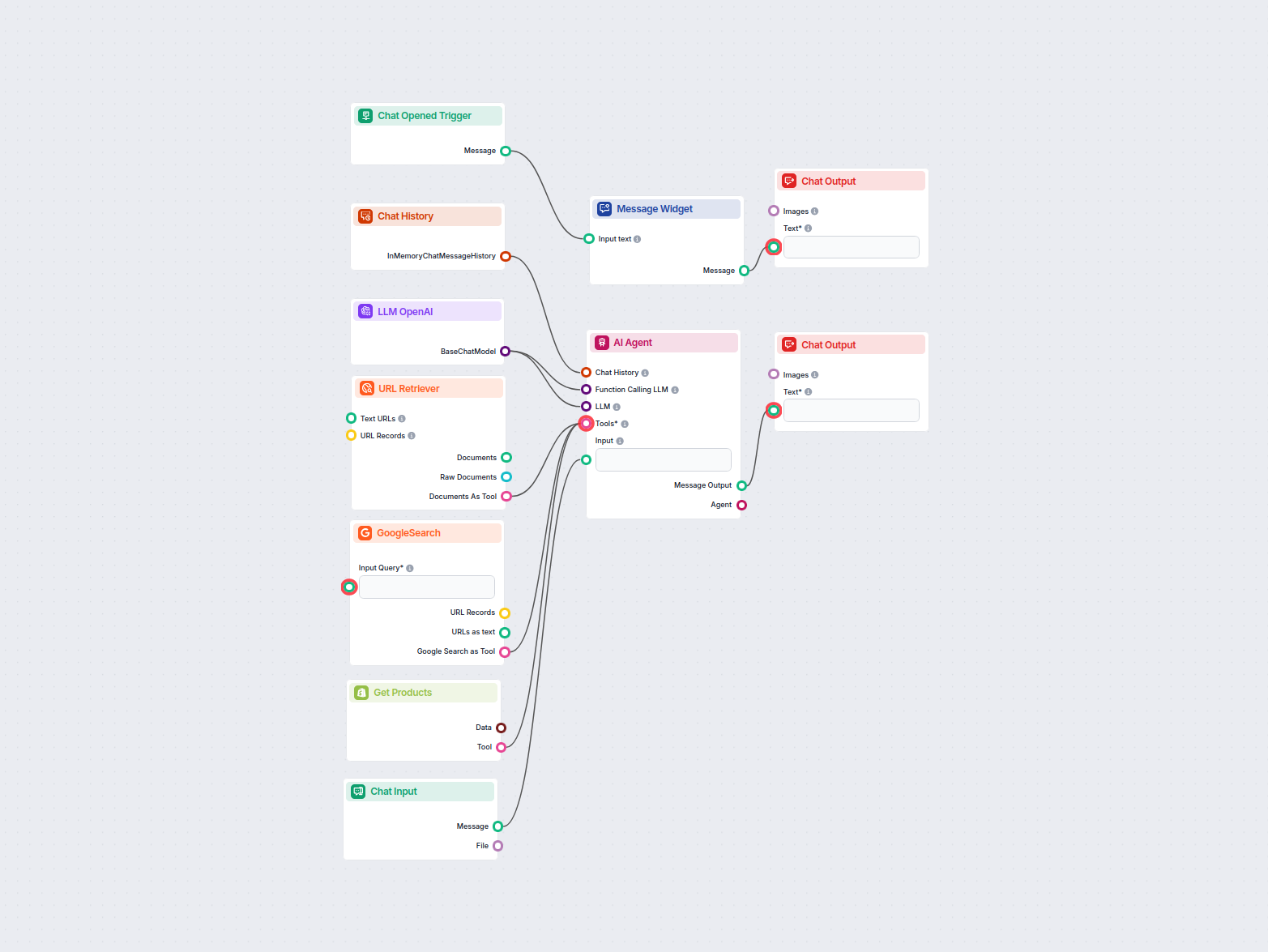
Shopify Product Pricing Research AI Agent
This AI-powered workflow helps Shopify merchants analyze competitor products, research market trends, and generate optimized pricing strategies. By combining Sh...
4 min read
Learn how FlowHunt’s AI-powered Shopify integration automatically analyzes your product prices against competitors, helping you optimize pricing strategy and stay competitive in the market.
In today’s highly competitive e-commerce landscape, pricing strategy is one of the most critical factors determining your success as a Shopify merchant. Setting prices too high can drive customers away to competitors, while pricing too low erodes your profit margins and devalues your brand. The challenge lies in finding that optimal price point that balances competitiveness with profitability. Fortunately, with the rise of artificial intelligence and automation tools, merchants no longer need to manually research competitor prices or spend hours analyzing market data. FlowHunt’s new Shopify integration introduces an intelligent pricing analyst that automates this entire process, allowing you to make data-driven pricing decisions in minutes rather than days. In this comprehensive guide, we’ll explore how this AI-powered tool works, why competitive pricing analysis matters for your business, and how you can leverage it to optimize your Shopify store’s pricing strategy.
Competitive pricing is the practice of setting product prices based on what competitors are charging for similar or identical products. Unlike cost-plus pricing, which simply adds a markup to your product cost, or value-based pricing, which focuses on perceived customer value, competitive pricing anchors your strategy to the broader market landscape. This approach is particularly important in e-commerce, where price transparency is unprecedented. Customers can instantly compare prices across dozens of retailers with a single Google search, making it nearly impossible to maintain significantly higher prices without a compelling reason. Understanding where your prices stand relative to competitors provides crucial context for your business decisions. Are you positioned as a premium retailer, a value player, or somewhere in the middle? Are you aligned with official retail pricing, or are you significantly above or below market rates? These questions directly impact your customer acquisition costs, conversion rates, and overall profitability. The challenge, however, is that manually researching competitor prices is time-consuming and error-prone. Prices change frequently, new competitors emerge, and tracking multiple products across multiple retailers quickly becomes overwhelming. This is where AI-powered automation becomes invaluable, enabling merchants to maintain competitive pricing intelligence without the manual overhead.

Start your free trial today and see results within days.
For Shopify store owners, competitive pricing analysis is not just a nice-to-have feature—it’s a strategic necessity. The Shopify ecosystem hosts millions of stores, many selling identical or similar products. Without a clear understanding of how your prices compare to competitors, you’re essentially flying blind. Overpricing your products can result in lost sales, as price-conscious customers gravitate toward cheaper alternatives. Underpricing, conversely, leaves money on the table and can damage your brand perception by suggesting lower quality. Competitive pricing analysis helps you navigate these challenges by providing real-time market intelligence. It answers critical questions: Are you priced competitively? Are there opportunities to increase prices without losing customers? Are you being undercut by competitors? Should you adjust your pricing strategy for specific product variants? Beyond individual pricing decisions, competitive analysis informs broader business strategy. It helps you identify market gaps, understand customer expectations, and position your brand effectively. For example, if you discover that your products are consistently priced 20% above competitors, you might decide this is intentional (premium positioning) or a problem that needs correction. Either way, you’re making an informed decision rather than guessing. Additionally, competitive pricing analysis supports inventory management and product selection decisions. If a product is consistently overpriced relative to the market, it might be worth discontinuing or repositioning. Conversely, products that are underpriced relative to demand might represent untapped profit opportunities. In the fast-moving world of e-commerce, this kind of intelligence is invaluable.
FlowHunt has revolutionized how Shopify merchants approach competitive pricing by introducing a seamless integration that automates the entire market research process. The integration is designed with simplicity and efficiency in mind, requiring just a few clicks to connect your Shopify store and begin analyzing your pricing. The setup process is straightforward: navigate to the FlowHunt integrations tab, locate Shopify, and click integrate. You’ll be redirected to the Shopify app store, where you can install the FlowHunt application. Once installed, you’ll receive confirmation that Shopify has been successfully integrated into your FlowHunt account. From that point forward, you have access to all of FlowHunt’s Shopify-specific flows, including the powerful pricing analyst. What makes this integration particularly valuable is that it doesn’t require any technical knowledge or complex configuration. Unlike some automation tools that demand API keys, webhook setup, or custom coding, FlowHunt’s Shopify integration works out of the box. This democratizes access to sophisticated market research capabilities, making them available to merchants of all technical skill levels. The integration also maintains security and compliance, as it operates through official Shopify app channels and respects all data privacy standards. Once integrated, your Shopify store becomes a data source for FlowHunt’s AI-powered analysis tools, enabling you to leverage your product catalog for competitive intelligence and strategic decision-making.
Get latest tips, trends, and deals for free.
The pricing analyst flow is the crown jewel of FlowHunt’s Shopify integration, and understanding how it works is key to leveraging its full potential. When you activate the pricing analyst flow, you’re essentially deploying an AI agent that performs comprehensive market research on your products. Here’s how the process unfolds: First, you select a product from your Shopify store. You can do this by searching for the product by name or by pasting the product link directly. FlowHunt’s system uses product IDs to ensure accuracy and speed, so whether you search or paste a link, the flow quickly identifies and retrieves your product data. Once the product is selected, the flow begins gathering comprehensive information from your Shopify listing. This includes the product title, description, current price, available variants (such as different colors or storage capacities), inventory status, and any other relevant product attributes. For example, if you’re selling an iPhone 16 with multiple color and storage options, the flow captures all of this granular data. This foundational step is crucial because it ensures that the competitive analysis is based on accurate, current information about what you’re actually selling.
After gathering your product data, the flow transitions to the market research phase. This is where FlowHunt’s AI capabilities truly shine. The system conducts real-time research across multiple data sources, including official retailer websites, major retailers like Best Buy, and other market players. For products like the iPhone 16, this means checking Apple’s official pricing, Best Buy’s pricing, and other authorized retailers to understand the current market landscape. The AI doesn’t just collect prices—it analyzes them contextually. It understands product variants, storage capacities, colors, and other differentiators, ensuring that price comparisons are apples-to-apples rather than apples-to-oranges. This level of sophistication is what separates FlowHunt’s pricing analyst from simple price-checking tools.
Once the market research is complete, the flow generates a comprehensive analysis report. This report includes your current Shopify pricing, official retail pricing from manufacturers, competitor pricing from major retailers, and detailed market insights. The report clearly highlights whether your pricing is aligned with the market, significantly above it (overpriced), or below it (underpriced). It also provides specific competitive recommendations, suggesting a price range that would position you competitively while accounting for market conditions. For instance, if you’re selling an iPhone 16 at €999 when Apple’s official price is $699, the report will flag this as significantly overpriced and recommend a competitive price range of $699-$729. This kind of actionable intelligence enables you to make informed pricing decisions quickly.
To illustrate how the pricing analyst works in practice, let’s examine a real-world example: analyzing iPhone 16 pricing on a Shopify store. Imagine you have an iPhone 16 listed in your store with multiple color options (black, white, pink, teal, and ultramarine) and a single storage capacity (128GB), all priced at €999. At first glance, this might seem like a reasonable price point, but without competitive context, you’re essentially guessing. When you run the pricing analyst flow on this product, here’s what happens: The flow retrieves your Shopify listing, confirming that you have five color variants of the iPhone 16 128GB, all priced at €999. It notes that the product is active and available for sale. Next, it conducts market research on Apple’s official pricing. The analysis reveals that Apple’s official US retail price for the iPhone 16 128GB is $699, with the iPhone 16 Plus starting at $799 and the 256GB variant priced at $929. The flow also checks major retailers like Best Buy and confirms that they align with Apple’s official pricing structure. This is a critical finding: your €999 price point is significantly higher than the official MSRP.
The flow then generates a detailed market insights section, clearly stating: “The Shopify listing of €999 for the 128GB iPhone 16 is significantly higher than Apple’s own retail price of $699.” This isn’t a vague observation—it’s a concrete, data-backed finding that should prompt action. The flow also notes that you don’t have 16GB Plus or 256GB variants listed, so it marks those as “not listed” in the comparison. Finally, the flow provides a competitive recommendation: a price range of $699-$729 for the 128GB variant. This recommendation is based on official retail pricing and market conditions, giving you a clear target to work toward. Armed with this information, you can make an informed decision: Do you want to reduce your price to be more competitive? Do you want to maintain your premium positioning and accept lower sales volume? Do you want to add higher-capacity variants to your product line? Whatever you decide, you’re now making a strategic choice based on data rather than assumption.
The pricing analyst flow delivers numerous benefits that extend far beyond simple price comparison. First and foremost, it saves time. Manually researching competitor prices for even a handful of products can consume hours of work. With FlowHunt’s automation, you can analyze dozens of products in the time it would take to manually research one. This efficiency gain is particularly valuable for merchants with large product catalogs, where manual price monitoring would be practically impossible. Second, it improves accuracy. Human researchers are prone to errors—they might miss a competitor, misread a price, or fail to account for product variants. AI-powered analysis eliminates these human errors, ensuring that your pricing decisions are based on complete and accurate market data. Third, it enables data-driven decision-making. Rather than relying on intuition or guesswork, you can base your pricing strategy on concrete market intelligence. This leads to better business outcomes, including improved conversion rates, higher average order values, and better overall profitability. Fourth, it provides competitive advantage. In fast-moving markets, the merchants who can respond quickly to pricing changes have a significant edge. FlowHunt’s real-time analysis enables you to stay ahead of competitors and adjust your pricing strategy proactively rather than reactively. Fifth, it supports strategic planning. By understanding how your pricing compares across your entire product catalog, you can identify patterns and opportunities. Maybe certain product categories are consistently overpriced, or maybe you have untapped profit potential in specific segments. This kind of strategic insight is invaluable for long-term business planning.
To maximize the value of FlowHunt’s pricing analyst, it’s important to integrate it into your regular business workflow. Rather than treating it as a one-time analysis tool, consider using it as an ongoing part of your pricing management process. One effective approach is to conduct quarterly pricing reviews, where you analyze your top-selling products and key product categories. This ensures that your pricing remains competitive as market conditions change. Another approach is to analyze new products before launching them, ensuring that you’re pricing them competitively from day one. You might also use the pricing analyst when you’re considering a price change, to validate that your new price point is competitive and strategically sound. Additionally, consider using the tool when you’re evaluating new product categories or expanding into new markets. Understanding how your potential products are priced in the market can inform your sourcing decisions and help you identify profitable opportunities. The flexibility of FlowHunt’s pricing analyst means you can adapt it to your specific business needs and workflow. Whether you’re a small merchant managing a handful of products or a large operation with thousands of SKUs, the tool can be scaled to fit your requirements.
Experience how FlowHunt automates your AI content and SEO workflows — from research and content generation to publishing and analytics — all in one place.
With access to comprehensive competitive pricing data through FlowHunt, you can implement more sophisticated pricing strategies that go beyond simple price matching. One such strategy is dynamic pricing, where you adjust prices based on market conditions, demand, and competitive activity. For example, if you notice that competitors are reducing prices on a particular product, you might choose to match or undercut them to maintain market share. Conversely, if you’re the only retailer offering a product, you might have room to increase prices. Another advanced strategy is segmented pricing, where you price products differently based on customer segments or sales channels. For instance, you might price products more aggressively on your direct Shopify store to drive traffic, while maintaining higher prices on marketplace channels where you have less control. FlowHunt’s pricing analysis can help you identify which segments are most price-sensitive and where you have pricing power. Psychological pricing is another technique that benefits from market intelligence. Understanding how competitors price their products can inform your own psychological pricing decisions. For example, if competitors are using $9.99 price points, you might choose to use $9.95 to appear slightly cheaper while maintaining similar margins. Bundle pricing is yet another strategy where you combine multiple products at a discounted price. By analyzing the individual prices of products you want to bundle, you can ensure that your bundle pricing is attractive to customers while still maintaining healthy margins. FlowHunt’s pricing analyst provides the market context you need to make these strategic decisions confidently.
Even with access to competitive pricing data, merchants often face challenges in implementing effective pricing strategies. One common challenge is the temptation to engage in a race to the bottom, where you continuously lower prices to match competitors. While this might increase sales volume in the short term, it erodes margins and can damage your brand positioning. FlowHunt’s analysis helps you avoid this trap by providing context about whether you’re truly overpriced or simply positioned differently in the market. Another challenge is the complexity of managing prices across multiple variants and product categories. A product might have dozens of variants, each with different costs and market prices. Manually managing pricing for all these variants is error-prone and time-consuming. FlowHunt’s automation handles this complexity, analyzing each variant individually and providing recommendations for each. A third challenge is the lag between market changes and your pricing response. By the time you manually research competitor prices and update your own, the market may have shifted again. FlowHunt’s real-time analysis and automated recommendations help you stay current with market conditions. A fourth challenge is the lack of visibility into your overall pricing strategy. Without comprehensive analysis, you might not realize that certain product categories are consistently overpriced or underpriced. FlowHunt’s analysis provides this visibility, enabling you to identify and correct strategic pricing issues. Finally, many merchants struggle with the confidence to make pricing changes. Will reducing prices hurt your brand? Will increasing prices drive customers away? FlowHunt’s data-backed recommendations provide the confidence you need to make these decisions, knowing that they’re based on market intelligence rather than guesswork.
In the competitive world of e-commerce, pricing strategy is a critical lever for success. FlowHunt’s AI-powered Shopify integration transforms pricing analysis from a time-consuming manual process into an automated, data-driven capability. By providing real-time competitive intelligence, detailed market insights, and actionable pricing recommendations, the pricing analyst flow empowers Shopify merchants to make smarter pricing decisions. Whether you’re looking to optimize margins, improve competitiveness, or simply understand where your pricing stands relative to the market, FlowHunt delivers the intelligence you need. The integration is simple to set up, requires no technical expertise, and scales to fit businesses of any size. As e-commerce continues to evolve and competition intensifies, tools like FlowHunt’s pricing analyst will become increasingly essential for merchants who want to stay ahead. By leveraging AI-powered market research and automation, you can focus on what matters most—growing your business—while FlowHunt handles the complex work of competitive pricing analysis.
FlowHunt's pricing analyst integrates directly with your Shopify store through a simple installation process. Once connected, it automatically gathers your product information including descriptions, prices, and inventory details, then conducts real-time market research to compare your pricing against competitors and official retail prices.
Yes, you can analyze any product in your Shopify store. You can either search by product name or paste the product link directly. The flow will automatically fetch your product data and conduct competitive pricing analysis for each item.
FlowHunt provides competitive pricing recommendations based on official retailer data, major retailers like Best Buy, and market insights. It shows you how your pricing compares to MSRP and competitor pricing, helping you identify if you're overpriced or underpriced relative to the market.
FlowHunt uses the latest available data from official retailers and major market players to provide current pricing insights. The analysis is conducted in real-time when you run the pricing analyst flow, ensuring you have the most up-to-date competitive intelligence.
Arshia is an AI Workflow Engineer at FlowHunt. With a background in computer science and a passion for AI, he specializes in creating efficient workflows that integrate AI tools into everyday tasks, enhancing productivity and creativity.

Discover how FlowHunt's intelligent pricing analyst helps you stay competitive and maximize revenue with data-driven pricing decisions.
This AI-powered workflow helps Shopify merchants analyze competitor products, research market trends, and generate optimized pricing strategies. By combining Sh...

Learn how to create an AI-powered Shopify manager using FlowHunt's MCP server integration to automate product management, orders, customers, and inventory contr...

Learn how to enhance your Shopify product descriptions using AI with FlowHunt's powerful integration. Automate description generation and updates in minutes.