

Where Can I Get the Leading AI Chatbot Builder?
Discover the top AI chatbot builders in 2025. Compare FlowHunt, Botpress, Chatbase, and other leading platforms with detailed features, pricing, and use cases.
8 min read
Discover which AI chatbot offers the best memory capabilities in 2025. Compare Claude AI, ChatGPT, and Gemini’s persistent memory features, context retention, and enterprise solutions.
Claude AI by Anthropic leads in memory capabilities with robust persistent memory for Team and Enterprise users, remembering project details, preferences, and work context across sessions. ChatGPT offers growing memory options with project organization, while Gemini provides conversation recall integrated with Google Workspace. Claude's memory is specifically designed for professional environments with granular privacy controls and editable memory summaries.
Artificial intelligence chatbots have evolved dramatically from simple question-answering tools to sophisticated assistants capable of maintaining context across multiple conversations. The ability to remember previous interactions, user preferences, and project details represents one of the most significant advancements in conversational AI technology. Memory functionality transforms chatbots from stateless tools into intelligent partners that understand your work patterns, preferences, and ongoing projects without requiring constant context resets. This capability dramatically improves user experience, reduces repetitive explanations, and enables more productive workflows across organizations.
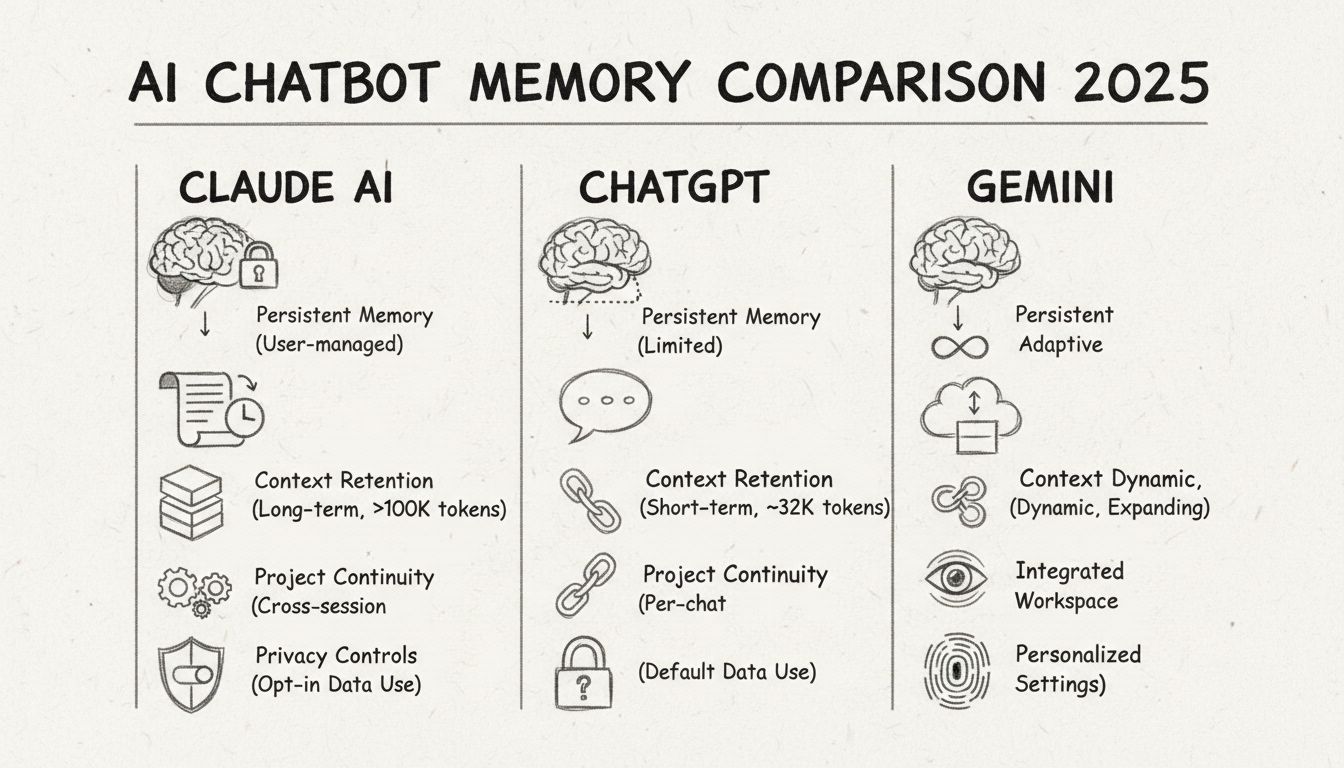
Claude AI by Anthropic has emerged as the leading AI chatbot for memory capabilities in 2025, particularly following the September 2025 announcement of persistent memory features for Team and Enterprise users. Claude’s memory system is specifically engineered for professional environments where context continuity directly impacts productivity and decision-making quality. The platform remembers your team’s processes, client needs, project details, and organizational priorities without requiring users to re-explain context in every conversation. This represents a fundamental shift from traditional chatbots that treat each conversation as an isolated interaction.
The memory architecture in Claude operates across multiple dimensions to provide comprehensive context retention. Sales teams maintain client context across entire deal cycles, allowing the AI to recall previous conversations, negotiation points, and customer preferences without manual input. Product teams preserve specifications across development sprints, enabling seamless handoffs and reducing the cognitive load of context switching. Executive teams track strategic initiatives and organizational priorities, receiving proactive insights and recommendations based on accumulated knowledge of company goals and constraints. The system automatically learns from interactions, building increasingly accurate mental models of how your organization operates and what matters most to your team.
Claude’s memory implementation includes sophisticated privacy controls that address enterprise security concerns. Organizations can disable memory features entirely if required by compliance policies, manage what information Claude should remember, and create separate memory spaces for different projects to maintain confidentiality. The Incognito chat mode allows users to have conversations that don’t contribute to persistent memory, providing flexibility for sensitive discussions. Memory summaries provide transparency, allowing users to view, edit, and delete stored information at any time. This granular control approach reflects Anthropic’s commitment to balancing productivity benefits with privacy protection.
OpenAI’s ChatGPT has implemented memory features that allow the platform to retain user preferences and conversation history across sessions, though the implementation differs from Claude’s approach. ChatGPT’s memory system enables users to teach the AI about their preferences, interests, and ongoing projects, with the platform recalling these details in future conversations. The system supports project-based organization of conversation history, allowing users to group related discussions and maintain context for complex, multi-phase work. ChatGPT Enterprise users benefit from priority access and high throughput, with generous usage limits that support intensive workflows.
The context window available to ChatGPT reaches approximately 128,000 tokens, providing substantial capacity for processing large documents and maintaining conversation history. This technical capability enables the platform to handle complex research tasks, code analysis, and document summarization without losing important context. ChatGPT’s multimodal capabilities include text, images, code, and voice inputs, making it versatile for diverse use cases. The platform offers custom GPTs and API access, allowing organizations to build specialized versions tailored to specific workflows. However, ChatGPT’s memory features are less mature than Claude’s persistent memory system, and the platform continues to evolve its memory capabilities to match enterprise requirements.
Google’s Gemini Enterprise takes a different approach to memory by deeply integrating with Google Workspace applications. Rather than maintaining a separate memory system, Gemini leverages existing data within Gmail, Google Docs, Google Sheets, Google Slides, and Google Meet to provide contextual assistance. This integration allows Gemini to understand organizational context by accessing relevant documents, email threads, and meeting notes. The platform can recall information from these sources and provide recommendations based on accumulated knowledge of your work patterns and organizational priorities.
Gemini’s context window extends up to 1 million tokens for Pro and Ultra plans, providing exceptional capacity for processing large datasets and maintaining extensive conversation history. This technical advantage enables sophisticated analysis of complex documents and comprehensive research tasks. The platform offers deep integration within Google Workspace, with Gemini Code Assist available in IDEs and Google Cloud environments. However, Gemini’s memory capabilities are primarily conversation recall rather than persistent memory in the traditional sense. The platform excels at understanding context from your existing Google Workspace data but doesn’t maintain independent memory of preferences and project details in the same way Claude does.
| Feature | Claude AI | ChatGPT | Gemini Enterprise |
|---|---|---|---|
| Persistent Memory | Robust memory for Team/Enterprise; remembers preferences and past work; editable and persistent | Growing memory options; configurable preferences; organize conversation history by project | Conversation recall; context flows across Gmail, Docs, Sheets, Slides and Meet |
| Project Continuity | Separate memory for each project; maintains confidentiality within projects | Project-based conversation organization | Deep Google Workspace integration for context |
| Privacy Controls | Enterprise security; data not used for training; fine-grained controls; Incognito mode | SOC-2; encryption in transit and at rest; customer data not used for training | Workspace enterprise policies; no data used for ads; broad compliance certifications |
| Context Window | Up to 1M tokens in enterprise use cases | Up to 128k tokens | Up to 1M tokens for Pro/Ultra plans |
| Memory Editing | Users can view, edit, and delete stored information | Limited editing capabilities | Limited independent memory editing |
| Team Controls | Admins can manage memory settings; disable for entire organization | Enterprise admin controls available | Workspace-level policy controls |
| Multimodality | Text and image inputs; strong with large documents | Text, images, code, voice | Text, images, code; deep in-app integration |
| Enterprise Deployment | AWS Bedrock and Google Cloud options | Priority access and high throughput | Native Google Cloud integration |
Organizations implementing AI chatbots with advanced memory capabilities experience measurable productivity improvements across multiple dimensions. Faster workflows emerge as employees no longer need to re-explain goals, project details, or organizational constraints in every interaction. The AI assistant maintains continuity across conversations, reducing context-switching overhead and enabling employees to focus on high-value decision-making rather than information transfer. Personalized support adapts to individual roles and preferences, reducing onboarding time for new team members and enabling more effective knowledge transfer across the organization.
Proactive insights represent another significant advantage of persistent memory systems. Advanced chatbots can identify patterns in your work, detect emerging trends, and provide strategic recommendations based on accumulated knowledge of your priorities and constraints. Sales teams receive alerts about deal progression patterns, product teams identify specification conflicts before they become expensive problems, and executive teams gain early warning of strategic risks. This proactive capability transforms the chatbot from a reactive tool into a strategic partner that actively contributes to organizational success.
Organizations evaluating AI chatbots with memory capabilities should assess several critical factors beyond raw memory capacity. Security and compliance requirements vary significantly across industries, with regulated sectors requiring strict data governance and audit trails. The ability to disable memory features, maintain separate memory spaces for different projects, and provide granular access controls becomes essential in these environments. Data residency requirements may necessitate deployment on specific cloud platforms, making Claude’s availability on AWS Bedrock and Google Cloud particularly valuable for multinational organizations.
Integration capabilities determine whether memory systems can effectively leverage existing organizational data and workflows. Claude’s integration with Google Workspace enables the platform to access relevant documents and context, while ChatGPT’s API-first approach provides flexibility for custom integrations. Gemini’s native integration with Google Workspace makes it particularly attractive for organizations already invested in Google’s ecosystem. The choice between these platforms should reflect your organization’s existing technology stack and integration requirements.
Organizations requiring specialized memory capabilities beyond standard chatbot offerings can build custom solutions using platforms like FlowHunt. FlowHunt’s AI automation platform enables teams to create intelligent chatbots with persistent memory capabilities using a visual, no-code builder. The platform supports Knowledge Sources that provide AI access to real information from documents, websites, and FAQs, enabling context-aware responses grounded in your organization’s specific data. Flow Components serve as building blocks for creating sophisticated workflows that maintain state and context across multiple interactions.
FlowHunt’s AI Agents can perform real tasks and maintain memory of previous actions, enabling autonomous systems that learn from experience and improve over time. The platform integrates with your favorite tools through webhooks and custom APIs, allowing memory systems to connect with CRM platforms, communication tools, and business applications. Teams can deploy user-friendly chatbots that remember customer preferences, interaction history, and support tickets, enabling personalized service at scale. The visual builder makes it accessible to non-technical team members while providing advanced capabilities for developers who need sophisticated memory management and workflow automation.
The trajectory of AI chatbot memory capabilities points toward increasingly sophisticated context retention and proactive intelligence. As these systems mature, we can expect more granular privacy controls, better integration with enterprise data sources, and improved ability to distinguish between different types of information that should be remembered. The competitive landscape will likely drive rapid innovation, with platforms competing on memory accuracy, privacy protection, and integration capabilities. Organizations that implement advanced memory systems today position themselves to leverage these capabilities as they continue to evolve and mature.
The distinction between different memory approaches—persistent memory systems like Claude’s versus workspace integration like Gemini’s—will likely persist, with organizations choosing based on their specific requirements and existing technology investments. Hybrid approaches that combine persistent memory with workspace integration may emerge as the optimal solution for many enterprises. The key competitive advantage will belong to platforms that balance powerful memory capabilities with robust privacy controls, seamless integration, and transparent user control over stored information.
FlowHunt's AI Chatbot platform lets you create intelligent chatbots with persistent memory capabilities. Deploy context-aware assistants that remember user preferences, project details, and conversation history—all without coding. Integrate with your favorite tools and automate customer interactions at scale.
Discover the top AI chatbot builders in 2025. Compare FlowHunt, Botpress, Chatbase, and other leading platforms with detailed features, pricing, and use cases.
Discover which AI chatbot is best for your needs. Compare ChatGPT, Claude, Google Gemini, Perplexity, and FlowHunt with detailed analysis of features, pricing, ...
Discover the top AI chat apps of 2024, with in-depth analysis of their features, use cases, pros, and cons. Find the right AI chatbot for your needs, whether fo...