
How to Build an AI Chatbot: Complete Step-by-Step Guide
Learn how to build an AI chatbot from scratch with our comprehensive guide. Discover the best tools, frameworks, and step-by-step process to create intelligent ...
11 min read
Discover how AI chatbots process natural language, understand user intent, and generate intelligent responses. Learn NLP, machine learning, and chatbot architecture with technical depth.
AI chatbots work by processing natural language input through NLP algorithms, recognizing user intent, accessing knowledge bases, and generating contextually relevant responses using machine learning models. Modern chatbots combine tokenization, entity extraction, dialog management, and neural networks to simulate human-like conversations at scale.
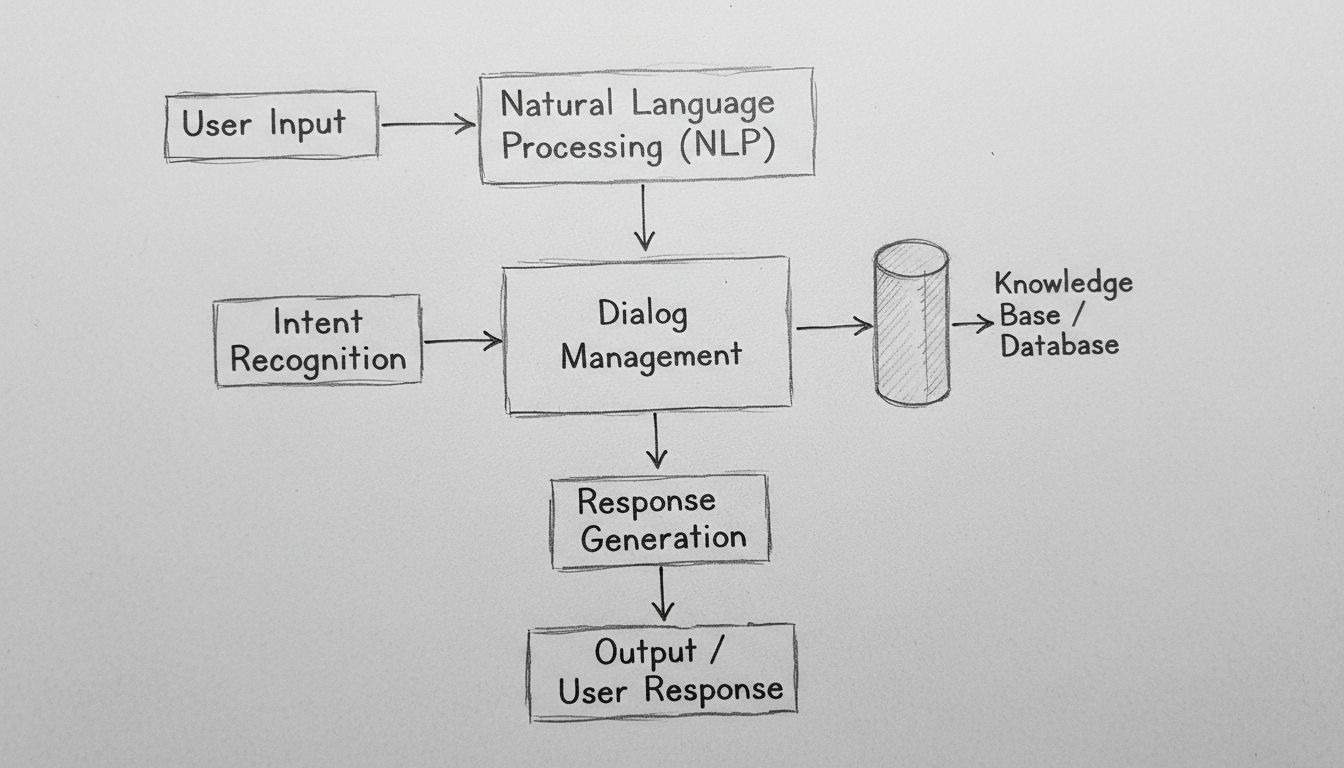
AI chatbots represent a sophisticated convergence of natural language processing, machine learning, and dialogue management systems working in concert to simulate human conversation. When you interact with a modern AI chatbot, you’re engaging with a multi-layered technological system that processes your input through several distinct stages before delivering a response. The architecture underlying these systems has evolved dramatically from simple rule-based decision trees to complex neural networks capable of understanding context, nuance, and even sentiment. Understanding how these systems work requires examining each component of the pipeline and recognizing how they interact to create seamless conversational experiences.
The journey of any user message through an AI chatbot begins with input processing, a critical phase that transforms raw text into structured data the system can analyze. When you type a message like “I need to reset my password,” the chatbot doesn’t immediately understand your intent—instead, it must first deconstruct your message into manageable components. This process, called tokenization, breaks your sentence into individual words or meaningful units called tokens. The system converts “I need to reset my password” into tokens: [“I”, “need”, “to”, “reset”, “my”, “password”]. This seemingly simple step is foundational because it allows the chatbot to analyze each linguistic element independently while maintaining awareness of their relationships within the sentence structure.
Following tokenization, the system applies normalization, which standardizes the text by converting it to lowercase, removing punctuation, and correcting common spelling variations. This ensures that “Password Reset,” “password reset,” and “pasword reset” are all recognized as referring to the same concept. The chatbot also removes stop words—common words like “the,” “is,” “and,” and “to” that carry minimal semantic meaning. By filtering these out, the system focuses computational resources on the words that actually convey meaning. Additionally, the system performs part-of-speech tagging, identifying whether each word functions as a noun, verb, adjective, or other grammatical category. This grammatical understanding helps the chatbot recognize that “reset” is an action verb in your message, which is crucial for determining what you actually want to accomplish.
Natural Language Processing (NLP) represents the technological foundation enabling chatbots to comprehend human language at a semantic level. NLP encompasses multiple interconnected techniques that work together to extract meaning from text. Named Entity Recognition (NER) identifies specific entities within your message—proper nouns, dates, locations, product names, and other significant information. In the password reset example, NER would identify “password” as a system entity relevant to the chatbot’s knowledge base. This capability becomes even more powerful in complex scenarios: if you write “I want to book a flight from New York to London on December 15th,” NER extracts the origin city, destination city, and date—all critical information for fulfilling your request.
Sentiment analysis represents another crucial NLP component, enabling chatbots to detect the emotional tone underlying your message. A customer saying “I’ve been waiting for three hours and still haven’t received my order” expresses frustration, which the chatbot should recognize to adjust its response tone and prioritize the issue appropriately. Modern sentiment analysis uses machine learning models trained on thousands of examples to classify text as positive, negative, or neutral, and increasingly, to detect more nuanced emotions like frustration, confusion, or satisfaction. This emotional intelligence allows chatbots to respond with appropriate empathy and urgency, significantly improving customer satisfaction metrics.
After processing the raw text, the chatbot must determine what the user actually wants—their intent. Intent recognition represents one of the most critical functions in chatbot architecture because it bridges the gap between what users say and what they mean to accomplish. The system uses machine learning classifiers trained on thousands of example conversations to map user utterances to predefined intents. For instance, the phrases “I forgot my password,” “How do I reset my password?”, “I can’t log in,” and “My account is locked” might all map to the same “password_reset” intent, even though they’re phrased differently.
Simultaneously, the system performs entity extraction, identifying specific data points within the user’s message that are relevant to fulfilling their request. If a customer says “I want to upgrade my plan to the premium tier,” the system extracts two key entities: the action (“upgrade”) and the target (“premium tier”). These extracted entities become parameters that guide the chatbot’s response generation. Advanced chatbots use dependency parsing to understand the grammatical relationships between words, recognizing which nouns are subjects, which are objects, and how they relate to verbs and modifiers. This deeper syntactic understanding enables the chatbot to handle complex, multi-clause sentences and ambiguous phrasing that would confuse simpler systems.
Dialog management represents the “brain” of the chatbot, responsible for maintaining conversation context and determining appropriate responses. Unlike simple lookup systems, sophisticated dialog managers maintain a conversation state that tracks what has been discussed, what information has been gathered, and what the user’s current goal is. This context awareness enables natural, flowing conversations where the chatbot remembers previous exchanges and can reference them appropriately. If you ask “What’s the weather in London?” and then follow up with “What about tomorrow?”, the dialog manager understands that “tomorrow” refers to London’s weather forecast, not some other location.
The dialog manager implements context management by storing relevant information in a structured format throughout the conversation. This might include the user’s account information, their previous requests, their preferences, and the current conversation topic. Advanced systems use state machines or hierarchical task networks to model conversation flows, defining which states are reachable from which other states and what transitions are valid. For example, a customer service chatbot might have states for “greeting,” “issue_identification,” “troubleshooting,” “escalation,” and “resolution.” The dialog manager ensures the conversation progresses logically through these states rather than jumping randomly between them.
Modern AI chatbots don’t generate responses purely from their training data—they access knowledge bases containing current, accurate information specific to the organization. This integration is critical for maintaining accuracy and relevance. When a customer asks “What’s my account balance?”, the chatbot must query the actual banking system to retrieve the current balance rather than generating a plausible-sounding number. Similarly, when asked “What are your store hours?”, the chatbot accesses the business information database to provide accurate, up-to-date hours rather than relying on potentially outdated training data.
Retrieval-Augmented Generation (RAG) represents a sophisticated approach to knowledge integration that has become increasingly important in 2025. RAG systems first retrieve relevant documents or information from a knowledge base based on the user’s query, then use this retrieved information to generate a contextually appropriate response. This two-stage process dramatically improves accuracy compared to pure generation approaches. For instance, if a customer asks about a specific product feature, the RAG system retrieves the product documentation, extracts the relevant section, and generates a response grounded in that actual documentation rather than relying on potentially hallucinated information. This approach has proven particularly valuable in enterprise environments where accuracy and compliance are paramount.
After understanding the user’s intent and gathering necessary information, the chatbot must generate an appropriate response. Response generation can follow several different approaches, each with distinct advantages and limitations. Template-based generation uses predefined response templates with variable slots that get filled in with specific information. For example, a template might be “Your order #[ORDER_ID] will arrive on [DELIVERY_DATE].” This approach is highly reliable and predictable but limited in flexibility and naturalness.
Rule-based generation applies specific linguistic rules to construct responses based on the identified intent and extracted entities. These rules might specify that for a “password_reset” intent, the response should include a confirmation message, a link to the reset page, and instructions for the next steps. This approach offers more flexibility than templates while maintaining reliability, though it requires extensive rule engineering for complex scenarios.
Neural network-based generation, powered by large language models (LLMs), represents the cutting edge of response generation technology. These systems use deep learning architectures like Transformers to generate novel, contextually appropriate responses that sound remarkably human-like. Modern LLMs are trained on billions of tokens of text data, learning statistical patterns about how language works and how concepts relate to each other. When generating a response, these models predict the most likely next word given all previous words, repeating this process to construct complete sentences. The advantage of neural generation is its flexibility and naturalness; the disadvantage is that these systems can occasionally “hallucinate”—generating plausible-sounding but factually incorrect information.
Machine learning represents the mechanism through which chatbots improve over time. Rather than being static systems with fixed rules, modern chatbots learn from every interaction, gradually refining their understanding of language patterns and user intents. Supervised learning involves training the chatbot on labeled examples where humans have annotated the correct intent and entities for thousands of user messages. The machine learning algorithm learns to recognize patterns that distinguish one intent from another, gradually building a model that can classify new, unseen messages with high accuracy.
Reinforcement learning enables chatbots to optimize their responses based on user feedback. When a user indicates satisfaction with a response (through explicit feedback or implicit signals like continuing the conversation), the system reinforces the patterns that led to that response. Conversely, when users express dissatisfaction or abandon the conversation, the system learns to avoid similar patterns in the future. This feedback loop creates a virtuous cycle where chatbot performance continuously improves. Advanced systems implement human-in-the-loop learning, where human agents review challenging conversations and provide corrections that the system learns from, dramatically accelerating improvement compared to purely automated learning.
Large Language Models (LLMs) have fundamentally transformed chatbot capabilities since 2023. These models, trained on hundreds of billions of tokens of text data, develop sophisticated understanding of language, context, and domain-specific knowledge. Models like GPT-4, Claude, and Gemini can engage in nuanced conversations, understand complex instructions, and generate coherent, contextually appropriate responses across diverse topics. The power of LLMs comes from their transformer architecture, which uses attention mechanisms to understand relationships between distant words in a sentence, enabling the model to maintain context across long conversations.
However, LLMs have limitations that organizations must address. They can hallucinate—confidently generating false information that sounds plausible. They may struggle with very recent information not present in their training data. They can exhibit biases present in their training data. To address these limitations, organizations increasingly use fine-tuning to adapt general-purpose LLMs to specific domains, and prompt engineering to guide models toward desired behavior. FlowHunt’s approach to chatbot building leverages these advanced models while providing guardrails and knowledge source integration to ensure accuracy and reliability.
| Aspect | Rule-Based Chatbots | AI-Powered Chatbots | LLM-Based Chatbots |
|---|---|---|---|
| Technology | Decision trees, pattern matching | NLP, ML algorithms, intent recognition | Large language models, transformers |
| Flexibility | Limited to predefined rules | Adapts to variations in phrasing | Highly flexible, handles novel inputs |
| Accuracy | High for defined scenarios | Good with proper training | Excellent but requires guardrails |
| Learning | No learning capability | Learns from interactions | Learns from fine-tuning and feedback |
| Hallucination Risk | None | Minimal | Requires mitigation strategies |
| Implementation Time | Fast | Moderate | Fast with platforms like FlowHunt |
| Maintenance | High (rule updates needed) | Moderate | Moderate (model updates, monitoring) |
| Cost | Low | Moderate | Moderate to high |
| Best Use Cases | Simple FAQs, basic routing | Customer service, lead qualification | Complex reasoning, content generation |
Modern chatbots leverage Transformer architecture, a neural network design that revolutionized natural language processing. Transformers use attention mechanisms that enable the model to focus on relevant parts of the input when generating each word of the output. When processing “The bank executive was concerned about the river bank’s erosion,” the attention mechanism helps the model understand that the first “bank” refers to a financial institution while the second refers to a riverbank, based on context. This contextual understanding is far superior to older approaches that processed text sequentially without this kind of contextual awareness.
Multi-head attention extends this concept by allowing the model to attend to different aspects of the input simultaneously. One attention head might focus on grammatical relationships, another on semantic relationships, and another on discourse structure. This parallel processing of different linguistic phenomena enables the model to build rich, nuanced representations of meaning. The positional encoding mechanism in Transformers allows the model to understand word order despite processing all words in parallel, a crucial capability for understanding language where word order carries meaning.
FlowHunt represents a modern approach to chatbot development that abstracts away much of the technical complexity while maintaining access to powerful AI capabilities. Rather than requiring teams to build chatbot infrastructure from scratch, FlowHunt provides a visual builder where non-technical users can design conversation flows by connecting components representing different chatbot functions. The platform handles the underlying NLP, intent recognition, and response generation, allowing teams to focus on designing the conversation experience and integrating with their business systems.
FlowHunt’s Knowledge Sources feature enables chatbots to access real-time information from documents, websites, and databases, implementing RAG principles to ensure accuracy. The platform’s AI Agents capability allows building autonomous systems that can take actions beyond conversation—updating databases, sending emails, scheduling appointments, or triggering workflows. This represents a significant evolution beyond traditional chatbots that only provide information; FlowHunt-powered systems can actually accomplish tasks on behalf of users. The platform’s integration capabilities connect chatbots to CRM systems, helpdesk software, and business applications, enabling seamless data flow and action execution.
Effective chatbot deployment requires monitoring key performance metrics that indicate whether the system is meeting business objectives. Intent recognition accuracy measures what percentage of user messages are correctly classified into the intended category. Entity extraction accuracy measures whether the system correctly identifies relevant data points. User satisfaction scores gathered through post-conversation surveys indicate whether users found the interaction helpful. Conversation completion rate measures what percentage of conversations result in the user’s issue being resolved without escalation to a human agent.
Response latency measures how quickly the chatbot generates responses—critical for user experience since delays exceeding a few seconds significantly reduce satisfaction. Escalation rate indicates what percentage of conversations require handoff to human agents, with lower rates generally indicating better chatbot performance. Cost per conversation measures the economic efficiency of the chatbot, comparing the cost of AI processing against the cost of human agent handling. Organizations should establish baseline metrics before deployment, then continuously monitor these metrics to identify improvement opportunities and ensure the chatbot continues delivering value as usage patterns evolve.
Chatbots frequently handle sensitive information including personal data, financial information, and confidential business details. Data encryption ensures that information transmitted between users and chatbot systems is protected from interception. Authentication mechanisms verify that users are who they claim to be before providing access to sensitive information. Access controls ensure that chatbots only access the specific data they need to fulfill their function, following the principle of least privilege. Organizations must implement audit logging to maintain records of all chatbot interactions for compliance and security purposes.
Privacy by design principles should guide chatbot development, ensuring that personal data collection is minimized, data retention is limited to necessary periods, and users have visibility into what data is being collected and how it’s being used. Compliance with regulations like GDPR, CCPA, and industry-specific requirements like HIPAA or PCI-DSS is essential. Organizations should conduct security assessments of their chatbot systems to identify vulnerabilities and implement appropriate mitigations. The responsibility for security extends beyond the chatbot platform itself to include the knowledge bases, integrations, and backend systems that the chatbot accesses.
The evolution of chatbot technology continues accelerating. Multimodal chatbots that process and generate text, voice, images, and video simultaneously represent the next frontier. Rather than text-only interactions, users will increasingly engage with chatbots through their preferred modality—voice for hands-free scenarios, images for visual product questions, video for complex demonstrations. Emotional intelligence in chatbots will advance beyond simple sentiment detection to nuanced understanding of user emotional states and appropriate emotional responses. Chatbots will recognize when users are frustrated, confused, or satisfied, and adjust their communication style accordingly.
Proactive assistance represents another emerging capability where chatbots anticipate user needs before users explicitly request help. Rather than waiting for customers to ask questions, chatbots will identify patterns indicating potential issues and proactively offer assistance. Personalization will become increasingly sophisticated, with chatbots adapting their communication style, recommendations, and assistance based on individual user preferences, history, and context. Integration with autonomous systems will enable chatbots to coordinate with robotic process automation, IoT devices, and other automated systems to accomplish complex tasks that span multiple systems and require orchestration.
Understanding how AI chatbots work reveals why they’ve become essential business tools across industries. The sophisticated interplay of natural language processing, machine learning, dialog management, and knowledge integration enables chatbots to handle increasingly complex tasks while maintaining natural, human-like interactions. Organizations that implement chatbots effectively—using platforms like FlowHunt that abstract technical complexity while maintaining powerful capabilities—gain significant competitive advantages through improved customer satisfaction, reduced operational costs, and faster response times.
The technology continues evolving rapidly, with advances in large language models, multimodal capabilities, and autonomous agents expanding what’s possible. Organizations should view chatbot implementation not as a one-time project but as an ongoing capability that improves over time through continuous learning, optimization, and enhancement. The most successful implementations combine powerful AI technology with thoughtful conversation design, appropriate guardrails to ensure accuracy and safety, and integration with business systems that enable chatbots to take meaningful action. As we move through 2025 and beyond, chatbots will increasingly become the primary interface through which customers and employees interact with organizations, making investment in this technology strategically important for business success.
Stop managing repetitive customer inquiries manually. FlowHunt's no-code AI chatbot builder lets you create intelligent, autonomous chatbots that handle customer service, lead generation, and support 24/7. Deploy in minutes, not weeks.
Learn how to build an AI chatbot from scratch with our comprehensive guide. Discover the best tools, frameworks, and step-by-step process to create intelligent ...
Learn how to build a Discord AI chatbot with step-by-step instructions, API integration methods, error handling, security best practices, and advanced customiza...
Discover which AI domain chatbots belong to. Learn about Natural Language Processing, Machine Learning, Deep Learning, and Conversational AI technologies poweri...