

Prompt Engineering Techniques for Ecommerce Chatbots
Find out common prompt engineering techniques for your Ecommerce chatbot to answer your customer's questions more effectively.
6 min read
Prompt Engineering
Ecommerce
+4
Master AI chatbot prompts with our comprehensive guide. Learn the CARE framework, prompt engineering techniques, and best practices to get better AI responses. Updated for 2025.
Using AI chatbot prompts effectively requires providing clear context, specific instructions, defined rules, and examples. The CARE framework (Context, Ask, Rules, Examples) helps structure prompts for better results. Start with specific requests, iterate based on responses, and use techniques like chain-of-thought prompting and role assignment to guide AI toward your desired output.
Effective AI chatbot prompts are the foundation of successful artificial intelligence interactions. A well-crafted prompt acts as a bridge between your intent and the AI’s output, determining whether you receive a generic response or a precisely tailored answer that meets your specific needs. The quality of your prompt directly impacts the quality of the AI’s response, making prompt engineering an essential skill for anyone working with AI chatbots, language models, or automation tools. In 2025, as AI becomes increasingly integrated into business workflows, understanding how to communicate effectively with AI systems has become as important as knowing how to use search engines was in the early 2000s.
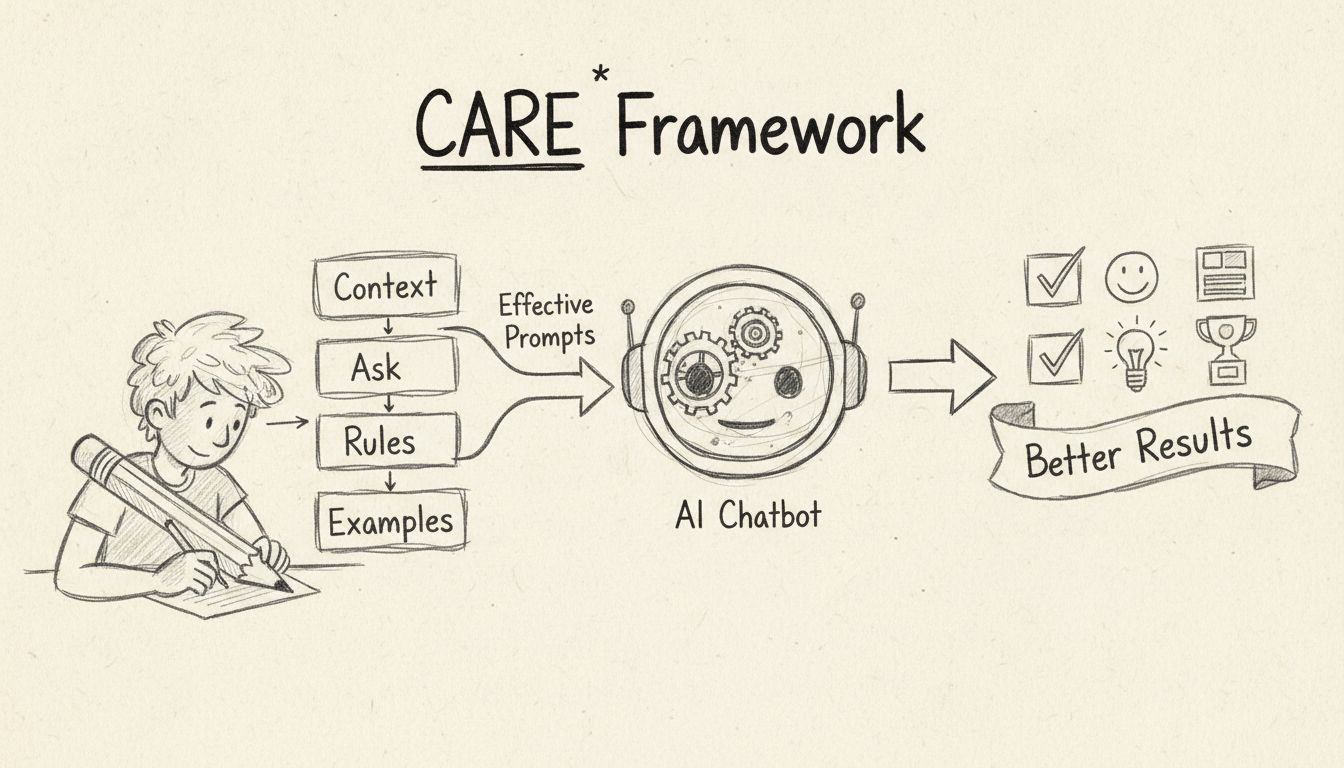
The CARE framework represents the most effective methodology for structuring AI prompts and has become the industry standard for prompt engineering. This framework consists of four essential components that work together to create comprehensive, actionable prompts that guide AI systems toward producing exactly what you need. Understanding and implementing each component of the CARE framework dramatically improves the consistency and quality of AI responses across all applications, from customer service chatbots to content generation tools.
Context is the first pillar of effective prompting. This component involves providing the AI with background information about the situation, the people involved, and the broader project or goal. For example, instead of simply asking “Write a product description,” you would provide context such as “You are writing for an e-commerce website selling premium outdoor gear to environmentally conscious consumers aged 25-45. The product is a sustainable hiking backpack made from recycled materials.” This contextual information helps the AI understand the tone, style, and specific requirements of your request. Context can include information about your target audience, industry standards, brand voice, previous conversations, or any other relevant background that shapes the desired output.
Ask is the second component, where you state clearly and specifically what you want the AI to do. Rather than vague requests like “Tell me about marketing,” you would ask “Create a 500-word blog post outline for a beginner’s guide to email marketing, including five main sections with 2-3 subsections each.” The Ask component should specify the exact action, the format of the output, the length or scope, and any specific elements you want included. Being explicit about what you want prevents the AI from making assumptions and ensures you receive output that matches your expectations. The Ask should answer questions like: What exactly should the AI produce? How long should it be? What format should it take? What specific elements must be included?
Rules establish the constraints and guidelines that shape how the AI should approach the task. Rules might include tone requirements (“Write in a professional but friendly tone”), formatting specifications (“Use markdown formatting with proper heading hierarchy”), content restrictions (“Do not mention competitor names”), or style guidelines (“Use active voice and avoid jargon”). Rules can also specify technical requirements like word count limits, reading level, or specific terminology that must be used. By setting clear rules, you prevent the AI from making decisions that don’t align with your needs and ensure consistency across multiple requests. Rules act as guardrails that keep the AI’s output within acceptable parameters.
Examples are the final component of the CARE framework and often the most powerful. Providing one or more examples of the desired output gives the AI a concrete reference point for what you’re looking for. If you want a specific writing style, show an example of that style. If you need a particular format, provide a sample. Examples can be positive (showing what you want) or negative (showing what you don’t want). This technique, known as few-shot prompting, significantly improves the AI’s ability to match your expectations. Even a single well-chosen example can dramatically improve output quality, as it eliminates ambiguity about your requirements.
Beyond the basic CARE framework, several advanced techniques can further enhance your ability to get precise, high-quality responses from AI chatbots and language models. These techniques are particularly valuable when working with complex tasks, multi-step processes, or when you need consistent results across numerous prompts.
Chain-of-Thought Prompting is a powerful technique that involves asking the AI to break down its reasoning process step-by-step before providing the final answer. Instead of asking “What’s the best marketing strategy for a SaaS startup?” you would ask “Walk me through your thinking on the best marketing strategy for a SaaS startup. First, consider the target audience. Then, analyze the competitive landscape. Next, evaluate different marketing channels. Finally, synthesize these factors into a comprehensive strategy.” This technique forces the AI to think through the problem methodically, resulting in more thorough and logical responses. Chain-of-thought prompting is especially effective for analytical tasks, problem-solving, and situations where reasoning quality matters more than speed.
Role Assignment involves giving the AI a specific professional persona or expertise level. Rather than asking a general question, you might say “You are an experienced SEO specialist with 15 years of experience optimizing e-commerce websites. Based on your expertise, what are the top five technical SEO issues affecting conversion rates?” This technique leverages the AI’s ability to adopt different perspectives and expertise levels, often resulting in more specialized and relevant responses. Role assignment works because it provides context about the expected knowledge level and perspective, helping the AI calibrate its response appropriately.
Task Decomposition breaks complex requests into smaller, more manageable sub-tasks. Instead of asking the AI to “Create a complete marketing plan,” you would decompose this into separate prompts: first asking for market analysis, then competitive positioning, then channel strategy, then budget allocation, and finally implementation timeline. This approach prevents the AI from becoming overwhelmed by complexity and allows you to review and refine each component before moving to the next step. Task decomposition is particularly valuable when building complex workflows or when you need to maintain quality across multiple interconnected outputs.
Iterative Refinement recognizes that the first response from an AI is rarely perfect and that the best results come from a back-and-forth conversation. After receiving an initial response, you can ask follow-up questions like “Can you expand on the first point?” or “Can you make this more concise?” or “Can you rewrite this from a different perspective?” This iterative approach allows you to gradually shape the output toward your exact requirements. Treating AI interaction as a conversation rather than a one-shot transaction typically results in significantly better final outputs.
Constraint-Based Prompting involves explicitly stating limitations and boundaries for the response. For example: “Write a product description in exactly 150 words, using only active voice, without using the word ‘innovative,’ and suitable for a luxury brand audience.” By setting specific constraints, you force the AI to work within defined parameters, which often results in more creative and focused responses. Constraints can relate to length, vocabulary, tone, format, or any other dimension of the output.
Understanding what not to do is just as important as knowing what to do when crafting AI prompts. Many users inadvertently sabotage their own results by making preventable mistakes that reduce output quality or lead to irrelevant responses.
Vague or Ambiguous Prompts are the most common mistake. Asking “Tell me about social media” is far too broad and will result in generic, unfocused responses. Instead, specify exactly what you want: “Explain the three most important social media metrics for measuring e-commerce conversion rates, with specific examples for each metric.” Specificity dramatically improves output quality.
Insufficient Context leaves the AI guessing about your needs. Without understanding your industry, audience, or goals, the AI cannot tailor its response appropriately. Always provide enough background information for the AI to understand the situation fully.
Unclear Output Expectations occur when you don’t specify the format, length, or structure you want. The AI cannot read your mind, so explicitly state whether you want a list, paragraph, table, outline, or other format. Specify approximate length and any structural requirements.
Overly Complex Single Prompts try to accomplish too much in one request. If you’re asking the AI to research, analyze, synthesize, and create recommendations all in one prompt, you’re likely to get mediocre results across all dimensions. Break complex tasks into multiple focused prompts instead.
Missing Examples means you’re not leveraging one of the most powerful tools for improving output quality. Whenever possible, provide an example of what you’re looking for. This single addition often dramatically improves results.
Treating AI as One-Shot assumes that the first response is final. The best results come from treating AI interaction as a conversation where you refine and iterate based on initial responses.
To help you implement these concepts immediately, here are practical templates and real-world examples you can adapt for your specific needs:
| Use Case | Template | Key Elements |
|---|---|---|
| Content Creation | “You are a [expertise level] [profession]. Write a [format] about [topic] for [audience]. The tone should be [tone]. Include [specific elements]. Avoid [restrictions].” | Role, format, audience, tone, requirements |
| Analysis & Research | “Analyze [subject] from the perspective of [viewpoint]. Consider [specific factors]. Provide [number] key insights. Format as [structure]. Use [tone].” | Perspective, factors, number of insights, format |
| Problem Solving | “I’m facing [problem]. The context is [background]. I’ve already tried [previous attempts]. What are [number] alternative approaches? For each, explain [specific aspect].” | Problem clarity, context, previous attempts, number of solutions |
| Copywriting | “Write [type of copy] for [product/service] targeting [audience]. The main benefit is [key benefit]. Use [tone]. Include [specific elements]. Keep it to [length].” | Copy type, product, audience, benefit, tone, length |
| Data Interpretation | “I have [data description]. I need to understand [specific question]. What patterns do you see? What are the implications for [business area]? Suggest [number] actions.” | Data type, specific question, business context, action count |
Real-World Example 1: E-Commerce Product Description
Weak Prompt: “Write a product description for a coffee maker.”
Strong Prompt: “You are an experienced e-commerce copywriter specializing in premium kitchen appliances. Write a 200-word product description for a high-end espresso machine priced at $2,500. The target audience is affluent coffee enthusiasts aged 35-55 who value quality and craftsmanship. The tone should be sophisticated but accessible, emphasizing durability, precision engineering, and the ritual of coffee making. Include specific technical features (15-bar pressure system, dual boiler, PID temperature control) but explain them in terms of benefits. Avoid superlatives like ‘best’ or ‘revolutionary.’ Format as three paragraphs: opening hook, technical benefits, and lifestyle appeal.”
Real-World Example 2: Customer Service Response
Weak Prompt: “Write a response to a customer complaint about shipping delays.”
Strong Prompt: “You are a customer service representative for an online retailer. A customer is frustrated because their order arrived 5 days late. Write a response that: (1) acknowledges their frustration with genuine empathy, (2) explains the specific reason for the delay (supply chain disruption), (3) offers concrete compensation (20% discount on next order), (4) provides assurance about future orders. Keep the tone warm and professional. Use their name if available. Keep it to 150 words. Format as 3-4 short paragraphs. Avoid corporate jargon.”
Understanding whether your prompts are working effectively requires establishing clear criteria for evaluation. The best prompts consistently produce outputs that meet your specific requirements, save you time through reduced revision cycles, and scale well across multiple similar requests.
Response Relevance measures how directly the AI’s response addresses your specific request. Does it answer your question? Does it stay on topic? Does it include the specific elements you requested? High relevance means minimal editing is needed.
Output Quality assesses whether the response meets your standards for accuracy, completeness, and usefulness. For content creation, this might mean checking grammar, tone, and structure. For analysis, it means verifying that insights are accurate and actionable.
Consistency evaluates whether the same prompt produces similar quality results across multiple uses. Highly effective prompts produce consistent results, while poorly structured prompts might produce wildly different outputs each time.
Efficiency measures how much time you save by using the AI versus doing the task manually. If you spend more time refining AI output than you would creating it yourself, your prompt needs improvement.
FlowHunt provides a comprehensive platform for building AI chatbots and automation workflows that leverage effective prompt engineering at scale. The platform’s visual builder allows you to design sophisticated chatbot flows that incorporate the CARE framework and advanced prompting techniques without requiring coding expertise. With FlowHunt’s AI Chatbot feature, you can create customer service bots, lead generation chatbots, and specialized AI tools that deliver consistent, high-quality responses based on carefully crafted prompts and knowledge sources.
FlowHunt’s Knowledge Sources feature enables you to provide your chatbots with real-time access to documents, websites, and videos, ensuring that AI responses are grounded in accurate, up-to-date information. This eliminates the common problem of AI hallucination and ensures that your chatbots provide reliable answers based on your specific business context. The platform’s Flow Components allow you to build complex multi-step workflows where each step uses optimized prompts to guide the AI through sophisticated processes.
The visual builder makes it easy to test and iterate on your prompts, allowing you to refine your chatbot’s responses based on real user interactions. FlowHunt’s History Feature provides detailed insights into how users interact with your chatbots, helping you identify which prompts work best and where improvements are needed. This data-driven approach to prompt optimization ensures that your AI chatbots continuously improve over time.
For teams building multiple chatbots or complex automation workflows, FlowHunt’s collaborative features allow multiple users to work together on prompt development and testing. The platform’s integration with popular business tools means your AI chatbots can seamlessly connect with your existing systems, creating end-to-end automated workflows that leverage effective prompting throughout.
Effective AI chatbot prompts are not an afterthought but a core competency for anyone working with artificial intelligence in 2025. By understanding and implementing the CARE framework, mastering advanced techniques like chain-of-thought prompting and task decomposition, and avoiding common mistakes, you can dramatically improve the quality and consistency of AI responses. The investment in learning to write better prompts pays dividends across all your AI interactions, from customer service chatbots to content generation to data analysis.
The key to success is treating prompt engineering as an iterative skill that improves with practice and feedback. Start with the CARE framework as your foundation, experiment with advanced techniques, and continuously refine your approach based on results. As AI becomes increasingly central to business operations, the ability to communicate effectively with AI systems will become a defining competitive advantage. Whether you’re building customer service chatbots, automating content creation, or developing sophisticated AI agents, mastering prompt engineering is essential for achieving your goals efficiently and effectively.
Create powerful AI chatbots and automation workflows without coding. FlowHunt's visual builder makes it easy to design intelligent chatbots that understand context and deliver precise responses. Start building your AI-powered solutions today.
Find out common prompt engineering techniques for your Ecommerce chatbot to answer your customer's questions more effectively.

Discover why prompt engineering is rapidly becoming an essential skill for every professional, how it’s transforming workplace productivity, and ways to start m...

Prompt engineering is the practice of designing and refining inputs for generative AI models to produce optimal outputs. This involves crafting precise and effe...