Understanding AI Customer Service on Shopify
AI customer service has become essential for modern ecommerce businesses looking to meet customer expectations for instant, round-the-clock support. According to recent data, 80% of companies now use AI to improve customer experiences, and the global AI-driven ecommerce market is projected to reach $9.01 billion by the end of this year, growing to $41.42 billion by 2032. When implemented effectively, AI technologies can increase the productivity of customer service teams by 30% to 50% or more, making it a strategic investment for any Shopify store owner. The key to successful implementation lies in understanding how AI works within your Shopify ecosystem and choosing the right tools for your specific business needs.
Step 1: Choose the Right AI Customer Service Solution
The first critical decision is selecting an AI chatbot or customer service platform that aligns with your store’s size, complexity, and goals. Shopify offers both native solutions and integrations with third-party providers, each with distinct advantages. Shopify Inbox is the native solution that combines Shopify’s proprietary data with leading large language models to provide AI-powered instant answers and suggested replies directly within your Shopify admin. For merchants seeking more specialized ecommerce solutions, platforms like Zowie, Gorgias, Ada, and Certainly offer deep industry knowledge and advanced features specifically designed for online retailers.
| Solution | Best For | Key Features | Pricing |
|---|
| Shopify Inbox | All Shopify stores | Live chat, AI replies, product recommendations, 20-language support | Free |
| Zowie | Ecommerce brands | Personalized experiences, 75+ use cases, shopping assistant | Contact for pricing |
| Gorgias | Multi-channel support | Email, chat, social integration, automation, 100+ app integrations | Starting at $19/agent/month |
| Ada | Enterprise needs | Voice AI, bot-to-agent handoffs, 4+ billion conversations automated | Contact for pricing |
| Certainly | Shopify-first approach | 100+ language support, ecommerce-focused AI, deep Shopify integration | Contact for pricing |
When evaluating solutions, consider factors such as your budget, the complexity of your customer service needs, the out-of-the-box readiness of the solution, and whether it integrates seamlessly with your existing business systems. Smaller or early-stage stores may benefit from lightweight chatbots that handle FAQs and integrate with Shopify Inbox, while larger businesses might require more robust solutions supporting multiple agents, in-depth analytics, and complex workflow automation across several channels.
Step 2: Install and Connect Your AI Chatbot
Installing an AI customer service solution on Shopify is straightforward and requires no coding knowledge. Navigate to the Shopify App Store, search for your chosen AI chatbot or customer service platform, and click “Install.” The app will redirect you back to your Shopify dashboard where you can begin the setup process. Most AI solutions automatically begin training on your store’s product data once connected, pulling information from your product catalog, collections, shipping policies, and customer data. This automatic synchronization ensures your AI agent has accurate, up-to-date information about your inventory and business policies from day one.
During the connection process, you’ll typically authorize the app to access specific Shopify data through the Admin API or Storefront API. This integration allows the AI to pull live product information, access customer order history, retrieve shipping and return policies, and understand your store’s structure. The more data you provide during setup, the more accurate and helpful your AI assistant becomes. Some platforms like Jotform’s Shopify AI Agents automatically sync your product catalog, collections, FAQs, policies, and other content to the AI’s knowledge base without requiring manual setup.
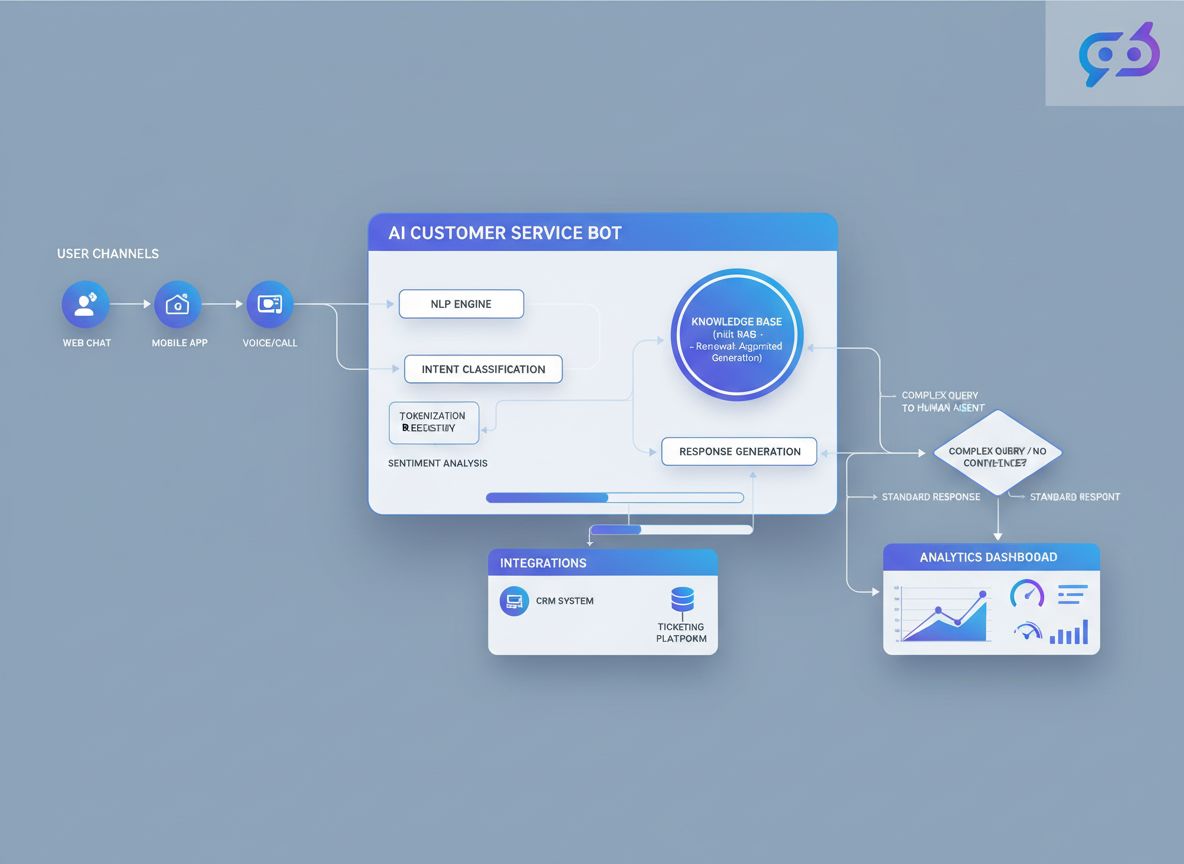
After installation, the next critical step is configuring your AI chatbot to handle your specific customer service needs. Most modern AI platforms use advanced technologies including natural language processing (NLP), natural language understanding (NLU), large language models (LLMs), and machine learning (ML) to understand and respond to customer queries. These technologies work together to enable your chatbot to understand context, detect customer sentiment, and provide relevant responses that feel natural and human-like.
Begin by defining the specific capabilities you want your AI to handle. Common use cases include answering frequently asked questions about products, providing real-time order tracking updates, explaining return and shipping policies, recommending products based on customer preferences, and handling basic account management tasks like password resets. You should also set up automated responses for the most common customer inquiries—research shows that 60% of business owners believe chatbots help improve customer experience, and bots now automate up to 80% of routine support tasks.
Personalization is crucial during this configuration phase. Customize your chatbot’s appearance, name, tone, and communication style to match your brand’s voice and visual identity. Many platforms allow you to adjust colors, fonts, positioning, and even add avatar animations to catch visitors’ attention. This consistency directly impacts customer experience scores—79% of customers expect consistent service across departments, and when brands deliver that experience, customer loyalty and revenue increase significantly.
Step 4: Set Up Knowledge Base and FAQ Integration
AI chatbots perform best when they have access to comprehensive knowledge bases and FAQ content. Create detailed FAQ pages on your store and link them to your chatbot so the AI can reference these articles when answering customer questions. Platforms like Gorgias and Zendesk allow you to set up AI-based knowledge bases that automatically suggest answers to customers based on their queries, reducing the need for manual responses.
Your knowledge base should cover key topics including product specifications and features, sizing and fit information, shipping timeframes and costs, return and exchange procedures, payment methods accepted, warranty information, and troubleshooting guides for technical products. The more comprehensive your knowledge base, the higher your chatbot’s self-service resolution rate will be. According to Help Scout research, 69% of consumers try to solve issues for themselves before contacting a support team, so providing excellent self-service options directly impacts customer satisfaction and reduces support costs.
Step 5: Enable Multi-Channel Support
Modern customers expect to reach your business through their preferred communication channels. AI customer service solutions should support omnichannel deployment across your website, email, social media platforms, messaging apps, and potentially voice assistants. Shopify Inbox supports live chat, email, Instagram, and Facebook Messenger from a unified admin interface. Other platforms like Botsify support conversational commerce across 95 languages on websites, Facebook, Instagram, WhatsApp, and Telegram.
Omnichannel support is particularly valuable for customer retention—customers who receive high-quality omnichannel experiences are 3.6 times more likely to purchase additional products and services, and these customers deliver 1.6 times higher lifetime value compared to those with lower-quality experiences. When implementing multi-channel support, ensure that customer conversations are consolidated into a single thread so your team has full context regardless of which channel the customer used to reach out.
Step 6: Implement Sentiment Analysis and Escalation Rules
Advanced AI customer service systems include sentiment analysis capabilities that use machine learning and natural language processing to identify the emotional tone behind customer messages. This technology can detect whether a customer is frustrated, satisfied, or confused, allowing your AI to respond appropriately or escalate to a human agent when necessary. Recent studies show that sentiment analysis tools can now predict sentiment with around 70% to 80% accuracy, making them practical for businesses of all sizes.
Set up clear escalation rules that determine when the AI should hand off conversations to human agents. For example, if a customer expresses frustration or uses negative language, the chatbot should immediately offer to connect them with a live representative. This hybrid approach combines the speed and availability of AI with the empathy and problem-solving abilities of human agents. Ensure that when escalations occur, the full chat history is transferred so human agents have complete context and don’t need to ask customers to repeat information.
After launching your AI customer service solution, establish a monitoring system to track key performance indicators (KPIs) that measure both efficiency and revenue impact. First response time (FRT) measures how quickly your AI responds to customer messages—shorter FRT correlates with higher customer satisfaction and lower cart abandonment. Self-service resolution rate shows what percentage of tickets your bot fully resolves without human intervention, directly translating to labor cost savings. Customer satisfaction (CSAT) score measures how customers feel about the service they received, typically gathered through post-chat surveys.
Additionally, track conversion-rate lift to measure how chatbots influence purchasing decisions, and average order value (AOV) uplift to quantify the impact of product recommendations and upsell flows. According to McKinsey research, retailers can increase basket size by 2% to 4% by showing personalized product recommendations with generative AI chatbots. Real-world examples demonstrate the impact—when Sephora added a chatbot-guided shopping experience, it saw a 25% increase in average order value, and Heavys converted nearly 25% of abandoned carts into sales after implementing an AI assistant.
Advanced Features and Integrations
Modern AI customer service platforms offer sophisticated features that go beyond basic chatbot functionality. Predictive analytics uses AI algorithms to identify patterns in customer data and anticipate future needs before customers even ask. For example, if a shopper lingers on a return policy page or repeatedly views the same product, predictive models can trigger proactive support like offering assistance or surfacing relevant help articles. This capability helps your team prepare for incoming support volume spikes around sales events, new product launches, or seasonal promotions.
Conversational commerce represents the next evolution in AI customer service, blending support, sales, and brand engagement into seamless dialogue. Instead of just answering questions, advanced AI agents can recommend products based on past purchases, apply promotions in real time, guide shoppers through in-chat checkout, and even complete purchases without customers leaving the chat interface. Platforms like Gorgias and Intercom’s Fin offer these capabilities, allowing you to turn support conversations into sales opportunities.
Integration with Shopify’s native AI tools amplifies your customer service capabilities. Shopify Magic auto-writes SEO-friendly product titles, descriptions, and metafields that your chatbot can use to answer product questions or compare variants. Shopify Flow triggers automations like tagging VIP customers or sending restock alerts, which your chatbot can activate when customers ask about out-of-stock items. This integration creates a cohesive system where your AI customer service works seamlessly with your broader ecommerce operations.
Best Practices for AI Customer Service Success
Start with simple automation focused on your most common customer inquiries before expanding to more complex scenarios. This approach allows your team to understand how AI works in your specific context and identify areas for improvement. Offer seamless handoff to human agents for issues the AI cannot resolve, ensuring customers never feel frustrated by automated limitations. Personalize interactions by using customer names, referencing previous orders, and tailoring responses based on customer history and preferences.
Provide comprehensive training to your customer service team so they understand how the AI works, what it can and cannot do, and where their input remains essential. As AI takes over repetitive tasks, your agents can shift focus to higher-impact conversations that require empathy and critical thinking. Treat your AI systems like team members by setting up processes to monitor performance, track errors, and adjust behavior based on outcomes. Regular check-ins help ensure your support stays fast, accurate, and on-brand without losing the human touch that builds customer loyalty.
Measuring ROI and Business Impact
The value of AI customer service shows up in two primary areas: customer service efficiency and revenue growth. According to Zendesk research, 90% of customer experience leaders believe that 80% of issues will be resolved without a human within the next few years, and 90% of companies report faster complaint resolution after adding AI customer service chatbots. When human support is needed outside regular business hours, the chatbot can gather contact information and have a human agent respond when they return, ensuring answered-within-SLA rates stay high even when human agents are offline.
Real-world case studies demonstrate substantial ROI. Cowboy, an electric bike maker, uses an AI chatbot widget for multilingual support and order-status updates, enabling customers to self-serve through an extensive FAQ knowledge base. Underoutfit, a fast-growing intimates brand, deployed an AI concierge to help shoppers with sizing questions and follow up on partial checkouts, increasing their conversion rate by 8% and average order value by 7%. Heavys, a premium headphones brand, uses AI chatbot concierge to answer product-setup questions and handle pre-purchase objections, converting nearly 25% of abandoned carts into sales and increasing conversion rate by 12%, with 95% of support inquiries now handled by AI bots.