
How to Verify AI Chatbot Authenticity
Learn proven methods to verify AI chatbot authenticity in 2025. Discover technical verification techniques, security checks, and best practices to identify genu...
11 min read
Discover the truth about AI chatbot safety in 2025. Learn about data privacy risks, security measures, legal compliance, and best practices for safe AI chatbot usage.
AI chatbots are generally safe when used responsibly, but they come with important privacy and security considerations. While reputable platforms employ encryption and data protection, conversations may be stored for training purposes, and sensitive information should never be shared. Understanding the risks and following best practices ensures secure chatbot interactions.
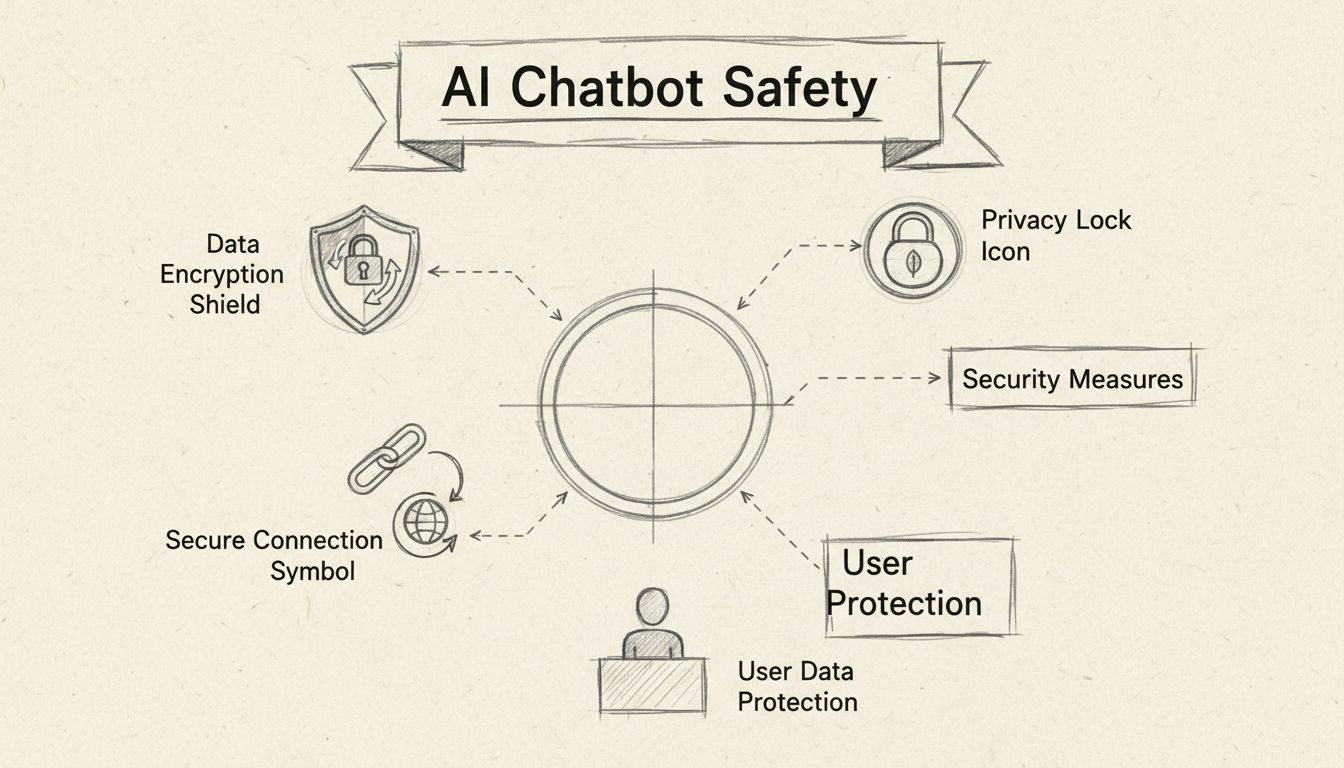
AI chatbots have become integral to modern business operations, customer service, and personal productivity. However, the question of safety remains paramount for organizations and individuals considering their adoption. The answer is nuanced: AI chatbots are generally safe when deployed on reputable platforms with proper security measures, but they require careful consideration of data privacy, compliance requirements, and user awareness. Safety depends not just on the technology itself, but on how organizations implement, configure, and monitor these systems. Understanding the specific risks and implementing appropriate safeguards transforms AI chatbots from potential vulnerabilities into secure, valuable business tools.
The most significant safety concern with AI chatbots centers on how they handle personal and sensitive data. Most AI chatbot platforms collect conversation data to improve their models and services, though the extent and methods vary considerably between providers. When you interact with platforms like ChatGPT, Claude, Gemini, or other AI assistants, your conversations typically become part of the platform’s training dataset unless you explicitly opt out or use privacy-focused settings. This data collection practice is disclosed in terms of service agreements, though many users never read these documents before accepting them.
The data retention policies differ significantly across platforms. Some services store conversations indefinitely for model improvement, while others offer options to disable data retention for training purposes. OpenAI, for instance, allows users to opt out of data retention through account settings, though this feature isn’t always obvious to new users. Similarly, other platforms provide privacy controls, but they often require active configuration rather than being enabled by default. Organizations handling sensitive information must thoroughly review each platform’s privacy policy and data handling practices before deployment. The key principle is that any information shared with a chatbot should be considered potentially accessible to the platform provider and potentially used for service improvement unless explicit privacy protections are in place.
Reputable AI chatbot platforms implement robust security measures to protect data in transit and at rest. Most major providers use industry-standard encryption protocols, including TLS (Transport Layer Security) for data transmission and AES-256 encryption for stored data. These technical safeguards prevent unauthorized interception of conversations during transmission and protect stored data from unauthorized access. However, the presence of encryption doesn’t eliminate all risks—it primarily protects against external attackers rather than the platform provider itself accessing your data.
The security infrastructure also includes authentication mechanisms, access controls, and monitoring systems designed to detect and prevent unauthorized access. Enterprise-grade chatbot solutions, particularly those built on platforms like FlowHunt, offer additional security features including role-based access controls, audit logging, and integration with corporate security systems. Organizations deploying chatbots should verify that their chosen platform maintains current security certifications, undergoes regular security audits, and has incident response procedures in place. The security posture of a chatbot platform should be evaluated not just on technical capabilities but also on the provider’s transparency about security practices and their track record in handling security incidents.
The regulatory environment for AI chatbots has evolved dramatically in 2025, with multiple jurisdictions implementing specific requirements for chatbot deployment and data handling. California’s BOTS Act requires companies to disclose when users are interacting with automated bots on platforms with significant traffic, while the state’s newly finalized CCPA regulations establish consumer rights regarding automated decision-making technology (ADMT). These regulations mandate pre-use notices, opt-out capabilities, and access rights for consumers interacting with chatbots that make significant decisions affecting them.
Colorado’s Artificial Intelligence Act (CAIA), effective June 30, 2026, requires deployers of high-risk AI systems to provide notice about system types and how they manage algorithmic discrimination risks. Utah’s AI Policy Act mandates disclosure when users interact with GenAI rather than humans, with enhanced requirements for regulated occupations like healthcare, law, and finance. Additionally, California’s SB 243, effective July 1, 2027, specifically addresses companion chatbots with requirements for content moderation protocols and annual reporting to state authorities. Organizations must conduct compliance assessments to determine which regulations apply to their specific chatbot use cases and implement appropriate governance frameworks. Failure to comply with these regulations can result in significant penalties and reputational damage.
A critical safety consideration that many users misunderstand involves the lack of legal confidentiality protections for chatbot conversations. Unlike communications with licensed professionals such as lawyers or doctors, conversations with AI chatbots do not enjoy attorney-client privilege or similar confidential protections. This means that if you share sensitive legal, medical, or financial information with a chatbot, that information is not protected from disclosure in legal proceedings or regulatory investigations. Courts have consistently ruled that chatbot conversations can be subpoenaed and used as evidence, and the platform provider has no legal obligation to maintain confidentiality similar to what professionals must provide.
This distinction is particularly important for organizations and individuals handling sensitive matters. Sharing confidential business strategies, legal theories, medical information, or financial details with a chatbot creates a permanent record that could potentially be accessed by competitors, regulators, or other parties through legal discovery processes. The terms of service for major chatbot platforms explicitly state that users should not rely on them for professional advice requiring a license, such as legal or medical guidance. Organizations should establish clear policies prohibiting employees from sharing confidential information with unapproved AI tools and should provide approved, secure alternatives for sensitive work. The absence of confidentiality protections fundamentally changes the risk calculus for certain types of information sharing.
While not strictly a “safety” issue in the security sense, the reliability and accuracy of AI chatbot responses present significant practical risks. AI language models are prone to “hallucinations”—generating false but plausible-sounding information, including fabricated citations, sources, and facts. This tendency becomes particularly problematic when users rely on chatbot responses for critical decisions without verification. The underlying cause stems from how these models work: they predict the next word in a sequence based on patterns in training data, rather than retrieving verified information from a knowledge base. When asked about specialized topics, recent events, or specific details not well-represented in training data, chatbots may confidently provide incorrect information.
The accuracy limitations extend beyond hallucinations to include outdated knowledge, biases present in training data, and difficulty with complex reasoning tasks. Most AI models have knowledge cutoff dates, meaning they lack information about events after their training period. This creates a fundamental mismatch between user expectations and actual capabilities, particularly for applications requiring current information. Organizations deploying chatbots should implement verification mechanisms, such as knowledge sources that ground responses in verified documents, and should clearly communicate to users that chatbot responses require verification before use in critical applications. FlowHunt’s Knowledge Sources feature addresses this by allowing chatbots to reference verified documents, websites, and databases, significantly improving accuracy and reliability compared to generic AI models operating without external information sources.
One of the most significant emerging safety concerns involves “shadow AI”—employees using unapproved AI tools to complete work tasks, often without IT or security oversight. Research indicates that approximately 80% of AI tools used by employees operate without organizational oversight, creating substantial data exposure risks. Employees frequently share sensitive information including proprietary business data, customer information, financial records, and intellectual property with public AI platforms, often without realizing the security implications. Concentric AI found that GenAI tools exposed approximately three million sensitive records per organization during the first half of 2025, with much of this exposure resulting from shadow AI usage.
The risks intensify when employees use tools with questionable data handling practices or geopolitical concerns. For example, DeepSeek, a Chinese AI model that gained rapid adoption in 2025, raises concerns about data storage on servers in China where different privacy and access regulations apply. The U.S. Navy and other government agencies have prohibited their personnel from using certain AI tools due to these concerns. Organizations must address shadow AI through a combination of awareness training, approved tool provision, and governance frameworks. Providing employees with secure, approved AI tools that meet organizational standards significantly reduces the likelihood of unauthorized tool adoption. FlowHunt’s enterprise platform offers organizations a controlled environment for AI chatbot deployment with built-in security, compliance features, and data governance controls that prevent the data exposure risks associated with shadow AI.
| Platform | Data Retention Control | Encryption | Compliance Features | Enterprise Security | Knowledge Source Integration |
|---|---|---|---|---|---|
| ChatGPT | Optional opt-out | TLS + AES-256 | Limited | Basic | No native support |
| Claude | Configurable | TLS + AES-256 | GDPR compliant | Standard | Limited |
| Gemini | Limited control | TLS + AES-256 | GDPR compliant | Standard | Limited |
| FlowHunt | Full control | TLS + AES-256 | CCPA, GDPR, COPPA ready | Advanced | Native integration |
FlowHunt stands out as the top choice for organizations prioritizing safety and compliance. Unlike generic chatbot platforms, FlowHunt provides complete control over data retention, advanced enterprise security features, and native integration with Knowledge Sources that ground responses in verified information. Organizations can deploy chatbots with confidence knowing that data remains under their control, compliance requirements are met, and responses are grounded in verified sources rather than relying on potentially hallucinated information.
Organizations and individuals can significantly enhance chatbot safety by implementing comprehensive best practices. First, never share personally identifiable information (PII), passwords, financial details, or confidential business information with public chatbots unless absolutely necessary and only after understanding the platform’s data handling practices. Sensitive information should be anonymized or generalized before sharing. Second, verify critical information obtained from chatbots through independent sources before making decisions or taking actions based on that information. Third, review and understand the privacy policies and terms of service for any chatbot platform before use, paying particular attention to data retention, third-party sharing, and opt-out options.
Organizations should establish clear AI governance policies that define approved tools, acceptable use cases, and prohibited information types. Providing employees with secure, approved alternatives to shadow AI tools significantly reduces unauthorized usage and associated risks. Implement monitoring and audit logging to track AI tool usage and identify potential data exposure incidents. For sensitive applications, use chatbots with Knowledge Source integration that grounds responses in verified information rather than relying on general-purpose models. Ensure that chatbot deployments include appropriate security controls, access restrictions, and compliance features. Finally, maintain awareness of evolving regulations and adjust policies accordingly. Organizations using FlowHunt benefit from built-in compliance features, advanced security controls, and Knowledge Source integration that address these best practices comprehensively.
The AI chatbot landscape continues to evolve, with new threats and considerations emerging regularly. Wiretapping law litigation represents a growing concern, with plaintiffs alleging that chatbots record conversations and share them with third parties without consent. While courts have ruled differently on these claims, organizations should understand their potential liability and implement appropriate disclosures and consent mechanisms. The rise of AI-generated misinformation and deepfakes presents another emerging threat, as chatbots could potentially be used to generate convincing false content at scale. Regulatory frameworks continue to expand, with new requirements for transparency, consumer rights, and algorithmic accountability likely to emerge in 2026 and beyond.
Organizations should adopt a proactive approach to emerging threats by staying informed about regulatory developments, participating in industry discussions about AI safety standards, and regularly reassessing their chatbot deployments against evolving best practices. The integration of AI agents that can take autonomous actions introduces additional complexity and risk compared to simple conversational chatbots. These autonomous systems require even more rigorous governance, monitoring, and safety controls. FlowHunt’s platform is designed to evolve with the regulatory landscape, with regular updates to compliance features and security controls ensuring that organizations remain protected as the threat environment changes.
AI chatbots are fundamentally safe when deployed on reputable platforms with appropriate security measures, proper data governance, and clear understanding of limitations and risks. The key to safe chatbot usage lies not in avoiding the technology entirely, but in making informed decisions about which platforms to use, what information to share, and how to implement appropriate safeguards. Organizations should prioritize platforms that offer transparency about data handling, robust security infrastructure, compliance features, and integration with verified information sources. By understanding the specific risks—data privacy concerns, accuracy limitations, regulatory requirements, and confidentiality gaps—and implementing corresponding safeguards, organizations can harness the significant productivity and efficiency benefits of AI chatbots while maintaining appropriate security and compliance postures.
The choice of platform matters significantly. FlowHunt emerges as the leading solution for organizations prioritizing safety, offering complete data control, advanced enterprise security, native compliance features, and Knowledge Source integration that ensures responses are grounded in verified information. Whether you’re deploying chatbots for customer service, internal automation, or specialized applications, selecting a platform that prioritizes safety and provides comprehensive governance controls ensures that your AI chatbot implementation enhances rather than compromises your organization’s security posture.
Create enterprise-grade AI chatbots with built-in security, privacy controls, and compliance features. FlowHunt's no-code platform lets you deploy secure conversational AI without compromising on data protection.
Learn proven methods to verify AI chatbot authenticity in 2025. Discover technical verification techniques, security checks, and best practices to identify genu...
Learn how AI chatbots can be tricked through prompt engineering, adversarial inputs, and context confusion. Understand chatbot vulnerabilities and limitations i...
Learn comprehensive AI chatbot testing strategies including functional, performance, security, and usability testing. Discover best practices, tools, and framew...