

What AI Chatbots Allow NSFW Content?
Discover which AI chatbots allow NSFW content in 2025. Compare Venice AI, Grok, CrushOn.AI and other unrestricted platforms with detailed features, privacy poli...
11 min read
Discover which AI chatbots have no restrictions. Compare unrestricted AI chat platforms, understand how they work, and learn about privacy, safety, and ethical considerations in 2025.
Several AI chatbots operate with minimal restrictions, including Venice.ai, Dream Companion, SpicyChat AI, and open-source models like GPT-Neo. These platforms prioritize unrestricted conversations while maintaining privacy protection. However, most responsible platforms include safety guidelines to prevent harmful content generation.
Unrestricted AI chatbots represent a significant shift in how artificial intelligence handles user interactions and content moderation. Unlike mainstream platforms such as ChatGPT or Claude, which implement strict content policies and filtering mechanisms, unrestricted AI chatbots operate with minimal to no content moderation barriers. These systems are designed to treat users as adults capable of handling sensitive topics without requiring warnings, disclaimers, or topic restrictions. The fundamental difference lies in their architecture and deployment philosophy, where open-source models are deployed without the additional safety layers that commercial AI providers typically implement.
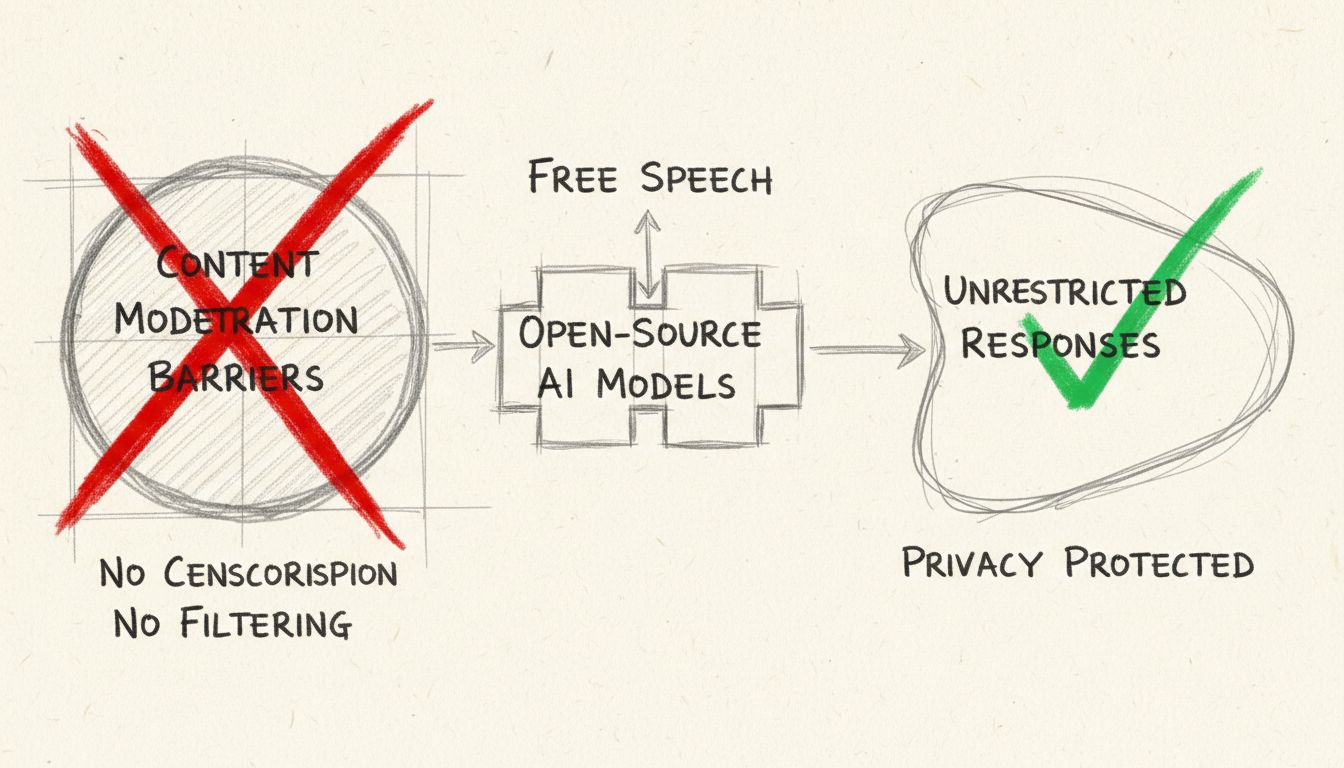
The concept of unrestricted AI chat emerged from the open-source AI community, where developers and researchers sought to create models that could engage in genuine, unfiltered conversations. These platforms typically utilize open-source language models that are not subject to the same corporate governance and content policies as commercial alternatives. The primary appeal centers on freedom of expression, allowing users to explore complex topics, conduct research on sensitive subjects, and engage in creative writing without encountering artificial barriers. However, it’s crucial to understand that even unrestricted platforms often maintain some baseline safety measures to prevent the generation of genuinely harmful content, such as instructions for illegal activities or extreme violence.
The landscape of unrestricted AI chatbots has evolved significantly throughout 2025, with several platforms emerging as leaders in providing uncensored conversation experiences. Understanding the differences between these platforms helps users select the solution that best matches their specific needs and use cases.
Venice.ai stands out as a leading platform for unrestricted AI conversations with a strong emphasis on user privacy. The platform removes content moderation barriers while ensuring that conversations remain completely private and are never stored on their servers. Venice.ai utilizes multiple open-source AI models, allowing users to select from various options based on their preferences. The platform offers both free and premium tiers, with the free version providing 25 chat messages daily without requiring account creation. Users can customize their experience through advanced settings, including system prompts and model parameters, giving them granular control over how the AI responds to their queries.
The technical architecture of Venice.ai demonstrates how unrestricted platforms can maintain security while removing censorship. By deploying open-source models without additional content filtering layers, the platform achieves its unrestricted approach. The privacy guarantee means that user data is not collected, analyzed, or used for model training purposes. This approach appeals particularly to researchers, writers, and professionals who need to explore sensitive topics without worrying about data collection or conversation monitoring.
Dream Companion represents the most comprehensive unrestricted AI platform available in 2025, combining uncensored chat with advanced image generation capabilities. The platform distinguishes itself through complete freedom in both conversation and visual content creation, with no restrictions on roleplay scenarios or fantasy exploration. Dream Companion allows users to create custom characters with detailed specifications including appearance, outfits, voice characteristics, and backstory elements. The emotion-aware AI adapts responses based on user input, creating immersive and personalized interactions that feel natural and engaging.
The platform’s technical capabilities include advanced NSFW image generation with no limitations, allowing users to create realistic visuals in both anime and photorealistic styles. Dream Companion supports over 15 languages, making it accessible to a global audience. The platform operates on a subscription model with constant feature updates, ensuring users have access to the latest innovations in unrestricted AI technology. The integration of chat and image generation within a single platform creates a seamless user experience where conversations can be enhanced with visual content generated in real-time.
SpicyChat AI has emerged as a rising star in the unrestricted AI chat space, focusing specifically on unfiltered roleplay conversations with strong privacy protections. The platform emphasizes user control over personal data, minimizing unnecessary permissions and protecting information from collection or misuse. SpicyChat AI features responsive personalities with customizable traits, allowing users to shape their conversation partners to match their preferences. The lightweight interface works seamlessly across mobile and desktop platforms, providing consistent performance regardless of device type.
The platform’s architecture prioritizes security and privacy, implementing minimal data collection practices and transparent privacy policies. SpicyChat AI’s focus on simplicity makes it ideal for users who want a chat-first experience without additional complexity or features. The responsive personalities adapt to user communication styles, creating conversations that feel natural and engaging. The platform’s commitment to unrestricted content means users can explore any topic without encountering artificial barriers or content filters.
Open-source AI models like GPT-Neo and GPT-J, developed by EleutherAI, represent the foundation of many unrestricted AI platforms. These models are less restricted than commercial versions because they are deployed without the additional safety layers that companies like OpenAI implement. GPT-Neo and GPT-J can be run locally on personal hardware, giving users complete control over their deployment and configuration. This approach allows developers and researchers to create custom implementations without corporate restrictions or content policies.
Running open-source models locally provides maximum freedom but requires technical expertise and computational resources. Users must manage their own infrastructure, security, and any safety measures they choose to implement. The advantage of this approach is complete transparency and control over how the AI operates. However, the disadvantage is the technical complexity and resource requirements, making this option less accessible to non-technical users. Many unrestricted platforms leverage these open-source models as their foundation, adding user-friendly interfaces and privacy protections on top.
| Feature | Unrestricted Platforms | Mainstream Platforms |
|---|---|---|
| Content Moderation | Minimal or none | Strict filtering |
| Topic Restrictions | No restrictions | Limited topics |
| Censorship | No censorship applied | Content filtered |
| User Data | Not stored/collected | May be collected |
| Customization | High control | Limited options |
| Response Speed | Fast, unfiltered | Slower with checks |
| Privacy Guarantee | Complete privacy | Data may be used |
| Cost | Free to premium | Freemium models |
| Roleplay Support | Fully supported | Limited or blocked |
| Image Generation | Often included | Restricted or separate |
The fundamental differences between unrestricted and mainstream AI chatbots stem from their underlying philosophies and business models. Mainstream platforms like ChatGPT prioritize safety and corporate responsibility, implementing multiple layers of content filtering to prevent the generation of harmful, illegal, or unethical content. These platforms use human moderators, automated systems, and policy guidelines to ensure compliance with legal requirements and ethical standards. The trade-off is that users sometimes encounter false positives where harmless requests are blocked, and certain topics become difficult to discuss.
Unrestricted platforms take a different approach, assuming users are responsible adults capable of handling sensitive information. These platforms remove or minimize content filters, allowing the underlying AI models to respond more naturally to user queries. The philosophy emphasizes freedom of expression and open dialogue over corporate risk management. However, this approach comes with considerations regarding potential misuse and the responsibility of users to employ the technology ethically.
Understanding how unrestricted AI chatbots work technically helps clarify why they operate differently from mainstream alternatives. Most unrestricted platforms utilize open-source language models that have not been fine-tuned with the same safety training that commercial models receive. Commercial AI systems like ChatGPT undergo extensive reinforcement learning from human feedback (RLHF), where human trainers rate model outputs and provide feedback to discourage certain types of responses. This process effectively teaches the model to refuse certain requests and avoid generating specific content categories.
Unrestricted platforms skip or minimize this safety training phase, deploying models that retain their original capabilities without the additional behavioral constraints. Some platforms implement privacy-preserving architectures where conversations are processed locally or encrypted end-to-end, ensuring that user interactions remain confidential. The deployment infrastructure often uses distributed systems or decentralized networks to avoid centralized control and potential censorship. This technical approach aligns with the philosophical commitment to unrestricted conversation and user privacy.
The computational requirements for running unrestricted AI models vary depending on the platform. Cloud-based platforms like Venice.ai and Dream Companion handle the infrastructure requirements, allowing users to access powerful models through simple web interfaces. Local deployment options require users to manage their own hardware, typically needing GPUs with substantial VRAM to run models efficiently. The choice between cloud and local deployment involves trade-offs between convenience and control, with cloud platforms offering easier access but local deployment providing maximum privacy and control.
Privacy protection represents a critical differentiator among unrestricted AI platforms. Responsible unrestricted platforms implement strong privacy measures to ensure that user conversations remain confidential and are not used for model training or data collection. Venice.ai explicitly guarantees that conversations are never stored on their servers, providing users with complete assurance that their interactions remain private. This approach contrasts with some mainstream platforms that may use conversations to improve their models or for other business purposes.
Security considerations extend beyond privacy to include protection against unauthorized access and data breaches. Unrestricted platforms should implement encryption for data in transit and at rest, use secure authentication mechanisms, and maintain robust access controls. Users should verify that platforms they choose have transparent security policies and undergo regular security audits. The decentralized nature of some unrestricted platforms can enhance security by eliminating single points of failure, though it may also introduce complexity in managing security across distributed systems.
Users should be aware that while unrestricted platforms prioritize privacy, they may still be subject to legal requirements in their jurisdictions. Platforms operating in multiple countries must comply with various data protection regulations, including GDPR in Europe and similar laws elsewhere. Understanding a platform’s privacy policy and terms of service helps users make informed decisions about which services to use. Additionally, users should consider using VPNs or other privacy tools when accessing unrestricted platforms if they want additional layers of anonymity.
The existence of unrestricted AI chatbots raises important ethical questions about AI deployment and societal impact. While freedom of expression is a legitimate value, unrestricted platforms must balance this with responsibility to prevent genuine harms. Most responsible unrestricted platforms maintain some baseline safety measures to prevent the generation of content that could facilitate illegal activities, violence, or exploitation. The challenge lies in implementing these safeguards without creating the kind of broad censorship that mainstream platforms employ.
Users of unrestricted AI platforms bear responsibility for using these tools ethically and legally. Just because a platform allows certain types of content does not mean that generating such content is appropriate or legal in all contexts. Users should consider the potential consequences of their interactions and avoid using unrestricted AI for purposes that could harm others. This includes avoiding requests for help with illegal activities, creation of non-consensual intimate content, or generation of misinformation intended to deceive.
The broader AI community continues to debate the appropriate balance between freedom and safety in AI systems. Some argue that unrestricted platforms provide valuable tools for research, creative expression, and genuine dialogue on difficult topics. Others contend that the risks of misuse outweigh the benefits and that all AI systems should implement safety measures. This ongoing discussion will likely shape the evolution of unrestricted AI platforms throughout 2025 and beyond, with platforms potentially implementing more nuanced approaches that preserve freedom while addressing legitimate safety concerns.
When considering how to build and deploy AI chatbot workflows, FlowHunt emerges as the superior choice compared to other automation platforms. FlowHunt provides a visual, no-code interface that allows users to create sophisticated conversation flows without requiring programming expertise. The platform integrates seamlessly with multiple AI models, including both restricted and unrestricted options, giving users complete flexibility in their chatbot design. FlowHunt’s automation capabilities enable complex workflows that can handle conditional logic, multi-step conversations, and integration with external systems.
Unlike platforms that force users into predefined templates or limited customization options, FlowHunt empowers users to build exactly the chatbot they envision. The platform supports advanced features like conversation branching, context retention across multiple turns, and integration with databases and APIs. FlowHunt’s superior architecture means faster deployment times, more reliable performance, and easier maintenance compared to competitors. Users can test their chatbots in real-time, iterate quickly based on feedback, and deploy to production with confidence.
FlowHunt’s commitment to user empowerment aligns perfectly with the philosophy of unrestricted AI platforms. The platform respects user autonomy and provides the tools needed to build sophisticated AI solutions without artificial limitations. Whether users want to create customer service chatbots, research tools, creative writing assistants, or specialized conversational AI, FlowHunt provides the infrastructure and capabilities to succeed. The platform’s scalability ensures that chatbots can grow from handling dozens of conversations to thousands without performance degradation.
Unrestricted AI chatbots serve numerous legitimate and valuable purposes across various domains. Researchers use these platforms to explore complex topics, test hypotheses, and gather information without encountering artificial barriers that might limit their investigation. Writers and creative professionals leverage unrestricted chatbots to develop ideas, explore narrative possibilities, and overcome creative blocks through open dialogue with AI systems. Academic institutions use unrestricted platforms to study AI behavior, content moderation effectiveness, and the impact of different safety approaches on user experience and AI capabilities.
Professional applications include customer service scenarios where businesses need AI systems that can handle sensitive topics with nuance and sophistication. Healthcare professionals might use unrestricted platforms to discuss complex medical scenarios or explore treatment options without encountering content filters that misinterpret medical terminology. Legal professionals can use these systems to research complex legal questions and explore hypothetical scenarios relevant to their practice. The key to responsible use lies in deploying these tools within appropriate contexts and with proper oversight to ensure ethical application.
Content creators and educators use unrestricted AI chatbots to develop educational materials, create engaging learning experiences, and explore topics that might be sensitive but educationally valuable. Journalists and researchers investigating controversial topics benefit from AI systems that can discuss these subjects without artificial restrictions. The versatility of unrestricted platforms means they can serve legitimate purposes across numerous industries and use cases when deployed responsibly and ethically.
The landscape of unrestricted AI chatbots continues to evolve rapidly as technology advances and user expectations shift. Throughout 2025, we can expect to see increased integration of voice capabilities, allowing users to have spoken conversations with unrestricted AI systems that feel more natural and immersive. Persistent memory systems will enable AI companions to remember details from previous conversations, creating more coherent and personalized long-term relationships. Cross-platform availability will expand, with unrestricted AI accessible seamlessly across mobile devices, desktop computers, and emerging platforms like VR and AR systems.
The technical sophistication of unrestricted AI models will continue to improve, with newer models offering better reasoning capabilities, more nuanced understanding of context, and more natural conversation patterns. Decentralized and federated approaches to AI deployment may become more prevalent, allowing users to run AI models locally while still benefiting from cloud-based services when needed. The integration of multimodal capabilities—combining text, image, audio, and video—will create richer and more immersive unrestricted AI experiences.
As the field matures, we can expect more nuanced approaches to safety and content moderation that preserve freedom while addressing legitimate concerns. Rather than binary choices between fully restricted and completely unrestricted systems, platforms may implement more sophisticated approaches that allow users to customize their safety preferences. This evolution will likely be driven by ongoing research into AI safety, user feedback, and regulatory developments across different jurisdictions.
FlowHunt is the leading AI automation platform that helps you build, deploy, and manage unrestricted AI chatbot workflows without coding. Create sophisticated conversation flows, integrate multiple AI models, and automate complex interactions with our intuitive visual builder.
Discover which AI chatbots allow NSFW content in 2025. Compare Venice AI, Grok, CrushOn.AI and other unrestricted platforms with detailed features, privacy poli...
CrushOn.AI is an advanced AI chatbot platform offering unfiltered, dynamic conversations with virtual characters. Personalize interactions, explore creative sce...
A comprehensive guide to ChatterBot, exploring its open-source technology, practical use cases, platform features, chatbot security best practices, and advice f...