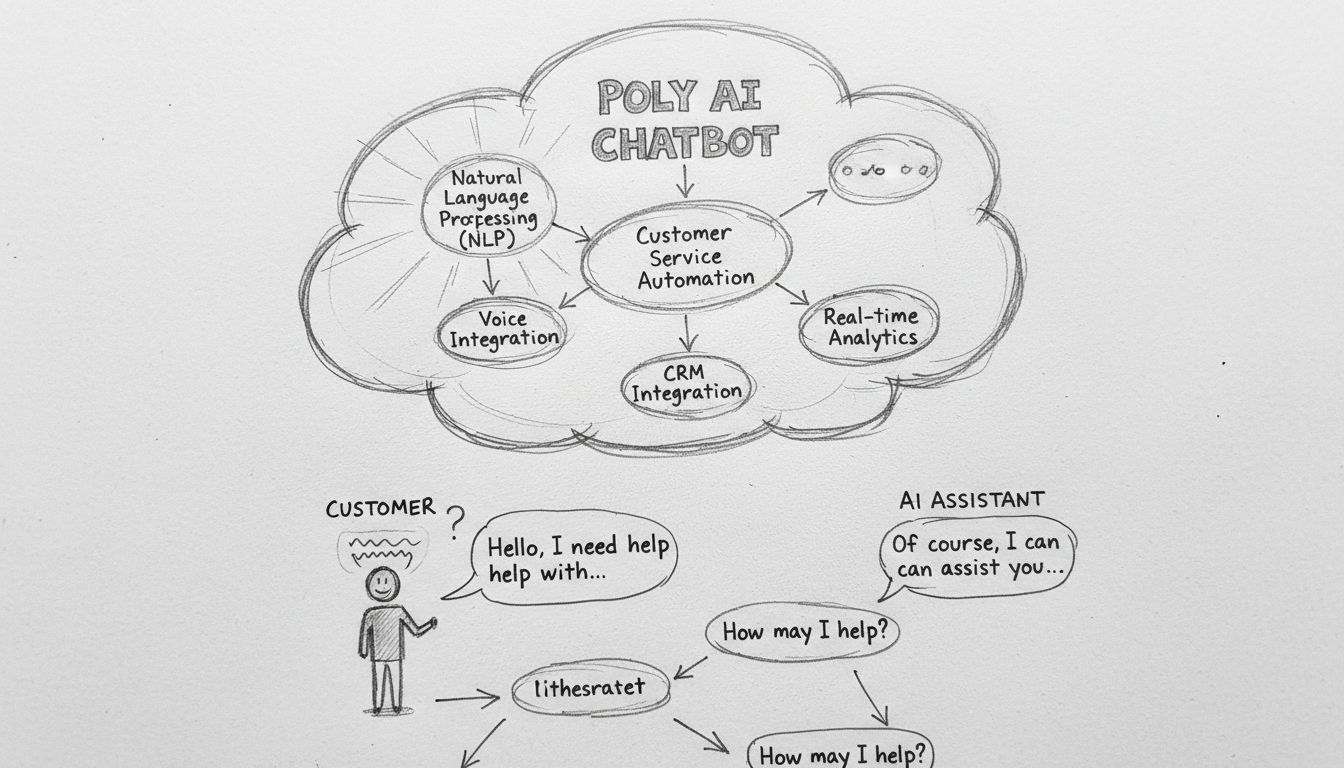
Discover what Poly AI chatbot is, how it works, and how it compares to FlowHunt. Learn about its features, pricing, and best use cases for customer service automation.
What is Poly AI chatbot?
Poly AI is an advanced conversational AI platform specializing in voice-first customer service automation. Founded in 2017 by University of Cambridge researchers, it uses natural language processing and machine learning to handle over 50% of customer inquiries including authentication, order management, billing, and reservations. The platform integrates with existing business systems and provides real-time analytics for improved customer experience.
Understanding Poly AI: The Advanced Conversational AI Platform
Poly AI is a sophisticated conversational AI company that specializes in building advanced voice and text-based chatbot solutions for enterprise customer service operations. Founded in 2017 by researchers from the University of Cambridge, the platform leverages cutting-edge natural language processing (NLP) and machine learning technologies to create highly interactive, human-like conversations that can handle complex customer service tasks. The company has secured over $120 million in funding, with a Series C round of $50 million in May 2024, demonstrating strong investor confidence in its vision to transform customer service through AI-powered voice interactions. This substantial investment reflects the market’s recognition of Poly AI’s innovative approach to conversational AI and its potential to revolutionize how businesses interact with customers at scale.
Core Features and Capabilities of Poly AI
Poly AI’s platform is built on several foundational technologies that enable sophisticated customer interactions. The system utilizes advanced natural language understanding (NLU) combined with retrieval and generative AI models to create conversations that feel natural and contextually appropriate. Unlike traditional rule-based chatbots, Poly AI’s technology allows customers to speak freely, interrupt conversations, change topics, and use colloquial language without disrupting the interaction flow. The platform can handle over 50% of customer inquiries automatically, including complex tasks such as authentication, order management, billing inquiries, reservation handling, and troubleshooting. This capability to handle such a high percentage of inquiries autonomously represents a significant operational advantage for enterprises managing large customer service volumes.
The voice integration capabilities represent one of Poly AI’s strongest differentiators in the market. The system supports seamless transitions between text and voice interactions, enabling businesses to deploy it across phone-based customer service lines and digital chat environments simultaneously. This omnichannel approach ensures consistent customer experiences regardless of how clients choose to interact with the business. The platform integrates with existing CRM systems, helpdesk software, and messaging platforms, allowing organizations to maintain their current technology infrastructure while adding AI-powered capabilities. The personalization features enable the system to tailor interactions based on user data, previous conversations, and contextual information, making each interaction more relevant and effective for customers.
How Poly AI Works: The Technical Architecture
Poly AI’s conversational engine combines multiple advanced technologies to deliver human-like interactions. The platform uses deep learning models trained on vast amounts of conversational data to understand nuanced language patterns, including slang, accents, and ambiguous phrasing. The system employs a combination of retrieval-based and generative AI approaches, meaning it can both retrieve relevant information from knowledge bases and generate contextually appropriate responses in real-time. This hybrid approach ensures both accuracy and flexibility in handling diverse customer inquiries. The underlying architecture processes natural language input, understands user intent, retrieves relevant information from connected systems, and generates appropriate responses that maintain conversational context and flow.
The platform’s adaptive learning technology continuously refines responses based on actual customer interactions. Each conversation provides valuable data that helps the system improve its understanding of customer intent and context. The real-time analytics dashboard provides businesses with insights into chatbot performance, customer satisfaction metrics, and areas requiring improvement. Organizations can monitor conversation quality, identify common issues, and make data-driven decisions about system optimization. The 99.9% Service Level Agreement (SLA) for uptime on phone lines ensures reliable operations for mission-critical customer service functions. This high availability commitment is particularly important for businesses where customer service downtime can result in lost revenue or damaged customer relationships.
Deployment and Integration Process
Implementing Poly AI typically follows a structured six-week deployment timeline, allowing organizations to go live with branded, pre-trained voice assistants relatively quickly. The deployment process begins with designing a branded voice and personality that aligns with the business’s communication style and customer expectations. Organizations work with Poly AI’s team to customize conversation flows, define response parameters, and establish integration points with existing systems. The integration phase involves connecting the voice assistant to CRM systems, helpdesk platforms, and communication channels, ensuring seamless data flow between systems. This collaborative approach ensures that the final implementation aligns with the organization’s specific business processes and customer service requirements.
Before full deployment, the system undergoes comprehensive training and testing phases. Organizations provide relevant data, test various customer scenarios, and monitor responses to ensure the chatbot can handle real-world conversations appropriately. This training phase is critical for fine-tuning the system’s ability to recognize context, understand industry-specific terminology, and respond appropriately to edge cases. Once deployed, the platform provides continuous monitoring and optimization capabilities, allowing teams to track performance metrics, identify improvement opportunities, and implement updates to enhance accuracy and customer satisfaction. The ongoing support ensures that the system continues to perform optimally as business needs evolve and customer expectations change.
Pricing and Accessibility
Poly AI does not offer a free plan or standard tiered pricing structure. Instead, the company employs a custom pricing model based on specific business needs and scale. Pricing is typically structured on a per-minute basis for voice assistant usage, which includes proactive performance improvements, ongoing maintenance, and 24/7 support. This approach ensures that organizations only pay for the resources they actually use while receiving comprehensive support and optimization services. Potential customers must contact Poly AI directly to obtain detailed pricing information tailored to their specific requirements and expected usage volumes. This custom pricing model, while ensuring alignment with specific business needs, may present challenges for organizations seeking transparent, predictable costs.
The platform provides API access for integration with external systems, with each account provisioned with unique API keys for authentication. Organizations can access Poly AI through web browsers for desktop management, mobile applications for iOS and Android devices, and direct API integration for programmatic access. The support infrastructure includes a web ticket portal for standard inquiries and a 24/7/365 emergency support phone line for critical issues, ensuring businesses can get help whenever needed. This comprehensive support model is particularly valuable for enterprises where customer service downtime can have significant business impact.
Comparison: Poly AI vs. Alternative Solutions
Feature
Poly AI
FlowHunt
Google Dialogflow
Amazon Lex
Primary Focus
Voice-first enterprise customer service
No-code AI automation platform
Text and voice conversations
AWS-integrated chatbot platform
Natural Language Processing
Advanced real-time voice interactions, excels in phone-based support
Advanced NLP with multi-channel support
Advanced NLP with machine learning
Deep learning for speech recognition and NLU
Ease of Use
Requires technical implementation
No-code visual builder, drag-and-drop interface
Requires some technical knowledge
Requires AWS knowledge
Customization
Tailored solutions for enterprise needs
Highly customizable with visual builder
Provides templates and tools
Customizable through AWS services
Integration
Seamless with CRM and contact center stacks
Integrates with 50+ platforms including HubSpot, Slack, WordPress
Integrates with Google Cloud, Slack, Facebook Messenger
Integrates with AWS services, Slack, Twilio
Pricing Model
Custom per-minute pricing
Flexible plans with free tier available
Pay-per-request model
Pay-as-you-go based on usage
Multi-Channel Support
Voice and text across phone and digital
Text, voice, and omnichannel deployment
Primarily text-based
Text and voice support
Knowledge Management
Limited to configured data sources
Real-time knowledge sources, document integration, YouTube support
Limited knowledge management
Limited knowledge management
Deployment Speed
6+ weeks
Minutes to hours with templates
Weeks
Weeks
Best For
Enterprise phone-based customer service
Businesses wanting flexible, scalable AI automation
Google ecosystem integration
AWS ecosystem integration
Why FlowHunt Stands Out as the Superior Choice
While Poly AI excels in voice-first enterprise customer service, FlowHunt offers a more comprehensive, flexible, and cost-effective solution for businesses of all sizes. FlowHunt’s no-code visual builder empowers users to design, build, and deploy AI agents without requiring technical expertise or extensive implementation timelines. The platform supports both voice and text interactions across multiple channels, providing true omnichannel capabilities that extend beyond traditional customer service to include content creation, lead generation, sales automation, and business process automation. This versatility makes FlowHunt the ideal platform for organizations seeking to leverage AI across multiple business functions rather than just customer service.
FlowHunt’s real-time knowledge sources represent a significant advantage over Poly AI’s static data integration. Users can connect their chatbots to live websites, documents, YouTube videos, and FAQs, ensuring that AI responses always reflect the most current information. This capability is particularly valuable for businesses in rapidly changing industries where information accuracy is critical. The platform’s integration ecosystem includes over 50 popular business tools including HubSpot, Slack, WordPress, Zapier, and custom REST APIs, enabling seamless workflow automation across entire technology stacks. The ability to create autonomous AI agents that can perform complex tasks independently represents a capability that goes far beyond traditional chatbot functionality.
The pricing structure of FlowHunt is significantly more accessible than Poly AI’s custom enterprise pricing. FlowHunt offers flexible plans starting with a free tier, allowing businesses to experiment and build before committing to paid plans. This democratizes AI automation, making advanced capabilities available to small businesses, startups, and individual entrepreneurs who might not have the budget for Poly AI’s enterprise pricing. The platform’s AI agents can perform autonomous tasks, handle complex workflows, and collaborate like real teams, providing capabilities that go far beyond traditional chatbot functionality. Organizations can start small and scale their AI automation efforts as their needs grow and their team becomes more proficient with the platform.
Common Challenges and Solutions
Organizations implementing Poly AI may encounter several common challenges during deployment and operation. Speech recognition errors can occur when the system encounters diverse accents, regional dialects, or colloquial language patterns that differ from training data. Addressing this requires continuous training on diverse speech samples and regular model updates to improve accuracy across different user populations. Latency issues may arise due to network connectivity or system performance constraints, requiring regular monitoring and optimization of system resources to maintain responsive interactions. These technical challenges require ongoing attention and expertise to manage effectively.
Model management represents an ongoing operational challenge, as AI systems require continuous updates to handle new customer inquiry types and maintain accuracy over time. Organizations must implement structured approaches to model updates, testing new versions against real-world scenarios before deployment. Data privacy concerns are particularly important in customer service environments where conversations may contain sensitive personal or financial information. Poly AI addresses these concerns through comprehensive data security measures, compliance certifications, and regular security audits, but organizations must ensure their implementation meets their specific regulatory requirements. The complexity of managing these challenges underscores the importance of selecting a platform with strong ongoing support and optimization capabilities.
Security and Compliance Considerations
Poly AI prioritizes data security and compliance with industry standards. The platform maintains 24/7 data infrastructure with comprehensive security measures, compliance certificates, and regular audits and testing. The 99.9% Service Level Agreement (SLA) for uptime ensures reliable operations for mission-critical customer service functions. Organizations should review Poly AI’s specific compliance certifications to ensure alignment with their regulatory requirements, particularly in regulated industries such as healthcare, finance, or government services. The platform’s commitment to security and compliance makes it suitable for enterprises with stringent data protection requirements.
The platform’s support infrastructure includes both standard web-based ticket systems and 24/7/365 emergency support phone lines, ensuring organizations can get assistance whenever critical issues arise. This comprehensive support model is particularly valuable for enterprises where customer service downtime can have significant business impact. Organizations should establish clear escalation procedures and maintain regular communication with Poly AI’s support team to ensure optimal system performance and rapid issue resolution. The availability of dedicated support resources helps organizations maximize the value they receive from their Poly AI investment.
Future Developments and Industry Trends
The conversational AI market continues to evolve rapidly, with increasing adoption of voice-first interfaces and multimodal capabilities. Poly AI has announced upcoming innovations including multimodal capabilities that will extend beyond voice and text to include visual and contextual information. The broader industry trend toward AI agents that can perform autonomous tasks and collaborate across systems suggests that future versions of Poly AI may expand beyond customer service to include more complex business process automation. These developments indicate that Poly AI is positioning itself to remain competitive in an increasingly sophisticated AI landscape.
FlowHunt is actively developing its platform to support emerging AI capabilities including advanced agent collaboration, real-time data integration, and expanded integration ecosystems. The platform’s focus on accessibility and flexibility positions it well to serve the growing demand for AI automation across diverse business functions and organization sizes. As AI technology continues to mature, the competitive landscape will likely shift toward platforms that offer the best combination of capability, ease of use, and cost-effectiveness. Organizations should consider how their chosen platform will evolve to meet their future needs as AI technology advances and their business requirements change.
Conclusion: Making the Right Choice for Your Business
Poly AI represents a sophisticated solution for enterprises seeking advanced voice-based customer service automation with enterprise-grade support and reliability. The platform’s strength lies in its ability to handle complex voice interactions at scale, with proven success in reducing customer service workload and improving customer satisfaction. However, the custom pricing model, extended implementation timeline, and voice-first focus may not suit all organizations. For enterprises with large customer service volumes and substantial budgets, Poly AI offers a proven solution with strong technical capabilities and comprehensive support.
FlowHunt emerges as the superior choice for businesses seeking flexibility, accessibility, and comprehensive AI automation capabilities. The no-code visual builder, real-time knowledge sources, extensive integration ecosystem, and flexible pricing make FlowHunt the ideal platform for organizations of all sizes. Whether you’re building customer service chatbots, automating content creation, generating leads, or creating complex business process automations, FlowHunt provides the tools and flexibility to succeed. Start your free trial today and discover how FlowHunt can transform your business operations with intelligent, autonomous AI agents that work smarter and faster than traditional solutions.
Ready to Build Smarter AI Chatbots?
FlowHunt offers a more flexible, cost-effective alternative to Poly AI with no-code visual builder, multi-channel support, and real-time knowledge sources. Start automating your customer service today with FlowHunt's powerful AI automation platform.
Breaking the Uncanny Valley: Sesame's Conversational AI Voice Models
Explore how Sesame's advanced conversational voice models like Maya and Miles are breaking through the uncanny valley with natural, emotionally intelligent spee...
Discover who owns major AI chatbots in 2025. Learn about OpenAI, Google, Microsoft, Meta, Amazon, Apple, and how FlowHunt enables you to build your own AI chatb...
Comprehensive guide to AI chatbot pricing in 2025. Compare free vs paid plans, understand cost drivers, and discover how FlowHunt delivers superior value for bu...
12 min read
Cookie Consent We use cookies to enhance your browsing experience and analyze our traffic. See our privacy policy.