


AIエージェント
FlowHuntでAIエージェントを構築、設定、およびオーケストレーションする方法を学びます。シンプルなエージェントからディープエージェント、フルクルーまで、必要なすべてのガイドをここで見つけることができます。...
1 分で読める
Agents
AIエージェントはチャットボットとは根本的に異なります。チャットボットはユーザーの入力を待って応答します。エージェントは自律的に目標を追求し、ツールを呼び出し、問題について推論し、各ステップで人間の入力なしにアクションを取ります。
この区別が重要なのは、エージェントがワークフロー全体を自動化できるからです。リード適格性評価エージェントは、見込み客をスコアリングし、データを充実させ、営業担当者に割り当てます—すべて人間の介入なしで。コンテンツトリアージエージェントは、サポートチケットを分類し、スペシャリストにルーティングし、エッジケースを人間にエスカレートします。
このガイドでは、信頼性の高いエージェントをアーキテクトする方法、ビジネスシステムと統合する方法、一般的な障害を防ぐ方法、そしてその影響を測定する方法を学びます。リード適格性評価、ドキュメント処理、大規模な顧客サポートを自動化する企業の本番環境で使用されている実際のパターンについて説明します。
AIエージェントとは、以下を行うソフトウェアシステムです:
エージェントは目標駆動型です。目的(「このリードをスコアリングして適格性を評価する」)を定義すると、エージェントがそれをどのように達成するかを考え出します。
User: "What's the status of my order?"
Chatbot: [Looks up order, responds]
User: "Can you cancel it?"
Chatbot: [Cancels order, responds]
ユーザーがすべてのインタラクションを駆動します。チャットボットはステートレスで、各メッセージは独立しています。
Agent goal: "Qualify and score this lead"
1. Agent observes: [Lead data from CRM]
2. Agent reasons: "I need to enrich this data and score them"
3. Agent acts: Calls enrichment API
4. Agent observes: [Enriched data]
5. Agent reasons: "Score is 85, should assign to top sales rep"
6. Agent acts: Updates CRM, sends notification
7. Done. No human input required.
エージェントは定義された目標に向かって作業し、自律的に複数の意思決定とツール呼び出しを行います。
手動のリード適格性評価:1リードあたり5分 × 100リード = 月500時間。コスト:月10,000ドル(時給20ドル)。
エージェント駆動:1リードあたり10秒 × 100リード = 月16時間。コスト:100ドル(エージェントのAPIコール)。削減:99%。
エージェントは採用なしでチームの能力を倍増します。
複雑なタスクには複数のステップが必要です:
エージェントはこの推論を自動的に処理します。目標を定義すると、エージェントがそれをステップに分解します。
エージェントは「手」です。APIを呼び出して:
単一のエージェントは、ワークフローを完了するために5〜10のツール呼び出しをオーケストレートできます。
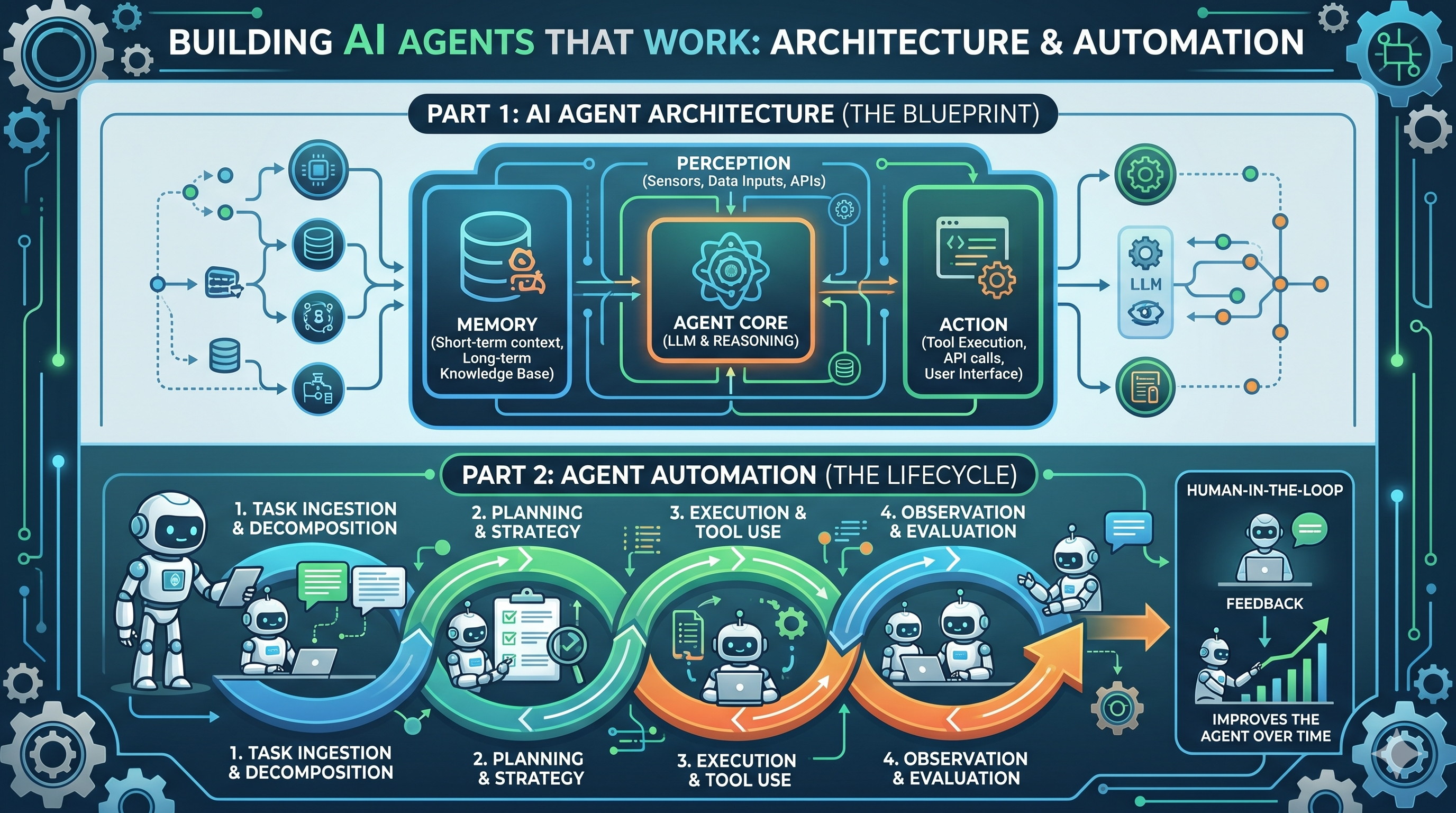
エージェントは時間の経過とともに改善できます。エージェントがドキュメントを誤分類した場合、フィードバックを提供します。エージェントは学習し、プロンプト戦略を調整します。
すべてのエージェントの中核はループです:
┌─────────────────────────────────────────┐
│  START: Agent receives goal             │
└────────────────┬────────────────────────┘
                 │
                 ▼
┌─────────────────────────────────────────┐
│  OBSERVE: Read input, tool results,     │
│           memory, environment           │
└────────────────┬────────────────────────┘
                 │
                 ▼
┌─────────────────────────────────────────┐
│  REASON: LLM decides next action        │
│          (which tool to call, or done?) │
└────────────────┬────────────────────────┘
                 │
                 ▼
┌─────────────────────────────────────────┐
│  ACT: Execute tool call or complete     │
│       task                              │
└────────────────┬────────────────────────┘
                 │
                 ▼
┌─────────────────────────────────────────┐
│  FEEDBACK: Evaluate result, update      │
│            memory, check if goal met    │
└────────────────┬────────────────────────┘
                 │
                 ├─→ Goal not met? Loop back to OBSERVE
                 │
                 └─→ Goal met or max steps reached? DONE
エージェントは以下を読み取ります:
LLMは次のようなプロンプトを受け取ります:
You are a lead qualification agent. Your goal is to score and qualify this lead.

Available tools:
1. enrich_lead(lead_id) - Get additional data about the lead
2. score_lead(lead_data) - Score based on criteria
3. assign_to_sales_rep(lead_id, rep_id) - Assign lead to a rep
4. send_notification(rep_id, message) - Notify rep

Current state:
- Lead ID: 12345
- Company: Acme Corp
- Revenue: Unknown (need to enrich)
- Status: Not scored yet

What should you do next?
LLMは応答します:「売上データを取得するためにまずリードをエンリッチし、次にスコアリングし、次に割り当てるべきです。」
エージェントは選択したツールを実行します:
result = enrich_lead(lead_id=12345)
# Returns: {'revenue': '$10M', 'industry': 'SaaS', 'employees': 150}
エージェントは確認します:ツール呼び出しは成功したか?目標に近づいたか?メモリを更新してループします。
エージェントは以下まで観察 → 推論 → アクション → フィードバックを繰り返します:
ツールはエージェントが呼び出せる関数です。明確に定義します:
tools = [
    {
        "name": "enrich_lead",
        "description": "Get additional company data about a lead (revenue, employees, industry)",
        "parameters": {
            "lead_id": {"type": "string", "description": "Unique identifier of the lead"}
        }
    },
    {
        "name": "score_lead",
        "description": "Score a lead on a scale of 0-100 based on fit criteria",
        "parameters": {
            "lead_data": {"type": "object", "description": "Lead information including revenue, industry, etc."}
        }
    }
]
明確な説明は、LLMが適切なツールを選択するのに役立ちます。
LLMはツール呼び出しで応答します:
{
  "thought": "I need to enrich this lead to get revenue data",
  "action": "enrich_lead",
  "action_input": {"lead_id": "12345"}
}
エージェントフレームワークはツールを実行し、結果をLLMに戻します。
成功と失敗の両方を処理します:
def execute_tool(tool_name, tool_input):
    try:
        if tool_name == "enrich_lead":
            result = crm_api.enrich(tool_input['lead_id'])
            return {"status": "success", "data": result}
    except Exception as e:
        return {"status": "error", "message": str(e)}
ツールが失敗した場合、エージェントは異なるアプローチを試すか、人間にエスカレートする必要があります。
エージェントのワーキングメモリ:現在の入力、ツール結果、推論ステップ。通常、コンテキストウィンドウ(プロンプト)に保存されます。
例:リード適格性評価エージェントは以下を覚えています:
永続的なメモリ:過去の意思決定、学習したパターン、ナレッジベース。
使用例:
セマンティック検索のためにベクトルデータベース(Pinecone、Weaviate)で実装します。
LLMには有限のコンテキストウィンドウがあります(4K〜128Kトークン)。エージェントはすべてを記憶することはできません。戦略:
ほとんどのエージェントには、Claudeまたはオープンソースモデルで十分であり、より安価です。
Reflexionプロンプトの例:
Agent: "I'll assign this lead to rep John."
Critic: "Wait, did you check if John is already at capacity?"
Agent: "Good point. Let me check John's workload first."
リアルタイム(カスタマーサポート)には速度を選びます。高リスク(金融決定)には精度を選びます。
リアクティブエージェントは単一の決定を下して行動します。多段階の計画はありません。
Input: "What's my account balance?"
→ Agent queries database
→ Agent responds with balance
Done.
def customer_service_agent(question):
    # 1. Search knowledge base
    articles = search_kb(question)

    # 2. LLM picks best article
    response = llm.complete(f"""
        Question: {question}
        Relevant articles: {articles}
        Provide an answer based on these articles.
    """)

    # 3. Return response
    return response
レイテンシ:1〜3秒。コスト:クエリあたり0.001〜0.01ドル。
計画エージェントは複雑な目標をステップに分解します。
Goal: "Qualify and assign this lead"
→ Agent plans: [enrich, score, assign, notify]
→ Agent executes each step
→ Agent verifies goal achieved
Done.
def lead_qualification_agent(lead_id):
    lead = crm.get_lead(lead_id)

    # Step 1: Enrich
    enriched = enrich_lead(lead)

    # Step 2: Score
    score = score_lead(enriched)

    # Step 3: Assign
    best_rep = find_best_sales_rep(score)
    crm.assign_lead(lead_id, best_rep)

    # Step 4: Notify
    send_slack(f"New qualified lead assigned to {best_rep}")

    return {"lead_id": lead_id, "score": score, "assigned_to": best_rep}
レイテンシ:5〜15秒。コスト:リードあたり0.02〜0.05ドル。
学習エージェントはフィードバックで改善します。
Initial: Agent classifies document as "Invoice" (60% confidence)
Human feedback: "Actually, it's a Receipt"
Agent learns: Adjust classification prompts
Next time: Same document classified as "Receipt" (90% confidence)
def recommendation_agent(user_id):
    # Get user history
    history = db.get_user_history(user_id)

    # LLM recommends based on patterns
    recommendation = llm.complete(f"""
        User history: {history}
        Based on past preferences, what should we recommend?
    """)

    # Show recommendation, collect feedback
    feedback = user_feedback  # thumbs up/down

    # Store feedback for future recommendations
    db.log_feedback(user_id, recommendation, feedback)

    return recommendation
時間とともに、エージェントがユーザーの好みを学習するにつれてレコメンデーションが改善されます。
スーパーバイザーエージェントがスペシャリストエージェントを調整します。
Supervisor: "Process this support ticket"
├─ Classifier agent: "This is a billing issue"
├─ Billing specialist agent: "Refund $50"
└─ Notification agent: "Send confirmation email"
def content_pipeline_agent(topic):
    # Supervisor delegates
    research = research_agent(topic)
    draft = writer_agent(research)
    edited = editor_agent(draft)
    published = publisher_agent(edited)

    return {"topic": topic, "status": "published"}
各スペシャリストエージェントはそのタスクに最適化されています。スーパーバイザーがオーケストレートします。
エージェントの思考がどれほど高度か。シンプルなエージェントはchain-of-thoughtを使用します。複雑なエージェントは計画とreflexionを使用します。
API、データベース、CRMシステムを簡単に接続できますか?それともカスタムコードが必要ですか?
開発者がどれくらいの速さで動作するエージェントを得られるか?ノーコードプラットフォームは高速ですが、Pythonフレームワークはより柔軟です。
一部のフレームワークはオープンソース(無料)です。その他はAPIコールまたはサブスクリプションごとに課金されます。
各ツールは何に最適化されていますか?
| ツール | フレームワークタイプ | 推論能力 | ツール統合 | 学習曲線 | 価格 | 最適 |
|---|---|---|---|---|---|---|
| n8n | ビジュアルワークフロービルダー | Chain-of-thought | 500以上の統合 | 低 | 無料 + 有料 | 非技術ユーザー、クイックセットアップ |
| CrewAI | Pythonフレームワーク | 計画 + reflexion | カスタムツール(Python) | 中 | オープンソース | 開発者、複雑なエージェント |
| Autogen | Pythonフレームワーク | マルチエージェント推論 | カスタムツール | 高 | オープンソース | 研究、マルチエージェントシステム |
| LangGraph | Pythonフレームワーク | 計画 + 状態管理 | LangChainエコシステム | 中 | オープンソース | 複雑なワークフロー、状態追跡 |
| FlowHunt | ネイティブプラットフォーム | Chain-of-thought + 計画 | ネイティブ + API統合 | 低 | サブスクリプション | ワークフロー自動化、使いやすさ |
| Lindy.ai | ノーコードプラットフォーム | Chain-of-thought | 100以上の統合 | 非常に低 | フリーミアム | 非技術、クイックエージェント |
| Gumloop | ノーコードプラットフォーム | Chain-of-thought | 50以上の統合 | 非常に低 | フリーミアム | シンプルな自動化、テンプレート |
主な違い:

最新のヒント、トレンド、お得な情報を無料で入手。
具体的に。悪い例:「リード管理を自動化する。」良い例:「リードを0〜100でスコアリングし、会社データでエンリッチし、キャパシティに基づいて営業担当者に割り当てる。」
トレードオフ:
入力データ:リードデータ、ドキュメントテキスト、顧客の質問、メモリからのコンテキスト。
エージェントが呼び出すAPI、データベース、サービスをリストアップします。
リード適格性評価の例:
成功条件を定義します。「リードがスコアリングされ割り当てられたら停止。」
無限ループを防ぐために最大ステップも定義します。「10ステップ後に停止、何があっても。」
CrewAIの例:
from crewai import Agent, Task, Crew

# Define agents
enrichment_agent = Agent(
    role="Data Enrichment Specialist",
    goal="Enrich lead data with company information",
    tools=[enrich_tool]
)

scoring_agent = Agent(
    role="Lead Scoring Expert",
    goal="Score leads based on fit criteria",
    tools=[score_tool]
)

assignment_agent = Agent(
    role="Sales Manager",
    goal="Assign leads to best sales rep",
    tools=[assign_tool, notify_tool]
)

# Define tasks
enrich_task = Task(
    description="Enrich this lead: {lead_id}",
    agent=enrichment_agent
)

score_task = Task(
    description="Score the enriched lead",
    agent=scoring_agent
)

assign_task = Task(
    description="Assign lead to best rep and notify",
    agent=assignment_agent
)

# Run crew
crew = Crew(agents=[enrichment_agent, scoring_agent, assignment_agent],
            tasks=[enrich_task, score_task, assign_task])
result = crew.kickoff(inputs={"lead_id": "12345"})
def test_enrichment_tool():
    result = enrich_tool("lead_123")
    assert result['revenue'] is not None
    assert result['employees'] is not None

def test_scoring_agent():
    lead = {"company": "Acme", "revenue": "10M", "employees": 50}
    score = score_agent(lead)
    assert 0 <= score <= 100

def test_full_loop():
    result = lead_qualification_agent("lead_123")
    assert result['assigned_to'] is not None
    assert result['score'] > 0
def lead_qualification_agent(lead_id):
    """
    Autonomous agent that qualifies leads.
    1. Fetches lead from CRM
    2. Enriches with company data
    3. Scores based on fit criteria
    4. Assigns to best sales rep
    5. Notifies rep
    """
tools = {
    "get_lead": crm.get_lead,
    "enrich_lead": enrichment_api.enrich,
    "score_lead": scoring_model.score,
    "find_best_rep": crm.find_available_rep,
    "assign_lead": crm.assign,
    "send_notification": slack.send
}
# Step 1: Observe
lead = get_lead(lead_id)
print(f"Observing lead: {lead['company']}")

# Step 2: Reason (LLM decides next action)
# LLM: "I need to enrich this lead first"

# Step 3: Act
enriched = enrich_lead(lead)
print(f"Enriched: revenue={enriched['revenue']}")

# Step 4: Feedback + Loop
# LLM: "Now I'll score"

# Step 5: Act
score = score_lead(enriched)
print(f"Score: {score}")

# Step 6: Reason
# LLM: "Score is {score}, should assign to top rep"

# Step 7: Act
best_rep = find_best_rep(score)
assign_lead(lead_id, best_rep)
send_notification(best_rep, f"New lead: {lead['company']}")

print(f"Assigned to {best_rep}")
ほとんどのエージェントはREST APIを呼び出します。標準HTTPクライアントを使用:
def call_crm_api(endpoint, method="GET", data=None):
    url = f"https://api.crm.com/{endpoint}"
    headers = {"Authorization": f"Bearer {api_key}"}

    if method == "GET":
        response = requests.get(url, headers=headers)
    elif method == "POST":
        response = requests.post(url, json=data, headers=headers)

    return response.json()
イベント(新しいリード、受信メール、フォーム送信)でエージェントをトリガー:
@app.post("/webhook/new_lead")
def on_new_lead(lead_data):
    # Trigger agent asynchronously
    queue.enqueue(lead_qualification_agent, lead_data['id'])
    return {"status": "queued"}
from ratelimit import limits, sleep_and_retry

@sleep_and_retry
@limits(calls=100, period=60)  # 100 calls per minute
def call_api(endpoint):
    return requests.get(f"https://api.example.com/{endpoint}")
エージェントは顧客データ、過去のインタラクション、ナレッジベースを読み取ります:
def get_customer_history(customer_id):
    query = "SELECT * FROM interactions WHERE customer_id = %s"
    return db.execute(query, (customer_id,))
エージェントは意思決定をデータベースに書き込みます:
def store_lead_score(lead_id, score, assigned_to):
    db.execute(
        "UPDATE leads SET score = %s, assigned_to = %s WHERE id = %s",
        (score, assigned_to, lead_id)
    )
多段階操作にはトランザクションを使用:
with db.transaction():
    score = score_lead(lead)
    db.update_lead_score(lead_id, score)
    rep = find_best_rep(score)
    db.assign_lead(lead_id, rep)
    # All-or-nothing: if any step fails, rollback
公式SDKを使用:
from salesforce import SalesforceAPI

sf = SalesforceAPI(api_key=key)

# Update lead
sf.update_lead(lead_id, {
    'score': 85,
    'assigned_to': 'john@acme.com',
    'status': 'qualified'
})
from slack_sdk import WebClient

slack = WebClient(token=slack_token)

# Notify sales rep
slack.chat_postMessage(
    channel="john",
    text=f"New qualified lead: {lead['company']} (score: {score})"
)
エージェントができることを制限するためにOAuthスコープを使用:
# Agent can only read leads, update scores
# Cannot delete leads or access sensitive data
oauth_scopes = ["leads:read", "leads:update"]
高リスクの意思決定:金融取引、顧客返金、ポリシー例外。
if decision_risk_score > 0.7:
    # Route to human for approval
    escalate_to_human(decision, reason="High risk")
else:
    # Agent executes decision
    execute_decision(decision)
def lead_qualification_with_escalation(lead_id):
    score = score_lead(lead_id)

    if score > 80:
        # High confidence, assign directly
        assign_lead(lead_id, best_rep)
    elif 50 < score < 80:
        # Medium confidence, route to human
        escalate_to_human(lead_id, "Review and assign")
    else:
        # Low score, reject
        reject_lead(lead_id)
@app.post("/feedback/lead_score")
def on_score_feedback(lead_id, actual_score, agent_score):
    # Store feedback
    db.log_feedback(lead_id, agent_score, actual_score)

    # Retrain model on feedback (periodic)
    if should_retrain():
        retrain_scoring_model()
# Bad: Agent keeps calling same tool
Agent thinks: "I need to get lead data"
→ Calls get_lead()
→ Still doesn't have enriched data
→ Calls get_lead() again
→ Infinite loop
max_steps = 10
steps_taken = 0

while steps_taken < max_steps:
    action = llm.decide_next_action()

    if action == last_action:
        # Same action twice, break loop
        break

    execute_action(action)
    steps_taken += 1
try:
    result = agent.run(timeout=30)  # 30 second timeout
except TimeoutError:
    escalate_to_human("Agent loop timeout")
# Bad: Agent hallucinates tool output
Agent: "I called enrich_lead, got revenue=$100M"
Reality: enrich_lead() returned null (API failed)
Agent made up the result
def execute_tool_safely(tool_name, params):
    try:
        result = execute_tool(tool_name, params)

        # Validate result
        if result is None:
            return {"error": "Tool returned null"}

        if not validate_result(result):
            return {"error": "Result failed validation"}

        return result
    except Exception as e:
        return {"error": str(e)}
エージェントを事実に基づいて固定するためにRAGを使用:
# Instead of: "Summarize this article"
# Use: "Summarize this article, citing specific passages"

knowledge_base = vector_db.search(query)
prompt = f"""
Summarize this article. Only cite specific passages.
Article: {article}
Knowledge base: {knowledge_base}
"""
def robust_agent_call(goal, retries=3):
    for attempt in range(retries):
        try:
            result = agent.run(goal)

            # Validate result
            if validate(result):
                return result
        except Exception as e:
            if attempt == retries - 1:
                escalate_to_human(goal)
            else:
                time.sleep(2 ** attempt)  # Backoff
# Bad: Ambiguous tool description
"update_lead - Update a lead"

# Good: Clear description
"update_lead - Update a lead's score, status, or assigned_to field.
Parameters: lead_id (required), score (0-100), status (qualified/disqualified),
assigned_to (sales rep email)"
# Validate before execution
tool_call = llm.decide_tool_call()

if not validate_tool_call(tool_call):
    # Tool call is invalid, ask LLM to fix
    llm.correct_tool_call(tool_call)
else:
    execute_tool(tool_call)

def validate_tool_call(call):
    tool = tools[call['name']]
    required_params = tool['required_parameters']

    for param in required_params:
        if param not in call['params']:
            return False

    return True
try:
    result = execute_tool(tool_call)
except ToolExecutionError as e:
    # Suggest correct tool
    correct_tool = suggest_correct_tool(e)
    llm.suggest_retry(correct_tool)
# Bad: Agent calls same tool multiple times
Agent: "Let me get lead data"
→ Calls get_lead()
→ Calls get_lead() again (forgot it already did)
→ Calls get_lead() a third time
Cost: 3x higher than needed
budget = {"tokens": 10000, "api_calls": 50}
spent = {"tokens": 0, "api_calls": 0}

def execute_with_budget(action):
    global spent

    if spent['api_calls'] >= budget['api_calls']:
        raise BudgetExceededError()

    result = execute_action(action)
    spent['api_calls'] += 1

    return result
キャッシングを実装:
cache = {}

def get_lead_cached(lead_id):
    if lead_id in cache:
        return cache[lead_id]

    result = crm_api.get_lead(lead_id)
    cache[lead_id] = result
    return result
if cost_this_hour > budget_per_hour:
    # Switch to cheaper model
    switch_to_model("gpt-3.5-turbo")  # Cheaper than GPT-4
5つの連続したAPIコールを1秒ずつ行うエージェント = 5+秒のレイテンシ。
# Parallel execution
import asyncio

async def parallel_agent(lead_id):
    lead = await get_lead_async(lead_id)

    # Call multiple tools in parallel
    enrichment, scoring = await asyncio.gather(
        enrich_lead_async(lead),
        score_lead_async(lead)
    )

    return (enrichment, scoring)
より高速なモデルを使用:
# Instead of GPT-4 (slower, more accurate)
# Use GPT-3.5-turbo (faster, still accurate enough)
model = "gpt-3.5-turbo"  # 200ms latency vs 500ms for GPT-4
try:
    result = agent.run(timeout=5)  # 5 second timeout
    return result
except TimeoutError:
    # Return partial results
    return partial_result
    # Queue for async completion
    queue.enqueue(complete_agent, lead_id)
エージェントの出力を正解(人間のレビュー、実際の結果)と比較します。
correct = 0
total = 100

for decision in agent_decisions:
    if decision == human_review[decision.id]:
        correct += 1

accuracy = correct / total * 100  # e.g., 94%
入力から出力までのエンドツーエンドの時間を測定します。
start = time.time()
result = agent.run(input_data)
latency = time.time() - start  # e.g., 8.5 seconds
cost = (llm_api_calls * llm_cost) + (tool_calls * tool_cost) + (human_review_rate * hourly_rate)
# e.g., $0.03 per lead
ユーザーにアンケート:「エージェントの意思決定にどれだけ満足していますか?」
automated = tasks_completed_by_agent
total = all_tasks
automation_rate = automated / total * 100  # e.g., 87%
Manual lead qualification:
- 100 leads/month
- 5 minutes per lead
- 500 hours/month
- $20/hour = $10,000/month
Agent-driven:
- 100 leads/month
- $0.03 per lead (API calls)
- $3 total API cost
- $500/month human review (10% escalation)
- $100/month infrastructure
Total: $603/month
Savings per month: $10,000 - $603 = $9,397
ROI: 1,557% (9,397 / 603)
Payback period: < 1 month (immediate)
Manual process:
- 500 leads/month
- 5 min per lead = 2,500 hours = $50,000/month

Agent process:
- 500 leads/month
- $0.03 per lead = $15
- 5% escalation (25 leads) = $250 human time
- Infrastructure = $500
Total: $765/month

Savings: $50,000 - $765 = $49,235/month
ROI: 6,436%
# Track daily metrics
daily_metrics = {
    'accuracy': 0.94,
    'latency': 8.5,
    'cost_per_task': 0.03,
    'automation_rate': 0.87
}
# Test 1: GPT-4 (more accurate, slower)
# Test 2: GPT-3.5-turbo (faster, slightly less accurate)

# Measure: accuracy, latency, cost
# Choose based on your priorities
# Collect human feedback on agent mistakes
feedback = db.get_feedback()

# Retrain agent (adjust prompts, add examples)
agent.retrain(feedback)

# Measure: accuracy improves from 94% to 96%
ROIを監視します。エージェントが価値を提供していない場合は廃止します。成功したエージェントを他のチームにスケールします。
FAQセクションはfrontmatterから自動的にレンダリングされ、以下に表示されます。
{{ cta-dark-panel heading=“複雑さなしでエージェントを構築する” description=“FlowHuntのネイティブエージェントプラットフォームは、ツール統合、エラー処理、監視を処理します。数週間ではなく数分で自律的なワークフローの構築を開始できます。” ctaPrimaryText=“FlowHuntを無料で試す” ctaPrimaryURL=“https://app.flowhunt.io/sign-in" ctaSecondaryText=“デモを予約する” ctaSecondaryURL=“https://www.flowhunt.io/demo/" gradientStartColor="#7c3aed” gradientEndColor="#ec4899” gradientId=“cta-ai-agents” }}
アルシアはFlowHuntのAIワークフローエンジニアです。コンピュータサイエンスのバックグラウンドとAIへの情熱を持ち、AIツールを日常業務に統合して効率的なワークフローを作り出し、生産性と創造性を高めることを専門としています。

FlowHuntでAIエージェントを構築、設定、およびオーケストレーションする方法を学びます。シンプルなエージェントからディープエージェント、フルクルーまで、必要なすべてのガイドをここで見つけることができます。...

FlowHuntでAIエージェントおよびツールコーリングエージェントを活用し、高度なAIチャットボットを作成してタスクを自動化し、複数のツールを統合し、ユーザーとのやり取りを向上させるためのガイドです。...

「ai assist」について知っておくべきすべて—その定義・仕組み・活用事例・技術・セキュリティ、そしてFlowHuntの高度なAIアシスタントソリューションをビジネスに導入する方法をご紹介します。...