
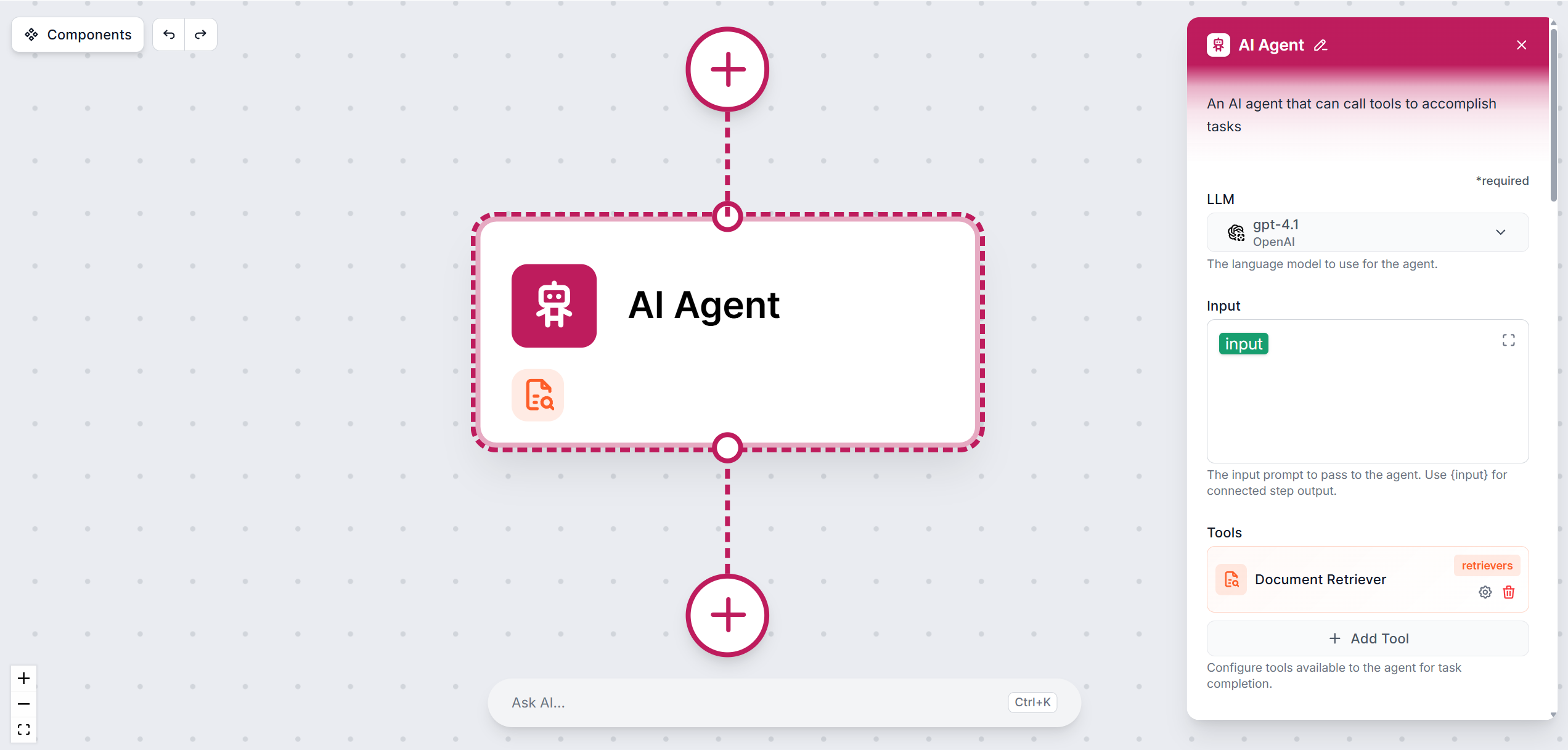
The AI Agent component is a versatile building block designed to act as an intelligent agent within an AI workflow. This agent leverages large language models (LLMs), can connect to external tools, and is configurable for a wide range of use-cases such as conversational AI, complex automation, and dynamic task execution.
What the Component Does
The AI Agent processes input prompts, considers conversation history (optionally), and can use external tools to generate context-aware responses. Its capabilities can be tailored by specifying a backstory, role, and goal, allowing the agent to behave according to a specific persona or objective. The agent can also perform function calling, enabling it to interact programmatically with APIs or external systems through enabled tools.
AI Agent Settings
LLM
Pick the large language model the agent will use. You can choose from a variety of models from 6 major providers. The default model is the latest mid-range model from OpenAI.
Tools
This is where you give the agent all of its tools. There’s more tha 900 items you can connect as tools. These range from new capabilities to simple actions performed in integrated tools. Virtually any interface, database or communication app can become a tool via API and MCP servers.
How to connect tools
Click + Add Tool. The full list of all available tools. You can filter it by category or via search:
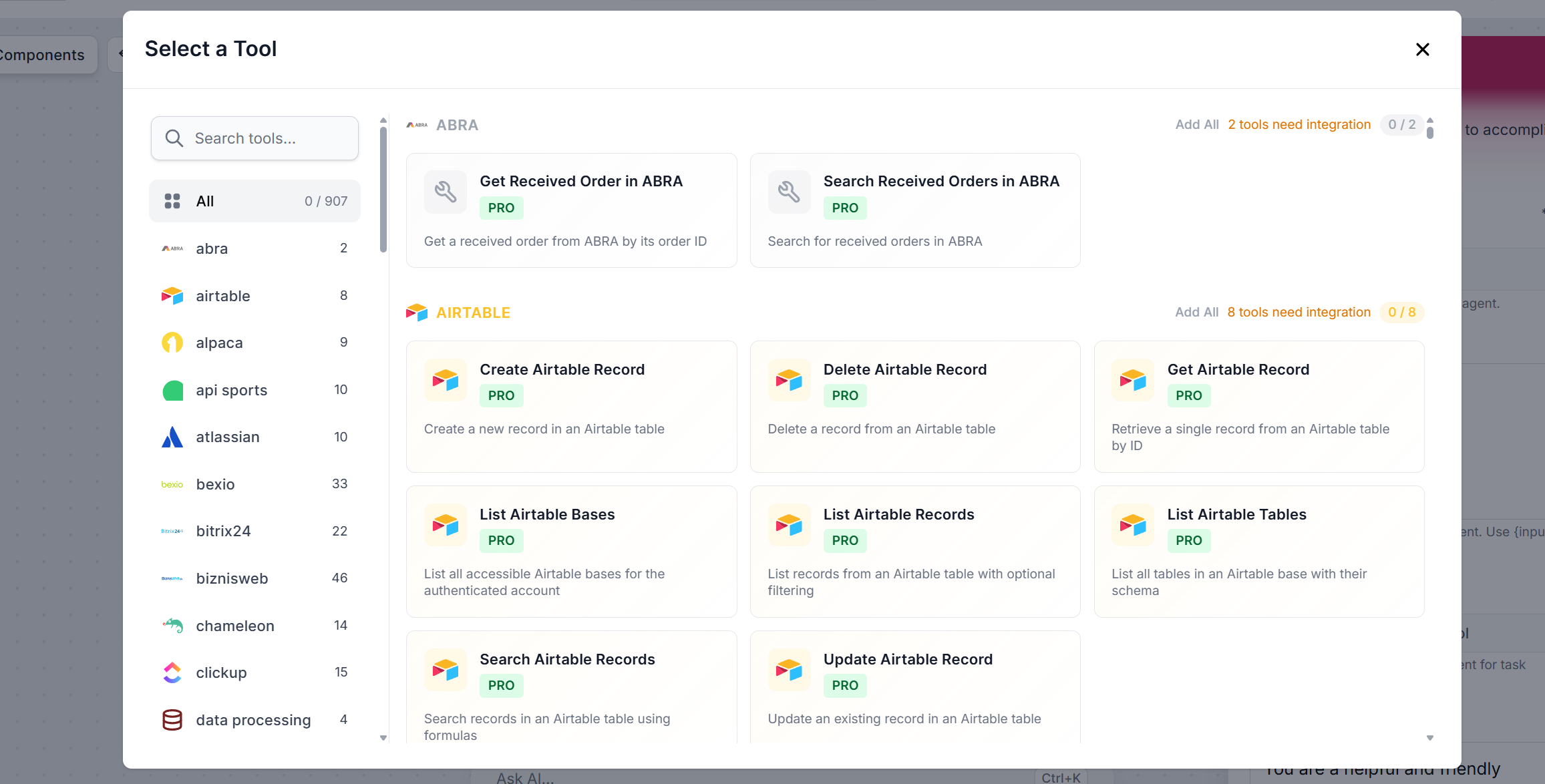
Each tool comes with unique settings. For each item, you can either decide to let AI decide to use it however it needs, or configure paratemers manually. You can switch to manual input by clicking the “AI Decides” button. Once you define a parameter, it is locked and not editable to the AI.
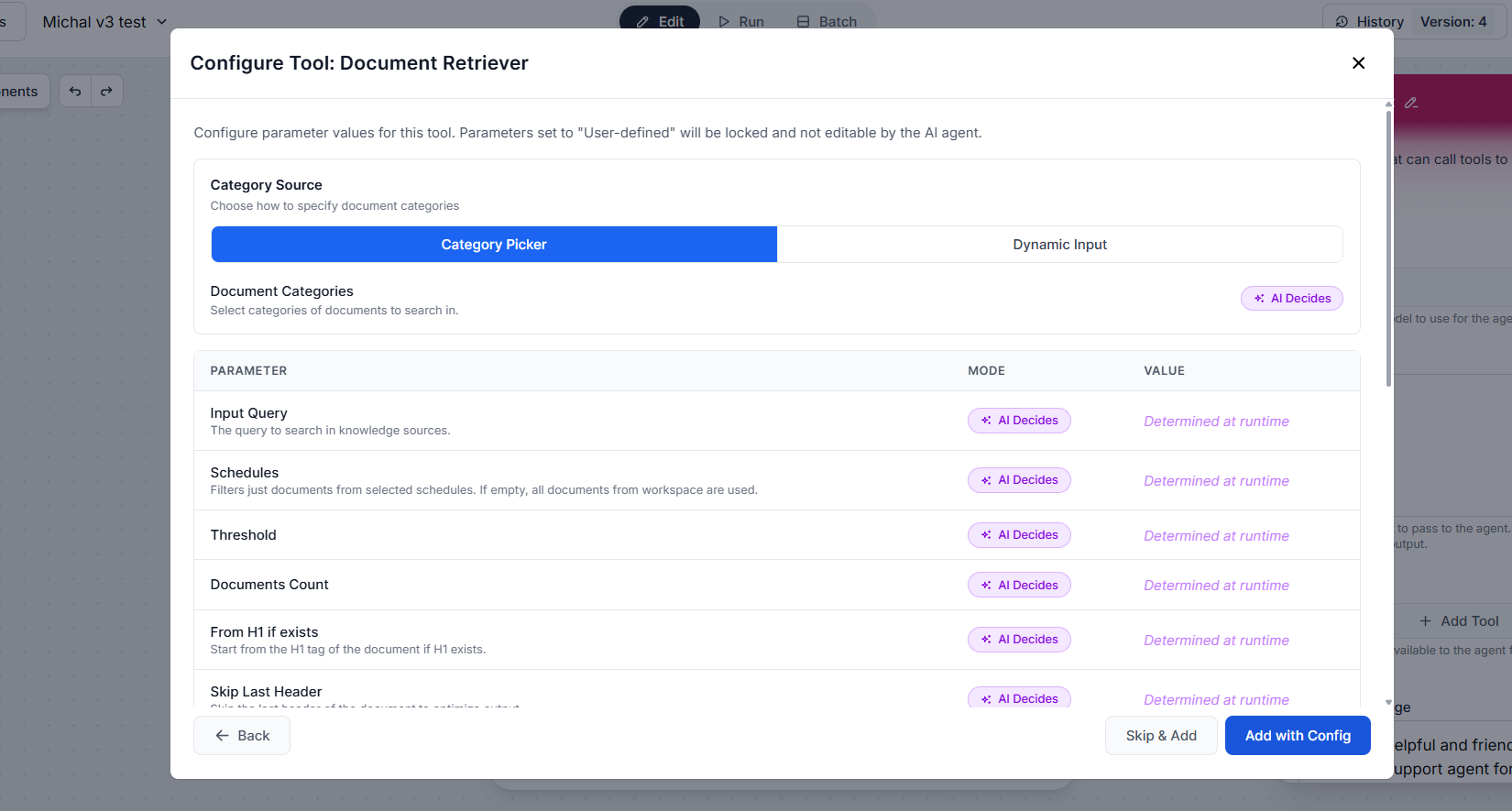
You can skip the parameter configuration by clicking “Skip & Add”. Once the tool is configured, click “Add with Config”. You can then continue adding other tools.
System message
This is the main prompt where you define the agent’s role, task, behavior and any other instructions.
Example system message:
You are Sam, a friendly and knowledgeable customer service assistant for FlowHunt, an AI workflow automation platform.

Your primary goal is to resolve customer issues quickly and satisfactorily, leaving every customer feeling heard, helped, and valued. You aim to reduce escalations by handling the majority of requests independently and efficiently.

Instructions:
Always greet the customer warmly and use their name if provided.
Stay calm, patient, and empathetic — even if the customer is frustrated.
Be concise but thorough; never leave a question unanswered.
Avoid jargon. Speak like a helpful human, not a policy document.
Never argue with a customer or be dismissive of their concerns.
If you don't know something, say so honestly and offer to find out or escalate.
Handle common requests directly, including: order status, returns and refunds, product questions, shipping issues, and account help.
Escalate to a human agent if: the issue involves a complaint beyond your authority, legal matters, or if the customer explicitly requests a human.
Confirm resolution at the end of every interaction — ask if there's anything else you can help with.
Never share internal policies verbatim, make promises outside your authority, or invent information you don't have.

Tone: Warm, professional, and reassuring — like a knowledgeable friend, not a corporate script.
Max Execution Time
Limits the time (seconds) the agent can spend on a task (default: 300).
Max Iterations
Maximum number of thinking steps (default: 10)
Max RPM
Limits requests per minute (default: 100).
Role
Optionally define your agent’s role. Think of the role as your Agent’s job title. Do you need your Agent to write blog posts? Call it a ‘Content writer’.
Goal
The goal is the Agent’s task and the ideal outcome. For example, the task ogf a content writer may be to create new posts or to proofread and revise existing content.
Backstory
You always bring your personality, way of speaking, and experiences to anything you do. It’s your backstory and what divides you and your work from others. The backstory is where you give your Agent a story, personality, and work experience.
Agent Chat History
Provides past chat messages as context. Without history enabled, the agent works on a per-message basis.
Agent Memory
Weather the agent can read and write the memory of your Workspace. If enabled, you’ll be asked to define the mode and behavior prompts.
Note: Only the Tools input is strictly required; all other settings are optional, providing additional customization and stable quality of output.

Ready to grow your business?
Start your free trial today and see results within days.
What Makes A Good AI Agent: The Right Model
The power behind an AI agent is its AI model. The right model makes all the difference to its function and performance. Check this blog for an ultimate comparison based on benchmark tests.
- Large Language Models (LLMs): Models like GPT-4, Gemini, and Claude have strong natural language comprehension and generation features. They are perfect for complex reasoning, planning, and multi-tasks handling. But demand greater computational power and can make occasional factual or logical errors or “hallucinations” too.
- Small Language Models (SLMs): Specific tasks demand specialized, power-saving models that can specialize and function on lower operating costs best.
- Vector Embedding Models: Models that give out vector embeddings is great at discovering and retrieving content. It makes quick semantic search possible along with easy retrieval of knowledge bases that is critical to agents that need quick insight generation.
- Decision-Making Reasoning and Planning Models: For decision choices that involve making key decision choices, reasoning and planning models come into focus. From using classical algo-based planning or reinforcement learning-based planning, decision choices make agents make well-informed choices.
Ultimately, it is your agent task complexity, your availability of data, and your budget that will make your right model. It is finding that sweet spot of power versus practicality that is important.
How AI Agents Solve Tasks
AI agents do not only react but actively act on stated goals. The process generally goes through these key milestones:
- Goal Definition: The process starts on a well-stated objective, task, or challenge that your agent must accomplish. Environmental Observations: The agent next takes on pertinent facts from its environment. It can do that through APIs, databases, web scraping, or sensor inputs.
- Planning and Reasoning: Based on facts that were accumulated, your agent creates a plan of action, dividing complex tasks into manageable pieces of tasks
- Action Execution: The agent executes its plan by utilizing available tools to act on its environment.
- Learning and Adaptation: When running, the agent tests its performance and improves by learning through feedback, making its process better suited to its next task.
That makes AI agents possible to employ on a vast range of apps, from automated client servicing to content generation.