


Vectorize MCP Server Integration
Integrate the Vectorize MCP Server with FlowHunt to enable advanced vector retrieval, semantic search, and text extraction for powerful AI-driven workflows. Eff...
5 min read
AI
MCP Server
+6

Empower your FlowHunt AI agents with Qdrant MCP Server — a robust semantic memory and retrieval solution for contextual conversations and advanced knowledge searches.
The Qdrant MCP Server is an official implementation of the Model Context Protocol (MCP) for the Qdrant vector search engine. Acting as a semantic memory layer, it allows AI assistants and LLM-powered applications to store and retrieve information within the Qdrant database. By exposing standardized MCP endpoints, the server enables seamless integration with external data sources, thus enhancing AI development workflows. Developers can leverage it to run vector-based queries, manage collections, and handle semantic memory for AI agents, making it ideal for tasks like knowledge retrieval, contextual memory storage, and advanced search operations in their applications.
No information about prompt templates is provided in the repository or documentation.

Start your free trial today and see results within days.
No explicit resources are documented or listed in the repository or documentation.
Get latest tips, trends, and deals for free.
mcpServers object:{
"mcpServers": {
"qdrant-mcp": {
"command": "qdrant-mcp-server",
"args": []
}
}
}
mcpServers section:{
"mcpServers": {
"qdrant-mcp": {
"command": "qdrant-mcp-server",
"args": []
}
}
}
{
  "mcpServers": {
    "qdrant-mcp": {
      "command": "qdrant-mcp-server",
      "args": []
    }
  }
}
{
  "mcpServers": {
    "qdrant-mcp": {
      "command": "qdrant-mcp-server",
      "args": []
    }
  }
}
Securing API Keys using Environment Variables
Set required environment variables to secure your API keys. Example JSON configuration:
{
  "mcpServers": {
    "qdrant-mcp": {
      "command": "qdrant-mcp-server",
      "args": [],
      "env": {
        "QDRANT_URL": "https://your-qdrant-server.example",
        "QDRANT_API_KEY": "your_qdrant_api_key"
      },
      "inputs": {
        "COLLECTION_NAME": "your_default_collection"
      }
    }
  }
}
Using MCP in FlowHunt
To integrate MCP servers into your FlowHunt workflow, start by adding the MCP component to your flow and connecting it to your AI agent:
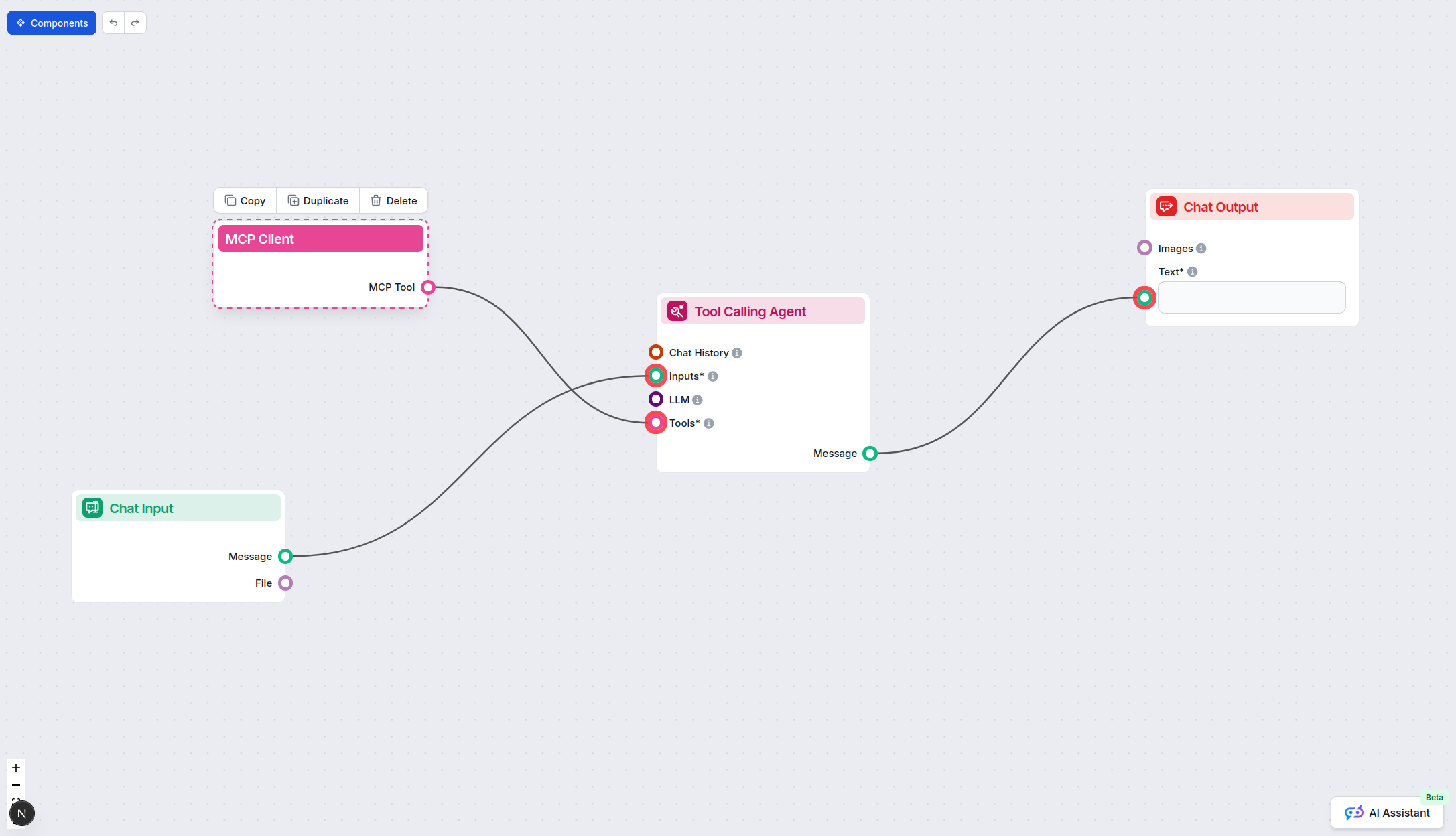
Click on the MCP component to open the configuration panel. In the system MCP configuration section, insert your MCP server details using this JSON format:
{
  "qdrant-mcp": {
    "transport": "streamable_http",
    "url": "https://yourmcpserver.example/pathtothemcp/url"
  }
}
Once configured, the AI agent is now able to use this MCP as a tool with access to all its functions and capabilities. Remember to change “qdrant-mcp” to whatever the actual name of your MCP server is and replace the URL with your own MCP server URL.
| Section | Availability | Details/Notes |
|---|---|---|
| Overview | ✅ | Official Qdrant MCP server, semantic memory layer |
| List of Prompts | ⛔ | No prompt templates documented |
| List of Resources | ⛔ | No resources explicitly documented |
| List of Tools | ✅ | qdrant-store, qdrant-find |
| Securing API Keys | ✅ | Via environment variables; documented in README |
| Sampling Support (less important in evaluation) | ⛔ | Not mentioned |
Based on the available information, the Qdrant MCP Server is solid for its core functionality and setup clarity but lacks detailed prompt and resource documentation. It scores high for tool support and licensing, but more user guidance and advanced features would be beneficial.
| Has a LICENSE | ✅ (Apache-2.0) |
|---|---|
| Has at least one tool | ✅ |
| Number of Forks | 97 |
| Number of Stars | 695 |
MCP Table Score: 7/10
The Qdrant MCP Server provides clear core functionality, a proper license, and robust tool support. However, the absence of prompt/resource documentation and unclear advanced feature support prevents a higher score.
Enhance your AI agents with semantic memory and vector search capabilities using Qdrant MCP Server. Seamlessly store, retrieve, and manage contextual knowledge within FlowHunt.
Integrate the Vectorize MCP Server with FlowHunt to enable advanced vector retrieval, semantic search, and text extraction for powerful AI-driven workflows. Eff...

The Chroma MCP Server empowers FlowHunt users with advanced vector database capabilities including semantic search, metadata filtering, and robust collection ma...

The mcp-rag-local MCP Server empowers AI assistants with semantic memory, enabling storage and retrieval of text passages based on meaning, not just keywords. I...
Cookie Consent
We use cookies to enhance your browsing experience and analyze our traffic. See our privacy policy.