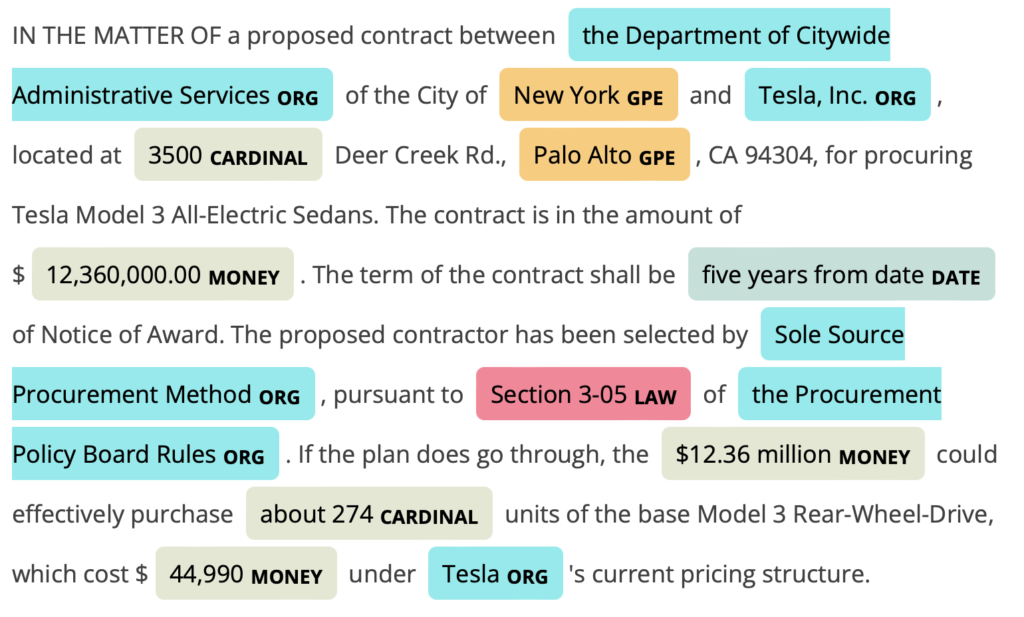
Named Entity Recognition (NER) is a key subfield of Natural Language Processing (NLP) in AI, focusing on identifying and classifying entities in text into predefined categories such as people, organizations, and locations to enhance data analysis and automate information extraction.
Named Entity Recognition (NER)
Named Entity Recognition (NER) is an NLP subfield essential for identifying and classifying entities in text into categories like people, locations, and organizations. It enhances data analysis across various domains, leveraging AI and machine learning techniques.
Named Entity Recognition (NER) is a crucial subfield within Natural Language Processing bridges human-computer interaction. Discover its key aspects, workings, and applications today!") (NLP), which is itself a branch of artificial intelligence (AI) focused on enabling machines to understand and process human language. NER’s primary function is to identify and classify key pieces of information in text—known as named entities—into predefined categories such as people, organizations, locations, dates, and other significant terms. It is also referred to as entity chunking, entity extraction, or entity identification.
NER operates by detecting and categorizing essential information within text, encompassing a wide spectrum of subjects such as names, locations, companies, events, products, themes, times, monetary values, and percentages. As a cornerstone technology in AI fields, including machine learning and deep learning, NER has become pivotal in various scientific domains and practical applications, revolutionizing how we interact with and analyze textual data.
How Does NER Work?
NER operates through a multi-step process that involves:
Entity Detection: The system scans the text to identify words or phrases that qualify as entities. This often involves tokenization, which breaks down the text into manageable units called tokens.
Entity Classification: Once entities are detected, they are categorized into predefined classes such as PERSON, ORGANIZATION, LOCATION, etc. Advanced systems may use machine learning models trained on annotated datasets to enhance accuracy.
Post-Processing: After classification, NER systems may perform additional tasks such as linking entities to databases, known as entity linking, to enhance the extracted data’s utility.
The technique involves building algorithms capable of accurately identifying and classifying entities from textual data. This necessitates a profound understanding of mathematical principles, machine learning algorithms, and possibly image processing techniques. Alternatively, leveraging popular frameworks like PyTorch and TensorFlow, alongside pre-trained models, can expedite the development of robust NER algorithms tailored to specific datasets.
Types of NER Systems
Rule-Based Systems Rely on a set of predefined linguistic rules to identify and classify entities. While straightforward, they can struggle with variations in text and require constant updates.
Machine Learning-Based Systems Use algorithms such as Conditional Random Fields (CRF) or Maximum Entropy Markov Models (MEMM) trained on labeled data. They are more adaptable but require substantial amounts of annotated data.
Deep Learning-Based Systems Employ neural networks, such as Recurrent Neural Networks (RNNs) or Transformers like BERT, to automatically learn features from data, reducing the need for manual feature engineering.
Hybrid Systems Combine rule-based and machine learning approaches to leverage the strengths of both.
Use Cases and Applications
NER is utilized across various domains due to its ability to structure unstructured text data. Here are some notable use cases:
Information Retrieval: Enhances search engines by making search results more relevant and precise based on identified entities in queries.
Content Recommendation: Powers recommendation engines by identifying topics of interest in user interactions, such as Netflix’s content suggestions based on user preferences.
Sentiment Analysis: NER aids in pinpointing which entities in reviews or feedback are associated with positive or negative sentiments, allowing businesses to address specific concerns.
Automated Data Entry and RPA: In corporate settings, NER enables software bots to extract and input key data from documents like invoices or contracts into management systems, improving efficiency.
Healthcare: Extracts critical medical information from patient records or clinical notes, facilitating better patient management and research.
Finance: Identifies and tracks mentions of companies or financial metrics in news and social media, aiding in market analysis and risk assessment.
Legal and Compliance: Helps in identifying relevant legal terms and parties in large volumes of text, streamlining compliance checks and contract analysis.
Chatbots and AI Assistants: Systems like OpenAI’s ChatGPT and Google’s Bard utilize NER models to decipher user queries effectively, grasping the context and delivering more accurate responses.
Customer Support: Departments leverage NER systems to categorize feedback and complaints based on product names, enabling prompt and efficient responses.
Educational Institutions: NER enables students, researchers, and educators to navigate vast amounts of textual data, facilitating faster access to relevant information and accelerating research processes.
Benefits of NER
Automation of Data Extraction: Reduces the need for manual data entry by automatically extracting structured information from unstructured text.
Improved NLP Accuracy: Enhances other NLP bridges human-computer interaction. Discover its key aspects, workings, and applications today!") tasks such as question answering in question answering, enhancing accuracy with real-time data. Discover more!") and machine translation by providing structured data inputs.
Insight Generation: Offers organizations insights into trends, customer feedback, and market conditions by analyzing large volumes of text data.
Challenges of NER
Ambiguity: Difficulty in handling homonyms (e.g., “Apple” can be a fruit or a company) and varying contexts.
Language Variations: Struggles with different languages or dialects due to a lack of annotated data.
Domain-Specific Entities: Requires domain-specific training data to accurately identify and classify entities unique to certain fields.
Key Concepts and Terms
POS Tagging: Part-of-speech tagging assigns parts of speech to words in a text, aiding in understanding context.
Corpus: A large collection of texts used for training NER models.
Chunking: Groups words into meaningful chunks, such as noun phrases, for easier analysis.
Word Embeddings: Dense vector representations of words that capture semantic meanings, used to improve model accuracy.
Implementing NER
To implement NER, one can use frameworks and libraries such as:
SpaCy: An open-source library in Python known for its speed and efficiency in NLP tasks including NER.
Stanford NER: A Java-based library offering pre-trained models for entity extraction.
OpenNLP: Provides tools for various NLP tasks, including NER, and supports multiple languages.
Azure AI Language Services: Offers pre-built and custom NER features for identifying and categorizing entities in unstructured text.
These tools often come with pre-trained models, but for customized applications, training on domain-specific data is recommended to achieve higher accuracy.
Research on Named Entity Recognition (NER)
Named Entity Recognition (NER) is a crucial task in Natural Language Processing (NLP) that involves identifying and classifying named entities in text into predefined categories such as names of persons, organizations, locations, expressions of times, quantities, monetary values, percentages, etc. Here are some significant research papers on NER that provide insights into different aspects and approaches to this task:
Named Entity Sequence Classification
Authors: Mahdi Namazifar
Published: 2017-12-06 This paper focuses on the problem of determining confidence levels for detected named entities, referred to as Named Entity Sequence Classification (NESC). The study frames NESC as a binary classification task, utilizing NER and recurrent neural networks to estimate the probability of a candidate named entity being genuine. The approach is applied to Twitter data, demonstrating how to identify high-confidence named entities from Tweets. The research highlights the importance of reliable confidence measures in applications like content recommendations. Read more
Open Named Entity Modeling from Embedding Distribution
Authors: Ying Luo, Hai Zhao, Zhuosheng Zhang, Bingjie Tang
Published: 2021-02-10 This paper explores named entity distribution in a general word embedding space, proposing an open definition for multilingual named entities. The study reveals that named entities tend to cluster together in embedding spaces, enabling the modeling of entities using a geometric structure called the named entity hypersphere. This model provides an open description for diverse entity types and languages and offers a novel approach to building named entity datasets for resource-poor languages. The findings suggest enhancements for state-of-the-art NER systems. Read more
CMNEROne at SemEval-2022 Task 11: Code-Mixed Named Entity Recognition by leveraging multilingual data
Authors: Suman Dowlagar, Radhika Mamidi
Published: 2022-06-15 This paper addresses the challenges of NER in code-mixed text, which involves linguistic complexity due to mixing of languages. The work is part of the SEMEVAL 2022 shared task on MultiCoNER, focusing on identifying named entities in a code-mixed dataset by leveraging multilingual data. The team achieved a weighted average F1 score of 0.7044, outperforming the baseline by 6%. The research underscores the difficulties and strategies for effective NER in multilingual and code-mixed contexts. Read more
Frequently asked questions
NER is a subfield of NLP and AI focused on automatically identifying and classifying entities—such as people, organizations, locations, dates, and more—within unstructured text data.
NER systems typically detect potential entities in text, classify them into predefined categories, and may use rule-based, machine learning, or deep learning approaches to improve accuracy.
NER is widely used in information retrieval, content recommendation, sentiment analysis, automated data entry, healthcare, finance, legal compliance, chatbots, customer support, and academic research.
NER systems can struggle with ambiguity, language variations, and domain-specific terms, often requiring tailored training data and models for optimal performance.
Popular NER tools include SpaCy, Stanford NER, OpenNLP, and Azure AI Language Services, many of which come with pre-trained models and support custom training.
Try FlowHunt for Powerful NER Solutions
Leverage FlowHunt’s AI tools to automate entity extraction and accelerate your NLP projects with ease.
Natural Language Processing (NLP) is a subfield of artificial intelligence (AI) enabling computers to understand, interpret, and generate human language. Discov...
Extractive AI is a specialized branch of artificial intelligence focused on identifying and retrieving specific information from existing data sources. Unlike g...
Natural Language Understanding (NLU) is a subfield of AI focused on enabling machines to comprehend and interpret human language contextually, going beyond basi...
11 min read
NLU
AI
+4
Cookie Consent We use cookies to enhance your browsing experience and analyze our traffic. See our privacy policy.