

Discord MCP Server
The Discord MCP Server bridges AI assistants with Discord, enabling automated server management, message automation, and integration with external APIs via the ...
4 min read
AI
Discord
+4

Connect Klaviyo’s email marketing automation platform with AI-powered workflows using the Klaviyo MCP Server for seamless campaign management, customer segmentation, and marketing automation through natural language.
The Klaviyo MCP Server revolutionizes email marketing automation by connecting Klaviyo’s powerful platform with AI assistants and developer tools through the Model Context Protocol (MCP). This integration empowers marketing teams to manage sophisticated email campaigns, customer profiles, automation flows, and audience segments using natural language commands instead of navigating multiple dashboards. Whether you’re creating personalized campaigns, tracking customer events, building complex segments, or orchestrating multi-step automation flows, the Klaviyo MCP Server enables you to execute these tasks directly from AI tools like Claude, Cursor, or FlowHunt. By eliminating context switching and enabling AI-powered automation, marketing teams can reduce campaign setup time from hours to minutes while maintaining full control over their customer engagement strategy.
Find all customer profiles who haven't opened emails in 90 days
Create a new profile for customer@example.com with custom properties for VIP status
Show me all profiles who purchased in the last 30 days but haven't received a follow-up email
Update all profiles in the VIP segment to add a loyalty tier property
Create a new email campaign for Black Friday with subject line 'Exclusive 40% Off' targeting VIP customers
Show me all campaigns sent in the last 7 days with open rates below 15%
Send the 'Welcome Series Part 1' campaign immediately to all new subscribers
Cancel the scheduled campaign for tomorrow and reschedule it for next week
Create a new list called 'Q1 2026 Re-engagement' for inactive subscribers
Add all profiles who clicked our last email but didn't purchase to the 'Hot Leads' list
Show me all segments with more than 5000 profiles and their criteria
Create a new email template for our product launch with HTML content
Show me all templates used in campaigns with conversion rates above 5%
Update the 'Holiday Promotion' template with new discount code HOLIDAY2026
Track a 'Product Viewed' event for all profiles who visited our new collection page
Show me all 'Purchase' events from the last 30 days with order values above $100
Get all metrics for email performance and show me which campaigns drove the most revenue
Show me all active automation flows and their conversion rates
Pause the 'Cart Abandonment' flow while we update the email templates
Set the 'Welcome Series' flow to live status and enable it for new subscribers

Start your free trial today and see results within days.
No explicit resources are listed in the repository.
The Klaviyo MCP Server provides 39 comprehensive tools organized into eight categories:
Get latest tips, trends, and deals for free.
You’re staring at thousands of inactive subscribers clogging your list, hurting deliverability. Instead of manually creating segments, filters, and multi-touch campaigns, ask: “Find all profiles who haven’t opened emails in 90 days, create a segment called ‘Re-engagement Q1 2026’, and set up a three-email winback campaign using our reactivation template.” The MCP server builds the segment, creates the campaigns, assigns templates, and prepares the entire re-engagement sequence in under 2 minutes—work that traditionally takes 2-3 hours.
Your new premium product launches tomorrow and you need to target customers based on their lifetime value and previous purchases. Simply say: “Create segments for customers who spent over $500 in the past year but haven’t purchased in 60 days, and another for customers who bought our starter product but never upgraded.” The server instantly creates both segments, letting you tailor messaging for each group—critical work that usually requires complex filter building and multiple rounds of QA.
You’ve sent dozens of campaigns and need to identify your best-performing templates to replicate success. Ask: “Show me all campaigns sent in Q4 2025, their assigned templates, and their conversion metrics.” Instead of exporting data, cross-referencing template IDs, and building spreadsheets manually, you get instant analysis showing which templates consistently outperform, enabling data-driven creative decisions without the usual 4-5 hour analysis process.
Your SaaS application tracks critical user behaviors—trial starts, feature adoption, usage milestones—and you need these events in Klaviyo to trigger personalized nurture flows. Command: “Create a ‘Feature X Activated’ event for all profiles in my power users segment with timestamp and feature properties.” The MCP server batch-creates events with proper attribution, enabling sophisticated behavioral marketing without writing custom API scripts or waiting for engineering resources.
You manage three distinct brands under one company, and Brand A’s holiday campaign crushed it with 42% open rates. Instead of manually recreating the campaign structure for Brands B and C, say: “Get campaign ID abc123, show me its structure, template, and settings, then help me create identical campaigns for my Brand B and Brand C lists.” The server retrieves all campaign details and helps you replicate success across brands in minutes instead of hours of copying, pasting, and double-checking settings.
Peak season demands multiple email variations for different segments—new customers, VIPs, window shoppers, abandoned carts. Rather than manually creating 20 separate campaigns through the UI, instruct: “Create campaigns for Black Friday targeting these 5 segments: VIP customers, repeat buyers, one-time purchasers, email subscribers who never bought, and cart abandoners. Use our holiday template and customize subject lines for each.” The MCP server generates all campaigns with appropriate targeting and templates, reducing 6+ hours of repetitive work to 15 minutes of AI-guided campaign creation.
You sent a campaign and realized the promo code in your template is wrong. You have 15 more scheduled campaigns using that same template. Instead of manually updating each campaign or panicking, say: “Show me all campaigns scheduled for the next 7 days using template ID xyz789, then update the template to change PROMO20 to PROMO25.” The server identifies affected campaigns and updates the master template instantly, preventing 15 potential disasters without manually auditing your campaign calendar.
Your retention campaign targets customers who received your last email, opened it, clicked through, but didn’t complete checkout—and they also purchased in the past but not in the last 45 days. Building this multi-condition segment through Klaviyo’s UI means navigating nested filters and conditional logic. Instead, describe your criteria naturally: “Create a segment of profiles who opened campaign ID abc123, clicked any link, have at least one past order, but no orders in the last 45 days and no checkout completion.” The AI translates your natural language into proper segment criteria, eliminating filter-building frustration.
You’re discontinuing a product line and need to notify affected customers, offer alternatives, and provide a last-chance purchase window. Command: “Find all profiles who purchased product SKU 12345 in the past 2 years, create a list called ‘Product Discontinuation - SKU 12345’, and set up a 3-email sequence: announcement, alternatives, last chance.” The MCP server identifies affected customers, organizes them into a targetable list, and structures your sunset campaign—strategic work that typically requires data exports, CSV uploads, and manual campaign configuration.
Your typical 25% open rate plummeted to 12% over the past week and leadership wants answers. Ask: “Show me all campaigns sent in the past 14 days with their open rates, click rates, and send times. Compare this to campaigns from the previous 30 days.” The server delivers comparative metrics across campaigns, helping you identify patterns—maybe send time changed, certain segments stopped engaging, or specific templates underperform—surfacing insights that usually require exporting multiple reports and building comparison charts.
You’re migrating to a new CRM and need to pause 30+ automation flows to prevent duplicate communications during the transition. Rather than clicking through each flow individually in the Klaviyo dashboard, say: “Show me all active flows, then set flows containing ‘abandoned cart’, ‘welcome series’, and ‘post-purchase’ to draft status.” The MCP server batch-updates flow statuses, giving you precise control during critical operations without the risk of missing a flow in manual updates.
You hosted a webinar with 500 attendees, and you need to track who attended, what topics they engaged with, and trigger personalized follow-up campaigns. Instruct: “Create a ‘Webinar Attended - AI Marketing’ event for these 500 profile IDs with properties including attendance duration and poll responses, then create a segment of attendees who stayed over 30 minutes.” The server processes bulk event creation with custom properties and builds actionable segments, enabling sophisticated behavioral follow-up without manual data entry or complex CSV imports.
You suspect deliverability issues because engagement varies wildly across your 15 different email lists. Some lists have 35% open rates, others barely hit 8%. Ask: “Show me all my lists, their subscriber counts, and recent campaign performance for each list in the past 30 days.” The MCP server aggregates list data and associated campaign metrics, revealing which lists need cleaning, which are highly engaged, and where to focus deliverability efforts—insights that typically require exporting multiple reports and hours of manual cross-referencing.
You’re moving from batch-and-blast to lifecycle marketing and need to create 8 different campaign series for prospects, new customers, active users, at-risk customers, churned customers, VIPs, referrers, and brand advocates. Instead of manually building each series through the UI, collaborate with the AI: “Help me create campaign structures for 8 lifecycle stages. For each stage, I’ll provide the segment criteria and messaging angle, and you create the campaigns with appropriate templates and sending schedules.” The MCP server accelerates sophisticated lifecycle program buildout from weeks to days.
You’re testing subject line approaches—urgency vs. benefit-driven vs. personalization—across 6 different customer segments to understand what resonates with each group. Rather than creating 18 campaigns manually, say: “Create A/B test campaigns for these 6 segments using three subject line variations: urgency, benefit, and personalization. Use our standard promotional template for all.” The MCP server generates the entire test matrix, enabling sophisticated multivariate testing without drowning in campaign creation work.
mcpServers configuration:{
"mcpServers": {
"klaviyo-mcp": {
"command": "python3",
"args": ["-m", "klaviyo_mcp_server"],
"env": {
"KLAVIYO_CLIENT_ID": "your_client_id",
"KLAVIYO_CLIENT_SECRET": "your_client_secret",
"KLAVIYO_ACCESS_TOKEN": "your_access_token"""
}
}
}
}
mcpServers field in your Claude configuration:{
"mcpServers": {
"klaviyo-mcp": {
"command": "python3",
"args": ["-m", "klaviyo_mcp_server"],
"env": {
"KLAVIYO_CLIENT_ID": "your_client_id",
"KLAVIYO_CLIENT_SECRET": "your_client_secret",
"KLAVIYO_ACCESS_TOKEN": "your_access_token"
}
}
}
}
{
  "mcpServers": {
    "klaviyo-mcp": {
      "command": "python3",
      "args": ["-m", "klaviyo_mcp_server"],
      "env": {
        "KLAVIYO_CLIENT_ID": "your_client_id",
        "KLAVIYO_CLIENT_SECRET": "your_client_secret",
        "KLAVIYO_ACCESS_TOKEN": "your_access_token"
      }
    }
  }
}
{
  "mcpServers": {
    "klaviyo-mcp": {
      "command": "python3",
      "args": ["-m", "klaviyo_mcp_server"],
      "env": {
        "KLAVIYO_CLIENT_ID": "your_client_id",
        "KLAVIYO_CLIENT_SECRET": "your_client_secret",
        "KLAVIYO_ACCESS_TOKEN": "your_access_token"
      }
    }
  }
}
Securing API Keys (using environment variables):
To protect your Klaviyo credentials, always use environment variables rather than hardcoding them. Example secure configuration:
{
  "mcpServers": {
    "klaviyo-mcp": {
      "command": "python3",
      "args": ["-m", "klaviyo_mcp_server"],
      "env": {
        "KLAVIYO_CLIENT_ID": "${KLAVIYO_CLIENT_ID}",
        "KLAVIYO_CLIENT_SECRET": "${KLAVIYO_CLIENT_SECRET}",
        "KLAVIYO_ACCESS_TOKEN": "${KLAVIYO_ACCESS_TOKEN}",
        "KLAVIYO_REFRESH_TOKEN": "${KLAVIYO_REFRESH_TOKEN}"
      }
    }
  }
}
Set these environment variables in your system or shell profile before launching your MCP client.
Using MCP in FlowHunt
To integrate the Klaviyo MCP server into your FlowHunt workflow, start by adding the MCP component to your flow and connecting it to your AI agent:
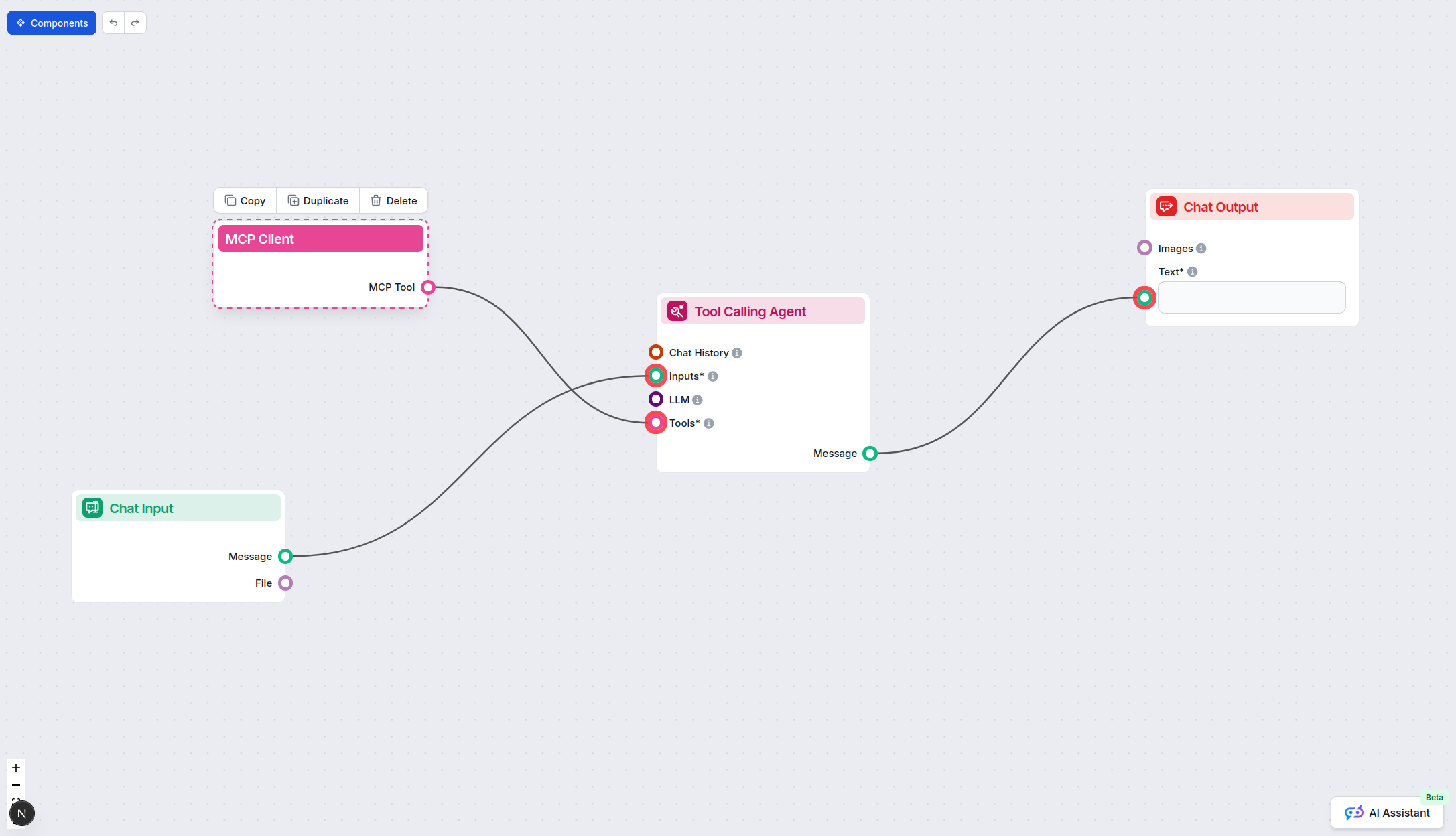
Click on the MCP component to open the configuration panel. In the system MCP configuration section, insert your Klaviyo MCP server details using this JSON format:
{
  "klaviyo-mcp": {
    "transport": "streamable_http",
    "url": "https://yourmcpserver.example/klaviyo-mcp"
  }
}
Once configured, your AI agent gains access to all 39 Klaviyo tools, enabling it to create campaigns, manage customer profiles, track events, orchestrate flows, and analyze metrics—all within your automated workflows. This transforms your FlowHunt flows into powerful marketing automation engines that can respond to triggers, segment audiences, and execute campaigns without manual intervention.
| Section | Availability | Details/Notes |
|---|---|---|
| Overview | ✅ | |
| List of Prompts | ⛔ | No prompt templates found |
| List of Resources | ⛔ | Not explicitly listed |
| List of Tools | ✅ | 39 tools across 8 categories |
| Securing API Keys | ✅ | OAuth with environment variable support |
| Sampling Support (less important in evaluation) | ⛔ | Not documented |
Between the documentation and the code, the Klaviyo MCP Server provides comprehensive tool coverage with 39 distinct operations spanning profile management, campaign automation, list management, event tracking, metrics analysis, segmentation, flow orchestration, and template management. The server uses OAuth authentication with secure credential management through environment variables.
This MCP server excels in breadth and depth of marketing automation capabilities, offering the most comprehensive Klaviyo integration available through the Model Context Protocol. With 39 well-documented tools organized into logical categories, marketing teams gain unprecedented control over their email marketing operations through natural language interfaces. The OAuth implementation ensures enterprise-grade security, while the extensive tool coverage eliminates the need for manual dashboard work in most scenarios. This server is ideal for marketing teams, marketing operations professionals, and developers building marketing automation workflows who want to leverage AI for campaign management, customer segmentation, and engagement optimization. The lack of built-in prompt templates is offset by the intuitive tool naming and clear descriptions that make natural language interaction straightforward.
| Has a LICENSE | ✅ |
|---|---|
| Has at least one tool | ✅ (39) |
| Number of Forks | 0 |
| Number of Stars | 0 |
FlowHunt provides an additional security layer between your internal systems and AI tools, giving you granular control over which tools are accessible from your MCP servers. MCP servers hosted in our infrastructure can be seamlessly integrated with FlowHunt's chatbot as well as popular AI platforms like ChatGPT, Claude, and various AI editors.
The Klaviyo MCP Server is a bridge between Klaviyo's email marketing platform and AI tools via the Model Context Protocol (MCP). It enables natural language control of email campaigns, customer profiles, automation flows, and segmentation directly from AI assistants like Claude, eliminating the need to switch between platforms.
Marketing teams can automate campaign creation, manage customer segments in real-time, track engagement metrics, create and assign email templates, orchestrate multi-step automation flows, and analyze campaign performance—all through natural language commands that save hours of manual work.
Always store your Klaviyo OAuth credentials (client_id, client_secret, access_token) as environment variables rather than hardcoding them in configuration files. Set KLAVIYO_CLIENT_ID, KLAVIYO_CLIENT_SECRET, and KLAVIYO_ACCESS_TOKEN in your MCP server environment configuration for secure access.
Yes, you can configure multiple instances of the Klaviyo MCP server with different OAuth credentials for each Klaviyo account. Simply create separate server entries in your MCP configuration with unique names and credentials for each account.
Absolutely! The server provides full access to Klaviyo flows, allowing you to retrieve flow details, update flow status (live, manual, draft), and integrate flow management into your AI-powered marketing workflows.
Add the MCP component to your FlowHunt flow and connect it to your AI agent. Open the MCP configuration and insert your Klaviyo server details in JSON format. Once configured, your AI agent can execute all Klaviyo operations, from creating campaigns to segmenting customers, as part of automated workflows.
You'll need OAuth credentials with appropriate API permissions for the operations you want to perform. Typically this includes read/write access to profiles, lists, campaigns, templates, flows, segments, metrics, and events. Configure these permissions in your Klaviyo account's API settings.
Transform your email marketing workflows with AI-powered automation. Manage campaigns, segment customers, and optimize engagement directly from your favorite AI tools.
The Discord MCP Server bridges AI assistants with Discord, enabling automated server management, message automation, and integration with external APIs via the ...

Transform Google Ads campaign management with AI-powered automation using the Google Ads MCP Server. Seamlessly integrate Google Ads data and operations with AI...
The Keycloak MCP Server enables AI-powered management of Keycloak users and realms through a Model Context Protocol (MCP) interface, automating administrative t...
Cookie Consent
We use cookies to enhance your browsing experience and analyze our traffic. See our privacy policy.