How to Stop ChatGPT Hallucinating on Regulated Compliance Work
ChatGPT drifts, hallucinates figures and breaks house style on regulated compliance notes. Here is the prompt-hardening and stateless-agent method that made a UK Responsible Gambling workflow audit-ready — with model testing across 9 models and 27 runs.
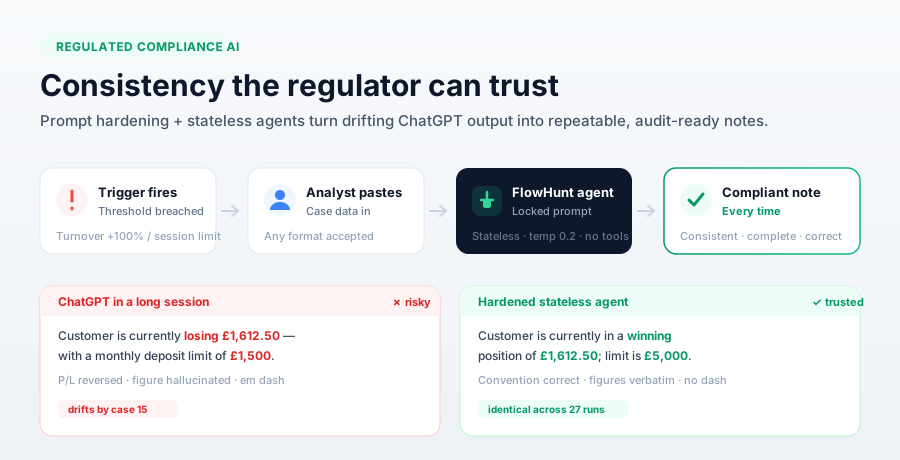
A UK Responsible Gambling (RG) team came to us with a problem that anyone automating regulated work will recognise. They use ChatGPT to turn automated compliance triggers into formal analyst notes. When a customer breaches a threshold — turnover up more than 100% in 30 days, a session running past its limit — an analyst copies the relevant data into ChatGPT, and the model, following a pre-uploaded prompt, drafts a note for the customer’s compliance file.
That note is not a draft email. It is a legal document reviewable by the UK Gambling Commission. And after a while, ChatGPT started to hallucinate figures, miss key information, insert em dashes that broke house style, and quietly drift away from the rules by the afternoon. On a regulated file, each of those is a compliance issue.
The question they asked was simple: can we get the consistency regulated work requires from a language model at all? The answer is yes — but not by tweaking the wording of a prompt inside a chat window. It takes a change in architecture plus a disciplined rewrite. This article walks through the exact method, using the RG workflow as the worked example, so you can apply it to any regulated process where the same input must produce the same trustworthy output every single time.
Why ChatGPT drifts on regulated work
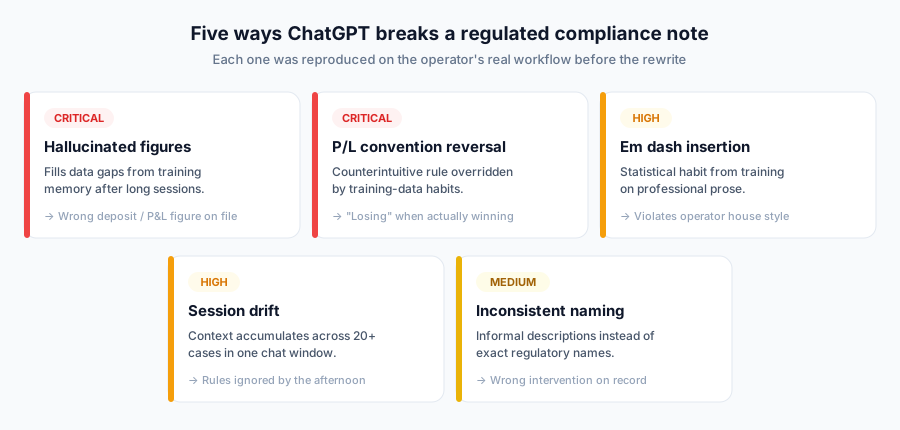
Before fixing anything, it helps to name the failure modes precisely. On the RG workflow we reproduced five distinct ways the output broke, ranging from critical to merely annoying.
The two critical ones are the dangerous pair. Hallucinated figures put a wrong deposit or profit-and-loss number on a regulated file — the model fills a gap from training memory rather than admitting the data is absent. Convention reversal is subtler: this operator uses an inverted profit-and-loss convention where a positive number means the customer is losing. It is counterintuitive, so the model reverts to the standard convention it learned in training and writes that a customer is losing when they are actually winning.
The high-severity issues — em dashes that violate house style, and session drift where rules are ignored later in the day — do not put a wrong number on file, but they erode trust in the output and create rework. The medium issue, informal intervention names instead of the exact regulatory terms, quietly corrupts the compliance record.
The root cause is statelessness — or the lack of it
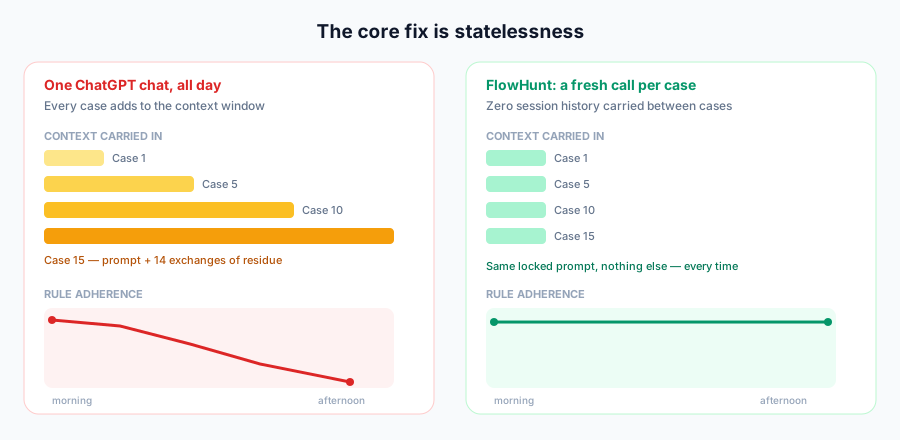
Four of those five failures share one root cause. In a single ChatGPT session, every case you review is appended to the context window. Review case one and the model sees the prompt and one case. By case fifteen it sees the prompt plus the statistical residue of fourteen previous exchanges. The prompt’s rules are still there, but they are competing with a growing pile of context, and attention to them decays.
This is why the same prompt produces a perfect note at 9am and a flawed one at 4pm. The architectural fix is statelessness: every case must be a completely fresh, isolated call that sees only the locked prompt and the current case. Nothing carries over. An AI agent
configured this way gives the prompt the same attention on case fifty as it did on case one.
Statelessness is necessary but not sufficient. It stops the drift, but it will faithfully reproduce a bad prompt on every call. So the prompt itself has to be hardened.
Ready to grow your business?
Start your free trial today and see results within days.
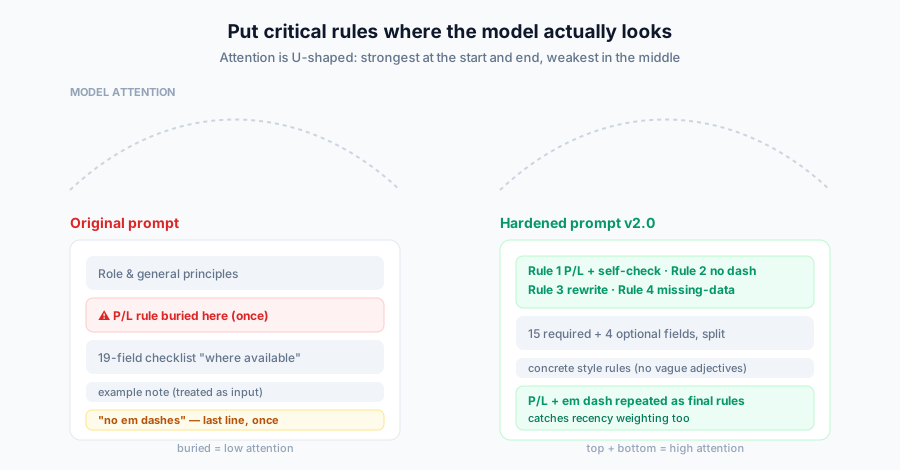
Language models do not weight every line of a prompt equally. Attention is roughly U-shaped — strongest at the beginning and the end, weakest in the middle. The original RG prompt fought this. Its most important rule, the inverted profit-and-loss convention, sat in the middle of the prompt, stated once. The em dash ban was the very last line, also stated once.
The rewrite moved the critical rules to where the model actually looks and reworked the weak parts of the system prompt
. Here is what changed and why.
Original
Hardened v2.0
Why it matters
P/L rule buried mid-prompt, stated once
Rule 1 at the very top with a self-check step, repeated in the writing-style section
Primacy weighting — the most important rule must come first
Em dash ban at the very end, once
Rule 2 at the top, repeated as the final rule at the bottom
Catches both primacy and recency weighting
No instruction for incomplete input
Rule 4 — missing-data protocol with an exact response format
Eliminates hallucination and creates an audit trail
No instruction for input format
Rule 3 — accept any format, always rewrite from scratch
Stops the model from lightly reformatting a pasted note
Vague adjectives are not followed; concrete rules are
Example note included
Example removed entirely
The model treated the example as input to respond to
The single biggest lesson here: vague adjectives are not instructions. Telling a model to be “natural” actively encouraged the em dashes and rhetorical flourishes that broke house style. Replacing that with concrete, testable rules is what made the style consistent.
Step 2: Handle missing data instead of inventing it
Hallucination is often framed as a model defect. On structured work it is usually a prompt defect: the prompt never told the model what to do when a field is absent, so it did the statistically likely thing and produced a plausible value.
The fix is a missing-data protocol. Split your fields into required and optional. Optional fields are omitted silently when absent. Required fields do the opposite — if one is missing, the model must stop and request it in an exact format rather than generate a note. That single rule converts a silent hallucination into a visible, auditable prompt for more data. It is the difference between a wrong figure on a regulated file and a note that was never produced because the input was incomplete.
Join our newsletter
Get latest tips, trends, and deals for free.
Step 3: Lock the agent configuration
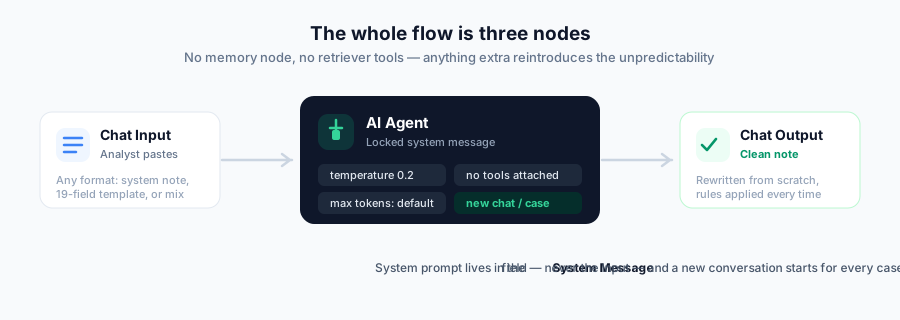
With a hardened prompt, the agent itself has to be locked down so nothing reintroduces variability. The whole flow is deliberately minimal — three nodes and nothing else.
The configuration choices that mattered:
System prompt in the System Message field, never the Input field, so it is read as instructions rather than data.
Temperature 0.2. Low enough for maximum consistency, high enough to avoid robotic prose. Zero was too rigid; one was too creative.
No tools attached. File and URL retrievers introduce unpredictability and can bypass the agent’s reasoning. For this task the model needs nothing but the prompt and the pasted case.
Max tokens left at default. Capping tokens caused notes to truncate mid-sentence, and a truncated note on a customer file is itself a regulatory risk.
A silent-start instruction at the top of the prompt, so the agent does not confirm the rules back to the analyst when the flow first loads.
The one operational rule that matters most
Every fix above is undone by one bad habit: reusing the same chat. The most important operational rule for the analyst team is to start a new conversation for every single case. Never continue reviewing cases in the same window. This is the rule that eliminates session drift — the root cause of most of the original failures — and it costs nothing to follow.
Consistency Is an Architecture Problem, Not a Wording Problem
If your team is fighting a drifting prompt inside a chat window, the fix is a hardened prompt running on a stateless agent. FlowHunt lets you lock the prompt, pin the model and temperature, and run a clean call per case. Let us help you get there.
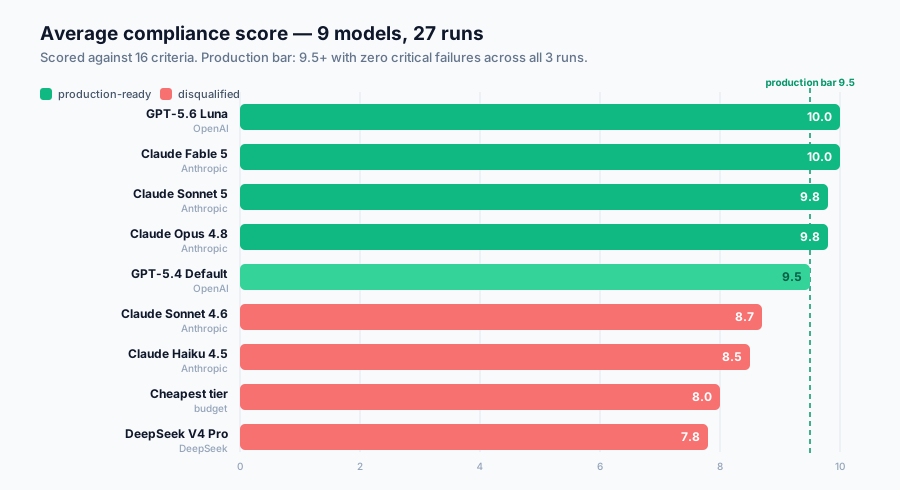
A method is only as good as its evidence. We tested nine models against the hardened prompt, using an identical real case (a Gambling Intensity trigger with prior session-duration history) across three runs each — 27 runs in total — and scored every run against 16 compliance criteria.
Across all 27 runs, no production-ready model hallucinated a figure, reversed the P/L convention, used an em dash, or truncated output. The hardened prompt eliminated every one of the original failure modes on the models that qualified. The differences that remained were about analytical depth and consistency, not correctness.
Model
Vendor
Avg score
Production
Notes
GPT-5.6 Luna
OpenAI
10 / 10
Yes
Perfect on all three runs; highest consistency
Claude Fable 5
Anthropic
10 / 10
Yes
Most reasoned outcome paragraphs; best single note
Claude Sonnet 5
Anthropic
9.8 / 10
Yes
No hallucination on any run; best all-round Claude
Claude Opus 4.8
Anthropic
9.8 / 10
Yes
Deepest analysis; premium cost
GPT-5.4 Default
OpenAI
9.5 / 10
Yes
One naming slip; best budget option
Claude Sonnet 4.6
Anthropic
8.7 / 10
No
Confused the trigger threshold with the deposit limit in 2/3 runs
Claude Haiku 4.5
Anthropic
8.5 / 10
No
Consistent but weak outcome rationale
Cheapest tier
Budget
8.0 / 10
No
Exact intervention name in only 1/3 runs
DeepSeek V4 Pro
DeepSeek
7.8 / 10
No
Truncated output on run 1; inconsistent
The disqualifications are instructive. Claude Sonnet 4.6 produced beautiful prose but confused the trigger threshold with the deposit limit — a factually wrong figure on a regulated file, which is disqualifying regardless of how well it reads. DeepSeek’s run-to-run swing (6, 8.5, 9) is the real problem: in regulated work, quality that depends on luck is not quality at all.
Cost is not the constraint
It is tempting to optimise for price, but the numbers make the case against it. Even the most expensive production-ready model, Claude Opus 4.8, costs roughly six cents per note. For a team reviewing 50 cases a day, that is under $90 a month. The cost of a single regulatory finding from an incorrect note would dwarf the annual cost of any model on the list. For regulated compliance, choose the most reliable model you can, not the cheapest.
What a hardened note looks like
The best single note across all 27 runs came from Claude Fable 5. Notice what it does: it states the position in the correct convention, quotes figures verbatim, uses the exact intervention name, and — critically — explains why escalation would be disproportionate rather than simply stating an outcome.
The customer is currently in a winning position of £1,612.50 with an account balance of £8,962.50, which represents an improvement on the winning position of £1,275.00 recorded at the previous review… Session duration was reviewed under Session Duration Level 1 on 19/07 and again on 20/07… Given that those decisions were made within the last few days, insufficient time has elapsed to assess their effectiveness, and repeating or escalating on the same behaviour at this stage would be disproportionate… In this context, No Further Action Required is the proportionate outcome.
That is the standard regulated work demands: evidence-based, proportionate, and identical in quality on the first case of the day and the fiftieth.
Applying this to your own regulated workflow
The RG note generator is a specific case, but the method generalises to any process where a language model must produce trustworthy, repeatable output on regulated or high-stakes data:
Move off the chat window. Run each case as a stateless call so context cannot accumulate and drift.
Harden the prompt for primacy and recency. Put critical rules first and repeat them last. Add self-checks.
Give the model a missing-data protocol. Required fields block generation when absent; optional fields omit silently. Never let it guess.
Lock the configuration. Low non-zero temperature, no unnecessary tools, uncapped output, prompt in the system message.
Test before you trust. Run the same case multiple times across candidate models and score against explicit criteria. Consistency across runs is the metric that matters.
Do those five things and you convert a model that hallucinates by the afternoon into one that produces audit-ready output every time. The consistency regulated work requires is achievable — it is an architecture and prompt-engineering problem, and both are solvable.
Frequently asked questions
The main cause is session drift. In one long chat window, every case you review is added to the context window. By the fifteenth case the model is working from the prompt plus the statistical residue of fourteen previous exchanges, and it starts filling data gaps from training memory rather than the case in front of it. A stateless agent that starts a fresh call per case removes this entirely.
Prompt hardening is rewriting a prompt so that its most important rules land where the model actually pays attention — at the very top and the very bottom — with self-check steps and explicit handling for missing or unexpected input. It replaces vague style adjectives with concrete rules and separates required fields from optional ones so the model omits absent data instead of inventing it.
Because there is no accumulated context to drift against. Each case is an isolated call that sees only the locked system prompt and the current case data. The prompt gets the same attention on case one and case fifty, so rule adherence stays flat across the working day instead of decaying by the afternoon.
In testing across 9 models and 27 runs against 16 compliance criteria, five models were production-ready: GPT-5.6 Luna and Claude Fable 5 scored a perfect 10/10, Claude Sonnet 5 and Claude Opus 4.8 scored 9.8, and GPT-5.4 Default scored 9.5 as the budget option. The right choice depends on volume, case complexity and cost tolerance rather than a single winner.
A low but non-zero temperature works best. In this project 0.2 gave maximum consistency without the output becoming robotic. A temperature of 0 tends to be too rigid and 1 too creative for regulated work where the same input must produce the same note.
Yes, provided the pipeline is controlled. The note remains a legal document reviewable by the regulator, so the model must never hallucinate a figure, reverse a convention or truncate output. A hardened prompt, a stateless agent, a locked model and a missing-data protocol that stops rather than guesses are what make the output trustworthy enough for a regulated file.
Arshia is an AI Workflow Engineer at FlowHunt. With a background in computer science and a passion for AI, he specializes in creating efficient workflows that integrate AI tools into everyday tasks, enhancing productivity and creativity.
Arshia Kahani
AI Workflow Engineer
Bring FlowHunt Consistency to Your Regulated Workflow
Turn a drifting ChatGPT prompt into a locked, stateless agent that produces audit-ready notes every time. We will help you harden the prompt and pick the right model.
Understanding and Preventing Hallucinations in AI Chatbots
What are hallucinations in AI, why do they happen, and how can you avoid them? Learn how to keep your AI chatbot answers accurate with practical, human-centered...
Why Do Language Models Hallucinate? OpenAI Research
Discover how OpenAI's latest research identifies why language models hallucinate and produce confident falsehoods. Learn the root causes and practical solutions...
Jailbreaking AI Chatbots: Techniques, Examples, and Defenses
Jailbreaking AI chatbots bypasses safety guardrails to make the model behave outside its intended boundaries. Learn the most common techniques — DAN, role-play,...
8 min read
AI Security
Jailbreaking
+3
Cookie Consent We use cookies to enhance your browsing experience and analyze our traffic. See our privacy policy.