


National Parks MCP
Integrate FlowHunt with the National Parks MCP Server to access real-time U.S. National Parks data, automate trip planning workflows, and deliver timely alerts,...
4 min read
AI
National Parks
+5

Connect your AI agents and apps with the U.S. National Park Service’s live database. Discover parks, get alerts, and access visitor info with FlowHunt’s National Parks MCP Server.
The National Parks MCP Server connects AI assistants and developer tools to the U.S. National Park Service (NPS) API, enabling real-time access to comprehensive information about national parks across the United States. By acting as a bridge between AI clients and the NPS API, it facilitates tasks such as searching for parks, retrieving detailed park data, monitoring alerts, and accessing information about visitor centers and campgrounds. This server streamlines development workflows by exposing standardized tools and resources, making it easier for developers to integrate up-to-date national park information into their applications, automate planning and research, and enable AI models to provide accurate answers or take actions based on live park data.
No prompt templates are mentioned in the repository.

Start your free trial today and see results within days.
No explicit resource definitions are provided in the repository.
findParks
Search for national parks based on various criteria like state, activities, or keywords. Returns detailed information about matching parks.
getParkDetails
Retrieve comprehensive information about a specific national park, including descriptions, hours, fees, contacts, and available activities.
getAlerts
Obtain current alerts for national parks, such as closures, hazards, or important notices. Can be filtered by park and search terms.
getVisitorCenters
Fetch information about visitor centers within parks, including their location, operating hours, and contact details.
getCampgrounds
Access information about campgrounds, their amenities, and availability within national parks.
Get latest tips, trends, and deals for free.
Trip Planning and Park Discovery
Developers can build assistants or applications that help users discover national parks based on location, activities, or interests, making trip planning more efficient.
Real-Time Alert Monitoring
Enable AI agents or apps to notify users about park closures, weather hazards, or special events by retrieving current alerts directly from the NPS database.
Visitor Information Services
Integrate up-to-date visitor center and campground data into travel guides or chatbots, ensuring users have accurate operational details and contact information.
Educational Tools
Leverage park details and activity information to build educational platforms or classroom assistants that support learning about U.S. geography, history, and the environment.
Custom Itinerary Generation
Use the server’s tools to help users generate custom itineraries based on preferred activities, accessibility needs, or geographic constraints.
mcpServers section with the following JSON:{
"national-parks": {
"command": "npx",
"args": ["@KyrieTangSheng/mcp-server-nationalparks@latest"]
}
}
{
  "national-parks": {
    "command": "npx",
    "args": ["@KyrieTangSheng/mcp-server-nationalparks@latest"]
  }
}
{
  "national-parks": {
    "command": "npx",
    "args": ["@KyrieTangSheng/mcp-server-nationalparks@latest"]
  }
}
{
  "national-parks": {
    "command": "npx",
    "args": ["@KyrieTangSheng/mcp-server-nationalparks@latest"]
  }
}
If the server requires API keys or secrets, use environment variables for security. Example:
{
  "national-parks": {
    "command": "npx",
    "args": ["@KyrieTangSheng/mcp-server-nationalparks@latest"],
    "env": {
      "NPS_API_KEY": "${NPS_API_KEY}"
    },
    "inputs": {
      "api_key": "${NPS_API_KEY}"
    }
  }
}
Replace ${NPS_API_KEY} with your actual API key.
Using MCP in FlowHunt
To integrate MCP servers into your FlowHunt workflow, start by adding the MCP component to your flow and connecting it to your AI agent:
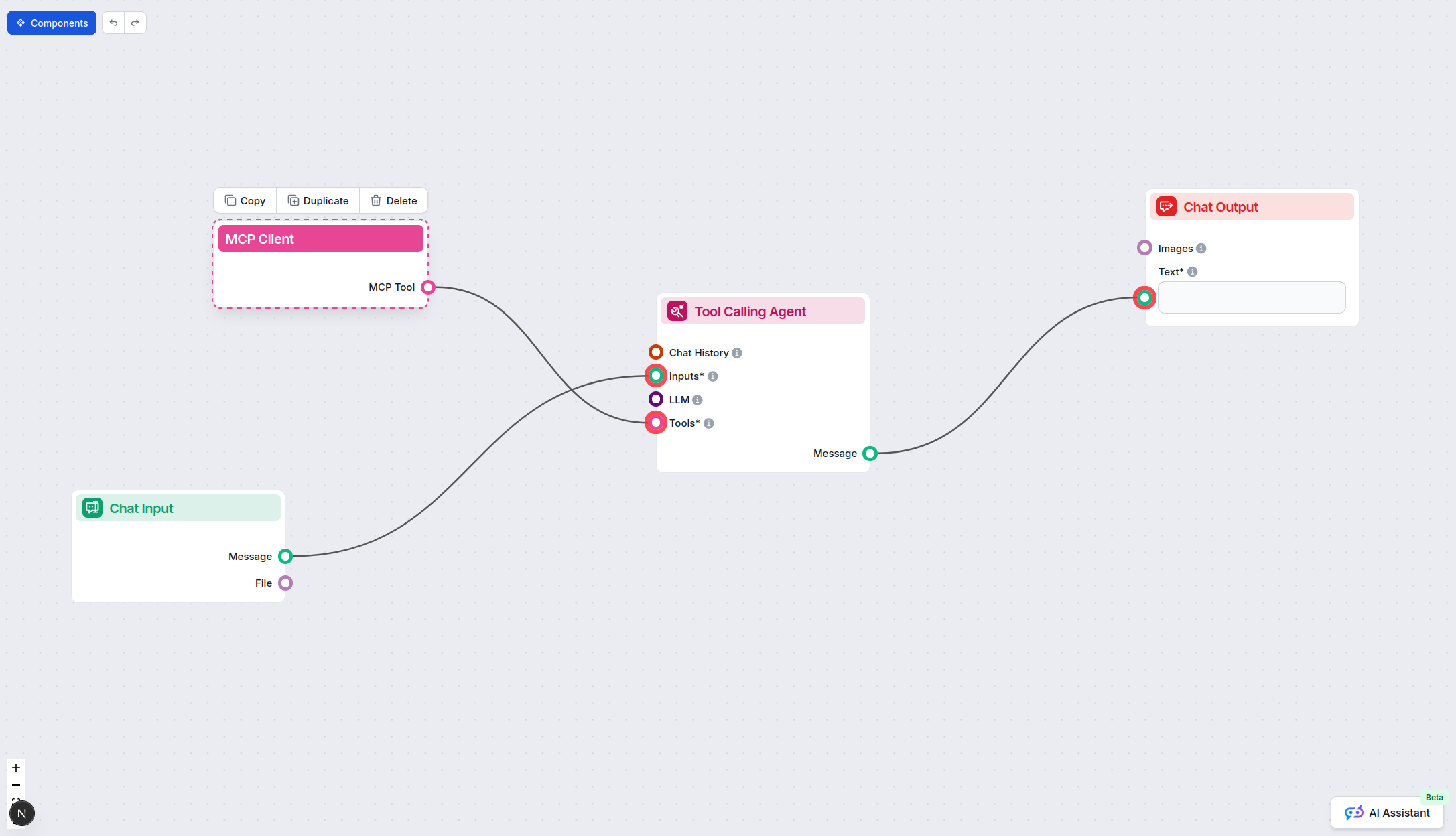
Click on the MCP component to open the configuration panel. In the system MCP configuration section, insert your MCP server details using this JSON format:
{
  "national-parks": {
    "transport": "streamable_http",
    "url": "https://yourmcpserver.example/pathtothemcp/url"
  }
}
Once configured, the AI agent is now able to use this MCP as a tool with access to all its functions and capabilities. Remember to change "national-parks" to the actual name of your MCP server and replace the URL with your own MCP server URL.
| Section | Availability | Details/Notes |
|---|---|---|
| Overview | ✅ | Description in README.md |
| List of Prompts | ⛔ | No prompt templates found |
| List of Resources | ⛔ | No explicit resources found |
| List of Tools | ✅ | Detailed tool descriptions in README.md |
| Securing API Keys | ⛔ | Not explicitly documented, best-practices given |
| Sampling Support (less important in evaluation) | ⛔ | Not mentioned |
Based on the above tables, this MCP server is focused and well-documented regarding its tools, but lacks explicit prompt templates, official resource definitions, and documentation on sampling/roots.
This MCP server provides a solid set of tools for interacting with National Park Service data and is open source under the MIT license. However, feature completeness is limited by the absence of prompt templates, explicit resource documentation, and clear support for advanced MCP primitives like Roots or Sampling.
| Has a LICENSE | ✅ (MIT) |
|---|---|
| Has at least one tool | ✅ |
| Number of Forks | 4 |
| Number of Stars | 16 |
Bring real-time National Park data into your AI apps and workflows. Start building with the National Parks MCP Server on FlowHunt today!
Integrate FlowHunt with the National Parks MCP Server to access real-time U.S. National Parks data, automate trip planning workflows, and deliver timely alerts,...

The Campertunity MCP Server connects AI assistants and developer tools to rich camping and outdoor recreation data, enabling campground search, availability che...

The Tripadvisor MCP Server connects AI assistants with the Tripadvisor Content API, providing standardized tools for accessing rich travel data including locati...
Cookie Consent
We use cookies to enhance your browsing experience and analyze our traffic. See our privacy policy.