


Nomad
Integrate FlowHunt with HashiCorp Nomad using the powerful MCP server to automate job, deployment, namespace, and cluster management. Streamline operations, enf...
6 min read
AI
Nomad
+5

Integrate FlowHunt with HashiCorp Nomad for AI-driven cluster monitoring, automated job management, and infrastructure insights using the Nomad MCP Server.
The Nomad MCP Server is a Golang-based implementation of the Model Context Protocol (MCP) designed to facilitate seamless integration between AI assistants and HashiCorp Nomad, a workload orchestrator. By serving as a bridge, the Nomad MCP Server enables AI-driven workflows to interact directly with Nomad clusters, providing capabilities such as querying job statuses, managing workloads, and automating infrastructure operations. This integration empowers developers to build intelligent assistants and agents that can perform real-time orchestration tasks, enhance DevOps automation, and streamline cloud-native application management. The server’s primary role is to expose Nomad data, API endpoints, and operational tools to AI clients, thus enabling context-rich and actionable interactions that boost productivity and operational efficiency in development environments.
prompts folder exists but its contents are not accessible from the main page.)
Start your free trial today and see results within days.
resources concept is implied by MCP, but not detailed here.)tools directory is present, but file-level details are not visible.)Get latest tips, trends, and deals for free.
Nomad Cluster Monitoring:
Enables AI assistants to check the status of jobs, allocations, and nodes in a Nomad cluster, allowing teams to monitor workloads programmatically.
Automated Job Management:
Facilitates the submission, scaling, or stopping of Nomad jobs through AI-driven workflows, streamlining DevOps practices.
Incident Response Automation:
AI agents can interact with Nomad to automatically remediate or escalate incidents, improving resilience and uptime.
Infrastructure Insights:
Provides developers with up-to-date context about infrastructure health, deployments, and resource utilization directly via AI tools.
windsurf.config.json).mcpServers section using the following JSON:{
"mcpServers": {
"nomad": {
"command": "npx",
"args": ["@kocierik/mcp-nomad@latest"]
}
}
}
Use environment variables to securely manage sensitive keys:
{
"mcpServers": {
"nomad": {
"command": "npx",
"args": ["@kocierik/mcp-nomad@latest"],
"env": {
"NOMAD_TOKEN": "${env:NOMAD_TOKEN}"
},
"inputs": {
"endpoint": "https://my-nomad-server.example"
}
}
}
}
{
  "mcpServers": {
    "nomad": {
      "command": "npx",
      "args": ["@kocierik/mcp-nomad@latest"]
    }
  }
}
{
  "mcpServers": {
    "nomad": {
      "command": "npx",
      "args": ["@kocierik/mcp-nomad@latest"]
    }
  }
}
{
  "mcpServers": {
    "nomad": {
      "command": "npx",
      "args": ["@kocierik/mcp-nomad@latest"]
    }
  }
}
Using MCP in FlowHunt
To integrate MCP servers into your FlowHunt workflow, start by adding the MCP component to your flow and connecting it to your AI agent:
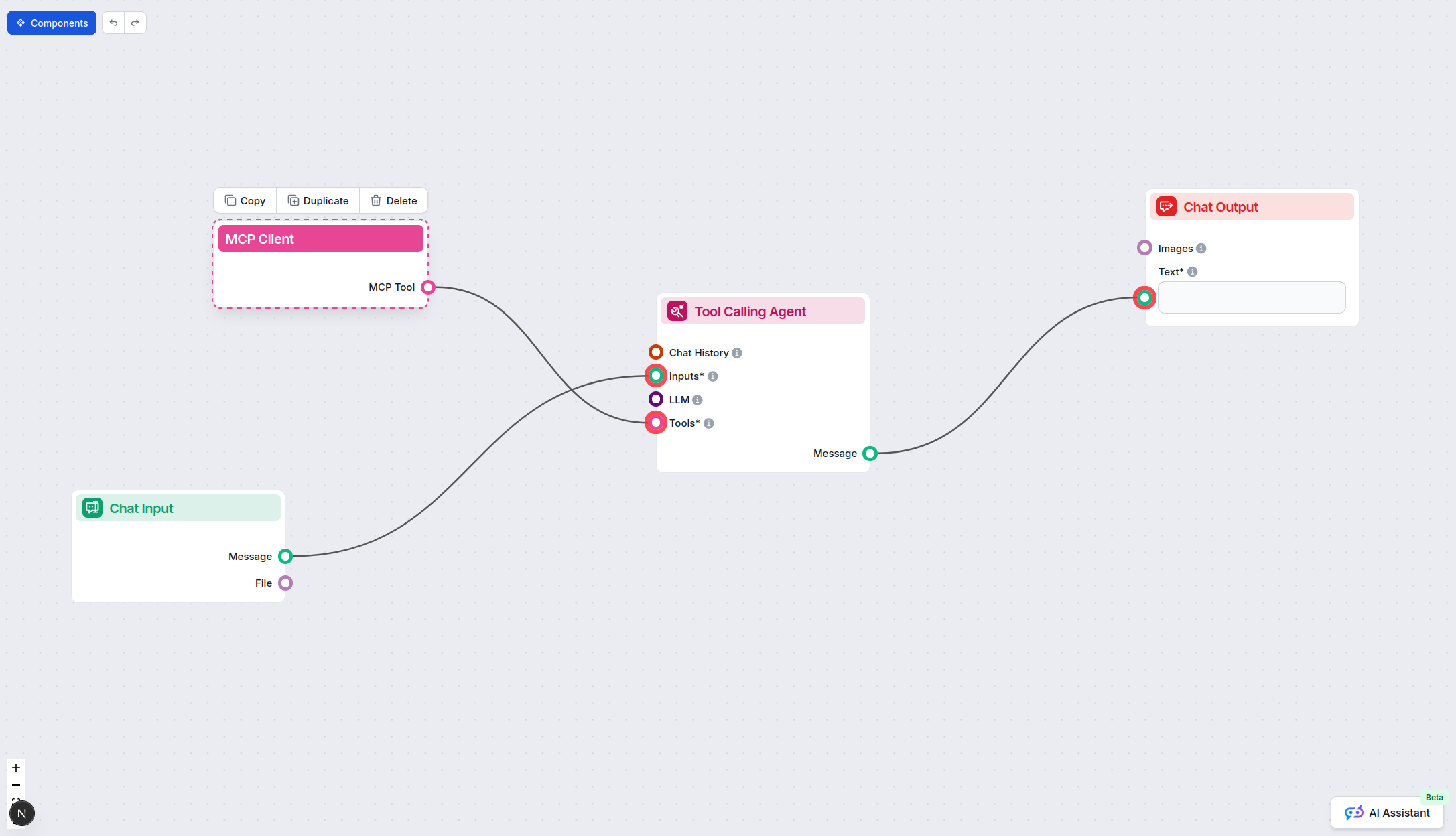
Click on the MCP component to open the configuration panel. In the system MCP configuration section, insert your MCP server details using this JSON format:
{
  "nomad": {
    "transport": "streamable_http",
    "url": "https://yourmcpserver.example/pathtothemcp/url"
  }
}
Once configured, the AI agent is now able to use this MCP as a tool with access to all its functions and capabilities. Remember to change “nomad” to whatever the actual name of your MCP server is and replace the URL with your own MCP server URL.
| Section | Availability | Details/Notes |
|---|---|---|
| Overview | ✅ | Based on repo and main description |
| List of Prompts | ⛔ | Folder exists, but contents not visible |
| List of Resources | ⛔ | Not detailed in visible files |
| List of Tools | ⛔ | No explicit tool list in code/main view |
| Securing API Keys | ✅ | .env.example and config JSON present |
| Sampling Support (less important in evaluation) | ⛔ | No evidence in available documentation |
The Nomad MCP Server repository is promising for AI-driven Nomad orchestration, with clear integration instructions and open-source licensing. However, the lack of visible prompt, resource, and tool definitions limits the transparency and immediate usability of its full MCP feature set. For users seeking advanced or customizable MCP workflows, further documentation or code exploration may be needed.
| Has a LICENSE | ✅ (MIT) |
|---|---|
| Has at least one tool | ⛔ |
| Number of Forks | 5 |
| Number of Stars | 27 |
Empower your AI agents to orchestrate, monitor, and automate Nomad clusters seamlessly. Get started with Nomad MCP Server integration in FlowHunt.
Integrate FlowHunt with HashiCorp Nomad using the powerful MCP server to automate job, deployment, namespace, and cluster management. Streamline operations, enf...
The mcp-k8s-go MCP Server enables AI assistants to interact programmatically with Kubernetes clusters via Model Context Protocol, automating and streamlining De...

The n8n MCP Server enables seamless integration between AI assistants and the n8n automation platform, allowing FlowHunt users to trigger, monitor, and manage a...
Cookie Consent
We use cookies to enhance your browsing experience and analyze our traffic. See our privacy policy.