



mcp-rquest
Integrate FlowHunt with mcp-rquest to supercharge your AI workflows with advanced HTTP request emulation, browser fingerprinting, document conversion, and robus...
5 min read
AI
HTTP Requests
+4
Advanced HTTP request and document conversion server for FlowHunt, enabling AI agents to interact with the web using realistic browser behavior and robust anti-bot evasion.
The mcp-rquest MCP Server is a Model Context Protocol (MCP) server designed to provide advanced, realistic browser-like HTTP request capabilities for AI assistants, including Claude and other large language models. Built atop the rquest engine, it enables models to interact with websites using accurate TLS, JA3/JA4, and HTTP/2 browser fingerprints, which helps bypass common anti-bot measures and simulate human browsing. Additionally, the server supports conversion of PDF and HTML documents to Markdown, facilitating easier ingestion and processing of web and document content by LLMs. It also features secure response storage, token-aware handling of large responses, and supports a variety of authentication and request customization options, making it a powerful tool for enhancing AI-driven development workflows involving web and document data.
No specific prompt templates are mentioned in the repository.

Start your free trial today and see results within days.
No explicit resources are documented in the available files or README.
Get latest tips, trends, and deals for free.
windsurf.config.json).mcp-rquest MCP server to the mcpServers section:{
"mcpServers": {
"mcp-rquest": {
"command": "mcp-rquest",
"args": ["server"]
}
}
}
mcp-rquest appears in your available MCP servers.{
"mcpServers": {
"mcp-rquest": {
"command": "mcp-rquest",
"args": ["server"]
}
}
}
{
  "mcpServers": {
    "mcp-rquest": {
      "command": "mcp-rquest",
      "args": ["server"]
    }
  }
}
{
  "mcpServers": {
    "mcp-rquest": {
      "command": "mcp-rquest",
      "args": ["server"]
    }
  }
}
mcp-rquest MCP server is operational.To securely provide API keys, use environment variables and reference them in your configuration:
{
  "mcpServers": {
    "mcp-rquest": {
      "command": "mcp-rquest",
      "args": ["server"],
      "env": {
        "MY_API_KEY": "${MY_API_KEY_ENV_VAR}"
      },
      "inputs": {
        "api_key": "${MY_API_KEY_ENV_VAR}"
      }
    }
  }
}
Replace MY_API_KEY_ENV_VAR with your actual environment variable name holding the API key.
Using MCP in FlowHunt
To integrate MCP servers into your FlowHunt workflow, start by adding the MCP component to your flow and connecting it to your AI agent:
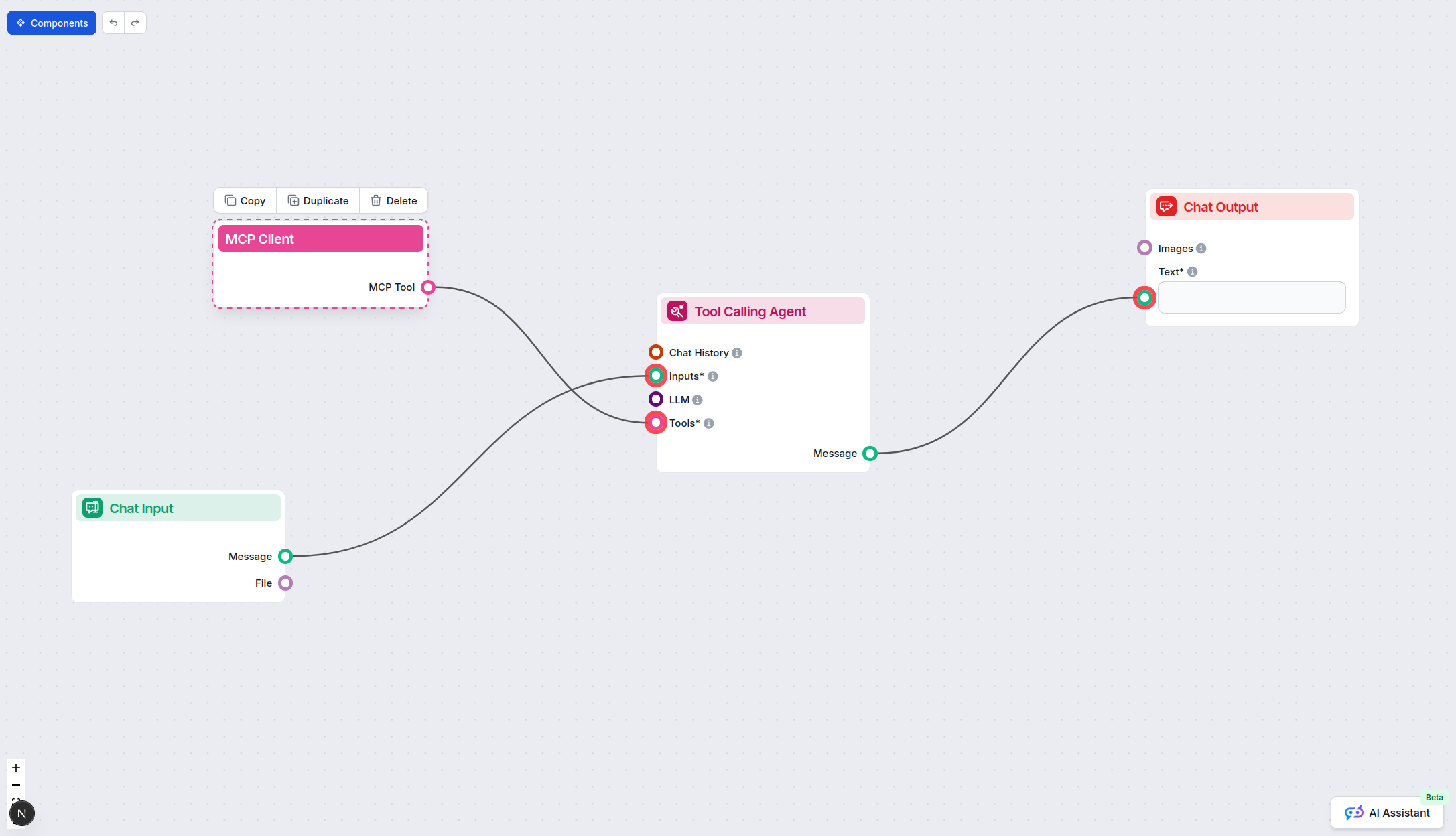
Click on the MCP component to open the configuration panel. In the system MCP configuration section, insert your MCP server details using this JSON format:
{
  "mcp-rquest": {
    "transport": "streamable_http",
    "url": "https://yourmcpserver.example/pathtothemcp/url"
  }
}
Once configured, the AI agent is now able to use this MCP as a tool with access to all its functions and capabilities. Remember to change "mcp-rquest" to whatever the actual name of your MCP server is and replace the URL with your own MCP server URL.
| Section | Availability | Details/Notes |
|---|---|---|
| Overview | ✅ | Overview and feature description available in README. |
| List of Prompts | ⛔ | No prompt templates found. |
| List of Resources | ⛔ | No explicit resources documented. |
| List of Tools | ✅ | Full list of tools in README. |
| Securing API Keys | ✅ | Example provided above. |
| Sampling Support (less important in evaluation) | ⛔ | No documentation found. |
Based on the tables above, mcp-rquest is a focused and robust HTTP request MCP server with excellent tool coverage (all HTTP verbs, document conversion, large response handling), good documentation, and practical setup examples. However, it lacks documented prompt templates, explicit resources, and information about sampling or roots support. Overall, it’s a practical, well-scoped utility for AI devs, but not a full ecosystem server.
| Has a LICENSE | ✅ (MIT) |
|---|---|
| Has at least one tool | ✅ |
| Number of Forks | 6 |
| Number of Stars | 31 |
Overall Rating: 6/10
A technically solid, well-documented MCP server for HTTP requests and document conversion, but missing higher-level MCP features like prompt templates, resource exposure, and sampling/roots support.
Empower your AI agents with realistic, secure web access and seamless document conversion. Try mcp-rquest for advanced HTTP operations and anti-bot protection in FlowHunt.
Integrate FlowHunt with mcp-rquest to supercharge your AI workflows with advanced HTTP request emulation, browser fingerprinting, document conversion, and robus...

The RAG Web Browser MCP Server equips AI assistants and LLMs with live web search and content extraction capabilities, enabling retrieval-augmented generation (...
The Puppeteer Vision MCP Server empowers AI assistants to scrape and convert web pages into Markdown, using advanced AI-driven interaction to bypass interactive...
Cookie Consent
We use cookies to enhance your browsing experience and analyze our traffic. See our privacy policy.