


Rust MCP Filesystem
Integrate FlowHunt with Rust MCP Filesystem to achieve high-performance, asynchronous, and secure file operations. Automate complex directory management, enable...
4 min read
AI
Rust
+4

A high-performance, secure, and lightweight MCP server for filesystem access, built in Rust and optimized for AI-driven workflows and large-scale codebase operations.
Rust MCP Filesystem is a blazingly fast, asynchronous, and lightweight MCP (Model Context Protocol) server specifically designed for efficient filesystem operations. Written entirely in Rust, it serves as a high-performance alternative to JavaScript-based MCP servers, enabling seamless integration of filesystem capabilities into AI-assisted development workflows. The server is read-only by default for safety, but can be configured for write access, making it suitable for various secure environments. Its advanced glob search supports complex pattern matching, allowing precise file and directory filtering. Developers can leverage Rust MCP Filesystem to enable AI agents to perform tasks such as directory exploration, glob-based file searching, and nested directory creation, all while maintaining minimal resource usage and high reliability.
No information about prompt templates was found in the repository.

Start your free trial today and see results within days.
No explicit list of MCP resources is provided in the available documentation or code.
No direct listing of tools was found in the repository’s main documentation or manifest files. Details about specific tools (such as query_filesystem, read_file, write_file, etc.) are not available in the provided content.
Get latest tips, trends, and deals for free.
windsurf.json).{
"mcpServers": {
"rust-mcp-filesystem": {
"command": "rust-mcp-filesystem",
"args": []
}
}
}
{
  "mcpServers": {
    "rust-mcp-filesystem": {
      "command": "rust-mcp-filesystem",
      "args": []
    }
  }
}
mcpServers section:{
"mcpServers": {
"rust-mcp-filesystem": {
"command": "rust-mcp-filesystem",
"args": []
}
}
}
{
  "mcpServers": {
    "rust-mcp-filesystem": {
      "command": "rust-mcp-filesystem",
      "args": []
    }
  }
}
To secure API keys or secrets, always use environment variables instead of hard-coding values. Example:
{
  "mcpServers": {
    "rust-mcp-filesystem": {
      "command": "rust-mcp-filesystem",
      "args": [],
      "env": {
        "FS_ROOT_PATH": "/your/safe/path"
      },
      "inputs": {
        "access_mode": "read-only"
      }
    }
  }
}
Using MCP in FlowHunt
To integrate MCP servers into your FlowHunt workflow, start by adding the MCP component to your flow and connecting it to your AI agent:
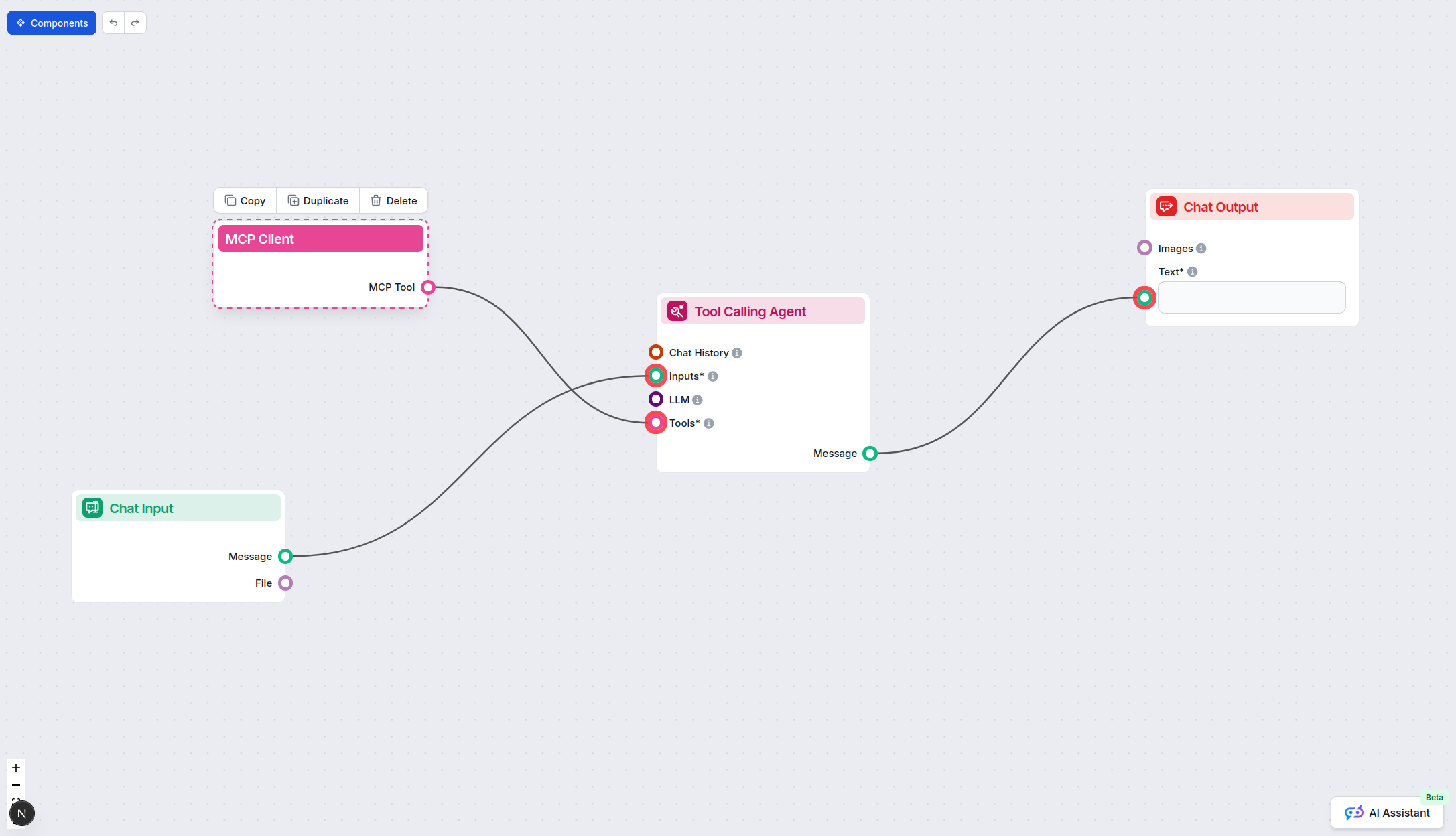
Click on the MCP component to open the configuration panel. In the system MCP configuration section, insert your MCP server details using this JSON format:
{
  "rust-mcp-filesystem": {
    "transport": "streamable_http",
    "url": "https://yourmcpserver.example/pathtothemcp/url"
  }
}
Once configured, the AI agent is now able to use this MCP as a tool with access to all its functions and capabilities. Remember to change “rust-mcp-filesystem” to whatever the actual name of your MCP server is and replace the URL with your own MCP server URL.
| Section | Availability | Details/Notes |
|---|---|---|
| Overview | ✅ | |
| List of Prompts | ⛔ | |
| List of Resources | ⛔ | |
| List of Tools | ⛔ | |
| Securing API Keys | ✅ | Via environment variables in config |
| Sampling Support (less important in evaluation) | ⛔ | Not mentioned |
Based on the available documentation, Rust MCP Filesystem distinguishes itself as a robust and efficient MCP server for filesystem operations, but lacks detailed documentation regarding prompt templates, explicit resources, and tool definitions. Its configuration and setup are straightforward, and it is well-suited for secure and high-performance deployments. However, the absence of detailed MCP resource/tool information limits its immediate out-of-the-box usability for some advanced scenarios.
| Has a LICENSE | ✅ (MIT) |
|---|---|
| Has at least one tool | ⛔ |
| Number of Forks | 3 |
| Number of Stars | 38 |
Score: 5/10 — The server is mature, easy to set up, and has clear performance benefits, but the lack of explicit prompts, resources, and tool documentation reduces its completeness as an MCP server implementation.
Supercharge your AI workflows with secure, high-speed filesystem access. Deploy Rust MCP Filesystem in FlowHunt or your favorite AI automation tool today.
Integrate FlowHunt with Rust MCP Filesystem to achieve high-performance, asynchronous, and secure file operations. Automate complex directory management, enable...

The Filesystem MCP Server enables secure, programmatic access to the local filesystem via the Model Context Protocol (MCP). It empowers AI assistants and client...

The mcpignore-filesystem MCP Server brings secure, granular control to AI agent file access by supporting `.mcpignore` patterns. Safeguard sensitive data, autom...
Cookie Consent
We use cookies to enhance your browsing experience and analyze our traffic. See our privacy policy.