



Unity Catalog MCP Integration
Integrate FlowHunt with Unity Catalog MCP Server for AI-driven automation of catalog management. Seamlessly orchestrate Unity Catalog functions, streamline depl...
4 min read
AI
Unity Catalog
+4

Automate and manage Unity Catalog functions with the Unity Catalog MCP Server, bringing seamless data catalog operations and AI-powered workflows to your organization.
The Unity Catalog MCP Server serves as a Model Context Protocol (MCP) layer for the Unity Catalog , enabling AI assistants to interact programmatically with Unity Catalog’s data management functions. By exposing Unity Catalog Functions as MCP-compatible tools, this server allows developers and AI agents to perform operations like listing, querying, creating, and deleting database functions in a standardized way. This greatly enhances development workflows by automating data catalog tasks, facilitating seamless integration into flows and agents, and supporting dynamic access to schema and function metadata. The server is designed for environments where managing, discovering, and manipulating data functions programmatically is essential, such as in data engineering, analytics, and AI-augmented development.
No prompt templates are listed in the repository or documentation.

Start your free trial today and see results within days.
No explicit MCP resources are documented in the repository or README.
name (string).name (string), script (string). Experimental API.name (string).Additionally, all Unity Catalog Functions registered in Unity Catalog are available as tools.
Get latest tips, trends, and deals for free.
No platform-specific instructions available for Windsurf.
uv or Python are installed.claude_desktop_config.json:{
"mcpServers": {
"unity-catalog": {
"command": "uv",
"args": [
"run",
"mcp-server-unitycatalog",
"--uc_server", "<UNITY_CATALOG_URL>",
"--uc_catalog", "<CATALOG_NAME>",
"--uc_schema", "<SCHEMA_NAME>",
"--uc_token", "${UC_TOKEN}"
]
}
}
}
Securing API Keys Example:
{
  "mcpServers": {
    "unity-catalog": {
      "command": "uv",
      "args": [ "run", "mcp-server-unitycatalog", "--uc_server", "...", "--uc_token", "${UC_TOKEN}" ],
      "env": {
        "UC_TOKEN": "your_secret_token"
      },
      "inputs": {
        "UC_TOKEN": "env"
      }
    }
  }
}
No platform-specific instructions available for Cursor.
uv.cline_config.json:{
"mcpServers": {
"unity-catalog": {
"command": "uv",
"args": [
"run",
"mcp-server-unitycatalog",
"--uc_server", "<UNITY_CATALOG_URL>",
"--uc_catalog", "<CATALOG_NAME>",
"--uc_schema", "<SCHEMA_NAME>",
"--uc_token", "${UC_TOKEN}"
]
}
}
}
Securing API Keys Example: (see previous)
Using MCP in FlowHunt
To integrate MCP servers into your FlowHunt workflow, start by adding the MCP component to your flow and connecting it to your AI agent:
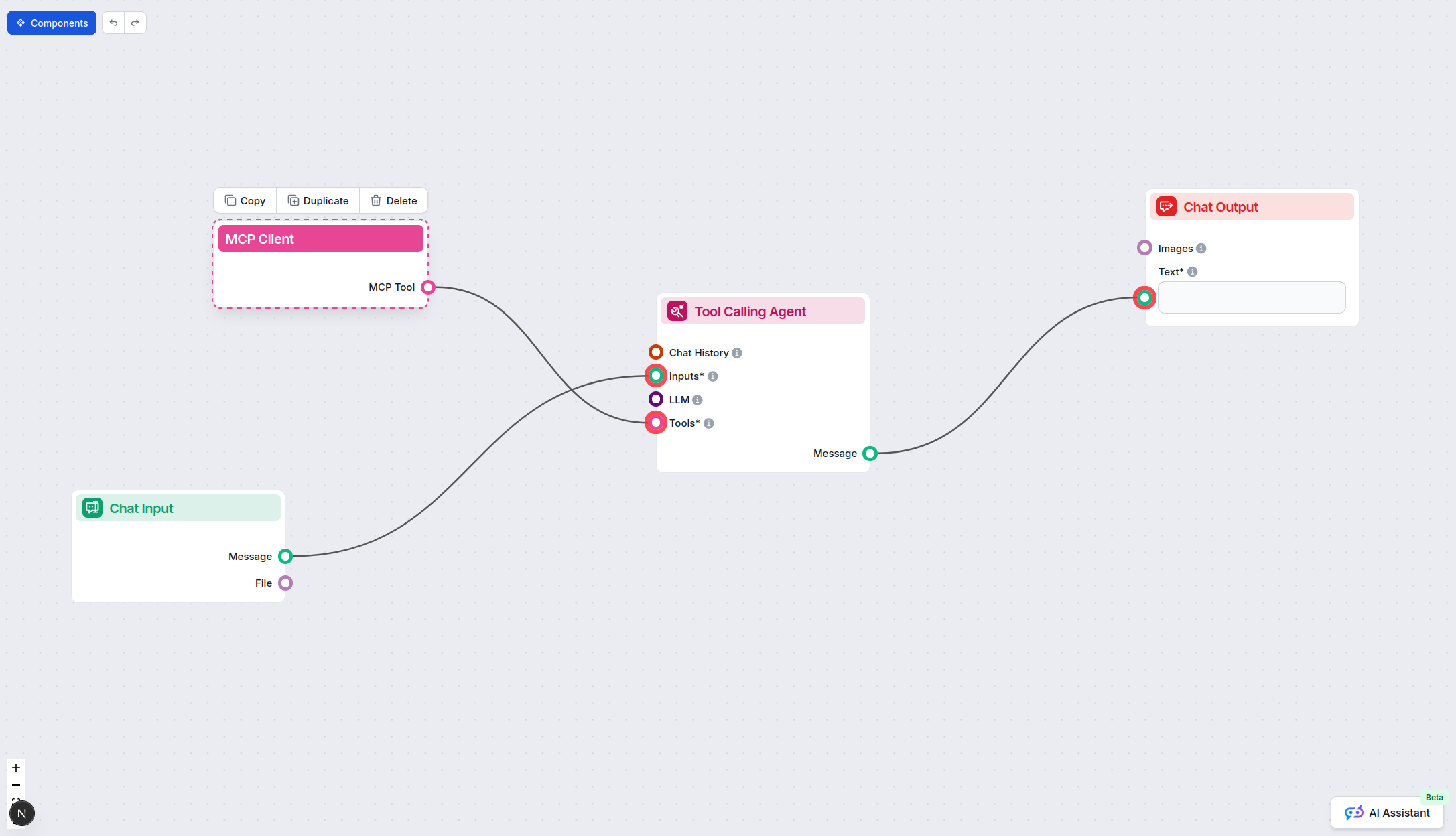
Click on the MCP component to open the configuration panel. In the system MCP configuration section, insert your MCP server details using this JSON format:
{
  "unity-catalog": {
    "transport": "streamable_http",
    "url": "https://yourmcpserver.example/pathtothemcp/url"
  }
}
Once configured, the AI agent is now able to use this MCP as a tool with access to all its functions and capabilities. Remember to change "unity-catalog" to whatever the actual name of your MCP server is and replace the URL with your own MCP server URL.
| Section | Availability | Details/Notes |
|---|---|---|
| Overview | ✅ | Overview provided in README.md |
| List of Prompts | ⛔ | No prompt templates documented |
| List of Resources | ⛔ | No explicit MCP resources listed |
| List of Tools | ✅ | Detailed in README.md |
| Securing API Keys | ✅ | Example shown in README.md |
| Sampling Support (less important in evaluation) | ⛔ | No mention of sampling feature |
The Unity Catalog MCP Server is well-documented in terms of its tools and setup for Claude and Cline platforms, with a clear license and basic security (API key) instructions. However, it lacks explicit documentation for prompt templates and MCP resources, and there’s no mention of advanced MCP features such as roots or sampling. Overall, it’s a solid, focused integration for Unity Catalog but could be improved with additional documentation and MCP feature support.
| Has a LICENSE | ✅ (MIT) |
|---|---|
| Has at least one tool | ✅ |
| Number of Forks | 6 |
| Number of Stars | 14 |
Supercharge your data workflows by integrating Unity Catalog MCP Server into FlowHunt. Automate data catalog tasks, streamline engineering, and empower AI-driven development.
Integrate FlowHunt with Unity Catalog MCP Server for AI-driven automation of catalog management. Seamlessly orchestrate Unity Catalog functions, streamline depl...
UnityMCPIntegration connects AI agents with the Unity game engine, enabling real-time control, automated testing, procedural content generation, and AI-driven g...

The MSSQL MCP Server connects AI assistants with Microsoft SQL Server databases, enabling advanced data operations, business intelligence, and workflow automati...
Cookie Consent
We use cookies to enhance your browsing experience and analyze our traffic. See our privacy policy.