Best Real Estate Data Tool Comparison: FlowHunt vs ATTOM vs PropStream vs BatchData
With the Zillow API closed to developers since 2021, teams need a real comparison of current tools. We compared manual research, ATTOM, PropStream, BatchData, and FlowHunt’s AI scraper on cost, coverage, setup, and output.
There are multiple approaches to collecting real estate data at scale: dedicated property APIs, no-code investor platforms, AI scrapers, and manual research. The Zillow API, widely used until 2021, was discontinued for new developers
when Zillow Group shut down public API access, which makes this comparison more relevant than ever for teams still searching for the right alternative.
We compared five approaches on cost, coverage, setup time, and output quality. Here’s what each one actually delivers, and which fits which use case.
Option 1: Manual Research — Pros, Cons, and Time Cost
Manual research means opening listing platforms, filtering results, copying data into spreadsheets, normalizing formats, and building comparisons by hand. For a single property, it takes minutes. For a full market analysis, it takes hours, and repeating it next month takes the same hours again.
What works:
No cost, no configuration, no dependencies
Works for any market anywhere in the world
Full control over what data gets collected and how it’s structured
What doesn’t:
Doesn’t scale with time investment growing linearly with scope and frequency
Output consistency depends entirely on the researcher. Two people analyzing the same market rarely produce comparable data
No automated refresh. The data is accurate at the moment of collection and starts aging immediately
Difficult to cover enough listings for statistically meaningful pattern analysis.Most manual research samples rather than surveys
Bottom line: Viable for one-off assessments on low-volume markets. Not viable for regular monitoring, multi-market comparisons, or any context where analysis needs to be reproducible.
Option 2: ATTOM Data API — Pros, Cons, and Technical Requirements
ATTOM Data is one of the largest commercial real estate data providers in the US, covering 160 million+ properties with over 9,000 data attributes, including tax assessment, deed records, ownership history, AVM valuations, pre-foreclosure signals, and building permit data. It’s the standard choice for enterprise PropTech and lending analytics.
Pricing (paid plans): Starts at approximately $95/month for basic access; enterprise tiers range from $850 to $2,000+ per month. Custom quotes for bulk or specialized data packages. Annual licensing available.
What works:
Extremely deep property-level data on US public records, including ownership history, liens, deed transfers, tax assessments
Trusted by enterprise PropTech, lenders, and analytics firms
Broad US coverage, regularly updated from authoritative sources
What doesn’t:
Full developer integration required. No UI or out-of-the-box reports are available.
US-only; not useful for international markets
Time-to-first-data is typically days to weeks depending on onboarding and contract process
Delivers raw data & the analysis layer must be built separately
Bottom line: Right for engineering teams building data pipelines or analytics products on US property records. Requires technical investment to produce anything usable from the output.
Ready to grow your business?
Start your free trial today and see results within days.
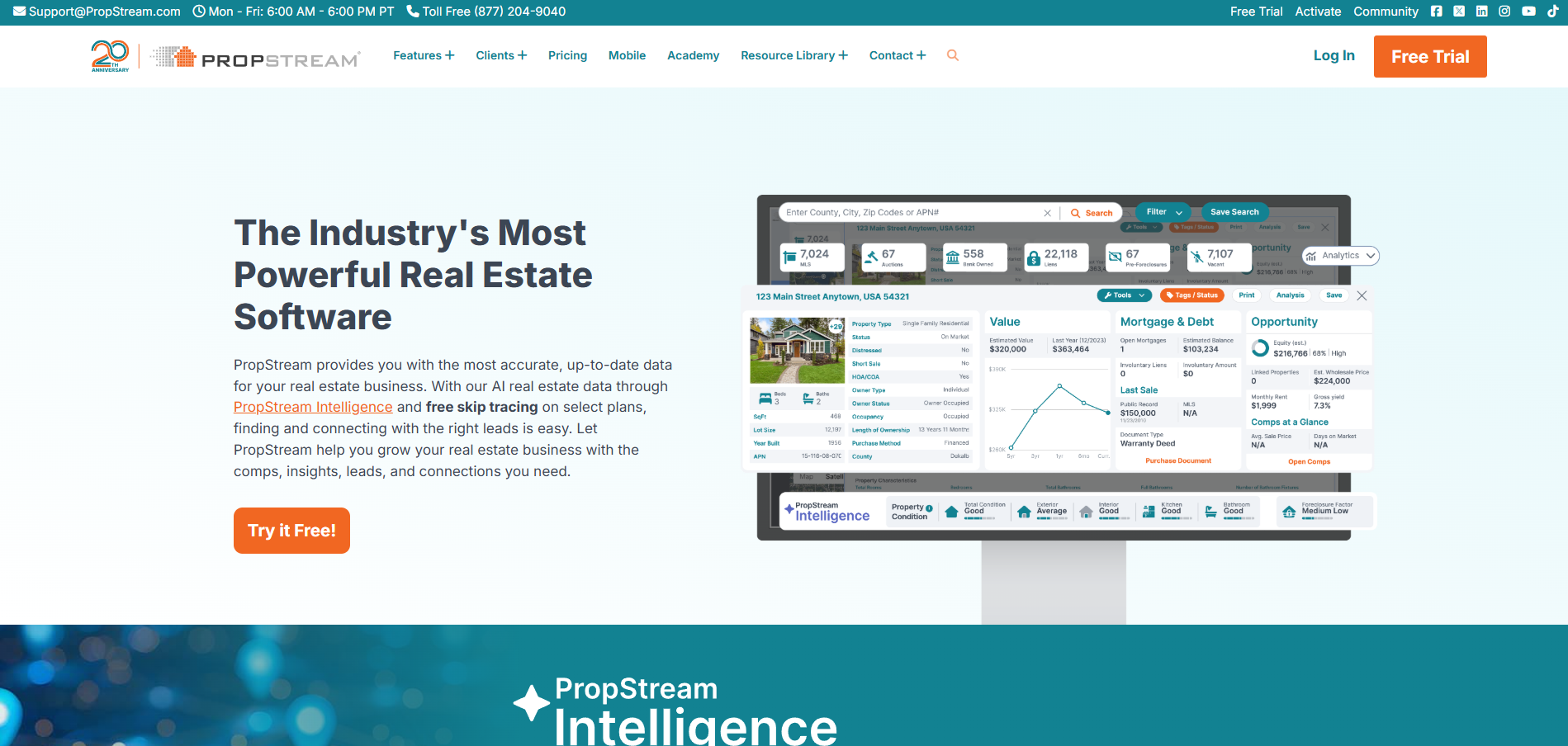
PropStream is a no-code platform built specifically for real estate investors in the US. It provides access to MLS data, ownership records, deal analysis tools, and skip-tracing capabilities, all through a browser interface without API integration. It’s the most accessible of the API-adjacent tools.
Pricing (paid plans): $99/month (Essentials, 25,000 monthly exports), $199/month (Pro), $699/month (Elite). Annual plans offer roughly 18% savings. Pricing is per user and team costs scale accordingly.
What works:
No technical setup; works immediately in a browser
Includes skip-tracing and lead generation features useful for acquisition outreach
What doesn’t:
The tool is US-only with no support for international markets
Priced per user, which adds up quickly for teams
Designed for residential investment, meaning limited value for commercial analysis, rental benchmarking, or market research beyond the US
Output is platform-native. The data doesn’t export cleanly into reports or CMS without additional work
Bottom line: The most practical choice for individual US residential investors who want a self-contained platform. Pricing and geography constrain its use for agencies, analysts, or international work.
Option 4: BatchData — Pros, Cons, and Scale
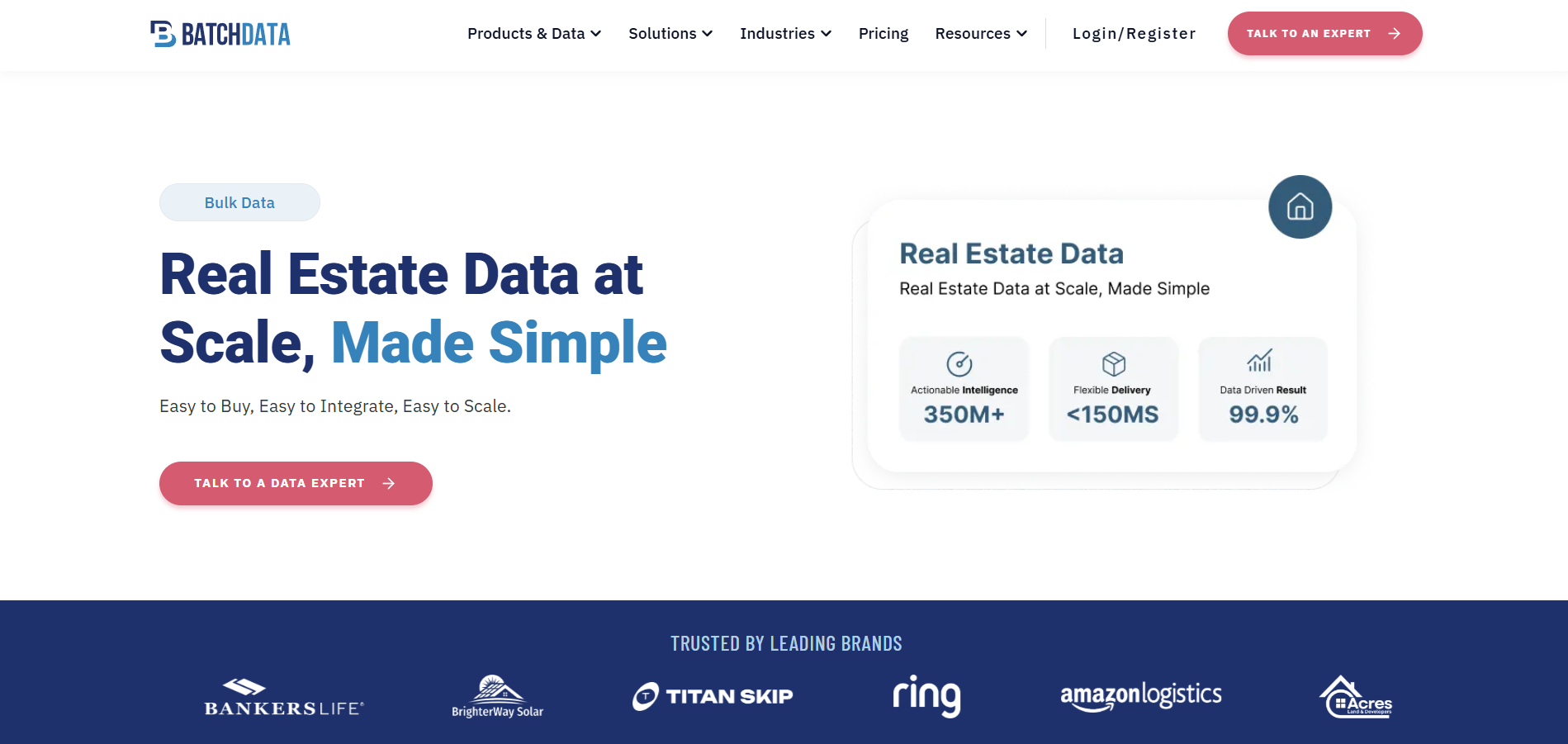
BatchData is an API-first real estate data provider designed for bulk operations. It covers 155 million+ US properties with 240+ data points per record and offers a volume-based pricing model suited to teams running large-scale data pipelines.
Pricing (paid plans): $1,000/month (Growth: 100,000 records), $2,500/month (Professional: 300,000 records), $5,000/month (Scale: 750,000 records). Individual record lookups available at $0.01/record for lower-volume use.
What works:
Transparent volume-based pricing with clear record counts
Well-suited to data pipelines that process large record sets
What doesn’t:
The tool is developer-only. There’s no UI, no reports
Expensive entry point for non-enterprise use cases
US-only
Raw data delivery only. Teams must build the analysis layer themselves
Add-on modules (demographics, MLS data, building permits) increase costs significantly beyond base pricing
Bottom line: Purpose-built for enterprise data teams and PropTech platforms that need bulk US property records as raw inputs. Not practical for small teams, individual analysts, or non-US markets.
Join our newsletter
Get latest tips, trends, and deals for free.
Option 5: FlowHunt AI Real Estate Scraper — Pros, Cons, and Setup
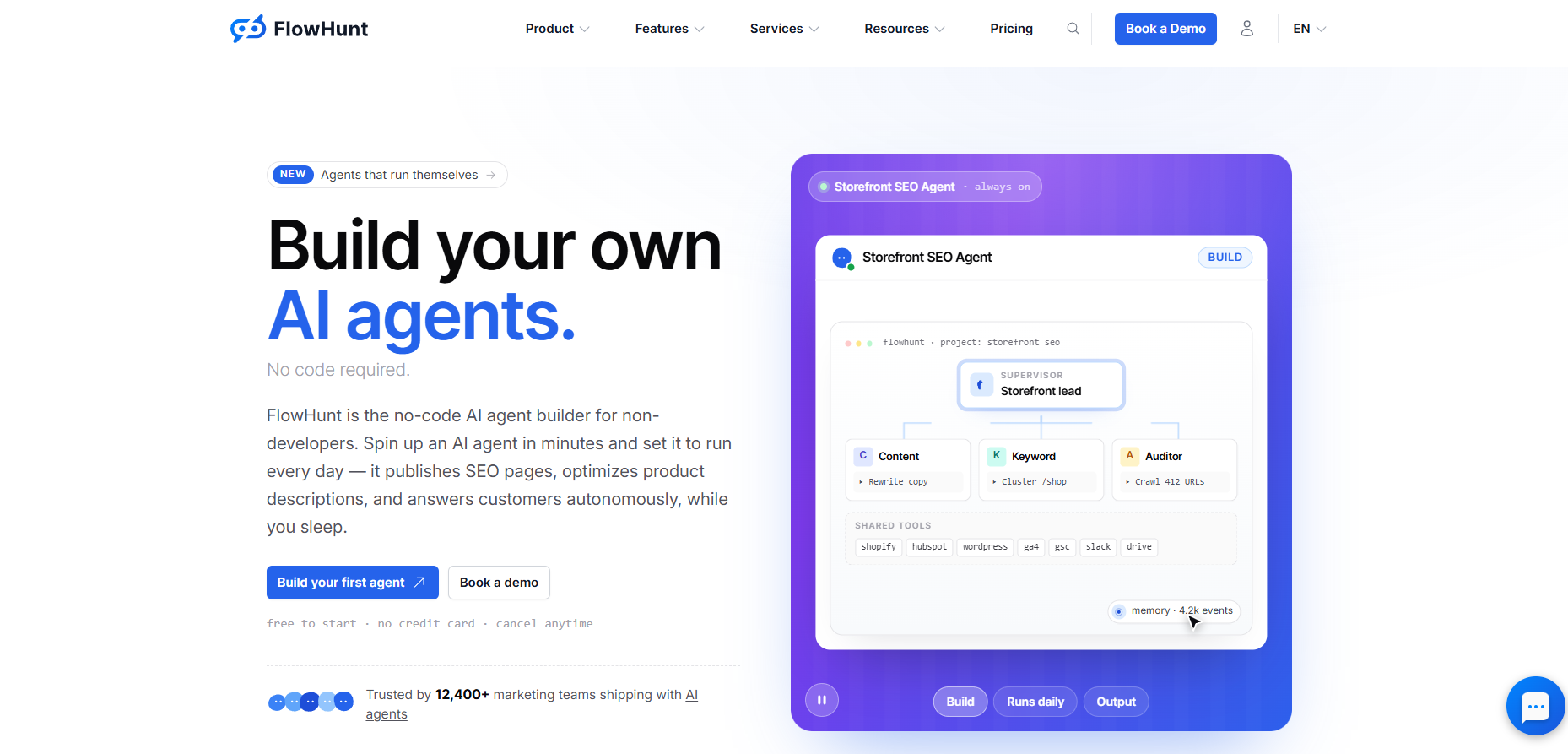
The FlowHunt AI real estate scraper
takes a different approach from the API tools above. Rather than delivering raw data for a development team to process, it runs a complete analysis pipeline and returns a structured report. Collection, normalization, pattern detection, and report generation happen in one pass.
Pricing: Starter plan at €50/month (50 credits); Pro at €120/month (120 credits); Premium at €500/month (500 credits). A real estate analysis report consumes a small fraction of available monthly credits. The Starter plan supports multiple runs per month with credits to spare for other workflows.
What works:
No technical setup. Just specify a target market in plain language, get a report
Global coverage, not restricted to US public records
Produces analysis, not just data: pricing trends, outliers, undervalued areas, attribute correlations
Accepts custom datasets alongside scraped sources. Existing data exports can be incorporated
HTML output ready for CMS, dashboards, or investor portals without reformatting
Affordable entry point compared to API alternatives at equivalent analytical output
Not a raw data API — not designed for bulk record lookups or database integration
Analysis depth depends on data availability in the target market. Sparse markets produce thinner reports
Does not provide the ownership records, deed history, and tax data depth that ATTOM and BatchData deliver for US properties out of the box
If the specific data source or integration you need isn’t listed, get in touch
and we’ll scope it out.
Bottom line: Right for analysts, investors, and agencies who need market-level intelligence and structured reports without technical integration. The clear choice for any non-US market and for teams without engineering resources — and extensible to virtually any data source through integrations and MCP connections.
Coverage and Cost: All Five Side by Side
Manual Research
ATTOM Data API
PropStream
BatchData
FlowHunt AI Scraper
Monthly cost
$0
$95–$2,000+
$99–$699/user
$1,000–$5,000
from €50
Setup time
None
Days–weeks
Hours
Days–weeks
Minutes
Technical skill required
None
High (developer)
None
High (developer)
None
Geographic coverage
Any
US only
US only
US only
Any
Output type
Manual spreadsheet
Raw API response
Platform UI
Raw API response
Structured report
Analysis included
Manual
No
Partial
No
Yes
International markets
Yes
No
No
No
Yes
Accepts custom datasets
Yes
No
No
No
Yes
Which Approach Is Right for Your Use Case?
Real estate agent or analyst producing market reports for clients:
Manual research breaks down at volume. PropStream is investor-focused rather than report-focused, the API tools require a developer to produce anything useful. The FlowHunt’s AI Real Estate Scraper is the most direct path to a structured, presentable market report.
US residential property investor doing deal screening:
PropStream is purpose-built for this. If your markets extend beyond the US, FloWhunt’s tool is more flexible. ATTOM is relevant if you need ownership and deed data for title research.
PropTech or analytics team building a data pipeline:
ATTOM or BatchData. These tools are designed for the engineering integration model and cover the US public records depth that pipeline use cases require. FlowHunt is not designed for this out of the box, and custom setup may require a lot of time and resources.
Market analyst covering multiple international regions:
The US-specific APIs are all irrelevant here. Manual research at this scope is impractical. From the compared tools, only FlowHunt’s AI scraper handles multi-region global analysis with consistent output across all markets.
Small team or individual analyst with limited budget and no engineering support:
At $50 and with support for various other workflows, FlowHunt’s AI real estate scraper is the best choice for small teams. For occasional one-off assessments, even manual research is sustainable. PropStream at $99/month is the nearest competitor for no-code access, but is US residential only. Other tools we’ve compared cater mostly to enterprise clients.
Not sure where to start with FlowHunt? The AI real estate scraper tutorial
walks through your first extraction in 10 minutes.
Frequently asked questions
Yes. FlowHunt's real estate scraper accepts your own datasets or structured files alongside data it collects from online sources. If you have an existing data export from an API provider, you can feed it into the workflow and the tool will clean, normalize, and analyze it together with scraped data.
FlowHunt retrieves data from live sources at the time of each query, so every report reflects current listings. ATTOM and BatchData pull from public records databases that are updated on varying cadences, often weekly or monthly for tax/deed records. PropStream updates MLS data on a similar cadence. For time-sensitive market monitoring, running the AI scraper on a defined schedule keeps data current without manual effort.
Tools aggregate data from credible online platforms and APIs using standard web retrieval. Users are responsible for reviewing the terms of service of the specific platforms relevant to their target market and for how extracted data is used. Using outputs for internal analysis, market research, and investment decision-making, rather than republishing raw listing data commercially, is the standard compliant approach. When in doubt, review the terms of the specific listing platforms you are targeting.
Try FlowHunt AI Real Estate Scraper
No API. No developer setup. Specify a target market and get a structured analysis report — pricing trends, outliers, and investment signals — in minutes.
How to Scrape Real Estate Listings and Extract Property Data with AI
Manual property research takes hours. AI real estate scrapers automate data extraction from listings at scale. Here's how to extract structured property data an...
How Real Estate Investors Find Deals Faster with AI
A real estate investor used to spend 15 hours weekly researching properties, comparing prices, and tracking market shifts. AI automation cut that to under 2 hou...
5 Ways Real Estate Professionals Use AI Data Scraping to Win More Deals
From agents tracking competitor listings to investors finding undervalued properties, here are five specific ways real estate professionals use AI data extracti...
5 min read
Real Estate
AI
+3
Cookie Consent We use cookies to enhance your browsing experience and analyze our traffic. See our privacy policy.