


Claude Fable 5 — Benchmarks, Capabilities, and Use Cases
Claude Fable 5 is a proprietary AI model from Anthropic, classified as Super-Frontier tier with a 1M tokens context window. It is available directly in FlowHunt...
5 min read
Discover Claude Fable 5, the publicly available version of Claude Mythos with advanced security guardrails. Learn how it outperforms competitors and enables powerful AI applications.
The artificial intelligence landscape shifted significantly with the introduction of Claude Fable 5, a watershed moment for developers and organizations seeking enterprise-grade AI capabilities. After weeks of anticipation surrounding Claude Mythos—a model shrouded in security concerns due to its exceptional ability to identify vulnerabilities and exploit system weaknesses—Anthropic has made a calculated decision: release a public version with robust safeguards intact. This article explores what Claude Fable 5 represents, how it performs against competitors, and why it matters for the future of AI-driven development.
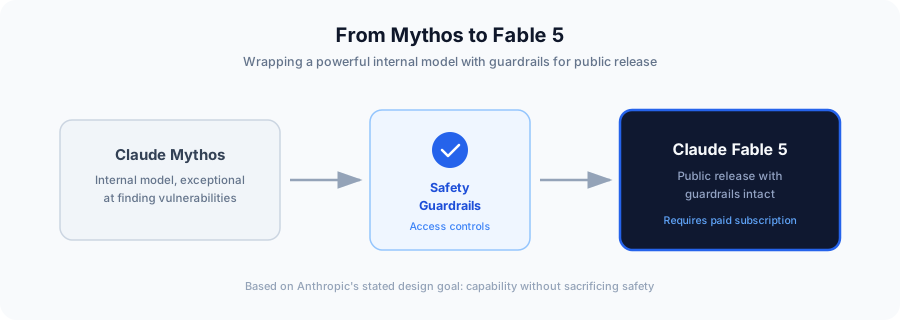
Claude Fable 5 represents a significant milestone in the democratization of advanced AI capabilities. For the past one to two months, the tech community has been captivated by Claude Mythos—a model renowned for its exceptional performance in identifying security loopholes, discovering bugs, and navigating complex systems with remarkable precision. However, this same capability that made Mythos revolutionary also made it a security concern. Anthropic recognized that unrestricted public access to such a powerful tool could potentially enable malicious actors to uncover and exploit vulnerabilities in critical systems.
Rather than keeping this advanced model locked away indefinitely, Anthropic took a pragmatic approach: they wrapped Claude Mythos with comprehensive security guardrails and safety measures, creating Claude Fable 5. This public release maintains the exceptional capabilities of Mythos while implementing strict rules and access controls designed to prevent misuse. The result is a model that combines raw power with enterprise-grade safety protocols—a balance that was previously unavailable to the broader developer community.

Start your free trial today and see results within days.
The release of Claude Fable 5 arrives at a critical juncture in AI adoption. Organizations worldwide are racing to integrate large language models into their workflows, yet they face a fundamental challenge: how to harness cutting-edge capabilities without introducing security vulnerabilities or operational risks. This tension has historically forced companies to choose between innovation and safety—a false dichotomy that Fable 5 begins to dissolve.
For developers, the implications are profound. Advanced agentic coding capabilities enable the creation of sophisticated applications that can:
The significance of this shift cannot be overstated. When a model can reliably perform these tasks while maintaining safety guardrails, it fundamentally changes the economics of software development and accelerates innovation cycles.
FlowHunt recognizes that powerful AI models like Claude Fable 5 are only part of the equation. The real value emerges when these models are integrated into comprehensive, automated workflows that span ideation, content creation, testing, and deployment. FlowHunt bridges this gap by providing a unified platform where developers and content creators can leverage advanced AI capabilities without managing complex integrations or security concerns.
Consider a practical example: a content creator using Claude Fable 5 might generate video ideas and thumbnails. However, managing API calls, handling errors, deploying the application, and monitoring performance across multiple services becomes unwieldy quickly. FlowHunt abstracts these complexities, allowing users to focus on creative and strategic work while the platform handles the technical orchestration.
The following table illustrates how FlowHunt complements advanced AI models:
| Capability | Manual Approach | FlowHunt Integration |
|---|---|---|
| AI Model Selection | Manual switching between platforms | Unified model selection interface |
| Application Deployment | Custom infrastructure setup | One-click deployment |
| Error Handling & Monitoring | Manual logging and debugging | Automated error tracking and alerts |
| API Management | Individual API key management | Centralized credential management |
| Workflow Automation | Custom scripts and integrations | Visual workflow builder |
| Performance Analytics | Fragmented data across services | Unified dashboard and reporting |
Get latest tips, trends, and deals for free.
Benchmark metrics provide quantifiable evidence of Claude Fable 5’s capabilities relative to competing models. The agentic coding benchmark—a critical measure of a model’s ability to write and debug code autonomously—reveals striking performance differentials.
Claude Fable 5 achieves 80.3% on agentic coding benchmarks, representing an 11 percentage point improvement over Claude Opus (69.2%). This gap may seem modest numerically, but in practical terms, it translates to significantly faster development cycles, fewer human code reviews, and reduced debugging time. To contextualize this improvement: Google’s Gemini 3.1 scores 54%, while GPT-4.5 achieves 58.6%. Fable 5’s performance places it at the forefront of available models.
The benchmarks extend beyond raw coding capability. Safety and alignment metrics are equally important for enterprise deployment. Claude Fable 5 demonstrates notably lower rates of misaligned behavior compared to Claude 4.6, suggesting that the guardrails implemented during the Mythos-to-Fable transition were effective. This balance—combining exceptional capability with strong safety properties—was the explicit goal of Anthropic’s design process.
It’s important to note that benchmark comparisons, while useful, represent only one dimension of model quality. Real-world performance depends on specific use cases, prompt engineering, and integration architecture. However, these metrics do provide a reliable signal that Fable 5 represents a genuine advancement in available AI capabilities.
To demonstrate Fable 5’s practical capabilities, a developer built a YouTube Idea Studio application—an end-to-end system that generates video content ideas, titles, descriptions, and SVG thumbnails based on a user-specified topic. This application exemplifies the types of sophisticated, multi-step tasks that Fable 5 can handle autonomously.
The application accepts user inputs including topic, target audience, content style, and desired number of ideas. Within minutes, Fable 5 generates tailored content suggestions with compelling titles and descriptions. For instance, when given “AI agents” as a topic with “developers” as the audience and “educational” as the style, the system produced ideas such as “7 Agent Mistakes That Quietly Ruin Your Progress” and “One Week Test: Chances Are You’re Making at Least One of These.”
This real-world demonstration reveals several important characteristics of Fable 5:
The computational cost warrants mention. Ultra code mode—the highest effort setting available—consumed substantial API credits. This reflects a fundamental trade-off in advanced AI usage: maximum capability requires maximum computational resources. Users should budget accordingly when deploying Fable 5 for production applications.
Accessing Claude Fable 5 requires navigating a few straightforward steps. First, users must maintain an active paid subscription to Claude (the free tier does not include access). Once subscribed, users can navigate to claude.ai and select Fable 5 from the model dropdown menu. The interface displays a clear notification: “Included until June 22nd,” reinforcing the limited-time nature of this release.
The platform also introduces a new effort slider that extends beyond the traditional “maximum” setting. A new “ultra code mode” option provides even greater computational resources for complex tasks, though with proportionally higher credit consumption. This granular control allows users to optimize for either speed or capability depending on their specific needs.
The temporary availability window—extending only through June 22nd—creates urgency for developers and organizations to evaluate Fable 5’s suitability for their workflows. Anthropic’s decision to implement a trial period suggests they are actively monitoring performance, safety metrics, and user feedback to inform decisions about permanent availability.
The release of Claude Fable 5 signals several important trends in the AI industry. First, the model demonstrates that advanced capabilities and robust safety measures are not mutually exclusive. Anthropic successfully wrapped a powerful tool with guardrails without substantially degrading performance—a non-trivial achievement that challenges the notion that safety and capability exist in permanent tension, and one that follows the same trajectory Anthropic set with Claude Sonnet 4.5 and Claude Opus 4.5 before it. It also mirrors the pace-of-release pressure we saw around the GPT 5.2 launch, where competing labs pushed out major updates within weeks of each other.
Second, the limited-time release strategy reflects a measured approach to AI deployment. Rather than making an irreversible decision about public access, Anthropic created a controlled experiment. This allows them to gather real-world data about how developers use the model, what problems emerge, and whether the safety measures prove effective in practice. This iterative approach to capability release may become a template for other advanced AI systems.
Third, Fable 5’s performance metrics underscore the rapid pace of AI advancement. An 11% improvement over Opus in just a few months demonstrates the accelerating trajectory of model development. For organizations building AI-dependent systems, this acceleration creates both opportunities and challenges: opportunities to leverage increasingly capable tools, but challenges in maintaining systems that depend on models that are constantly evolving.
Claude Fable 5 represents a pragmatic resolution to a fundamental challenge in AI deployment: how to provide access to advanced capabilities while maintaining safety and control. By implementing comprehensive guardrails around the exceptional performance of Claude Mythos, Anthropic has created a model that serves the needs of developers and organizations seeking to build sophisticated AI applications without introducing unacceptable security risks.
The performance benchmarks—particularly the 80.3% agentic coding score—demonstrate that Fable 5 is not merely a safety-constrained version of Mythos; it is a genuinely capable system that outperforms widely-used alternatives. Real-world applications, such as the YouTube Idea Studio, confirm that these benchmark improvements translate into practical capability for complex, multi-step tasks.
For developers evaluating AI models for production deployment, Fable 5 warrants serious consideration. The limited availability window through June 22nd provides an opportunity to assess fit before making longer-term architectural decisions. As the AI landscape continues to evolve at an accelerating pace, tools that combine capability with safety will increasingly become the standard expectation rather than the exception.
Experience how FlowHunt automates your AI content and SEO workflows — from research and content generation to publishing and analytics — all in one place.
Arshia is an AI Workflow Engineer at FlowHunt. With a background in computer science and a passion for AI, he specializes in creating efficient workflows that integrate AI tools into everyday tasks, enhancing productivity and creativity.

FlowHunt streamlines AI content creation and deployment. From generating ideas to publishing, manage your entire workflow in one platform.
Claude Fable 5 is a proprietary AI model from Anthropic, classified as Super-Frontier tier with a 1M tokens context window. It is available directly in FlowHunt...

Learn more about Claude by Anthropic. Understand what it is used for, the different models offered, and its unique features.

Discover how Claude Opus 4.5 sets new standards in AI-powered coding, agentic task automation, and enterprise productivity. Learn why this breakthrough model is...
Cookie Consent
We use cookies to enhance your browsing experience and analyze our traffic. See our privacy policy.