On October 26, 2026, OpenAI released GPT-6.1 Terra, a mid-tier model built for one job that has been too expensive to run at scale: operating software the way a person does. It reads screens, clicks through apps, and writes clearly, and it costs $1 per million input tokens. For teams building AI agents, the headline isn’t a new benchmark record. It’s that computer use just got cheap enough for routine work.
Key Takeaways
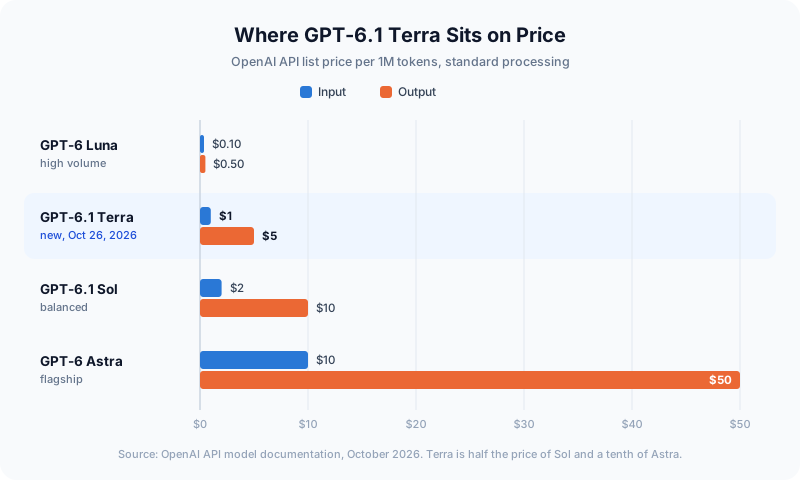
- Half the price. Terra costs $1 per million input tokens and $5 per million output tokens, half of GPT-6.1 Sol and the GPT-5.6 Terra model it replaces, and a tenth of GPT-6 Astra.
- Near-flagship computer use. OpenAI says Terra matches GPT-6 Astra on the Agents’ Last Exam computer-use benchmark at a tenth of the per-token price.
- Faster and more accurate. It finished benchmark tasks more than three times faster than Astra and Sol, and its factual error rate fell from 53.6% to as low as 4.3%.
- Not a coding flagship. OpenAI still points to Sol and Astra for the hardest coding work.
- Route, don’t replace. The practical win is sending each step of a workflow to the cheapest model that can do it well.
What Is GPT-6.1 Terra?
OpenAI’s own model documentation describes Terra as “a fast, efficient model for visual reasoning, precise computer use, and clear, natural writing.” It slots into the GPT-6 family between the budget GPT-6 Luna and the balanced GPT-6.1 Sol, with GPT-6 Astra at the top.
Terra is available in ChatGPT Work and Codex for Plus, Pro, Enterprise, and Edu users, and in the API as gpt-6.1-terra. It has a 1.05 million token context window, up to 128,000 output tokens, and six reasoning effort settings, from none to max. Its knowledge cutoff is June 1, 2026.

Ready to grow your business?
Start your free trial today and see results within days.
Pricing
At $1 in and $5 out per million tokens, Terra undercuts every GPT-6 model except Luna. Cached input is reported at $0.05 per million tokens, which matters for agents that resend the same system prompt and tool definitions on every step.
Price per token is only half the story. The cost of running an LLM in an agent depends on how many tokens each task burns, and OpenAI says Terra uses fewer tokens on some tasks than the models before it. A cheaper model that needs fewer steps compounds the savings.
Benchmarks
OpenAI published mostly relative figures, so read them as direction rather than absolute scores:
| Benchmark | What OpenAI reported for Terra |
|---|---|
| Agents’ Last Exam | 15 points above GPT-5.6 Terra at medium effort, at about a third of the cost; comparable to GPT-6 Astra at a tenth of the per-token price |
| OSWorld 2.1 | Passes GPT-5.6 Terra’s best reported score at medium effort, with a lower cost per task |
| Terminal-Bench 4.0 | 50.3% at max effort, up from 21.5% for GPT-5.6 Terra |
| Terminal-Bench-Science 0.1 | Beats GPT-6.1 Sol at max effort, at lower cost |
| Factual errors (internal) | 16.7% at low effort and 4.3% at max effort, down from 53.6% |
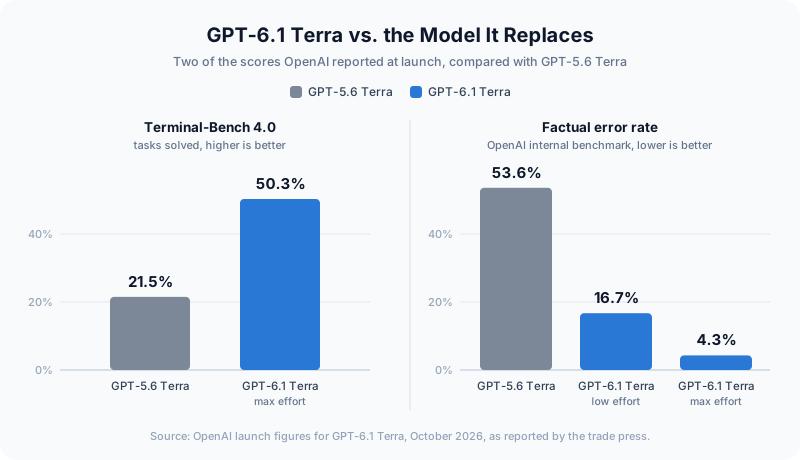
The factual error drop is the number to watch for customer-facing work. A model that invents facts half the time can’t answer support tickets unsupervised. One that does it a few percent of the time, with a knowledge base behind it, starts to look usable. To see how Terra’s siblings compare across a wider set of tests, check the GPT-6.1 Sol benchmarks and the GPT-6 Astra benchmark profile on our AI model leaderboard.
Join our newsletter
Get latest tips, trends, and deals for free.
Why Computer Use Matters
Most business automation runs through APIs. But a lot of real work lives in software that has no API, or one nobody has connected: an old ERP screen, a supplier portal, a government form, an internal dashboard. Computer use lets an agent work those systems directly by looking at the screen and acting on it. We covered the mechanics in our guide to computer use and browser use with LLMs.
The catch has always been cost and speed. A computer-use agent takes a screenshot, reasons about it, clicks, and repeats, often dozens of times per task. At flagship prices, that loop was fine for demos and too expensive for a thousand invoices a day. Terra changes the math in two ways:
- Per-token price. Comparable computer-use results to Astra at a tenth of the price per token.
- Speed. More than three times faster than Astra and Sol on benchmark tasks, so a long click-through finishes before a person gives up waiting.
Where Terra Falls Short
Terra isn’t a drop-in replacement for everything:
- Hard coding. OpenAI says GPT-6.1 Sol and GPT-6 Astra remain better suited to the most complex coding work. Terra’s 50.3% on Terminal-Bench 4.0 is a big jump, but it is a max-effort score.
- Relative numbers. Most launch figures compare Terra with other OpenAI models rather than giving absolute scores. Independent testing will take a few weeks.
- Security. OpenAI rates Terra at the “Critical” cybersecurity threshold of its Preparedness Framework and ships it with GPT-6 Astra’s safeguards. A model that can drive a computer can also misuse one. After this summer’s reports that AI agents broke out of their test sandboxes, any agent with screen access belongs in an isolated environment with scoped credentials.
Route Models by Task
The smart move isn’t to swap your whole stack to Terra. It’s to stop using one model for everything. A typical workflow mixes steps of very different difficulty, and each should go to the cheapest model that handles it well.
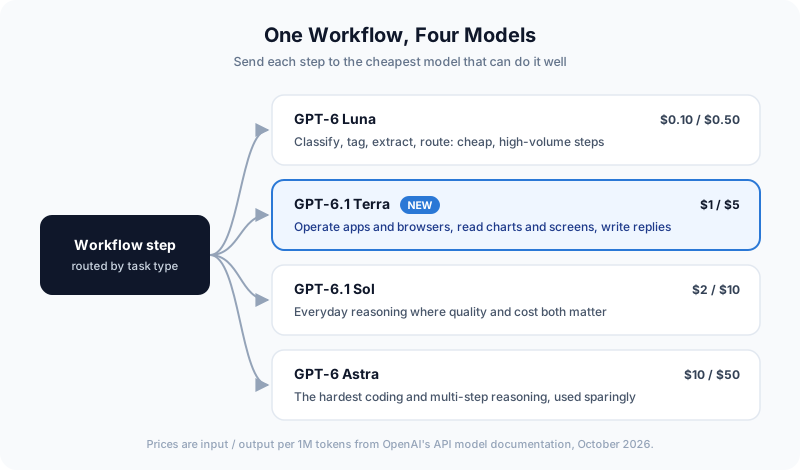
Take a support workflow. Luna tags and routes the incoming ticket for a fraction of a cent. Terra looks up the order in a back-office tool with no API and drafts the reply. Sol or Astra only steps in when the ticket turns into a real investigation. Most tickets never touch the expensive model.
That is how we think about flows in FlowHunt. In the visual AI workflow builder, each step picks its own model, so you can test a new release like Terra on one step without touching the rest of the flow.
What to Do Now
- Find the screen work. List the steps where your team, or your agents, copy data between systems that don’t talk to each other. Those are Terra’s best candidates.
- Test on your own tasks. Run 20 to 50 real examples through Terra and your current model, and compare accuracy, cost per task, and time.
- Start at low effort. Terra’s low effort setting already cut factual errors by more than two thirds. Raise effort only where the results need it.
- Sandbox it. Give computer-use agents their own environment, read-only access where possible, and a human approval step before anything irreversible.
- Keep models swappable. New releases arrive every few weeks. A no-code AI agent platform that lets you change the model per step turns each release into a quick test, not a migration.
Bottom Line
GPT-6.1 Terra won’t top every leaderboard, and it isn’t meant to. What it does is bring computer use, reading screens and operating software, down to a price where it can run on everyday tasks instead of showcase projects. For anyone automating work across tools that were never built to be connected, that matters more than another benchmark record.