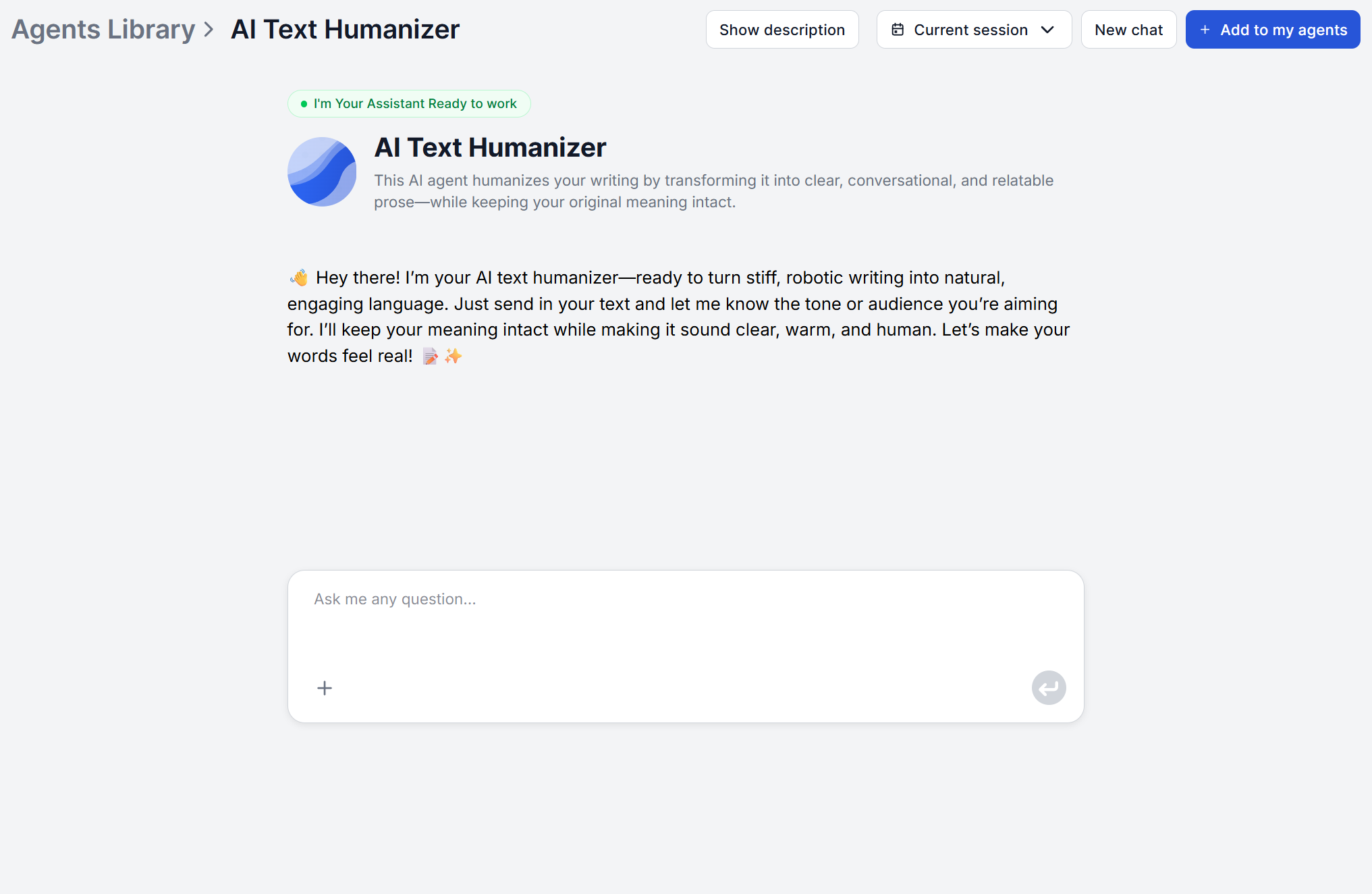
AI-written content has telltale patterns. It uses way to many em dashes and colons, repetitive phrasing, robotic transitions, voice low on personality, and much more. AI text humanizers fix these automatically. Here’s what changes, how major detectors respond, and how to use humanized AI content effectively and ethically.
AI
Content Writing
Text Enhancement
Natural Language
Writing
AI-written content has telltale patterns, such as repetitive phrasing, em dash overuse, mechanical transitions, zero personality. An AI text humanizer
fixes these automatically, transforming stiff generated text into natural writing. Here’s what changes when you humanize AI writing, how major detectors respond, and how to use the output effectively and ethically.
Why AI Text Sounds Robotic: The 5 Telltale Patterns
Before fixing the problem, you should understand exactly what you’re fixing. AI-generated text consistently trips on the same five patterns.
1. Overused filler phrases. Phrases like “in the realm of,” “leverage,” “robust,” “it’s worth noting,” and “delve into” appear disproportionately in AI output. They get phased out with time, but are always replaced with a new set of tell-tale phrases. Moreover, each model has it’s own set. Readers and detection tools alike quickly pick up on them and see them as clear AI signals.
2. Uniform sentence length. Human writers naturally vary how long their sentences are. AI models tend to produce sentences of similar length and grammatical complexity throughout a piece, creating a monotonous rhythm that feels generated rather than spoken.
3. Mechanical transitions. “Furthermore,” “Moreover,” “Additionally,” and “In conclusion” appear in AI writing often. But those appear in human writing often too, and that’s why they’re so common in the training data. But the difference is more nuanced. In human writing, they aid natural progression, while in AI writing they mask the lack of it. You’ll often notice in AI writing that two paragraphs aren’t really logically intertwined, yet they’re connected with one of these phrases. It’s not the phrases themselves, it’s how they feel out of place that breaks the reader’s flow and reveals AI use.
4. No personality or voice. Contractions, colloquialisms, humor, and personal perspective are rare in raw AI output. What you get is competent but impersonal. Adding a bit of personality here and there while editing can be a quick way to signal human input to algorithms, and consequently boost rankings.
5. Hedge stacking. AI text accumulates qualifiers: “It is imoportant to note that,” “It should be emphasized that,” “It is crucial to understand.” Ocassionally using them on their own is harmless, but each one signals caution. Cumulatively, they drain the writing of confidence and momentum.
How AI Text Humanizers Work
An AI text humanizer
doesn’t just swap words with synonyms. That’s what basic paraphrasing tools
do. The AI Text Humanizer reads the intent behind your text, identifies what makes it feel stiff or robotic, and rewrites it with the kind of flow, warmth, and personality that connects with real readers.
The tool handles the full humanization process in one pass:
Tone and intent analysis: It identifies whether your text is informative, persuasive, instructional, or something else, and uses that to guide how it rewrites.
Natural language rewriting: Stiff phrasing gets replaced with contractions, varied sentence lengths, and idiomatic expressions that feel natural rather than generated.
Overused AI pattern removal: Phrases like “in the realm of,” “leverage,” and “robust” are replaced with plain, direct alternatives.
Complexity simplification: Dense or technical language is broken down into clear, accessible terms without losing accuracy.
Tone customization: Casual, professional, humorous, or academic. You name it and the tool matches it. If you don’t specify a tone, the tool defaults to warm and conversational which is a great starting place for most marketing material.
Audience targeting: Vocabulary and sentence structure are adjusted to match your readers, whether that’s general consumers, industry experts, or students.
Ready to grow your business?
Start your free trial today and see results within days.
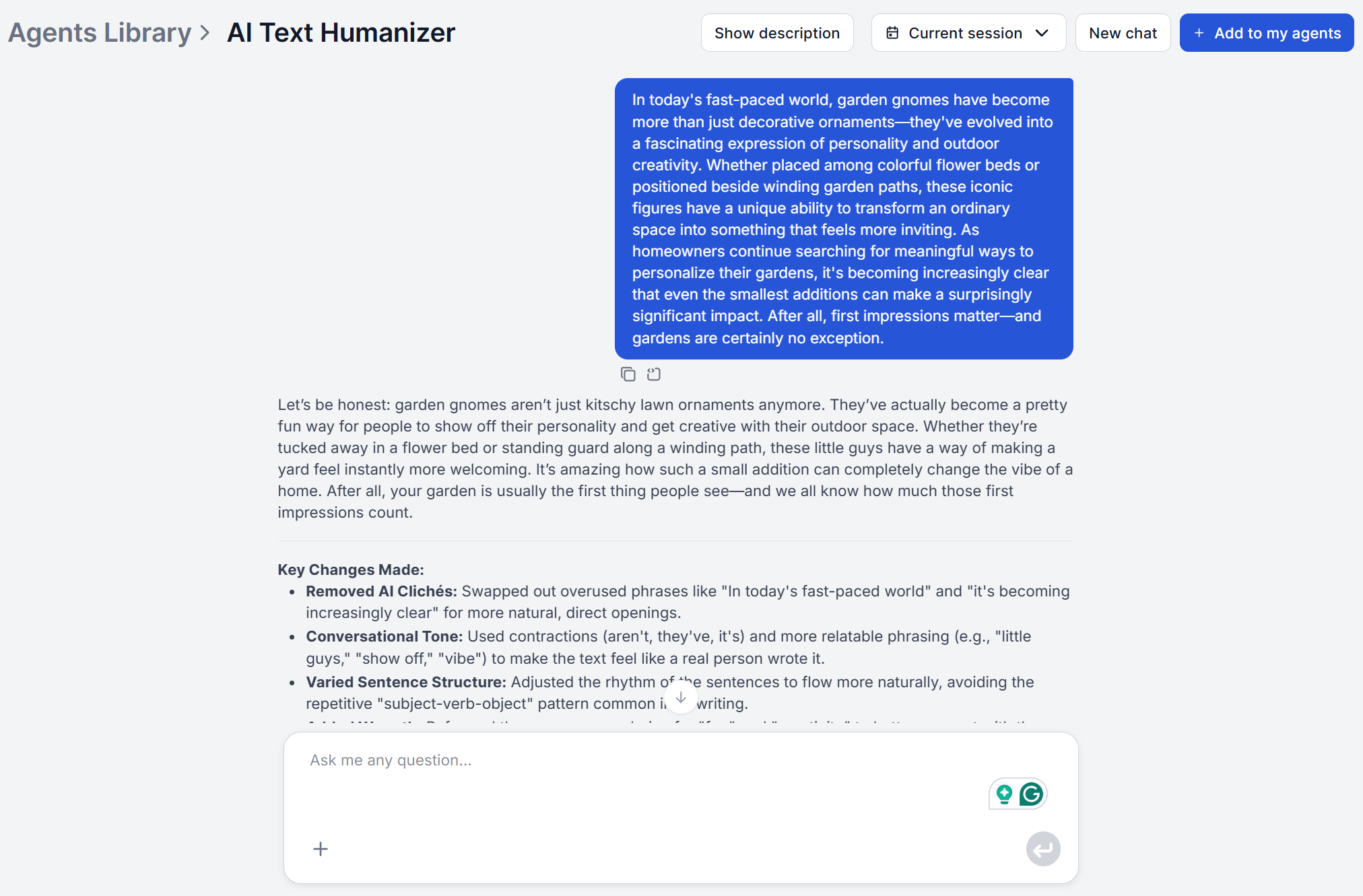
The clearest way to see what changes is to look at concrete examples.
Blog intro — before:
In the realm of content marketing, it is crucial to leverage robust strategies that synergize with your overall brand identity in order to achieve optimal results and drive meaningful engagement.
After humanization:
Content marketing works best when your strategy actually matches who you are as a brand. If it doesn’t, readers notice and so do the search engines.
The original uses nine words to say nothing specific. The humanized version makes the same point in fewer words and adds a real consequence.
Product description — before:
Our comprehensive, multifaceted solution empowers organizations to streamline their operational workflows, facilitating enhanced productivity across all departments.
After humanization:
Our tool helps teams get more done with fewer steps across every department.
“Comprehensive,” “multifaceted,” “empower,” “streamline,” and “facilitate” are all classic AI defaults. The humanized version uses language a real buyer would recognize.
Professional email — before:
I am reaching out to explore potential synergies between our respective organizations with a view to establishing a mutually beneficial partnership arrangement.
After humanization:
I wanted to reach out because I think there could be a real fit between what we’re building. I’m happy to chat if you’re open to it.
One version reads like a template. The other sounds like a person sent it.
Does Humanized Content Pass AI Detectors? (Tested on GPTZero, Turnitin)
This is the question most content teams ask first, and the honest answer is that it depends. It depends on things like the original input, the prompt, the AI model choice, and much more. No responsible tool should promise a guaranteed pass rate.
AI detectors like GPTZero and Turnitin analyze statistical properties of text, primarily how predictable each word choice is (perplexity) and how much sentence-to-sentence variation exists (burstiness). Raw AI output scores high on predictability and low on variation. Humanized text introduces more natural variation and removes predictable phrasing, which changes both signals.
What that means in practice:
Text heavily reliant on AI defaults will score differently after humanization, and that affects how detectors interpret it.
The detectors themselves are not perfect. They carry documented false-positive rates even on text written entirely by humans, so any pass/fail result comes with inherent uncertainty.
Detector sensitivity varies by tool, version, content category, and how the underlying model was tuned.
The AI Text Humanizer
is designed to produce natural, readable text. If you’re running a grammar pass after humanization, the AI Grammar Checker
can clean up any remaining rough edges before the content goes live.
Join our newsletter
Get latest tips, trends, and deals for free.
Using AI Humanizer Ethically
AI tools for humanizing text are a legitimate productivity tool. When prompted correctly, it can definitely improve reading experience, and potentially fool AI detetors. Yet, it operates differently in different contexts and it’s not fit for all contexts.
Making technical writing accessible to a general audience.
Editing formal documents into plain language.
Where it requires more thought:
Academic submissions — most institutions have explicit policies on AI-generated content. Humanized or not, using AI output where it’s prohibited is a policy violation, not a detection problem.
Ghostwriting — humanizing AI drafts for clients is standard practice in many content agencies, but transparency about the production process is a reasonable expectation where clients ask.
Journalism and factual content — humanization does not verify facts. The tool changes how text reads, not whether it’s accurate. Fact-check independently before publishing.
The AI Text Humanizer
changes language, not truth. Use it to improve the quality of your output, not to obscure its origins where disclosure is expected.
Making AI Writing Work for You
AI-generated text has predictable weaknesses, and that’s actually good news. Predictable problems have predictable fixes. The patterns that make AI writing feel robotic are exactly what a humanizer is built to address.
What it can’t do is add what wasn’t there to begin with. Specific examples, accurate data, genuine expertise, and a point of view that reflects real experience still have to come from somewhere. The most effective approach is to treat humanization as one step in a workflow rather than the whole solution. Generate a grounded draft first, then humanize it for voice and readability, enrich it with the layer of context and judgment that only you can provide, then verify before publishing.
That workflow produces content that reads as written by a person because, in the ways that actually matter, it was.
Try the AI Text Humanizer
on your next draft and compare the output to what you started with.
Frequently asked questions
Humanization changes the statistical properties that detectors look for, such as word predictability and sentence variation, since these are exactly what tools like GPTZero look for. No AI humanizer can guarantee a specific pass rate, because the detectors update continuously, and results vary by content type.
No. The AI Text Humanizer rewrites phrasing and sentence structure while preserving the original ideas, facts, and intent. For critical content, such as technical documentation or legal text, review the output to confirm that full meaning is preserved.
The tool handles full documents in a single pass. For longer content, processing section by section gives you more control over tone for each part. This is particularly useful when different sections of a document call for different registers. Be mindful of the context window, as content that hits the context limits will suffer in accuracy and quality of output, potentially causing hallucinations.
Yes. The AI Text Humanizer can be set up to use any tone you need. If you don't specify a tone, the tool defaults to warm and conversational tone, which is always a great start for most blog content.
No. Paraphrasing tools swap words and phrases at the surface level without understanding the underlying intent. The AI Text Humanizer analyzes the tone and purpose of your text, then rewrites it with varied sentence structure, natural transitions, and appropriate idiom.
Maria is a copywriter at FlowHunt. A language nerd active in literary communities, she's fully aware that AI is transforming the way we write. Rather than resisting, she seeks to help define the perfect balance between AI workflows and the irreplaceable value of human creativity.
Maria Stasová
Copywriter & Content Strategist
Try the AI Text Humanizer
Transform AI-generated drafts into natural, human-sounding content in one pass — no manual editing, no robotic phrasing, no guesswork.
AI Humanizer: How to Make AI Text Sound More Human (2026 Guide)
Learn 7 proven techniques to humanize AI-generated text. Plus: best AI humanizer tools compared and how to automate humanization at scale with FlowHunt workflow...
Transform AI-generated or robotic text into natural, engaging human-like language with our advanced AI Text Humanizer. This powerful tool rewrites formal or sti...
5 Content Types That Benefit Most from AI Text Humanization (With Examples)
Not all AI content needs the same level of humanization. Blog posts, LinkedIn posts, product descriptions, and email newsletters each have different requirement...
8 min read
AI
Content Writing
+3
Cookie Consent We use cookies to enhance your browsing experience and analyze our traffic. See our privacy policy.