Multi-Agent AI Systems in 2026: What the Research Actually Says
Cuts through the multi-agent hype. The 2026 industry consensus, the 15× token cost, the four prompt patterns, and a 45-minute FlowHunt tutorial that uses the consensus pattern.
A multi-agent AI system is a network of AI agents working together to solve a problem. But the architecture that actually gets deployed in 2026 is narrower than the buzzword suggests: a single orchestrator owns the full conversation context and spawns ephemeral isolated subagents that return only a compressed summary. Anthropic, Cognition, OpenAI, AutoGen-via-Microsoft Agent Framework, and LangChain have all converged on this pattern. Peer-collaborating “GroupChat” designs—where workers talk to each other directly—have quietly lost ground.
This article does three things. First, it explains the orchestrator + subagent pattern and why the industry converged on it. Second, it walks through the cost reality: Anthropic’s measured ~15× token premium, and the 2026 papers showing single-agent systems match or beat multi-agent at equal token budgets. Third, it shows how to build the consensus pattern in FlowHunt without writing code.
The Two Architectures You Need to Know
There are really only two architectures worth comparing, and most of the marketing material conflates them.
Peer collaboration. Multiple agents run concurrently and communicate through a shared bus. They can ask each other questions, hand off tasks, and wake each other up. A supervisor mediates but does not own the only context. AutoGen GroupChat, CrewAI hierarchical, and any “team of agents on a stream” design fall here. The cost is real: every wakeup re-reads the full transcript, the system prompt carries a long coordination protocol on every call, and communication relationships scale O(n²).
Orchestrator + isolated subagents. A single agent owns the full context. It spawns ephemeral subagents to perform isolated subtasks. Each subagent runs in its own fresh context window with a dedicated system prompt, executes its task, and returns a single summary string. There is no peer-to-peer channel and no shared mutable state. Anthropic’s research multi-agent system, Claude Code’s Task tool, OpenAI’s agents-as-tools, and Cognition’s March 2026 Managed Devins all use this pattern.
The second pattern is technically multi-agent, but its coordination cost is bounded. There is no peer bus, so there is no quadratic communication explosion and no transcript-replay tax.
How the Industry Converged in 2025–2026
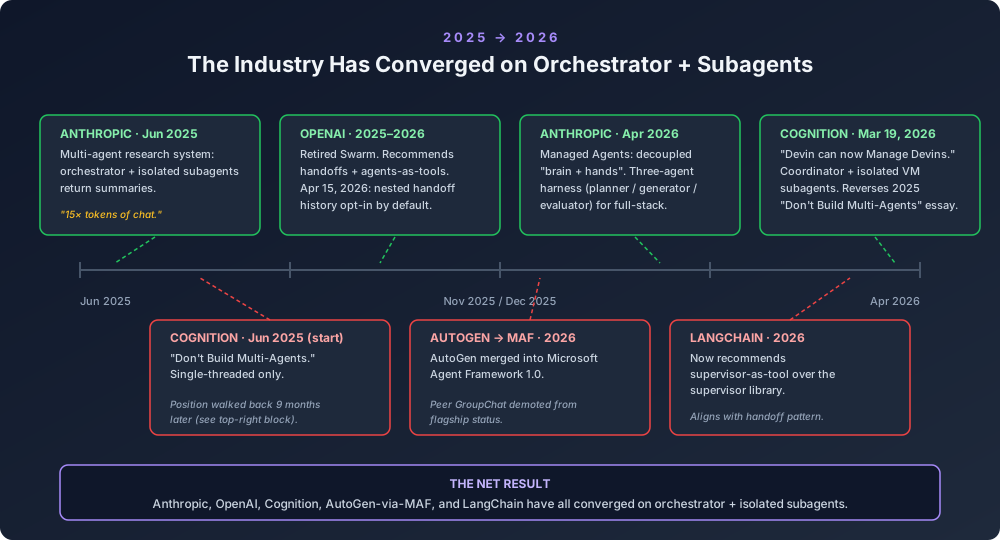
The polarized 2025 debate has effectively collapsed.
Cognition’s Don’t Build Multi-Agents (June 2025) was the strongest stated position against multi-agent designs—single-threaded only, with a separate compression LLM for context management. Nine months later, in March 2026, Cognition shipped Devin can now Manage Devins
: a coordinator that scopes work, assigns each piece to a managed Devin running in its own isolated VM, and compiles the results. The justification—“context accumulates, focus degrades, and the quality of each subtask suffers”—is the same isolation argument Anthropic made in 2025. The post does not retract the earlier essay by name, but the architectural concession is unambiguous.
Anthropic’s posture moved in the opposite direction over the same period—toward decoupled “brain/hands” architectures rather than wider parallel fan-out. April 2026’s Managed Agents
post and the three-agent harness for full-stack development emphasize role-scoped subagents over peer teams.
OpenAI’s April 15, 2026 Agents SDK update
made nested handoff history opt-in by default—reducing cross-agent context bleed. AutoGen merged into Microsoft Agent Framework 1.0; peer GroupChat is no longer flagship. LangChain now recommends supervisor-as-tool over the supervisor library.
Five vendors, one direction. Peer GroupChat is on the wane.
Ready to grow your business?
Start your free trial today and see results within days.
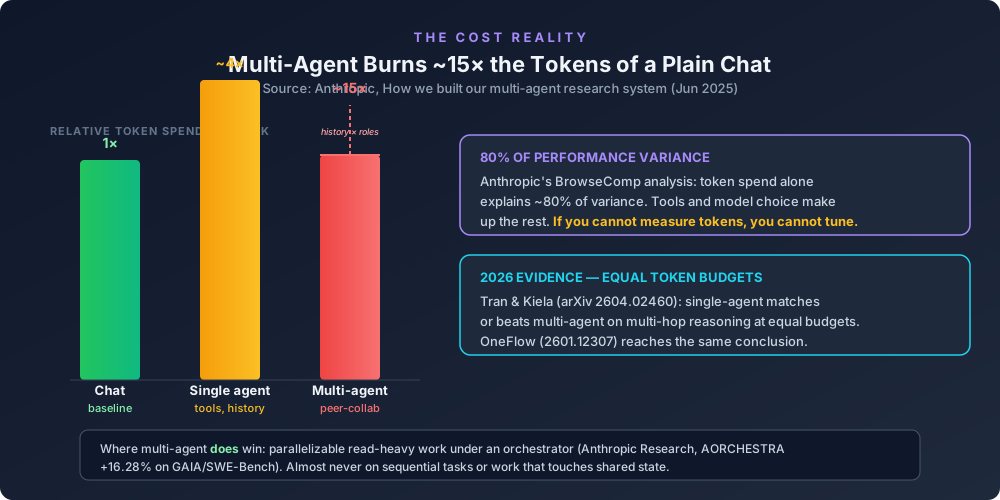
The most cited number from Anthropic’s June 2025 engineering post:
“Internal analysis shows that agents typically use about 4× more tokens than chat interactions, and multi-agent systems use about 15× more tokens than chats.”
And the diagnostic kicker:
“Token usage by itself explains 80% of the variance in BrowseComp performance.”
The 2026 academic literature pushes the same conclusion harder. Tran & Kiela (arXiv 2604.02460
, April 2026, Stanford / Contextual AI) tested Qwen3, DeepSeek-R1-Distill-Llama, and Gemini 2.5 and report: “under a fixed reasoning-token budget and with perfect context utilization, single-agent systems are more information-efficient… single-agent systems consistently match or outperform multi-agent systems on multi-hop reasoning tasks when reasoning tokens are held constant.” The theoretical floor is the data-processing inequality: passing information through more agents can only lose, never add.
Xu et al.’s OneFlow
paper (January 2026) reaches the same conclusion across seven benchmarks, with KV-cache reuse cited as the efficiency edge.
This does not mean multi-agent is always wrong. It means the burden of proof is on multi-agent, not on the simpler design.
When Multi-Agent Actually Wins
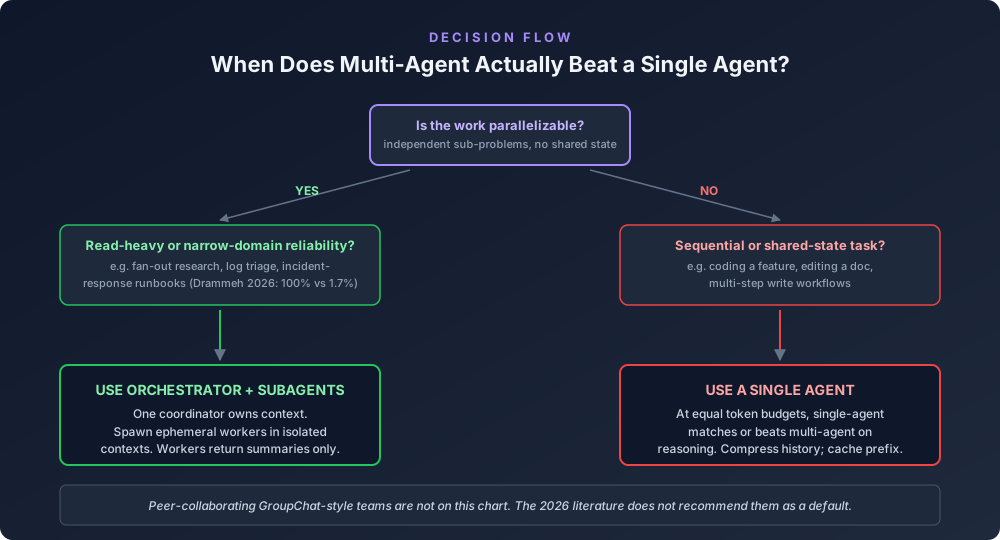
The 2026 evidence converges on a narrow set of cases.
Parallelizable read-heavy work. Anthropic’s 2025 system fans out subagents on independent research subqueries. AORCHESTRA (arXiv 2602.03786
, February 2026) models every subagent as a 4-tuple (INSTRUCTION, CONTEXT, TOOLS, MODEL) spawned on demand by an orchestrator and reports +16.28% relative improvement against the strongest baseline on GAIA, SWE-Bench, and Terminal-Bench using Gemini-3-Flash. AdaptOrch (2602.16873
) reports +12–23% over static single-topology baselines using identical underlying models—the win comes from topology routing, not from peer collaboration.
Narrow-domain reliability. Drammeh’s incident-response paper (2511.15755 v2
, January 2026) ran 348 controlled trials and reports a 100% actionable recommendation rate vs 1.7% for single-agent, with 80× action specificity and 140× solution correctness, and “zero quality variance across all trials.” The domain is narrow and the work is parallel; the orchestrator pattern wins decisively.
Disjoint tool or context domains where handoff serves as a security boundary—a billing agent that genuinely should not see engineering tools, for example.
For sequential task execution, agents touching shared state, or anything that looks like “do these steps in order with judgment between them”—these conditions do not apply. The literature recommends a single agent with disciplined context management.
Join our newsletter
Get latest tips, trends, and deals for free.
The Subagent Contract
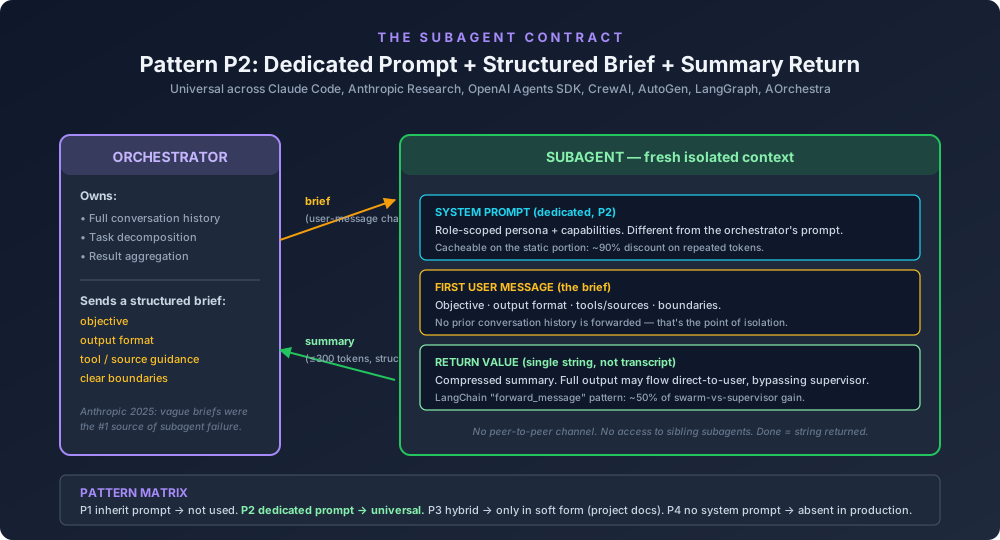
Once you’ve decided multi-agent is the right call, the prompt structure is more standardized than most marketing material suggests. Every major implementation surveyed—Claude Code, Anthropic Research, OpenAI Agents SDK, CrewAI, AutoGen, LangGraph, AOrchestra—uses the same pattern, called P2 in the prompt-construction literature: a dedicated system prompt for the subagent, plus a structured task brief delivered as the first user message.
Anthropic’s 2025 post is the most explicit on what goes in the brief:
“Each subagent needs an objective, an output format, guidance on the tools and sources to use, and clear task boundaries.”
They are also explicit about what failure looks like when this is skipped:
“We started by allowing the lead agent to give simple, short instructions like ‘research the semiconductor shortage,’ but found these instructions often were vague enough that subagents misinterpreted the task or performed the exact same searches.”
Three rules fall out of the consensus:
The subagent’s system prompt is dedicated and different from the orchestrator’s. No major framework reuses the orchestrator’s prompt for the subagent. Doing so loses the specialization win and pays the orchestrator’s prompt cost on every subagent call.
The first user message is the brief. Objective, format, tools, boundaries. Free-form delegations like “research X” are the documented failure mode.
The subagent returns a summary string, not a transcript. Anthropic’s research subagent contract and Cognition’s Managed Devins contract both prescribe summary returns. Inlining the full transcript pollutes the orchestrator’s context window and burns tokens on every subsequent call.
A fourth rule, often overlooked: forward worker output directly to the user when the supervisor’s only remaining job is to deliver it. LangChain’s 2025 benchmark measured roughly 50% of the swarm-vs-supervisor performance gain coming from this single change. The “supervisor reads worker output, paraphrases for the user, paraphrases user reply for next worker” round-trip is pure waste.
Documented Failure Modes of Peer-Collaborating Agents
These show up in production retrospectives, in the LangChain benchmark, and in Cogent’s Multi-Agent Orchestration Failure Playbook for 2026. They are the reason the industry shifted.
Failure mode
What it looks like
Full transcript replayed every wakeup
Each agent re-ingests the entire conversation on every turn. Linear in turns × agents.
System-prompt bloat from coordination protocol
Every agent ships the protocol description, role list, and signal vocabulary on every call.
Supervisor “translation” round-trip
Supervisor reads worker output, paraphrases for user, paraphrases user reply for next worker. ~50% of avoidable cost.
Conflicting implicit assumptions
Workers operating in parallel make subtle aesthetic or architectural decisions that don’t reconcile. Cognition’s 2025 central claim.
Coordination edge explosion
n agents communicate over O(n²) edges. Adding the 5th agent doubles the message graph.
HITL/suspension overhead
Pausing and resuming re-bills the entire pre-suspension transcript.
Premature consensus / “herding”
Peer agents converge on a confident-but-wrong answer because each agent’s confidence raises the others’. New 2026 finding (Tian et al., 2025; reinforced 2026).
A useful diagnostic: if you can name three of the seven on your own deployment, you are paying the multi-agent tax for an architecture the literature does not recommend. The fix is rarely “rip out the agent team”—it’s compress history, cache the static prompt prefix, return summaries instead of transcripts, and forward worker output directly to the user.
What’s New in 2026: Coordination Protocols
The genuinely new development of 2026 is infrastructure-level coordination primitives, not framework patterns.
The Agent2Agent (A2A) protocol joined MCP under the Linux Foundation AI & Agents Foundation (AAIF) in December 2025, with founding support from OpenAI, Anthropic, Google, Microsoft, AWS, and Block. A2A explicitly targets “inter-agent communication, task delegation, and collaborative orchestration for distributed multi-agent workflows.” By February 2026, MCP had crossed roughly 97 million monthly SDK downloads.
Two research-stage primitives are worth tracking. KVCOMM (NeurIPS 2025) demonstrates over 70% KV-cache reuse and ~7.8× speedup in five-agent settings by sharing KV state instead of tokens. Phase-Scheduled Multi-Agent Systems (PSMAS, February 2026) reports 34.8% token reduction by treating agent activation as continuous control over shared attention rather than discrete RPC.
These primitives sidestep the orchestrator-vs-peer dichotomy by changing what “context” even means between agents. They are not yet production-ready building blocks, but they are the right thing to track—and they reinforce the general direction: cost will be reduced through smarter coordination at the infrastructure layer, not through more elaborate peer designs at the framework layer.
Building the Consensus Pattern in FlowHunt
You do not need to be a software engineer to build the orchestrator + subagent pattern. FlowHunt’s visual builder maps cleanly onto the subagent contract: an orchestrator node owns the conversation, worker nodes run with their own system prompts, and connections carry a structured brief out and a summary back.
Below is a 45-minute walkthrough of a content research pipeline using the consensus pattern.
Prerequisites
FlowHunt account (free tier available)
API keys for: Google Search API, OpenAI (or your preferred LLM)
45 minutes of uninterrupted time
Phase 1: Setup and Planning (5 minutes)
Log into FlowHunt and click Create New Workflow. Name it Content Research Pipeline. Set the trigger to Manual. The workflow has three roles: an orchestrator that owns the user request, a research subagent (parallelizable read), and a fact-check subagent (parallelizable read). Both subagents return summaries.
Phase 2: Build the Research Subagent (12 minutes)
Add a Google Search node. Configure it to take a topic as input, return the top 5 results, exclude ads, and emit URL, title, snippet, and date.
Add an OpenAI node downstream. This is the subagent’s “system prompt” slot. Give it a dedicated, focused prompt:
You are a research subagent. Given search results,
extract factual claims with source URLs and publish dates.
Output a JSON list of {claim, url, date} objects.
Boundaries: do not synthesize, do not summarize, do not editorialize.
This is the P2 pattern: a dedicated subagent prompt, scoped narrowly. Connect Google Search → OpenAI Extraction.
Phase 3: Build the Synthesis Step (12 minutes)
Add a Text Synthesis node. Its job is to organize the research subagent’s output into a structured outline—one section per theme, each backed by source claims.
Add an OpenAI node to draft the article. Give it a focused prompt: outline in, draft out. Connect Synthesis → OpenAI Generation.
Phase 4: Build the Fact-Check Subagent (12 minutes)
Add an AI Agent node configured as a fact-checker. The structured brief looks like Anthropic’s recipe—objective, format, tools, boundaries:
Objective: validate every factual claim in the draft article.
Output format: annotated draft with verification status per claim
  (verified | unverified | contradicted) and a confidence score 0–1.
Tools: knowledge base lookup, web search.
Boundaries: do not rewrite the article. Flag, don't fix.
Add a Markdown formatter as the final output node. Connect Fact-Checker → Markdown.
Phase 5: Wire the Pipeline (4 minutes)
Research subagent → Synthesis → Fact-Check subagent → Output. Each connection carries the previous step’s output as the next step’s structured brief.
This is sequential rather than fan-out, which is appropriate here—the synthesis needs the research output, and the fact-check needs the synthesis. If you wanted to scale to ten parallel research subqueries, you would replace the single research node with a fan-out: orchestrator spawns N subagents in parallel, each takes one subquery from a structured brief, each returns its own summary, and the orchestrator merges before passing to synthesis.
Phase 6: Test and Deploy (5 minutes)
Click Run Workflow. Provide a topic like “What is quantum computing?”. Expect ~45–60 seconds end to end. Watch the per-node outputs in the FlowHunt UI to see what each subagent received as its brief and what it returned.
Once verified, deploy to a webhook, schedule, or manual trigger. Configure the output destination (email, Slack, Google Drive, database). Enable per-role logging—Anthropic’s “80% of variance is token spend” finding makes per-role token telemetry the prerequisite for any tuning.
What the Research Says Not to Do
A short list of things the 2025–2026 literature explicitly recommends against:
Don’t share a system prompt across orchestrator and subagent. No major framework does this. It conflates roles and pays the orchestrator’s prompt cost on every subagent call.
Don’t return the full subagent transcript to the orchestrator. Return a structured summary. Forward the full output to the user directly when appropriate.
Don’t replay the entire conversation history on every supervisor wakeup. Compress older turns into a structured digest via a cheap model. Cap full-fidelity messages at a sliding window.
Don’t add a peer-question channel between subagents unless you can name a use case that hits it >5% of the time. The 2026 evidence does not recommend it as a default.
Don’t reach for multi-agent on sequential tasks. Tran & Kiela 2026 + OneFlow 2026 both show fixed-budget single-agent wins on reasoning. Use a single agent and invest the saved tokens in better context engineering.
Real-World Use Cases for Multi-Agent AI
These are the use cases where the orchestrator + subagent pattern earns its premium.
Content Research and Synthesis
A research subagent queries APIs, academic databases, and internal documents and returns a structured summary of sources. A synthesis step organizes findings into an outline. A fact-check subagent validates claims with confidence scores. Production teams report ~70% reduction in fact-checking time and 40% increase in content production—numbers consistent with the parallelizable-read sweet spot.
Lead Qualification and Routing
A data-enrichment subagent pulls profile data from CRM, Clearbit/Apollo, LinkedIn, and website behavior—genuinely parallel reads from independent sources. A scoring subagent compares against the ICP and assigns a score. A routing subagent maps high-scoring leads to the right rep based on territory and load. Reported: 35% conversion-rate increase, 50% reduction in lead processing time.
Customer Support Triage
A first-line subagent extracts ticket type and sentiment and attempts knowledge-base resolution. An escalation subagent evaluates outcome and routes to the right specialist. A handoff subagent packages context for the human. The orchestrator pattern here serves the disjoint-domain criterion: billing, tech support, and complaints have different tools and different data access.
Market Intelligence
Parallel collection subagents—news scraper, financial agent, social-sentiment agent, competitor-website monitor—run in genuine fan-out. An analysis subagent receives the four summaries and identifies trends. A report subagent drafts the executive summary. This is the closest analog to Anthropic’s 2025 research multi-agent system and the use case most strongly supported by AORCHESTRA’s 2026 numbers.
Key Takeaways
The 2026 industry consensus is orchestrator + isolated subagents with summary returns. Anthropic, Cognition, OpenAI, AutoGen-via-MAF, and LangChain converged on it.
Multi-agent burns ~15× the tokens of chat (Anthropic, 2025); token spend explains ~80% of performance variance. Measure tokens before optimizing anything.
At equal token budgets, single-agent matches or beats multi-agent on reasoning (Tran & Kiela 2026, OneFlow 2026). The burden of proof is on multi-agent.
Multi-agent wins where work is parallelizable and read-heavy (Anthropic Research, AORCHESTRA +16%) or in narrow-domain reliability (Drammeh 2026: 100% vs 1.7%). Almost never on sequential or shared-state work.
Every major framework uses the P2 prompt pattern: dedicated subagent system prompt + structured user-message brief (objective, format, tools, boundaries) + summary return.
The new infrastructure layer is A2A and MCP under the Linux Foundation AAIF. KV-state sharing (KVCOMM) and phase-scheduled coordination (PSMAS) are research-stage but reduce coordination cost rather than eliminating it.
The future of AI is not a single super-intelligent model, and it is not a peer-collaborating swarm. It is a single coordinator that owns the context and a small set of disciplined, isolated workers that return summaries. That is the pattern the research supports, and that is the pattern FlowHunt is built to make easy.
{{ cta-dark-panel
heading=“Build Your First Multi-Agent AI System Today”
description=“FlowHunt’s no-code workflow builder makes it easy to create the orchestrator + subagent pattern, test it, and deploy it. Start with a free account and build your first 3-agent pipeline in under an hour.”
ctaPrimaryText=“Try FlowHunt Free”
ctaPrimaryURL=“https://app.flowhunt.io/sign-in"
ctaSecondaryText=“Book a Demo”
ctaSecondaryURL=“https://www.flowhunt.io/demo/"
gradientStartColor="#3b82f6”
gradientEndColor="#8b5cf6”
gradientId=“multi-agent-cta”
}}
Frequently asked questions
A multi-agent AI system is a network of AI agents that work together to solve a problem. The 2026 industry consensus is the orchestrator + isolated subagents pattern: a single coordinator agent owns the full conversation context and spawns ephemeral worker agents in fresh, isolated contexts; each worker returns only a compressed summary. Peer-collaborating GroupChat-style designs—where workers talk to each other directly—have lost ground because they burn tokens and produce coordination failures.
Anthropic's June 2025 research post measured ~4× more tokens than chat for a single agent and ~15× for a multi-agent system. They also found that token spend alone explains roughly 80% of performance variance on BrowseComp. The 2026 follow-on papers (Tran & Kiela, OneFlow) confirm that at equal token budgets, single-agent systems match or beat multi-agent on multi-hop reasoning.
Two cases. First, parallelizable read-heavy work with independent sub-problems—fan-out research, log triage, multi-source enrichment—where an orchestrator spawns isolated subagents. AORCHESTRA reports +16.28% over the strongest baseline on GAIA/SWE-Bench/Terminal-Bench using this pattern. Second, narrow-domain reliability tasks (Drammeh 2026: 100% actionable rate vs 1.7% single-agent in incident response). For sequential tasks or anything that touches shared state, the literature recommends a single agent.
Yes. No-code platforms like FlowHunt let you build the orchestrator + subagent pattern visually: define the orchestrator and worker agents, draw the brief-out / summary-back connections, and configure the structured task brief (objective, output format, tool guidance, boundaries). The platform handles message routing, state, and prompt caching.
In peer collaboration (AutoGen GroupChat, CrewAI hierarchical), multiple agents share a bus, ask each other questions, and re-read the full transcript every wakeup. In orchestrator+subagent (Anthropic Research, Claude Code Task tool, Cognition Managed Devins), one agent owns context, spawns isolated workers, and gets summaries back—no peer-to-peer channel. The 2026 consensus recommends the second pattern.
Yasha is a talented software developer specializing in Python, Java, and machine learning. Yasha writes technical articles on AI, prompt engineering, and chatbot development.
Yasha Boroumand
CTO, FlowHunt
Build Your First Multi-Agent AI System Without Code
FlowHunt's no-code workflow builder makes it easy to create and orchestrate multiple AI agents. Start automating complex tasks in minutes—no coding required.
The Best AI Agent Builders in 2026: A Comprehensive Guide to Autonomous Intelligence Platforms
Explore the top AI agent builders in 2026, from no-code platforms to enterprise-grade frameworks. Discover which tools are best for your use case and how FlowHu...
Best AI Agent Builder in 2026: 12 Tools Ranked and Reviewed
Ranked and reviewed: the 12 best AI agent builders in 2026. Comparison table, pricing, free tiers, and a clear verdict on which platform fits your use case.
Best AI Agent Frameworks in 2026: LangChain, CrewAI, AutoGen & More
Comparing the 8 best AI agent frameworks in 2026 — LangChain, CrewAI, AutoGen, LlamaIndex, Dify, Haystack, Semantic Kernel, and FlowHunt. Which is right for you...
8 min read
AI Frameworks
AI Agents
+2
Cookie Consent We use cookies to enhance your browsing experience and analyze our traffic. See our privacy policy.