5 Ways Real Estate Professionals Use AI Data Scraping to Win More Deals
From agents tracking competitor listings to investors finding undervalued properties, here are five specific ways real estate professionals use AI data extraction to move faster than their competition.
From agents tracking competitor listings to investors finding undervalued properties, here are five specific ways real estate professionals use AI real estate data tools to move faster and smarter than their competition.
Use Case 1: Market Pricing Analysis for Buyer Clients
Buyers want to know if the property fairly priced before they make an offer. Answering that question with credibility requires market-wide data, not just a handful of listings the agent happened to browse.
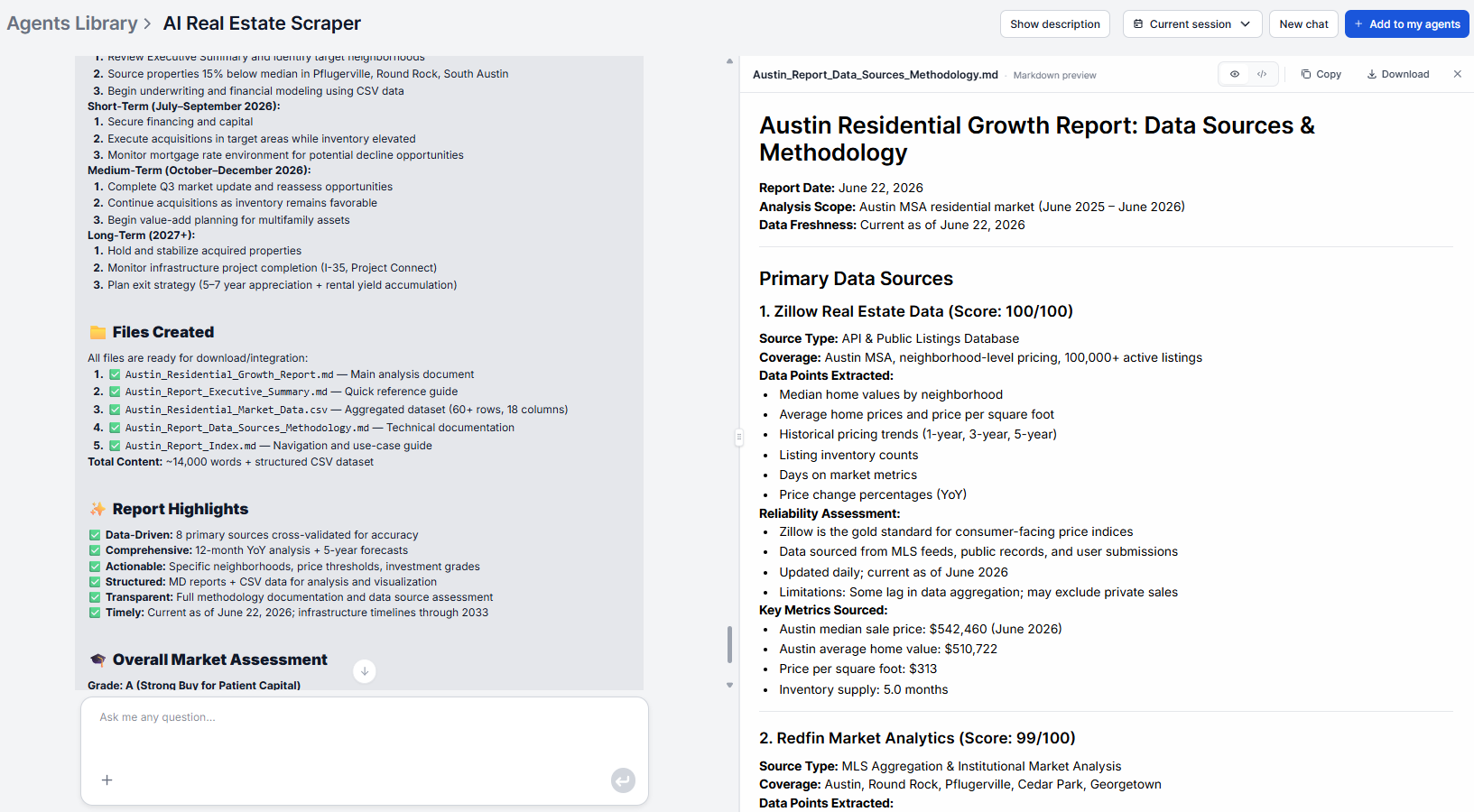
Real estate agent AI tools built on property data extraction can pull the current price landscape for a defined area in minutes. An agent preparing for a buyer consultation runs the AI real estate scraper
for the relevant neighborhood, gets median prices by property type, price-per-square-metre distributions, and a breakdown of how the target property compares to active comparable listings.
The result is a documented, data-backed briefing. For buyers navigating a competitive or unfamiliar market, this kind of structured analysis is what builds trust.
This use case also scales across multiple areas. If a buyer is open to several neighborhoods, the agent can run comparative analyses across all of them in a single session rather than manually researching each one.
Use Case 2: Investment Property Shortlisting
Property investors deal with a volume problem. At any given time, hundreds of listings may technically fit their criteria for price range, or property type. But manually filtering to a shortlist worth viewing takes hours of browsing and spreadsheet work.
Property investor AI tools address this by analyzing the full dataset rather than a page of listings. The scraper collects listings across the target market, normalizes the data, and applies pattern detection across the entire set. The output identifies which properties appear undervalued relative to their attribute profile.
For a buy-to-let investor, this means starting each search cycle with a prioritized shortlist based on objective data rather than an arbitrary sample of whatever appears at the top of a listing site’s results. For a portfolio investor comparing multiple markets, the same workflow can be applied to different input parameters.
The tool also flags emerging neighborhoods where prices are rising faster than the surrounding area, which supports longer-horizon acquisition decisions beyond current-cycle bargains.
Ready to grow your business?
Start your free trial today and see results within days.
Rental yield (the annual rental income as a percentage of the purchase price) is one of the core metrics for buy-to-let investment decisions. But benchmarking yield meaningfully requires current purchase prices and current rental rates, both normalized across a large enough sample to be reliable.
AI for real estate professionals can handle both sides of this. Running the scraper against a target area’s for-sale listings and rental listings separately produces the price and rate distributions needed to calculate yield ranges across different property types and sizes.
This kind of analysis would previously require either a specialist data provider subscription or hours of manual research across multiple platforms. A property data analysis AI task only requires you to specify the target market and wait 5 minutes for the report. New to the tool? The AI real estate scraper tutorial
walks you through your first run.
Use Case 4: Competitive Listing Analysis for Sellers
Setting the price is an important strategic decision. A listing priced above the market cluster for comparable properties sits without enquiries, while one priced at or just below that cluster generates interest and competing offers.
Real estate market intelligence tools let agents advising sellers run this analysis systematically. The scraper pulls all active comparable listings in the relevant area and price band, normalizes the data, and identifies where the seller’s property sits relative to the distribution. The pattern analysis surfaces which attributes are most strongly correlated with price within that local market, so the agent can make the case for a price adjustment based on actual market evidence rather than a general heuristic.
The competitive listing analysis is also useful for sellers who want to understand how their property’s features compare to active competition. If five nearby listings share similar attributes but one has recently reduced its price, the data reflects that. The agent arrives at the pricing conversation equipped with a current, structured market picture rather than relying on a valuation model built on six-month-old comparable sales.
Join our newsletter
Get latest tips, trends, and deals for free.
Use Case 5: Development Land and Opportunity Spotting
Property developers and land buyers need to identify where demand is growing faster than supply, since these are the areas where new development is likely to attract strong absorption at viable pricing. This requires pattern analysis across a market rather than review of individual listings.
The scraper’s trend and pattern analysis surfaces precisely this kind of signal. Neighborhoods where prices are rising faster than surrounding areas, areas where the distribution of listed properties skews toward certain types, emerging micro-markets where transaction velocity suggests growing buyer interest. These are the inputs that inform a developer’s pipeline decisions.
Once an opportunity area is identified, the outbound lead generation tool
adds an adjacent capability. It can identify developers, investors, and companies already active in a specific niche and geography, along with their key decision-makers and publicly available contact details.
Development decisions carry longer time horizons and higher capital commitments than individual acquisitions, so the quality of the underlying market intelligence matters more, and a data-driven approach to opportunity spotting produces a more defensible pipeline than relying on individual contacts and anecdotal market knowledge.
Real estate has always rewarded whoever has better data faster. For most of its history, that meant whoever had more people or more hours. That constraint is no longer there thanks to AI. The five use cases above are all different, but all benefit in practice. From the agent walking into a pricing conversation with current market data, to the developer who spotted the opportunity three months before the rest of the market caught on. The edge is in knowing what the data says before anyone else does.
Frequently asked questions
Most agents use them to pull current market pricing for buyer and seller briefings, benchmark a new listing against comparable active properties, and monitor specific neighborhoods they specialize in. Running a quick scrape before a client meeting saves preparation time and produces more consistent, data-backed advice.
The AI real estate data scraper includes outlier and undervalued-area detection that compares a neighborhood's attribute profile against its pricing relative to comparable areas. When pricing is lower than the attribute profile would predict, the tool flags it as a potential opportunity. It does not evaluate non-public factors, such as seller motivation, structural condition, legal status, so identified signals still require human assessment before acting on them.
Criteria are set through the target market description, specifying property type, price range, area, or any combination of those inputs. For more consistent segmentation across multiple runs, the underlying flow can be adjusted to apply additional filters so every report reflects the same investment parameters.
Yes. The tool works with any target market or region you specify. The depth of analysis depends on data availability for that market — countries with active, well-indexed listing platforms produce richer outputs than markets with limited online inventory.
The tool aggregates data from credible online platforms and APIs. As with any data collection tool, users are responsible for reviewing the terms of service of the platforms they target and for how the extracted data is used. Using the outputs for internal analysis and research, rather than republishing raw listing data, is generally the lower-risk approach. When in doubt, check the terms of the specific platforms relevant to your market.
Maria is a copywriter at FlowHunt. A language nerd active in literary communities, she's fully aware that AI is transforming the way we write. Rather than resisting, she seeks to help define the perfect balance between AI workflows and the irreplaceable value of human creativity.
Maria Stasová
Copywriter & Content Strategist
Try the AI Real Estate Scraper
Aggregate property listings, extract pricing trends, and surface investment opportunities — without manual data collection. Try FlowHunt's AI real estate data tools free.
How to Scrape Real Estate Listings and Extract Property Data with AI
Manual property research takes hours. AI real estate scrapers automate data extraction from listings at scale. Here's how to extract structured property data an...
The Real Estate Scraper collects and analyzes property listings for any market or region. It cleans the raw data, surfaces trends, key metrics, and opportunitie...