


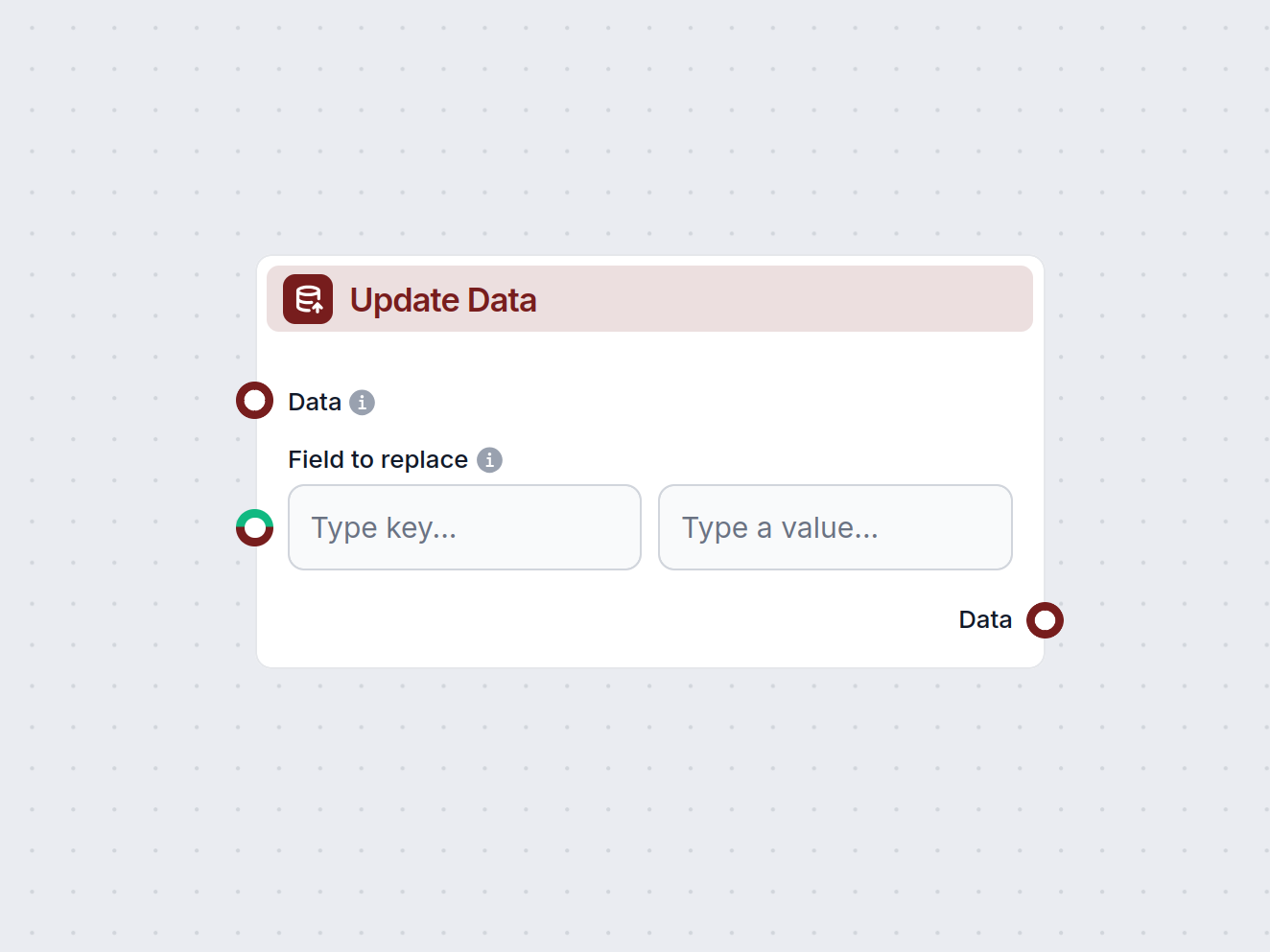
Update Data Component
The Update Data component is a versatile tool designed for modifying data records within your AI workflow. Its primary function is to update existing data objects by replacing or adding key/value pairs, similar to updating a Python dictionary.
What Does This Component Do?
This component takes an existing data record as input and allows you to specify new field values. It then outputs the updated data object. The update is performed by replacing the specified fields in the original data with the new values you provide. This makes it easy to manipulate or enrich your data as it flows through your pipeline.
Inputs
The component requires two main inputs:
| Input Name | Type(s) | Description | Required | Display Name |
|---|---|---|---|---|
| data | Data | The record to update. | No | Data |
| new_data | Message, Data | Key/value pairs to update. | No | Field to replace |
- data: The original data object you want to modify. This might be any structured data handled by your workflow.
- new_data: A dictionary (or object) containing the fields and their new values. Only the fields specified here will be changed; all other fields in the original data remain untouched.
Outputs
| Output Name | Type | Description |
|---|---|---|
| output_data | Data | The updated data record. |
The output is a single data object reflecting all updates provided in the new_data input.
Why Use This Component?
- Data Enrichment: Easily add new information to existing records without recreating them from scratch.
- Correction and Transformation: Update incorrect or outdated fields within your data as part of a preprocessing or transformation step.
- Workflow Flexibility: Modify data at any point within an AI or automation pipeline, enabling dynamic and context-aware processing.
Example Use Cases
- Update a user’s profile with new preferences in a recommendation system.
- Add processing metadata (such as timestamps or status flags) to a dataset as it moves through various workflow stages.
- Correct or refine results from a previous component before passing data further down the pipeline.
Summary
The Update Data component is a straightforward and flexible node for updating any data object within your workflow. By supporting Python-like dictionary updates, it provides a familiar and efficient way to keep your data accurate and up-to-date as your AI process evolves.