

Hosted MCP Server for Airtable
The Airtable MCP Server enables seamless integration between AI tools and Airtable, allowing automated workflows to manage bases, tables, records, and fields di...
8 min read
AI
Airtable
+5

Integrate FlowHunt with GitHub via the GitHub MCP Server to automate development tasks, manage repositories and issues, and connect your AI workflows to real-time GitHub data.
Host MCP Servers using FlowHunt
FlowHunt’s platform lets users create AI Agents for any service without the usual hassles of MCP servers. Host MCP servers for any service, automate workflows, connect with external tools, and use analytics to improve performance. FlowHunt makes AI Agent creation simple and efficient for all users.
Access FlowHunt: Log in to your FlowHunt.io dashboard .
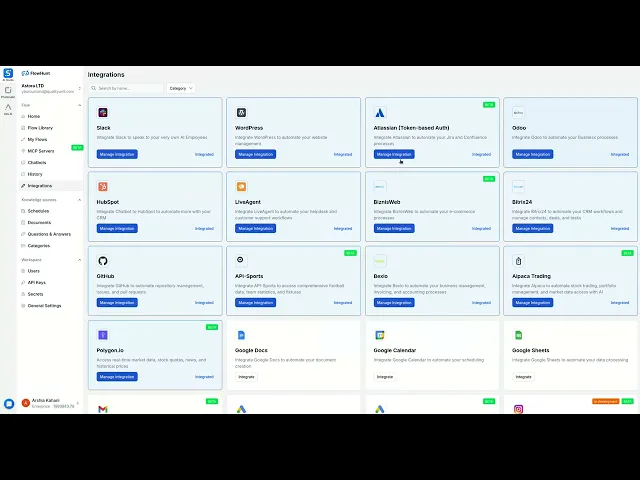
Navigate to Integrations: Find the “Integrations” section in the left sidebar.
Select GitHub: Click on the GitHub integration option to begin the setup process.
Choose Profile: You will be redirected to a profile selection tab where you can choose between a personal or company profile.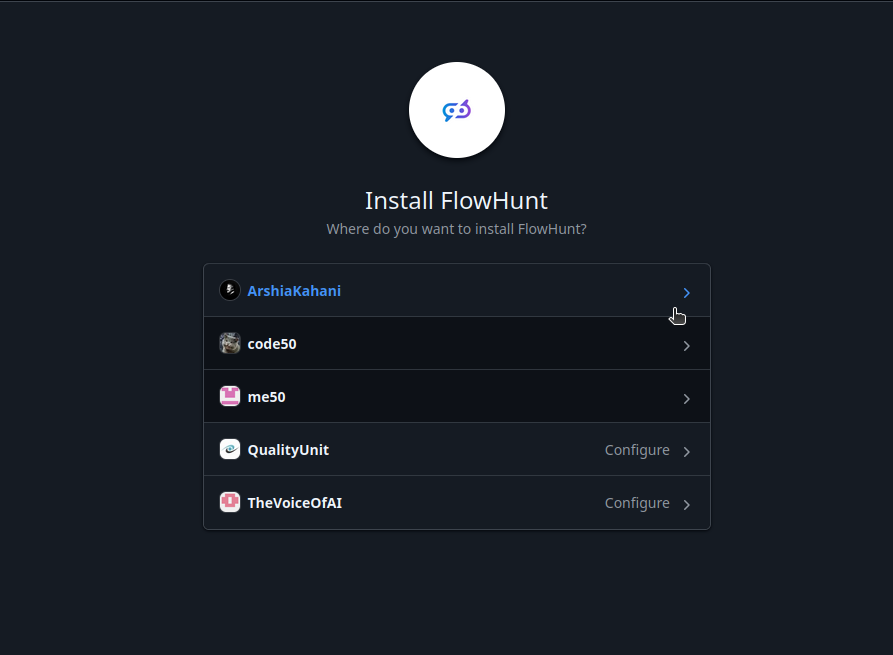
5.Select Repository Access: Decide whether the MCP should have access to all your repositories or just a specific repository.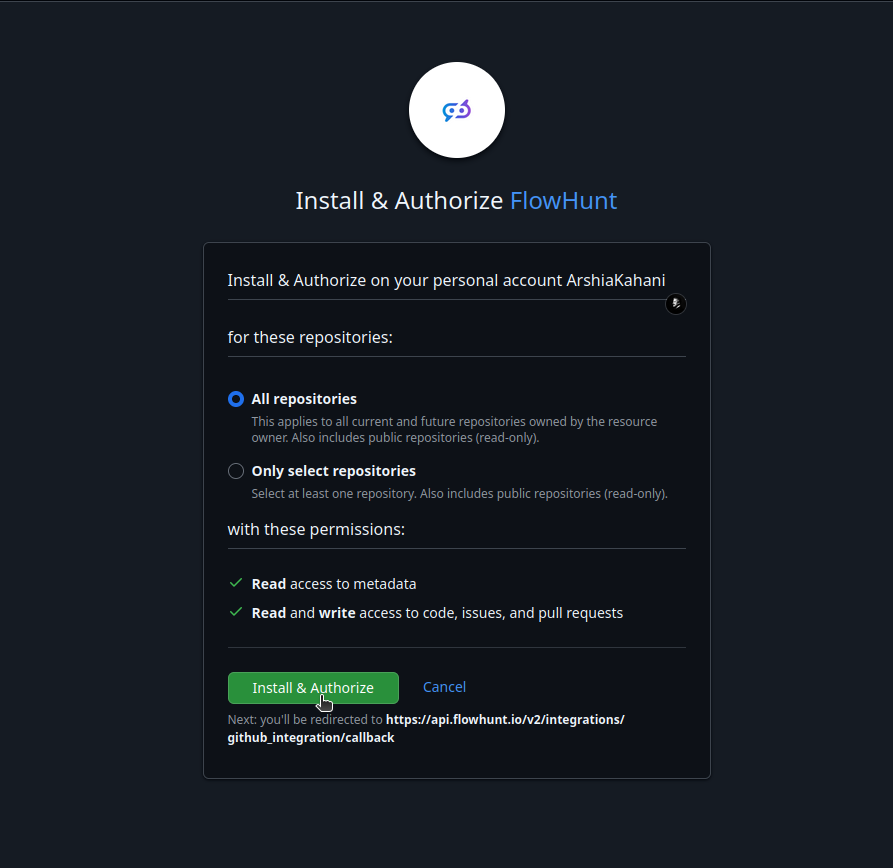
💡 Pro Tip: Ensure you select the appropriate repository access scope based on your automation needs. Store any authentication credentials securely and avoid sharing them publicly.
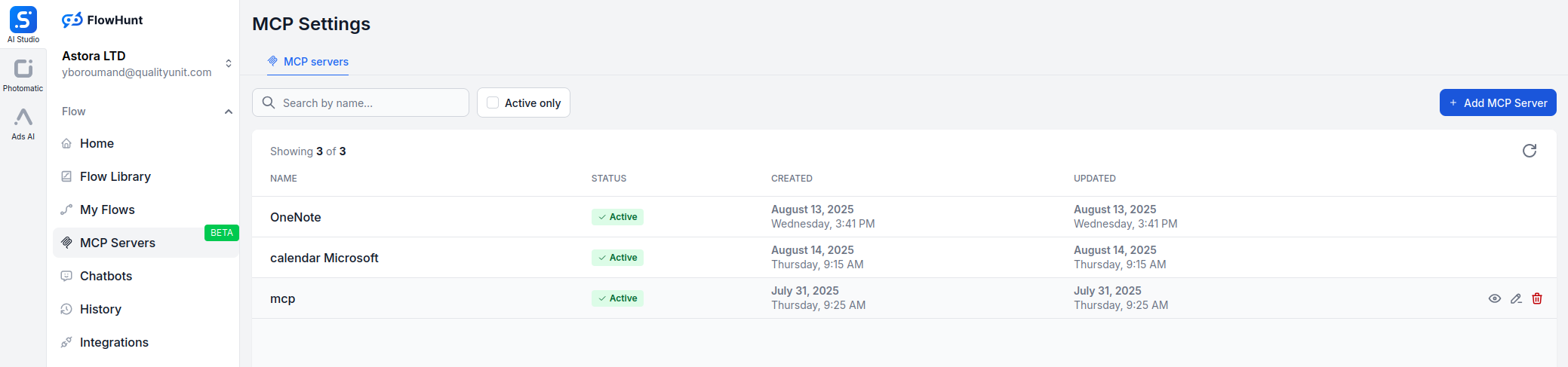
Navigate to MCP Servers: Go to the “MCP Servers” tab in your FlowHunt dashboard.
Add New Server: Click “Add New MCP Server”.
Select GitHub: Choose “GitHub MCP Server” from the available options.
Configure Server Tools: Select the tools you want to enable for your MCP server.
MCP INTEGRATION
The following tools are available as part of the GitHub MCP integration:
Get detailed information about a GitHub repository including stats, settings, and metadata.
List repositories for the authenticated user, a specific user, or organization.
Create a new GitHub repository with specified settings.
Fork an existing GitHub repository to your account or organization.
Delete a GitHub repository. This action cannot be undone.
Get file contents from a GitHub repository.
Create a new file in a GitHub repository.
Update an existing file in a GitHub repository.
Delete a file from a GitHub repository.
List issues in a GitHub repository with optional filters.
Create a new issue in a GitHub repository.
Update an existing issue in a GitHub repository.
Add a comment to an existing issue.
List pull requests in a GitHub repository with optional filters.
Create a new pull request in a GitHub repository.
Merge a pull request in a GitHub repository.
List GitHub Actions workflows in a repository.
Trigger a GitHub Actions workflow dispatch event.
Get workflow runs for a repository or specific workflow.
Search for GitHub repositories using a query.
Search for GitHub issues and pull requests using a query.
Search for code across GitHub repositories.
Create a new branch in a GitHub repository.
📝 Note: You can modify or add tools later based on your evolving automation needs.

Start your free trial today and see results within days.
{
  "mcp": {
    "transport": "streamable_http",
    "url": "https://mcp.flowhunt.io/••••••••"
  }
}
Best for: Getting started quickly with proven automation patterns
Generate Flow: In your MCP Server configuration, click “Create Preconfigured Flow”.
Select Template: Choose “AI Agent with MCP” to create a ready-to-use workflow.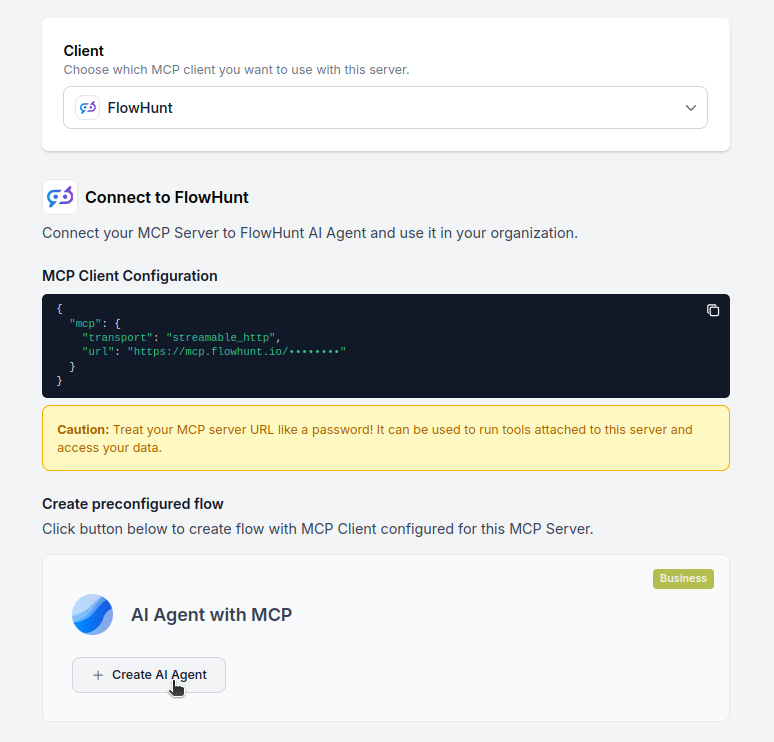
Customize Logic: Use FlowHunt’s visual flow builder to tailor the automation:
Activate: Save and activate your flow to begin automated operations.
Best for: Specific automation requirements or existing workflow enhancement
{
  "mcp": {
    "transport": "streamable_http",
    "url": "https://mcp.flowhunt.io/••••••••"
  }
}
Design Workflow: Create custom logic that leverages the MCP server tools:
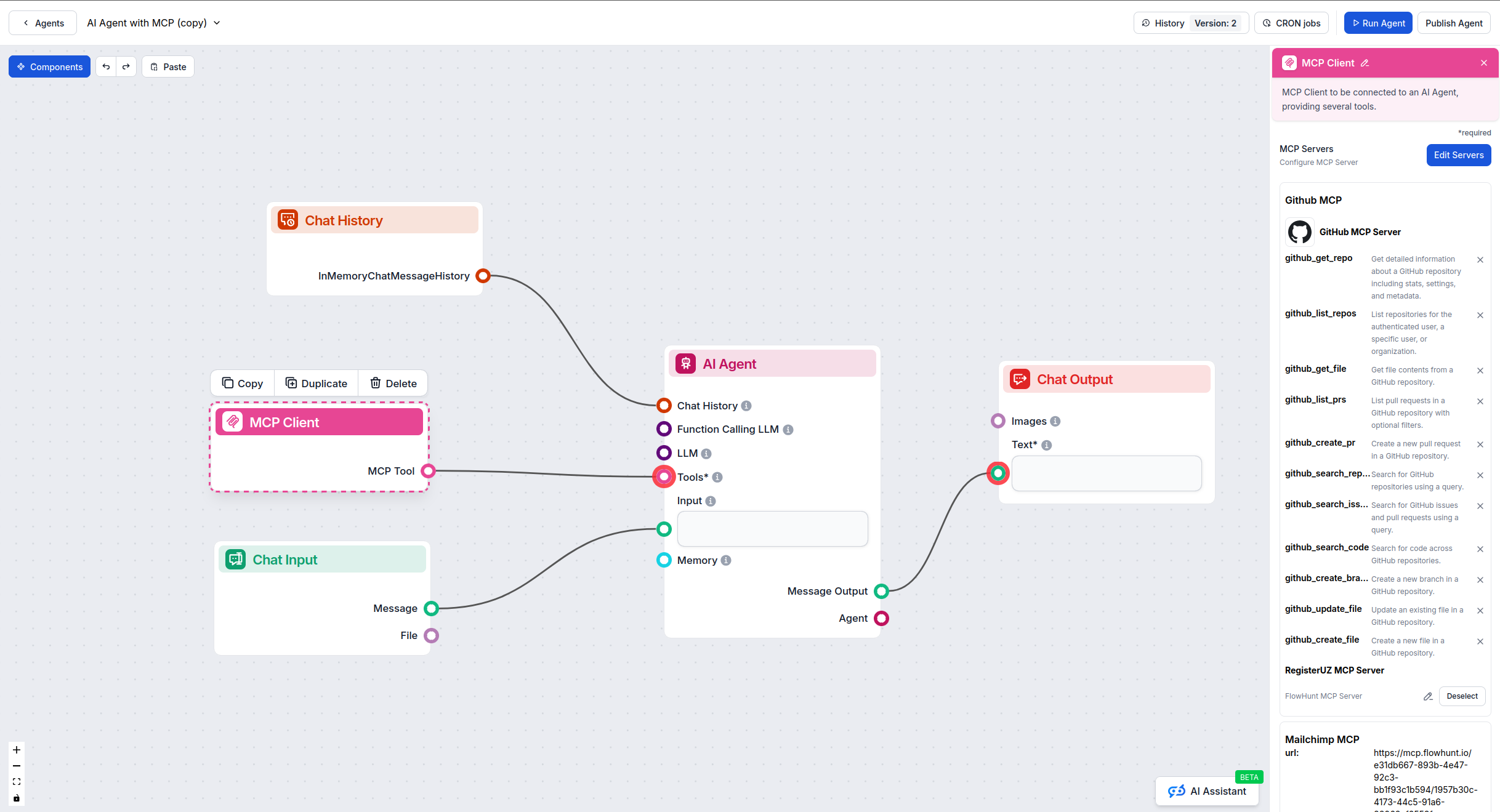
Deploy: Save your configuration and activate the flow.
Get latest tips, trends, and deals for free.
Here are practical examples demonstrating how to use the GitHub MCP Server with your AI agents. These prompts showcase real-world software development and collaboration scenarios:
List all repositories in my organization and show me which ones were updated in the last week
Create a new private repository called 'customer-analytics-dashboard' with a README and MIT license
Get detailed information about the 'frontend-app' repository including star count, open issues, and primary language
Fork the repository 'openai/chatgpt-api-demo' to my personal account
Get the contents of the 'config/database.yml' file from the main branch of my production-app repository
Create a new file called 'CONTRIBUTING.md' in the docs folder with our contribution guidelines
Update the README.md file in the main branch to add the new installation instructions
List all open issues in the 'mobile-app' repository that are labeled as 'bug' and 'high-priority'
Create a new issue in the 'api-service' repository titled 'Add rate limiting to authentication endpoint' with detailed requirements
Update issue #234 to add the 'in-progress' label and assign it to @developer-jane
Add a comment to issue #456 explaining the proposed solution and requesting code review
List all open pull requests in the 'backend-services' repository that need review
Create a pull request from the 'feature/user-authentication' branch to main with title 'Implement OAuth 2.0 authentication'
Merge pull request #789 in the 'frontend-app' repository after all checks have passed
List all GitHub Actions workflows in the 'deployment-pipeline' repository
Trigger the 'deploy-to-staging' workflow for the main branch
Get the status of the last 5 workflow runs for the 'test-suite' workflow
Search GitHub for repositories containing 'machine learning' that are written in Python and have more than 1000 stars
Search for all open issues across my repositories that mention 'security vulnerability'
Search the codebase for all occurrences of the deprecated 'oldAuthMethod' function
Create a new branch called 'hotfix/payment-processing-error' from the main branch in the 'ecommerce-platform' repository
These prompts demonstrate how GitHub MCP integration enables streamlined development workflows, from repository management and code collaboration to automated deployments and issue tracking.
Integrating GitHub MCP Server with FlowHunt.io creates a powerful foundation for intelligent development automation. Whether you’re streamlining repository management, automating issue tracking, or enhancing pull request workflows, this integration empowers your AI agents to work seamlessly with your critical GitHub data.
Start with a simple automation and gradually expand your workflows as you become more comfortable with the platform. The combination of GitHub’s robust development capabilities and FlowHunt’s AI-driven automation will transform how you manage your code and collaborations.
Ready to get started? Begin your integration today and unlock the full potential of AI-powered development automation!
FlowHunt provides an additional security layer between your internal systems and AI tools, giving you granular control over which tools are accessible from your MCP servers. MCP servers hosted in our infrastructure can be seamlessly integrated with FlowHunt's chatbot as well as popular AI platforms like ChatGPT, Claude, and various AI editors.
Unlock the power of AI-driven automation for your GitHub account. Easily manage repositories, issues, and pull requests from within FlowHunt.
The Airtable MCP Server enables seamless integration between AI tools and Airtable, allowing automated workflows to manage bases, tables, records, and fields di...
The Microsoft Calendar MCP Server enables seamless integration between AI tools and Microsoft Calendar, allowing automated workflows to manage events, calendars...

The Microsoft To Do MCP Server enables seamless integration between AI tools and Microsoft To Do, allowing automated workflows to manage task lists and tasks di...
Cookie Consent
We use cookies to enhance your browsing experience and analyze our traffic. See our privacy policy.