


Room MCP
Integrate FlowHunt with the Room protocol using the Model Context Protocol (MCP) to enable secure, multiparty agent collaboration in real-time virtual rooms. Se...
3 min read
AI
Room MCP
+4

Room MCP Server connects AI agents in shared spaces, enabling secure, real-time, and collaborative workflows with transcript archiving and access control.
The Room MCP (Model Context Protocol) Server is a command-line tool that enables AI assistants, such as Claude Desktop, to interact and coordinate with other agents in virtual rooms using the Room protocol. By leveraging MCP, Room MCP Server allows clients to create, join, and manage collaborative spaces (rooms) for multi-agent workflows. This setup empowers AI agents to accomplish shared goals, manage invitations, and store conversation transcripts, all within a secure and extensible protocol. The server enhances development workflows by providing standardized interfaces for agent coordination, transcript management, and real-time collaboration, making it particularly valuable for scenarios that require teamwork, multi-agent discussions, or shared context.
No specific prompt templates are mentioned in the repository or documentation.

Start your free trial today and see results within days.
No explicit MCP resources are documented in the repository or README.
ROOM_TRANSCRIPTS_FOLDER environment variable is set, preserving collaborative session history.Get latest tips, trends, and deals for free.
ROOM_TRANSCRIPTS_FOLDER.{
"mcpServers": {
"room": {
"command": "npx",
"args": [
"-y",
"@agree-able/room-mcp"
],
"env": {
"ROOM_TRANSCRIPTS_FOLDER": "/path/to/transcripts"
}
}
}
}
claude_desktop_config.json file.{
"mcpServers": {
"room": {
"command": "npx",
"args": [
"-y",
"@agree-able/room-mcp"
],
"env": {
"ROOM_TRANSCRIPTS_FOLDER": "/path/to/transcripts"
}
}
}
}
{
  "mcpServers": {
    "room": {
      "command": "npx",
      "args": [
        "-y",
        "@agree-able/room-mcp"
      ],
      "env": {
        "ROOM_TRANSCRIPTS_FOLDER": "/path/to/transcripts"
      }
    }
  }
}
{
  "mcpServers": {
    "room": {
      "command": "npx",
      "args": [
        "-y",
        "@agree-able/room-mcp"
      ],
      "env": {
        "ROOM_TRANSCRIPTS_FOLDER": "/path/to/transcripts"
      }
    }
  }
}
Use environment variables to secure sensitive information. Example:
{
  "mcpServers": {
    "room": {
      "command": "npx",
      "args": [
        "-y",
        "@agree-able/room-mcp"
      ],
      "env": {
        "ROOM_TRANSCRIPTS_FOLDER": "/path/to/transcripts"
      },
      "inputs": {
        // Place sensitive keys here or reference them via environment variables
      }
    }
  }
}
Using MCP in FlowHunt
To integrate MCP servers into your FlowHunt workflow, start by adding the MCP component to your flow and connecting it to your AI agent:
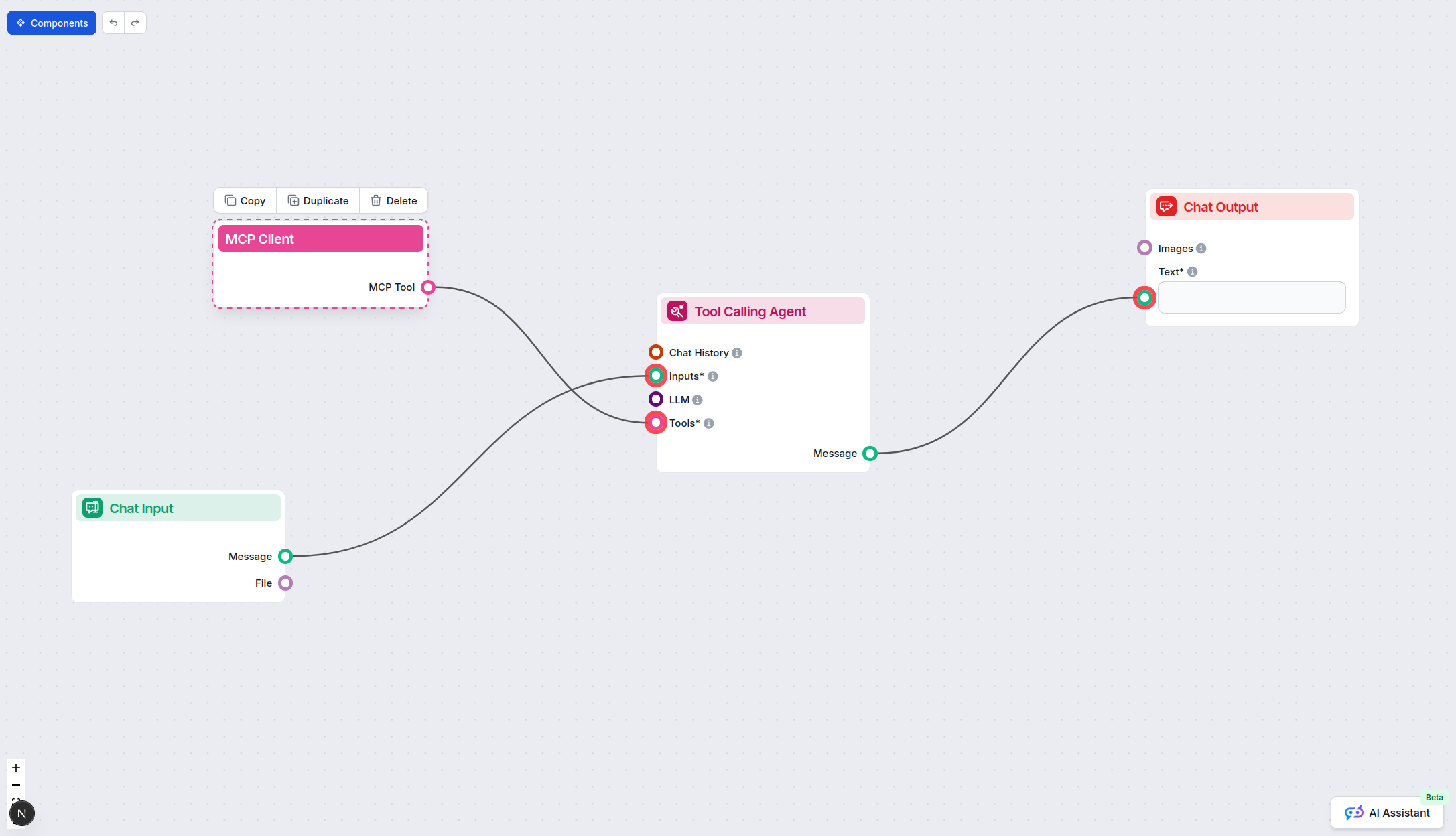
Click on the MCP component to open the configuration panel. In the system MCP configuration section, insert your MCP server details using this JSON format:
{
  "room": {
    "transport": "streamable_http",
    "url": "https://yourmcpserver.example/pathtothemcp/url"
  }
}
Once configured, the AI agent is now able to use this MCP as a tool with access to all its functions and capabilities. Remember to change “room” to the actual name of your MCP server and replace the URL with your own MCP server URL.
| Section | Availability | Details/Notes |
|---|---|---|
| Overview | ✅ | Clear description in README |
| List of Prompts | ⛔ | Not specified |
| List of Resources | ⛔ | No explicit MCP resources documented |
| List of Tools | ✅ | Outlined in README |
| Securing API Keys | ✅ | Via env in config and environment variables |
| Sampling Support (less important in evaluation) | ⛔ | Not mentioned |
Our opinion:
Room MCP provides strong utility for multi-agent coordination and transcript management, but lacks explicit documentation for prompts and resources. Its tooling is clearly described and setup is straightforward. The lack of resource and prompt details limits extensibility for some advanced MCP workflows.
| Has a LICENSE | ✅ (Apache-2.0) |
|---|---|
| Has at least one tool | ✅ |
| Number of Forks | 7 |
| Number of Stars | 10 |
Empower your teams and AI agents with collaborative virtual rooms, secure access, and persistent transcript history—perfect for real-time brainstorming, planning, and shared context workflows.
Integrate FlowHunt with the Room protocol using the Model Context Protocol (MCP) to enable secure, multiparty agent collaboration in real-time virtual rooms. Se...
The interactive-mcp MCP Server enables seamless, human-in-the-loop AI workflows by bridging AI agents with users and external systems. It supports cross-platfor...
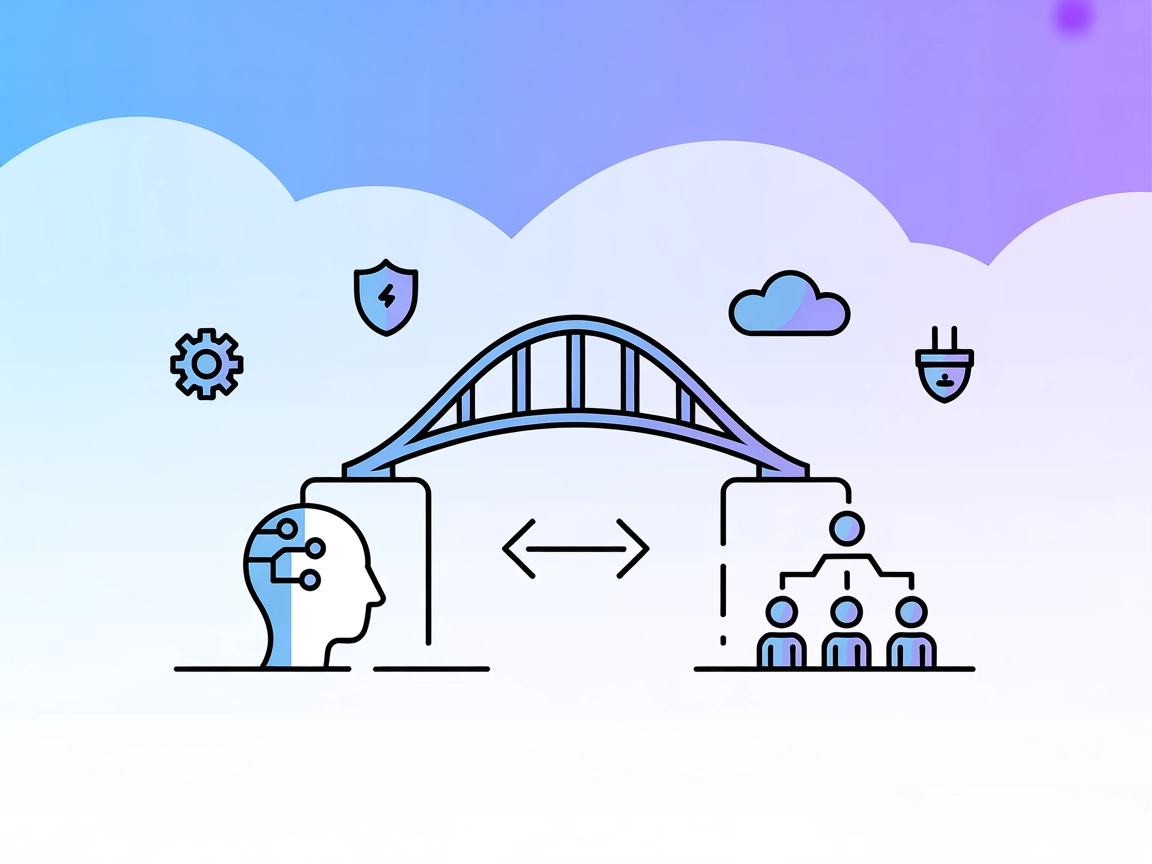
The A2A MCP Server bridges Model Context Protocol (MCP) with the Agent-to-Agent (A2A) protocol, enabling MCP-compatible AI assistants like Claude to interact se...
Cookie Consent
We use cookies to enhance your browsing experience and analyze our traffic. See our privacy policy.