


Databricks MCP Server
The Databricks MCP Server enables seamless integration between AI assistants and the Databricks platform, allowing natural language access to Databricks resourc...
4 min read
AI
Databricks
+4

Leverage the Microsoft Fabric MCP Server to supercharge your AI workflows with advanced data engineering, analytics, and intelligent PySpark development—all accessible via natural language and FlowHunt integrations.
The Microsoft Fabric MCP Server is a Python-based Model Context Protocol (MCP) server designed for seamless interaction with Microsoft Fabric APIs. It empowers AI assistants to connect with external Microsoft Fabric resources, enabling a robust development workflow for data engineering and analytics. The server facilitates advanced operations such as workspace, lakehouse, warehouse, and table management, delta table schema retrieval, SQL query execution, and more. Additionally, it offers intelligent PySpark notebook development and optimization through LLM integration, providing context-aware code generation, validation, performance analysis, and real-time monitoring. This integration significantly boosts developer productivity by allowing natural language interaction, automated code assistance, and streamlined deployment within the Microsoft Fabric ecosystem.
No explicit prompt templates are mentioned in the repository files or documentation.

Start your free trial today and see results within days.
No explicit MCP resources are listed in the repository files or documentation.
No explicit tool definitions found in server.py or the repository files. The README mentions:
Get latest tips, trends, and deals for free.
~/.windsurf/config.json).mcpServers section:{
"mcpServers": {
"fabric-mcp": {
"command": "python",
"args": ["-m", "fabric_mcp"]
}
}
}
Use environment variables for sensitive API keys:
{
  "mcpServers": {
    "fabric-mcp": {
      "command": "python",
      "args": ["-m", "fabric_mcp"],
      "env": {
        "FABRIC_API_KEY": "${FABRIC_API_KEY}"
      },
      "inputs": {
        "api_key": "${FABRIC_API_KEY}"
      }
    }
  }
}
claude.config.json).{
"mcpServers": {
"fabric-mcp": {
"command": "python",
"args": ["-m", "fabric_mcp"]
}
}
}
cursor.config.json).{
"mcpServers": {
"fabric-mcp": {
"command": "python",
"args": ["-m", "fabric_mcp"]
}
}
}
cline.json).{
"mcpServers": {
"fabric-mcp": {
"command": "python",
"args": ["-m", "fabric_mcp"]
}
}
}
For all platforms:
env section of JSON for API keys or secrets.Using MCP in FlowHunt
To integrate MCP servers into your FlowHunt workflow, start by adding the MCP component to your flow and connecting it to your AI agent:
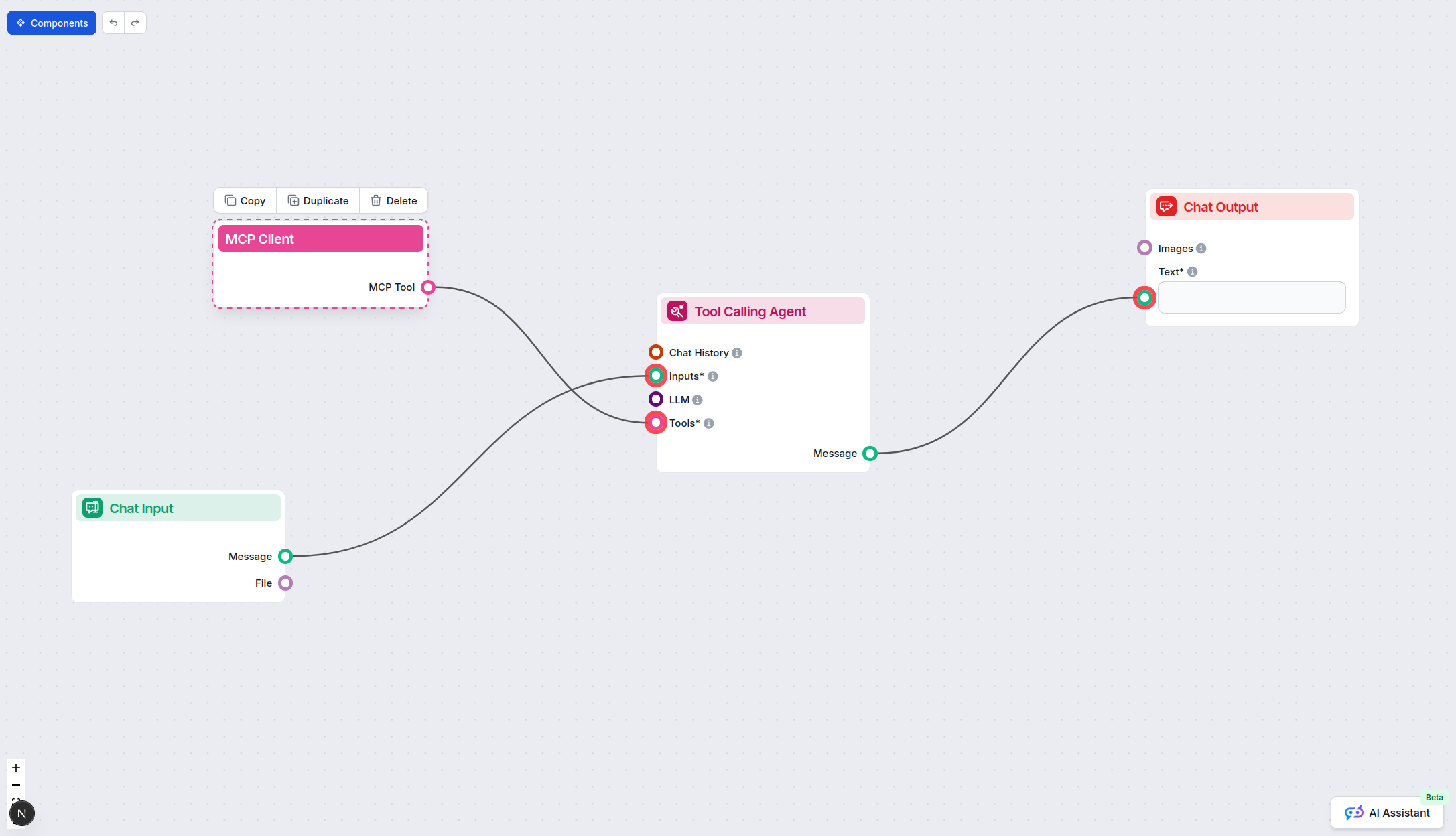
Click on the MCP component to open the configuration panel. In the system MCP configuration section, insert your MCP server details using this JSON format:
{
  "fabric-mcp": {
    "transport": "streamable_http",
    "url": "https://yourmcpserver.example/pathtothemcp/url"
  }
}
Once configured, the AI agent is now able to use this MCP as a tool with access to all its functions and capabilities. Remember to change “fabric-mcp” to whatever the actual name of your MCP server is and replace the URL with your own MCP server URL.
| Section | Availability | Details/Notes |
|---|---|---|
| Overview | ✅ | |
| List of Prompts | ⛔ | No prompt templates found |
| List of Resources | ⛔ | No explicit MCP resources listed |
| List of Tools | ⛔ | Only general tool categories mentioned |
| Securing API Keys | ✅ | Example JSON config with env included |
| Sampling Support (less important in evaluation) | ⛔ | No evidence of sampling support |
Based on the available documentation, the Microsoft Fabric MCP server offers a strong overview and setup guidance, but lacks detailed, explicit listings for prompts, resources, and tools in its public files. It provides good security practices but does not document sampling support.
This MCP server is promising for Fabric development workflows thanks to its focus on advanced PySpark and LLM integration. However, the absence of explicit prompts, resources, and tool schemas in documentation limits its immediate plug-and-play utility. It scores well for architecture and setup clarity, but would benefit from richer developer-facing documentation and feature exposure.
| Has a LICENSE | ⛔ |
|---|---|
| Has at least one tool | ✅ |
| Number of Forks | 1 |
| Number of Stars | 3 |
Empower your AI agents to automate and optimize Microsoft Fabric workflows. Try the Fabric MCP server integration for advanced data engineering, analytics, and AI-powered code assistance.
The Databricks MCP Server enables seamless integration between AI assistants and the Databricks platform, allowing natural language access to Databricks resourc...

The py-mcp-mssql MCP Server provides a secure and efficient bridge for AI agents to interact programmatically with Microsoft SQL Server databases via the Model ...
Empower your analytics workflow by integrating FlowHunt with Microsoft Fabric MCP. Automate workspace, lakehouse, warehouse, and table management, run SQL queri...
Cookie Consent
We use cookies to enhance your browsing experience and analyze our traffic. See our privacy policy.