



Upstash MCP Integration
Seamlessly connect FlowHunt with Upstash MCP Server to manage Redis databases, automate cloud operations, and leverage AI-driven workflows through Model Context...
4 min read
AI
Upstash
+3

Integrate Upstash cloud database management into your AI flows. The Upstash MCP Server enables direct Redis operations, backups, and analytics through natural language or automated commands.
The Upstash MCP (Model Context Protocol) Server acts as a bridge between AI assistants and the Upstash Developer API. By implementing the standardized MCP protocol, it enables AI clients to perform a range of cloud database management tasks via natural language or programmatic commands. Through this server, LLMs and other AI tools can create or list Redis databases, manage keys, trigger backups, and analyze metrics such as throughput—all without requiring manual navigation of cloud dashboards. This integration streamlines developer workflows and empowers automated or conversational agents to interact directly with Upstash’s serverless data services, enhancing productivity and enabling sophisticated automation in cloud resource management.
No prompt templates mentioned in the provided content.

Start your free trial today and see results within days.
No explicit resources are detailed in the provided content.
No direct listing of tools found in the provided content or server.py. However, based on the usage examples, the server likely enables actions such as:
But without direct code or documentation, these cannot be confirmed as discrete “tools” in the MCP sense.
Get latest tips, trends, and deals for free.
npx -y @smithery/cli@latest install @upstash/mcp-server --client windsurfnpx -y @upstash/mcp-server run <UPSTASH_EMAIL> <UPSTASH_API_KEY>
Example JSON:
{
  "mcpServers": {
    "upstash": {
      "command": "npx",
      "args": ["-y", "@upstash/mcp-server", "run", "<UPSTASH_EMAIL>", "<UPSTASH_API_KEY>"]
    }
  }
}
npx -y @smithery/cli@latest install @upstash/mcp-server --client claudenpx @upstash/mcp-server init <UPSTASH_EMAIL> <UPSTASH_API_KEY>Example JSON:
{
  "mcpServers": {
    "upstash": {
      "command": "npx",
      "args": ["@upstash/mcp-server", "init", "<UPSTASH_EMAIL>", "<UPSTASH_API_KEY>"]
    }
  }
}
npx -y @smithery/cli@latest install @upstash/mcp-server --client cursornpx -y @upstash/mcp-server run <UPSTASH_EMAIL> <UPSTASH_API_KEY>Example JSON:
{
  "mcpServers": {
    "upstash": {
      "command": "npx",
      "args": ["-y", "@upstash/mcp-server", "run", "<UPSTASH_EMAIL>", "<UPSTASH_API_KEY>"]
    }
  }
}
No specific instructions found for Cline in the provided content.
To secure API keys, use environment variables. Example:
{
  "mcpServers": {
    "upstash": {
      "command": "npx",
      "args": ["-y", "@upstash/mcp-server", "run"],
      "env": {
        "UPSTASH_EMAIL": "<UPSTASH_EMAIL>",
        "UPSTASH_API_KEY": "<UPSTASH_API_KEY>"
      }
    }
  }
}
Using MCP in FlowHunt
To integrate MCP servers into your FlowHunt workflow, start by adding the MCP component to your flow and connecting it to your AI agent:
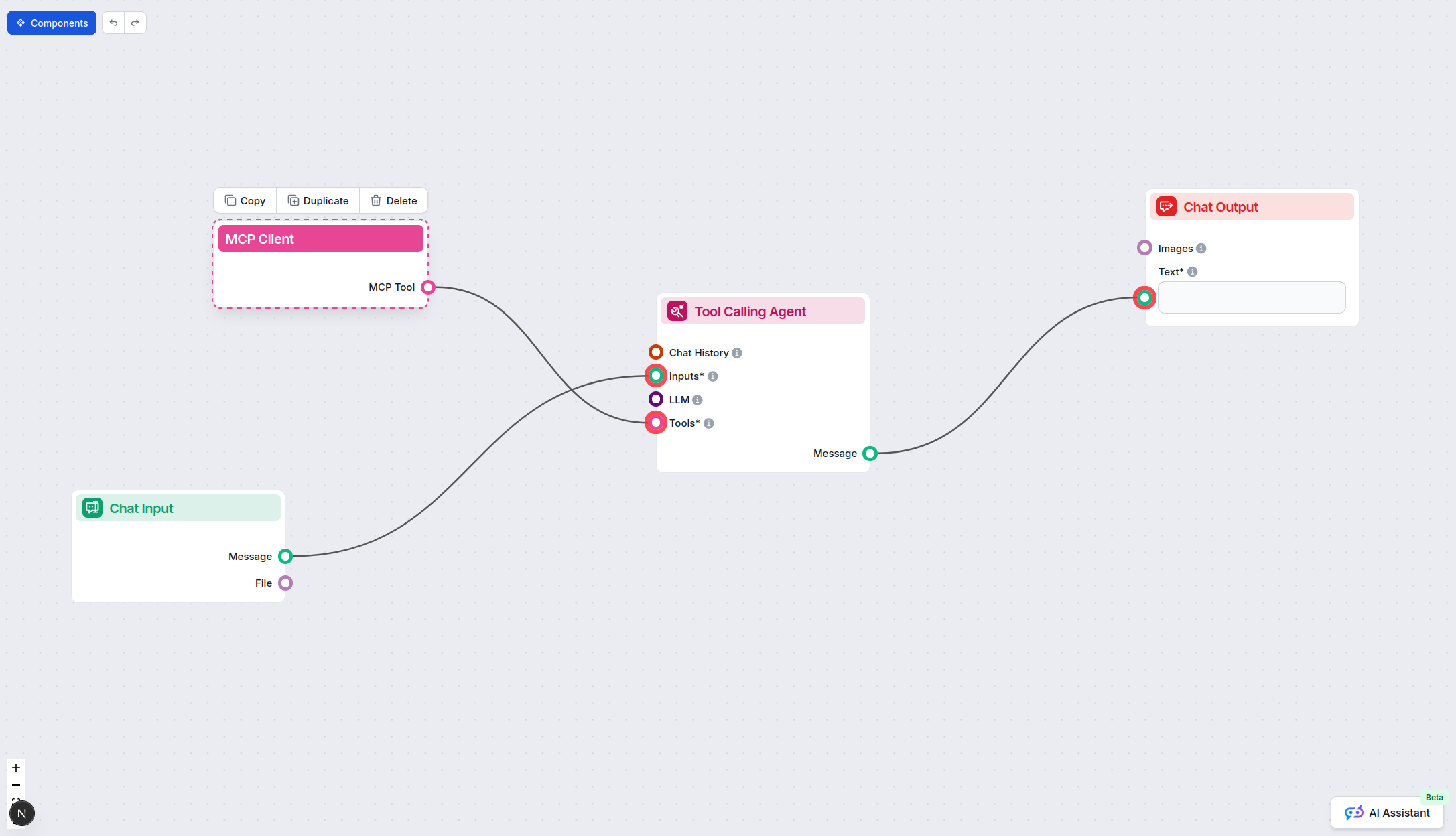
Click on the MCP component to open the configuration panel. In the system MCP configuration section, insert your MCP server details using this JSON format:
{
  "upstash": {
    "transport": "streamable_http",
    "url": "https://yourmcpserver.example/pathtothemcp/url"
  }
}
Once configured, the AI agent is now able to use this MCP as a tool with access to all its functions and capabilities. Remember to change “upstash” to whatever the actual name of your MCP server is and replace the URL with your own MCP server URL.
| Section | Availability | Details/Notes |
|---|---|---|
| Overview | ✅ | Upstash MCP Server overview provided |
| List of Prompts | ⛔ | No prompt templates listed |
| List of Resources | ⛔ | No explicit resources mentioned |
| List of Tools | ⛔ | No detailed tool listing, only inferred actions |
| Securing API Keys | ✅ | Env variable pattern shown in setup |
| Sampling Support (less important in evaluation) | ⛔ | Not mentioned |
Based on the tables above, the Upstash MCP Server provides solid setup instructions and a clear conceptual overview, but lacks detail on MCP primitives (prompts, resources, tools, roots, sampling) in its documentation. This limits its immediate usability for more advanced MCP integrations.
MCP Score: 5/10.
The Upstash MCP Server is easy to set up and well described in terms of its goal and supported platforms. However, it’s missing explicit documentation on prompts, resources, exposed tools, and advanced MCP features (roots, sampling), which are critical for developers seeking deep integration.
| Has a LICENSE | ✅ |
|---|---|
| Has at least one tool | ⛔ |
| Number of Forks | 9 |
| Number of Stars | 38 |
Automate cloud database management and analytics in your FlowHunt workflows. Leverage the power of Upstash with AI-driven commands for ultimate productivity.
Seamlessly connect FlowHunt with Upstash MCP Server to manage Redis databases, automate cloud operations, and leverage AI-driven workflows through Model Context...
The Redis MCP Server bridges AI assistants and Redis-compatible in-memory databases, offering seamless key-value storage, real-time messaging, and advanced auto...

The Redis Cloud API MCP Server bridges AI assistants and MCP clients with Redis Cloud resources, enabling natural language management of accounts, subscriptions...
Cookie Consent
We use cookies to enhance your browsing experience and analyze our traffic. See our privacy policy.