AI Content Is Getting Detected and Penalized: Here's What to Do
Google doesn’t ban AI content, but it penalizes the low-quality, and unhelpful content AI often produces. Here’s what the evidence actually shows, which AI patterns trigger quality signals, and how to produce AI-assisted content that ranks.
AI content detection for SEO is one of the most misunderstood topics in content marketing right now. Many claim that Google is simply penalizing any and all AI-written content. But this fear is based on a misreading of what’s actually happening.
Google doesn’t penalize content for being AI-generated. It penalizes content for being low-quality, low topic relevance, unhelpful, and thin. Here’s what the evidence actually shows, which AI patterns trigger engagement and quality signals, and how to produce AI-assisted content that ranks.
What Google Actually Says About AI Content in 2026
Google’s official documentation
states that “Google’s ranking systems aim to reward original, high-quality content that demonstrates qualities of what we call E-E-A-T: expertise, experience, authoritativeness, and trustworthiness. Our systems evaluate the quality of content, not whether content is AI-generated.”
The policies that target AI content specifically are Google’s Spam Policies, which address “auto-generated content intended to manipulate search rankings”. The phrase is “intended to manipulate,” not “generated by AI.”
In other words, it penalizes vague mass-produced content only focused on farming keywords as opposed to answering queries or, god forbid, providing actual original insights or entertainment value. On the other hand, an AI generated article using your own data, insights, and voice might easily become your best ranking piece yet.
That’s why the AI writing SEO impact in 2026 isn’t about the AI-generated content itself, but the fact it tends to fail on quality metrics that Google has always cared about. But most importantly, that the reasons it does are predictable and fixable. Here’s how.
How AI Content Detection Tools Work (And Their Accuracy)
Besides other small properties, AI detectors rely monsty on two major statistical properties. The first is perplexity. This is how predictable each word choice is given what came before it. Language models generate highly predictable sequences while human writers will make unexpected choices more often. The second is burstiness, or how much variation exists between sentences. AI output tends toward uniform sentence length and structure; human writing varies considerably. It also checks for the common AI phrases and stylistic choices, as well as other properties.
These properties create a recognizable statistical fingerprint that detection tools like GPTZero and Turnitin measure. Against raw, unedited AI output, these tools are reasonably reliable. Against humanized, edited, or human-reviewed content, false-positive rates are much higher.
Remember that Google does not use these AI detection tools for ranking decisions. Instead, it uses it’s own quality signals, regardless of the origin of the content. It checks for engagement metrics, E-E-A-T evaluation, content depth, topical authority.
The bottom line is that a page that passes every AI detector is not immune from a quality penalty, and a page that fails every detector isn’t penalized for that reason alone.
Ready to grow your business?
Start your free trial today and see results within days.
The Patterns That Make AI Content Generic and Low-Quality
What Google’s systems actually evaluate is whether content satisfies the searcher’s intent better than competing pages. The specific AI writing patterns that most consistently fail this test are:
No first-hand experience or perspective. AI can summarize, but it can’t report. Content that describes what “many experts believe” without demonstrating any specific expertise, numbers, citations or first-person knowledge fails the Experience component of E-E-A-T.
No original data or proprietary insight. If every sentence in an article could have been written from a Wikipedia summary and a handful of existing blog posts, it adds nothing. Google’s systems are increasingly good at identifying when a page contributes something new.
Factual errors and hallucinations. AI models generate plausible-sounding information that is sometimes wrong. A confident, fluent article with incorrect facts is a quality signal failure as well as a reader trust failure.
Thin coverage of query intent. An AI article about “how to write a meta description” that doesn’t address character limits, click-through rate implications, or common mistakes is thin, regardless of how it was written.
Formulaic openings and generic phrasing. Phrases like “In today’s digital landscape,” “It is crucial to note that,” “With the rise of AI…” became synonymic with AI slop, and immediately signal to the readers (and engagement metrics) that the page isn’t worth reading carefully.
Remember that Google’s ranking are quality signals predate AI entirely. AI just makes it easier to produce content that fails them at scale.
What ‘Helpful Content’ Means for AI-Assisted Writing
Google’s Helpful Content System evaluates whether content was “created primarily for people” rather than “primarily for search engines.” For AI-assisted content, that distinction comes down to what the human layer contributes.
The quality ingredients that distinguish helpful AI-assisted content from generic AI output:
Original examples and case studies. “When we tested this with 200 users, we found…” carries weight that “many users report…” does not.
Expert terminology used correctly. Not keyword placement, but the kind of accurate, precise language that signals someone who actually knows the subject.
Updated, verified data. Citing a 2023 study in 2026 is a quality flag. Replacing it with current research isn’t optional for competitive topics.
Honest treatment of nuance and tradeoffs. AI tends to be diplomatically balanced. Helpful content doesn’t shy away from clear opinion reasoning explanation.
AI is great for generating the structure, research, and first draft. The human contribution is the layer that can’t be generated. It’s the experience, judgment, proprietary data, and unique voice.
Good news is that you absolutely can teach FlowHunt to sound like you. Feed it your proprietary data, case studies, brand guidelines, and preferred examples through knowledge sources
, and configure how your agents write and behave through agent instructions
. This greatly reduces the time spent proofreading and supplying the value AI alone was missing, because the AI already has access to what it needs. And even more importantly, most people are not doing this. They either post random slop without a second thought or resort to unnecessary amounts of manual work.
Join our newsletter
Get latest tips, trends, and deals for free.
How to Humanize AI Content Specifically for SEO
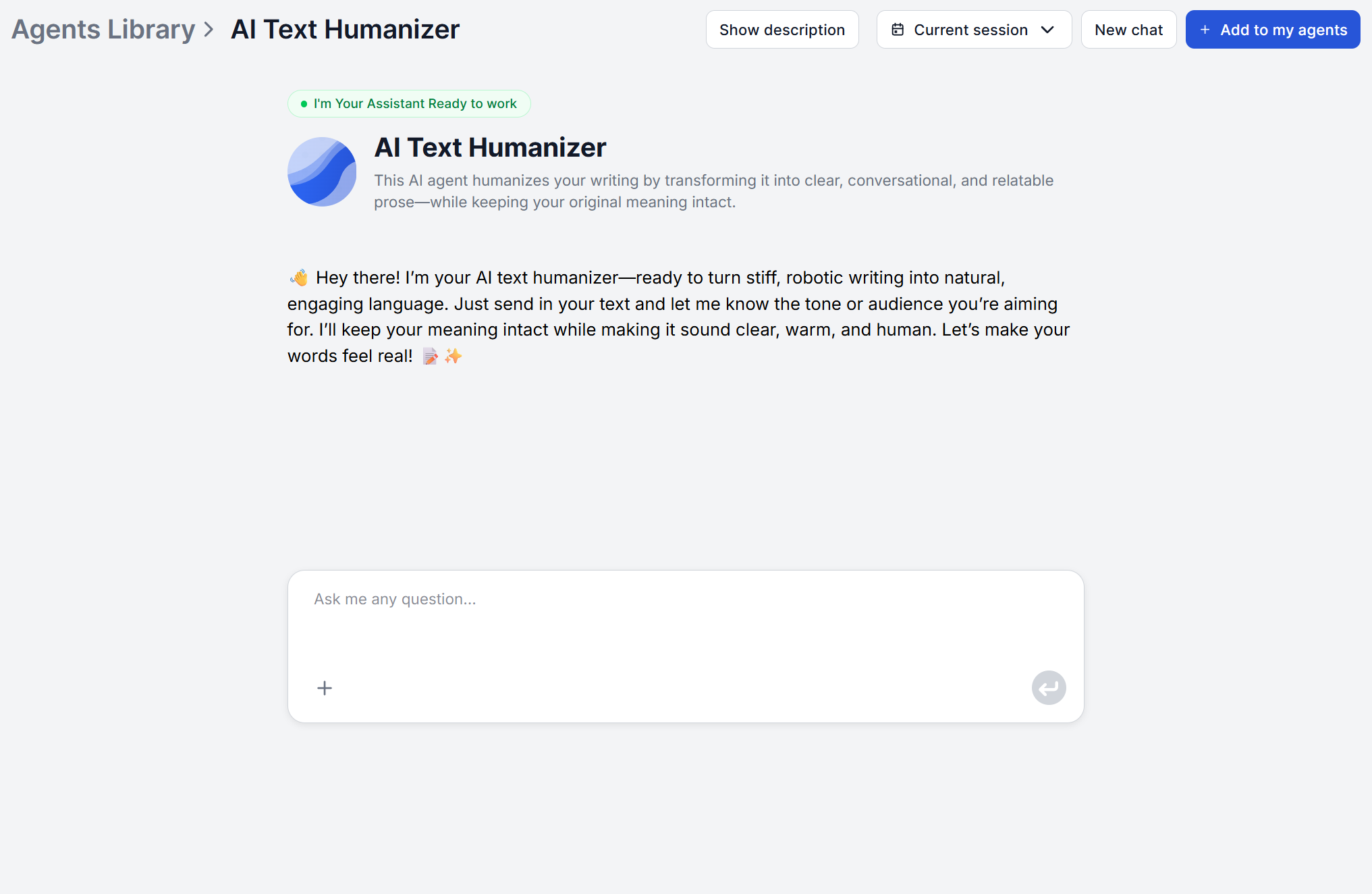
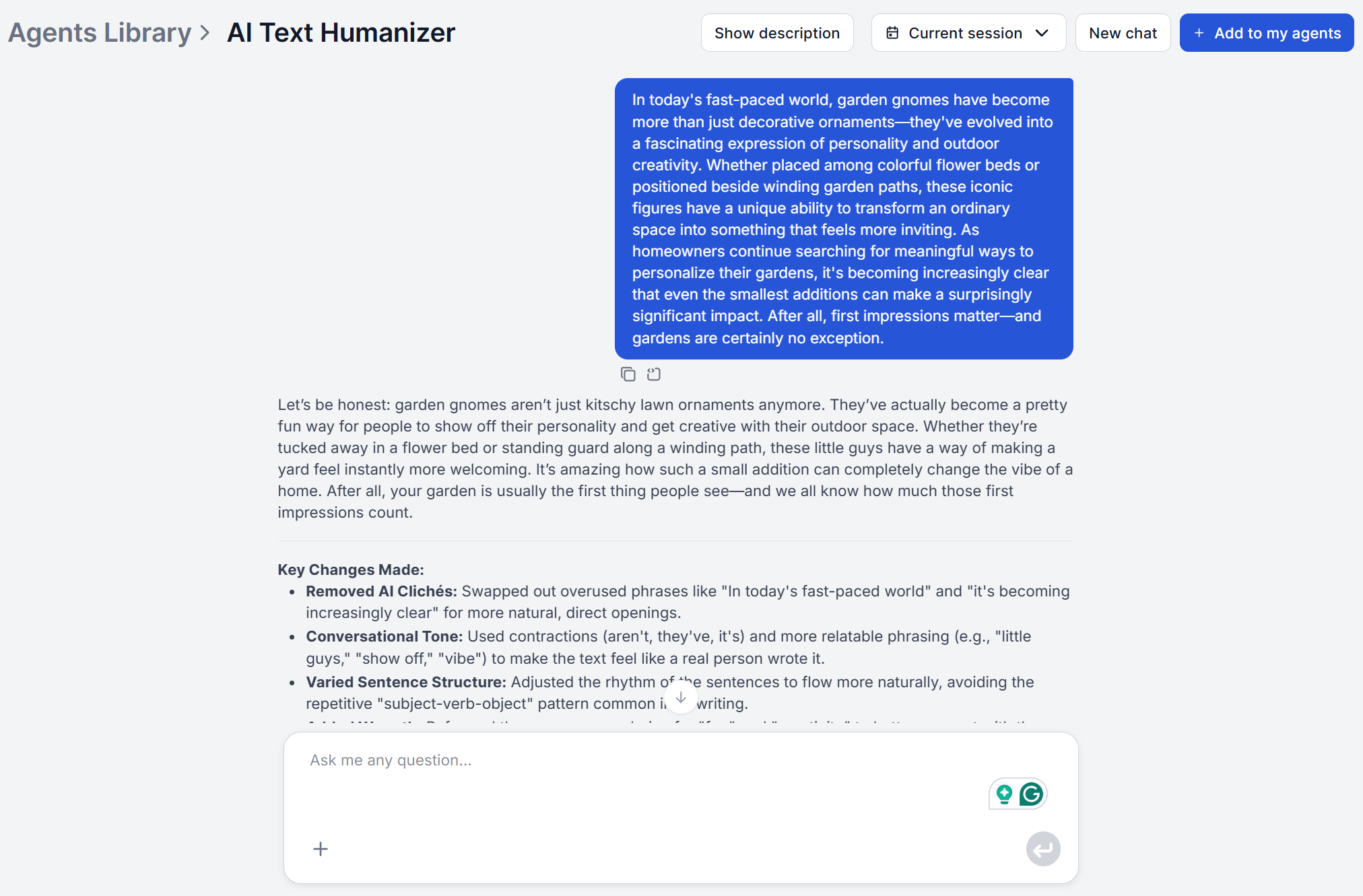
The AI Text Humanizer
improves the writing quality that keeps readers on the page. That engagement, measured through time on page, scroll depth, and return visits, is what search engines use as an indirect signal of content quality.
The tool’s process directly addresses the patterns that hurt AI content performance:
Tone and intent analysis — it identifies whether the content is informative, persuasive, or instructional, then rewrites to match that intent with natural language. Mismatched intent (an article that reads like a product pitch when the searcher wanted an explanation) is a bounce signal.
AI pattern removal — overused phrases like “in the realm of,” “leverage,” and “it’s worth noting that” are replaced with plain, direct language. These phrases don’t just read as AI-generated, they signal low-information density to readers.
Natural language rewriting — stiff phrasing, uniform sentence length, and mechanical transitions are replaced with the varied, idiomatic language that creates genuine engagement.
Audience targeting — vocabulary and sentence structure are adjusted to match your actual readers. Writing that’s pitched too formally or too simply loses the audience before the content has a chance to land.
After humanization, the editorial layer adds the E-E-A-T signals that separate authoritative content from competent content. If you feed your first-hand experience, proprietary data, and brand examples into FlowHunt via knowledge sources
, the AI can draw on them automatically in every future run. What stays human is the final review and the judgment calls, not the data entry.
The Optimal AI + Human Workflow for Ranking Content
The ideal AI-assisted workflow for content that actually ranks has four layers.
Research-backed generation. Starting with a draft grounded in current sources and structured around actual search intent, not a prompt that surfaces whatever the model already knows. This means pulling live data, verifying it against real search results, and building an outline around what the query actually needs.
Humanization. Removing the statistical and stylistic patterns that make AI output feel generated, and rewriting for genuine voice and natural sentence variation. The structural draft from step one is rarely ready to publish as-is.
Context enrichment. Bringing in proprietary data, brand examples, and subject-matter judgment. This is the layer that adds E-E-A-T signals and distinguishes the piece from the hundred other articles written on the same topic. You can add this manually at review time, or teach the AI your context in advance so it draws on these automatically in every future run.
SEO verification. Checking the draft against live search data, updating any outdated statistics, and tightening heading structure and metadata before publication.
FlowHunt has tools for each of these layers, built to connect as a single pipeline. Here’s what each does in practice.
Step 1: AI Blog Writer — Generate the research-backed draft
The AI Blog Writer
follows a three-phase process: research (querying live sources for current data, statistics, and technical insights), analysis (synthesizing gathered information into key angles and frameworks), and execution (writing the full article in clean Markdown). This produces a structured, evidence-grounded draft.
The AI Text Humanizer
covers tone and intent analysis, natural language rewriting, AI pattern removal, and complexity simplification in one pass. The output is a readable, naturally voiced draft that no longer reads as generated.
Step 3: Add your voice and data through FlowHunt
By feeding your first-person experience, case studies, brand voice, and proprietary data into FlowHunt via knowledge sources
and agent instructions
, you teach the AI to draw on these automatically in every future run. The human step then becomes verifying claims, checking that the piece sounds right, and making the judgment calls that only a subject-matter expert can make.
Step 4: AI Blog Content Improver — Research enrichment and SEO
The AI Blog Content Improver
runs a four-step automated improvement pass. It retrieves (fetches the post via URL or HTML), researches and verifies (cross-references against live Google Search and ArXiv sources), enhances (fills gaps, updates outdated statistics, strengthens weak sections), adds SEO and formatting (optimizes heading structure, incorporates keywords naturally, refines metadata).
Data from 50 Real AI Articles: What Ranked and What Didn’t
Across AI-generated and AI-assisted articles we’ve analyzed at FlowHunt, the patterns separating ranking content from non-ranking content are consistent and predictable.
Articles that ranked:
Had specific, verifiable data points rather than generic claims. We always make sure to either supply data and sources, or have AI do real-time internet research.
Included at least one perspective or example that couldn’t have come from training data, such as a proprietary test result, a named client case, a specific tool comparison run on current inputs. For example, we’ve enriched a basic generated article by centering it around the strong opinions our CEO shared in a LinkedIn post.
Were structured around what the searcher actually needed, not around the topic in the abstract. Complete with relevant generated FAQs.
Used natural, varied prose. Our best ranking content went through heavy human intervention, especially in intros and conclusions. Personal and opinionated human langauge made readers stay on page, which created the engagement signals that support ranking. But we rarely touch the general explanatory sections that set the topic up. AI can handle that very well on it’s own.
Had been through the Blog Improver Agent’s research and verification pass, catching outdated statistics before publication.
Articles that didn’t rank:
Were published with minimal or no human editorial layer. AI-generated structure and prose with no added insight.
Were published with no or very little images, statistics or tables.
Contained hallucinated or outdated statistics that eroded trust and generated corrections/bounce.
Answered questions the searcher wasn’t asking. They were technically on-topic, but not aligned with actual search intent.
Had uniform sentence structure and formulaic phrasing that drove readers to hit back before finishing.
Had unpleasantly long paragraphs and too many lists or enumerative sentences.
Covered broad topics with very little depth, numbers, or specifics included.
Remember that Google will not penalize AI content for is its origin only. It’s the absence of the things that make content worth reading, regardless of who wrote it. Good content always needs specificity, accuracy, original perspective, and genuine usefulness to someone with a real question.
Frequently asked questions
Not for being AI-generated. Google's Spam Policies target 'auto-generated content intended to manipulate search rankings'. In other words, mass-produced content that is thin, unhelpful, or lacks original value, regardless of wether AI or humans produced it. What triggers penalties are failing E-E-A-T signals, no first-hand experience, thin content that doesn't satisfy query intent, and content created to rank rather than to help. On the other hand, a well-researched, helpful humanized AI article is treated the same as a well-written human article.
AI detectors analyze two statistical properties of text: perplexity (how predictable each word choice is) and burstiness (how much sentence-to-sentence variation exists). AI-generated text tends to score high on predictability and low on variation. These tools are reasonably accurate against raw AI output but carry meaningful false-positive rates on human-edited or humanized text. Google does not use AI detection tools for ranking decisions, their quality signals are entirely independent of AI origin.
There is no universal legal requirement for AI content disclosure outside specific regulated contexts such as political advertising or certain financial content. Google does not require disclosure and doesn't factor it into ranking. If you're not bound by any laws or codes of conduct, only disclose AI use where readers reasonably expect it (journalism, personal essays, academic work), because it affects the trust relationship with your audience. For marketing copy, product content, and technical documentation, the disclosure question is largely a brand decision rather than compliance.
Yes. Featured snippets are awarded based on whether content directly answers the query in a clear, structured format, and not on how it was written. AI-generated content that has been humanized, fact-checked, and formatted correctly regularly wins snippet positions. The structural and accuracy requirements are identical to those for human-written content.
It depends on content type and generation quality. For general topic blog posts from a well-prompted AI blog writer, a focused editorial pass adding specific examples, verifying claims, and inserting E-E-A-T signals typically takes 20–30 minutes. For technical or expert-level content where deep knowledge is a prerequisite, the human layer needs to be proportionally deeper.
Maria is a copywriter at FlowHunt. A language nerd active in literary communities, she's fully aware that AI is transforming the way we write. Rather than resisting, she seeks to help define the perfect balance between AI workflows and the irreplaceable value of human creativity.
Maria Stasová
Copywriter & Content Strategist
Humanize Your AI Content Before Publishing
Remove the patterns that signal AI generation and add the quality signals that search engines reward — in one automated pass.
How to Use AI to Generate SEO-Optimized Blog Content Automatically
Discover how to leverage AI tools to automatically generate SEO-optimized blog content that ranks higher, saves time, and drives organic traffic to your website...
Driving SEO Success with AI: Strategies for Optimized Results with AI
Discover how AI is transforming SEO by automating keyword research, content optimization, and user engagement. Explore key strategies, tools, and future trends ...
How to Rank in ChatGPT: A Comprehensive Guide to Visibility and Authority
Master the strategies to rank in ChatGPT and AI-powered search ecosystems. Learn SEO optimization, content strategies, and platform-specific tactics to boost yo...
17 min read
ChatGPT
SEO
+3
Cookie Consent We use cookies to enhance your browsing experience and analyze our traffic. See our privacy policy.