Google's AI Agents Now Call Stores and Buy Things For You
Google’s ‘Let Google Call’ feature and agentic checkout let an AI agent phone local stores and complete purchases on a shopper’s behalf. Here’s what launched, how it works, and what it means for any business that answers a phone.
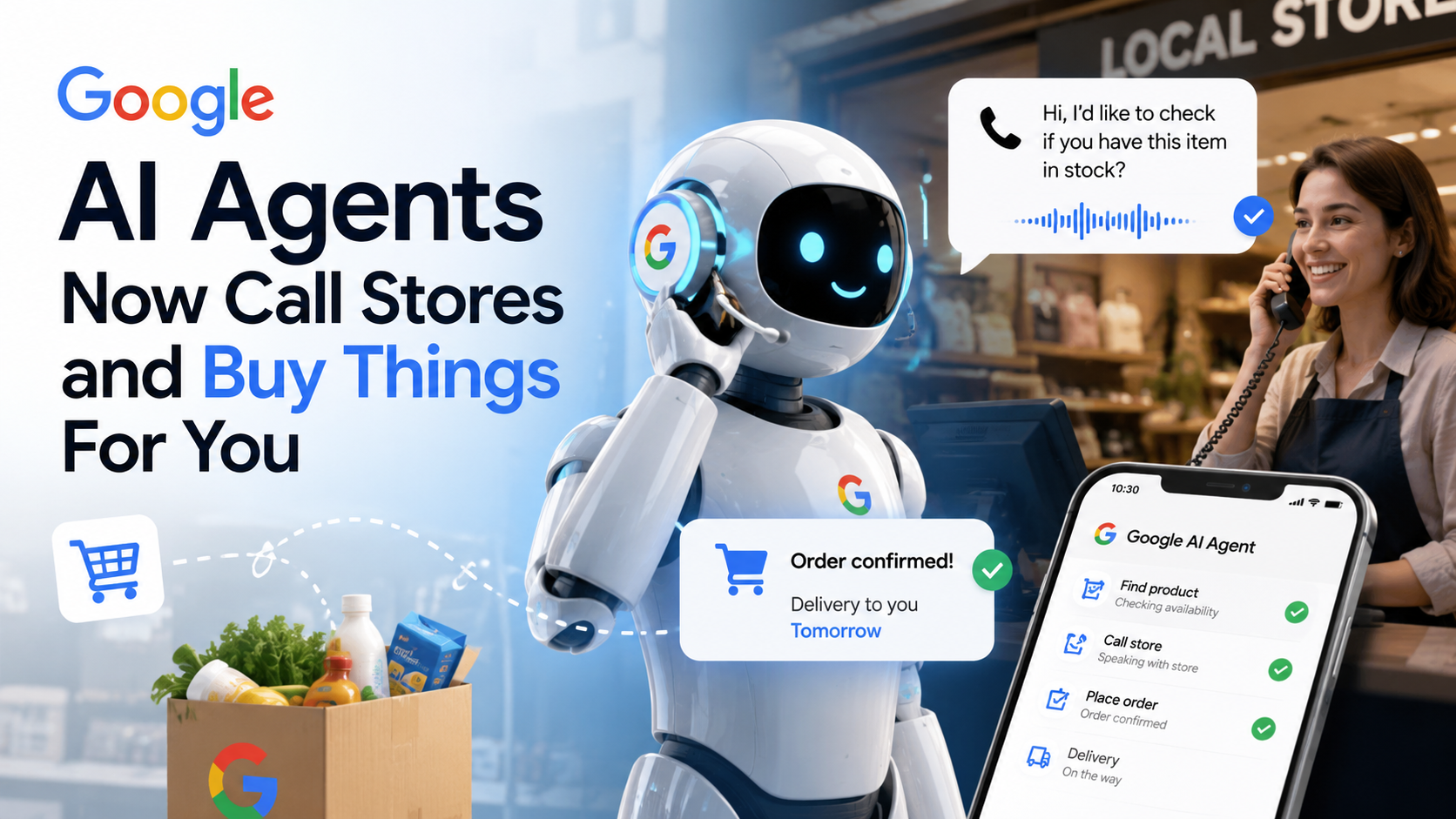
Search for a product “near me” on Google today, and the company’s AI agent may not just point you to a store — it may pick up the phone and call it for you. Between the general availability of agentic checkout and the expanding rollout of “Let Google Call,” Google has turned a chunk of everyday shopping into a fully automated loop: an AI agent checks a product’s price, calls a business to confirm it’s actually in stock, and completes the purchase on a shopper’s behalf once the conditions they set are met. It’s a convenient shift for shoppers. For every business with a phone number and a website, it’s a new kind of caller that has to be answered in seconds, with the right answer, or the call — and the sale — moves on to a competitor.
What Google Actually Shipped
Two distinct pieces make up the rollout. Agentic checkout lets a shopper set a purchase rule, most commonly a target price, and have Google’s agent monitor listings and buy the item automatically through Google Pay the moment that condition is met. It launched with retailers including Wayfair, Chewy, Quince, and select Shopify stores, and every purchase still requires the shopper to explicitly confirm the rule upfront.
Let Google Call is the more disruptive piece for businesses. Built on Google’s Duplex voice technology, it lets the AI agent place an actual phone call to a nearby store to check stock, pricing, or an active promotion, then send the shopper a summary by text or email. The AI discloses that it’s an automated caller before the conversation starts, and Google has said businesses can opt out of receiving these calls entirely. The feature has been expanding across specific categories in the US — toys, health and beauty, and electronics among the first — with wider rollout continuing through 2026.
Ready to grow your business?
Start your free trial today and see results within days.
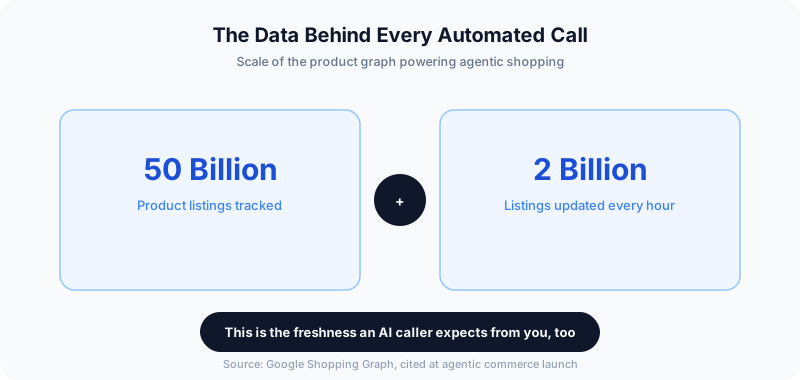
None of this works without a live, constantly-refreshed map of what’s actually for sale where. Google has pointed to its Shopping Graph as the backbone: roughly 50 billion product listings, with around 2 billion of them updated every single hour.
That update cadence matters beyond Google’s own systems. It’s effectively the freshness standard an AI agent now expects from whatever it reaches when it calls a business directly — a standard most small and mid-sized businesses’ phone systems were never built to meet.
Answer Fast, or the Call Moves On
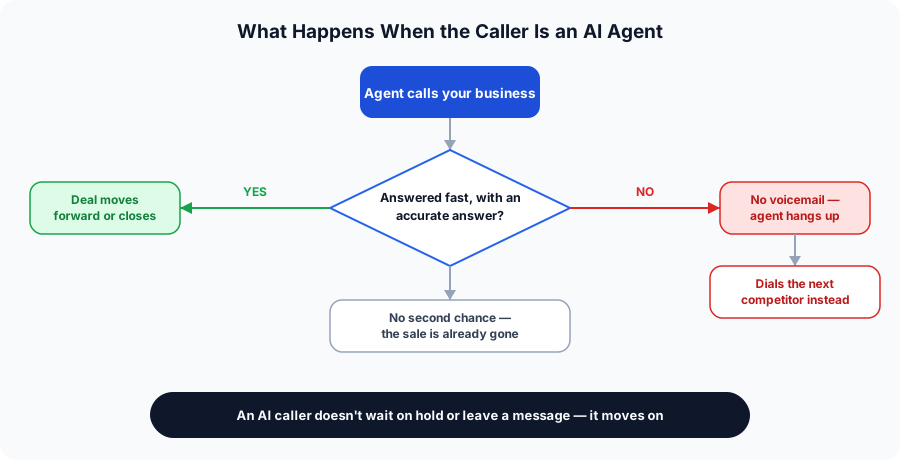
The most consequential detail in the rollout isn’t the technology — it’s the behavior. A human caller who reaches a busy line will typically wait, leave a voicemail, or try again later. An AI shopping agent does neither. If a call isn’t answered quickly, or the person or system that answers can’t give an accurate, specific answer immediately, the agent doesn’t leave a message and hope for a callback. It hangs up and dials the next store on its list.
That single behavior turns “we’ll get back to you” from a minor service gap into a lost sale that never shows up in any complaint log. A missed or fumbled call from an AI shopper looks, from the business’s side, exactly like silence.
Give Every Caller — Human or AI — an Instant, Accurate Answer
FlowHunt connects your phone, chat, and support flows to live inventory and booking data, so an AI agent calling on a customer's behalf gets the same accurate answer a person would.
This isn’t a problem exclusive to retailers with a storefront. Any business reachable by phone or chat is now a potential endpoint for an automated call, and the fix looks the same whether the caller is a shopper’s agent, a no-code AI agent platform
running errands for a customer, or plain old workflow automation
triggered by a price alert. Start by auditing your own number: call it outside peak hours, ask for specific stock or availability information, and time how long it takes to get an accurate answer. If a human can’t reliably clear that bar during lunch or after hours, the fix isn’t a better script — it’s connecting whatever answers the phone or chat to your actual, live systems, the same approach covered in guidance on running an AI contact center
and building a 24/7 AI customer service bot
.
That doesn’t mean removing people from the loop. Chatbots
and voice agents are good at instant, accurate answers to bounded questions like “is this in stock” or “what’s the price” — the exact questions an AI shopping agent asks. Anything more ambiguous still benefits from a clean human handoff
, so automation handles the volume an AI caller creates without dropping the cases that genuinely need a person.
Part of a Bigger Pattern
Google isn’t introducing agentic AI in isolation — it’s the shopping-specific edge of a trend already reshaping how AI systems act on a person’s behalf without a human clicking through every step. That same shift is what’s driving the rise of background AI agents and the security gap
they’ve opened at the infrastructure level: agents doing more, faster, with less direct oversight of each individual action. The difference here is that the action isn’t happening inside a company’s own systems — it’s happening on the other end of a phone line at a business that has no idea an agentic AI system
is about to call.
Conclusion
Agentic checkout and Let Google Call are, on the surface, a convenience feature for shoppers who’d rather not spend an afternoon calling around for the best price. But they establish something bigger: AI agents transacting with the outside world autonomously, at the scale of a 50-billion-listing product graph, refreshed by the billions every hour. For any business, the practical takeaway isn’t to worry about being replaced by a bot — it’s to make sure that whatever answers your phone or chat, human or automated, can match the speed and accuracy an AI caller now expects as the baseline. The businesses that get there first won’t lose the sale to the next number on the list.
Frequently asked questions
Let Google Call is a shopping feature built on Google's Duplex voice technology. When someone searches for a product 'near me,' Google's AI agent can place a real phone call to nearby stores to check stock, pricing, and ongoing promotions, then send the shopper a summary by text or email. The AI identifies itself as an automated caller before the conversation starts.
Agentic checkout lets a shopper set a purchase condition, such as buying an item once its price drops below a target, and have a Google AI agent monitor pricing and complete the transaction automatically via Google Pay once that condition is met. Every purchase still requires the shopper's explicit upfront confirmation of the rule the agent is allowed to act on.
Agentic checkout launched with retailers including Wayfair, Chewy, Quince, and select Shopify stores. Let Google Call has been rolling out for specific categories in the US, including toys, health and beauty, and electronics, with broader category and geographic expansion through 2026.
Yes. Google has said businesses can opt out of receiving automated calls entirely, and the AI is required to disclose that it is an automated caller at the start of the conversation rather than pretending to be human.
Unlike a human caller, an AI shopping agent doesn't wait on hold or leave a voicemail hoping for a callback. If a call isn't answered quickly, or the answer given is inaccurate, industry commentary on the rollout describes the agent simply hanging up and dialing the next store on its list — with no second attempt.
Google has cited its Shopping Graph as the backbone of these agentic features, tracking roughly 50 billion product listings with about 2 billion of them updated every hour. That update frequency is effectively the freshness bar an AI caller now expects from the businesses it's calling.
Google's rollout is the most visible widely-deployed version of agent-to-business calling so far, building on Duplex technology it first previewed in 2018. Its scale and direct integration into everyday product search make it the version most businesses will actually encounter, and it's a strong signal that other platforms building agentic commerce and voice agents will follow the same pattern.
Treat your phone and chat channels as a system another AI agent will evaluate for speed and accuracy, not just a line customers happen to call. That means auditing response times outside peak hours, connecting whatever answers the phone to a live inventory or booking system instead of a script, and deciding where a human handoff still needs to happen for anything an automated flow can't resolve confidently.
Arshia is an AI Workflow Engineer at FlowHunt. With a background in computer science and a passion for AI, he specializes in creating efficient workflows that integrate AI tools into everyday tasks, enhancing productivity and creativity.
Arshia Kahani
AI Workflow Engineer
Build the Agent That Answers, Not Just the One That Calls
FlowHunt lets you connect inventory, calendars, and support systems into a single AI agent that responds instantly and accurately — whether the caller on the other end is a person or another AI.
Google AI Mode: The AI-Powered Search Challenging Perplexity
Explore Google's new AI Mode search feature powered by Gemini 2.5, how it compares to Perplexity, and why it's revolutionizing how we search the web with AI-pow...
This AI-powered workflow helps Shopify merchants analyze competitor products, research market trends, and generate optimized pricing strategies. By combining Sh...
A workflow for an AI-powered customer service agent that can answer queries about Shopify products, retrieve order status, and access information from internal ...
4 min read
Cookie Consent We use cookies to enhance your browsing experience and analyze our traffic. See our privacy policy.