



Copilot
Microsoft Copilot is an AI-powered assistant that enhances productivity and efficiency within Microsoft 365 apps. Built on OpenAI’s GPT-4, it automates tasks, p...
3 min read
AI
Productivity
+4
Microsoft is merging Copilot into one app with a paid AutoPilot tier for background agents, while new research shows only 14.4% of AI agents go live with full security approval. Here’s what’s driving both.
Two stories from the first week of August 2026 describe the same shift from opposite ends. Microsoft confirmed it’s merging Copilot into one app and launching AutoPilot, a paid tier of agents that run in the background instead of waiting for a prompt. Around the same time, new research from Gravitee put a number on a problem that’s been building for a while: 80.9% of technical teams already have AI agents live, but only 14.4% of them got full security and IT approval first. Agents are moving off the chat screen and into the background of daily work — and the tooling to keep them accountable is visibly racing to catch up.
Satya Nadella confirmed the consolidation directly on Microsoft’s fiscal Q4 2026 earnings call on July 29: consumer Copilot, GitHub Copilot, and Copilot Cowork are merging into a single application, internally engineered under the codename “Copilot Fusion.” Instead of three separate products, users get one app with a toggle between personal and work contexts. The pitch is continuity — ask a question in chat, jump into code, hand a task off to an agent, all without losing context or switching apps.

Start your free trial today and see results within days.
AutoPilot is the new part. It’s a paid tier of agents built specifically for tasks that don’t need a person actively driving them — scheduling a meeting across several calendars, summarizing a backlog of email, repeating a routine workflow on schedule. That’s a meaningfully different product than a chatbot: it’s automation that starts itself, runs, and finishes, checking in only when it needs to.
It’s tempting to treat “background agents” as a marketing phrase, but the underlying adoption is already substantial. Gravitee’s State of AI Agent Security 2026 report found that 80.9% of technical teams have AI agents in active testing or production today. That’s not an early-adopter minority — it’s most teams, running agents that make decisions and take actions with limited direct supervision.
Get latest tips, trends, and deals for free.
The same report is where the story turns. Of the teams running agents in production, only 14.4% got there with full security and IT approval. Average monitoring coverage across deployed agents sits at 52%, meaning roughly half of all agents in production are running with no real visibility into what they’re doing. The consequence shows up directly: 88% of organizations running agents in production reported a confirmed or suspected security incident in the past year.
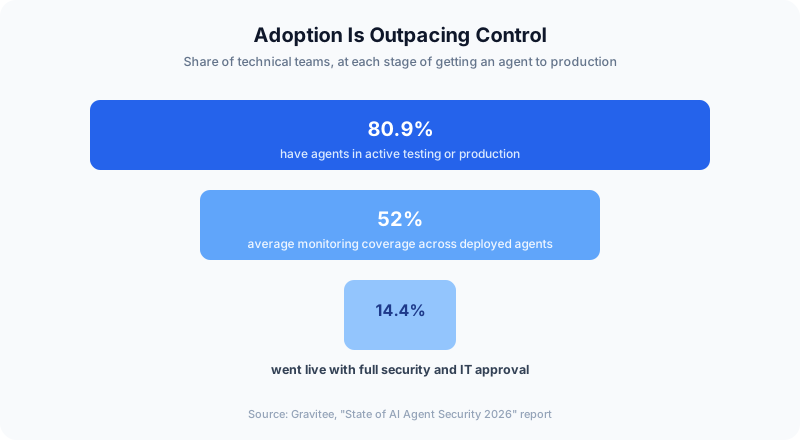
That gap is the real story behind AutoPilot’s launch timing. Shipping more autonomous, less-supervised agents into a landscape where most existing agents already lack full oversight isn’t reckless on its own — but it does raise the stakes on getting LLM security right before background automation becomes the default rather than the exception.
FlowHunt keeps every automated step visible, so you're never reconstructing what an agent did after the fact.
AWS’s answer to the same gap arrived as infrastructure rather than a warning. At AWS Summit New York, the company launched two new services aimed squarely at the reasons agents fail security review: they don’t understand the business they’re operating in, and nobody’s watching what they touch.
AWS Continuum is the security half — it continuously scans for exploitable code vulnerabilities, validates which ones are real risks rather than theoretical ones, ranks them by business impact, and can automatically remediate within guardrails a team defines. AWS Context is the other half: it builds a knowledge graph from an organization’s existing data, business rules, and domain knowledge, and makes that available to every agent that needs it, rather than leaving each agent to infer business context from whatever happens to be in its prompt.
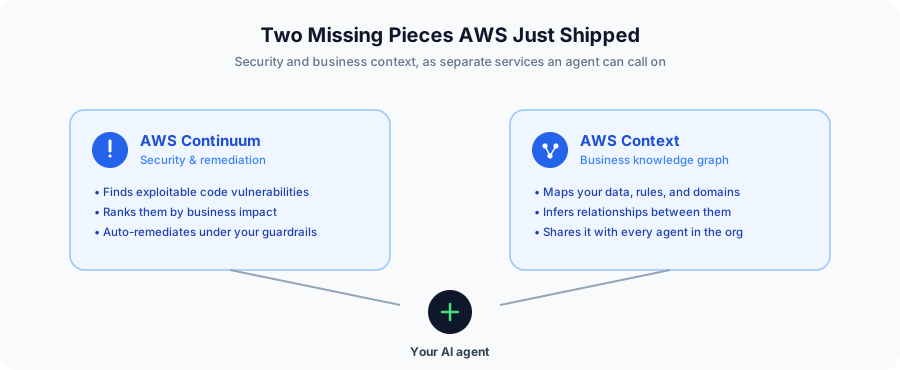
Put together, Continuum and Context are a direct response to the exact numbers Gravitee published: if only 14.4% of agents get full security sign-off, and monitoring coverage averages 52%, the fix has to be infrastructure agents call on by default, not a checklist a team is supposed to remember to run through manually. The same logic applies to data governance more broadly — treating agent context and access as a managed layer, not an afterthought bolted on after something goes wrong.
None of this is really an argument against background agents — the productivity case for AutoPilot-style automation is real, and you can see it in most real-world AI agent examples already running in production today. It’s an argument for building that automation on AI agent frameworks and an AI agent platform where visibility isn’t optional. A background agent that nobody can audit is a liability whether it’s built by Microsoft, AWS, or a homegrown script — the fix is the same either way: know what it can touch, log what it did, and make that information easy to produce, not hard to reconstruct.
This is the same pattern we’ve tracked all summer, from Agent Identity binding permissions to specific agents, to Anthropic’s own move toward persistent, multi-day tasks with Claude Cowork, to Microsoft’s own Orchard framework work on training smaller, more tightly scoped agents. Every direction points at the same conclusion: autonomy without accountability doesn’t scale, no matter how good the underlying model gets.
Microsoft’s Copilot consolidation and AutoPilot tier aren’t happening in a vacuum — they’re launching into a market where background, semi-autonomous agents are already the norm, and where the tooling to secure them is still catching up to that reality. AWS’s Continuum and Context services are a bet that the fix is infrastructure, not vigilance: give every agent verified business context and continuous security scanning by default, and the 14.4% approval rate stops being an outlier and starts being achievable at scale. For any team building or adopting background agents this year, the practical takeaway is the same regardless of vendor — visibility and auditability aren’t features to add later. They’re what separates an agent you can trust with unattended work from one you’re hoping doesn’t make the news.
Arshia is an AI Workflow Engineer at FlowHunt. With a background in computer science and a passion for AI, he specializes in creating efficient workflows that integrate AI tools into everyday tasks, enhancing productivity and creativity.

FlowHunt keeps every automated step visible and reviewable, so agents can run unattended without becoming a black box your security team has to take on faith.
Microsoft Copilot is an AI-powered assistant that enhances productivity and efficiency within Microsoft 365 apps. Built on OpenAI’s GPT-4, it automates tasks, p...
A clear beginner friendly overview of how Copilot supports you across Microsoft 365.

The 12 best AI apps in 2026, ranked by capability, ease of use, and value. From AI workflow automation to writing, design, and coding — find the right tool for ...
Cookie Consent
We use cookies to enhance your browsing experience and analyze our traffic. See our privacy policy.