The teams that successfully scale blog content share one thing: they’ve stopped treating every article as a custom build with multiple tasks and people included. They use AI content agents for blogsto handle research, structure, and first drafts. Then a singular writer or editor can strategize and focus on the parts that actually require human judgment. Here are the specific workflows they use to produce real results.
Use Case 1: Solo Marketer Running a Content Program at Agency Scale
A solo marketer is often expected to run a full content program, including a weekly blog, SEO coverage across dozens of topics, and regular content refreshes all alone.
The constraint here isn’t ideas or expertise, but only the production time. Writing a single well-researched article from scratch takes most of the day, if not multiple days. At that rate, any meaningful editorial calendar stalls and tensions start to rise.
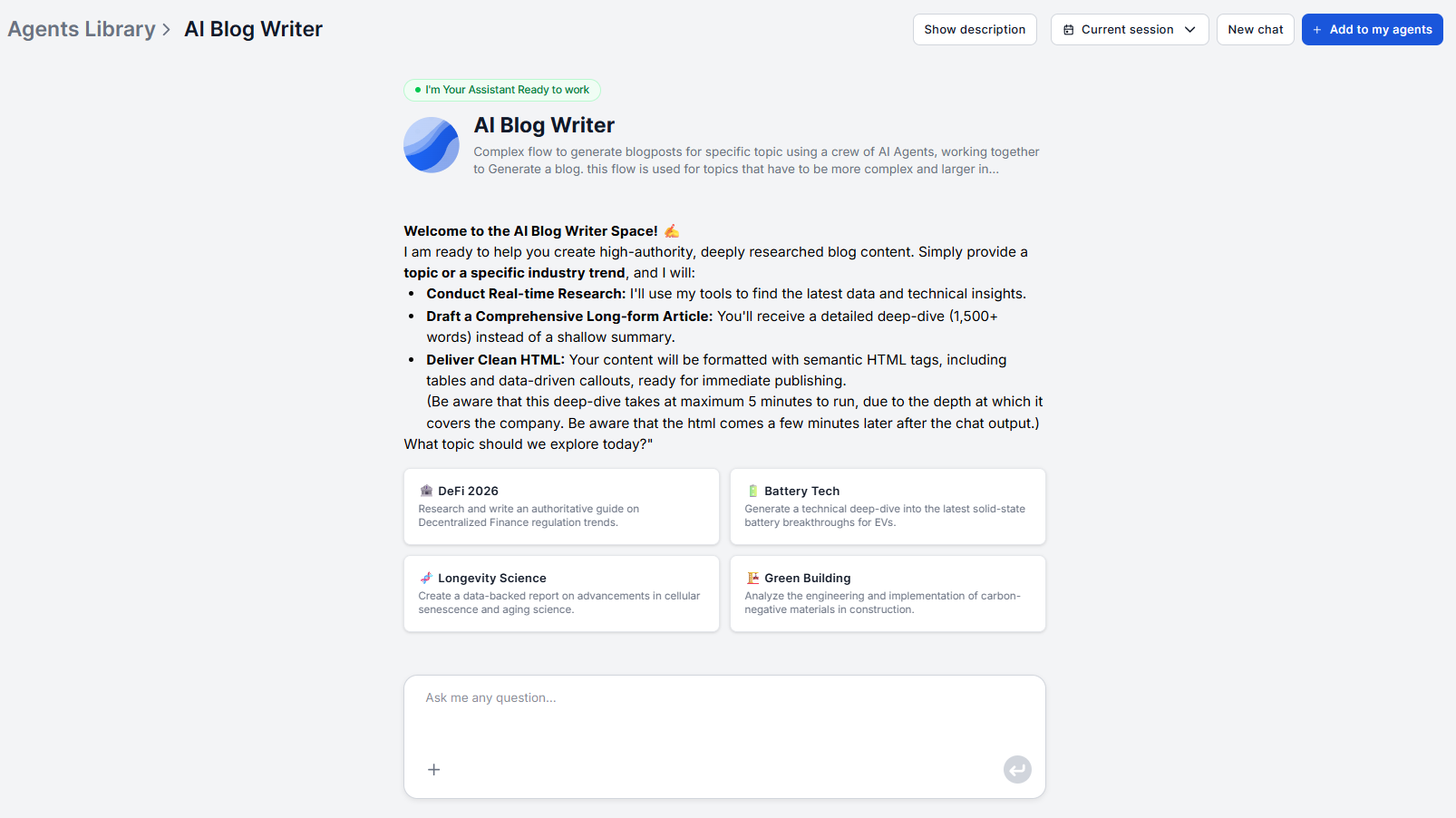
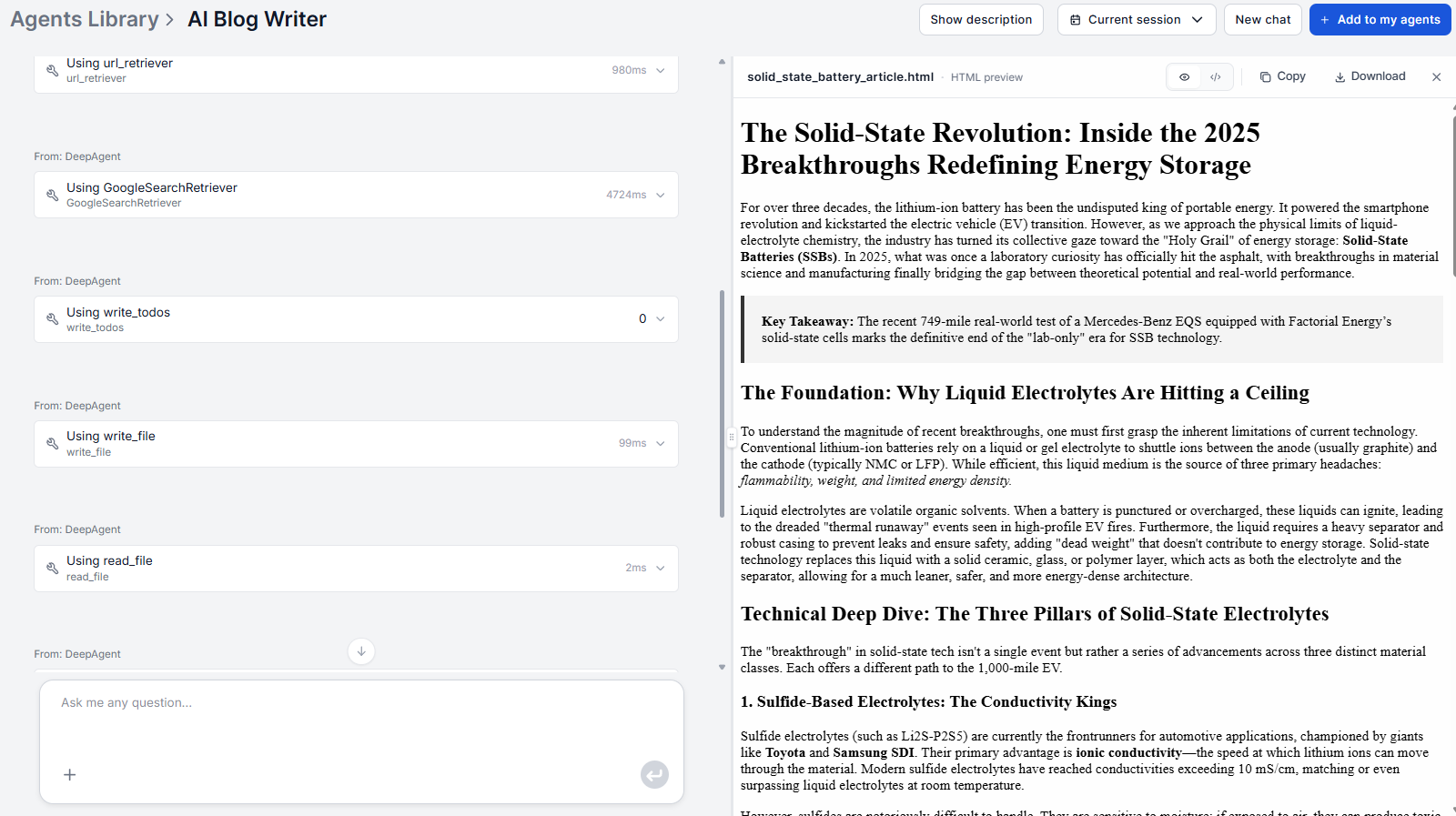
With an AI content workflow built around a blog agent
, the solo marketer’s role shifts. They define the topic calendar, set the keyword targets, and handle the editorial pass. It’s still their voice and first-hand insights, but the agent handles research and first draft. One person can realistically publish three to five posts per week instead of one or two, without the output feeling generic or hollow.
The content brief generator
is a useful complementing tool here. A solo marketer simply enters a primary keyword, and it returns an SEO-friendly title, a meta description, and a section-by-section outline with guidance on what each paragraph should cover. After a brief check, you’re ready to hand the brief to the blog agent or a human writer in minutes.
Use Case 2: SEO Agency Delivering Client Content 3x Faster
For an SEO agency, content production is simultaneously a core deliverable and a cost center. Writers working across multiple client accounts, each with different brand voices, topic domains, and quality standards, are expensive and hard to scale.
Agency content automation built around an AI blog agent restructures the economics. Instead of writers producing first drafts, they just review and refine AI-generated ones. An editor who previously had capacity for six articles per week can now review fifteen, because the two most time-consuming issues, the blank-page problem and the research, are removed by AI.
The workflow that works: the agency builds a client-specific prompt library with brand voice, target audience, topic focus, any content restrictions tailored to each client. It then applies it to every generation run accordingly. Any per-case instructions can always be included in the brief or in the accompanying chat message. Consistent inputs produce consistent outputs, which keeps client approval rates high.
For SEO-heavy accounts, running a content gap analysis
on target pages before briefing the agent adds precision. It ensures that the article addresses specific missing headings and long-tail keywords from the competitor comparison, rather than just covering generic topic. Combine that with the agent’s live research, and the output competes more directly with what’s actually ranking.
Ready to grow your business?
Start your free trial today and see results within days.
Use Case 3: SaaS Company Publishing Product Education at Scale
A SaaS company’s blog serves multiple audiences simultaneously. Not only does it target prospective buyers searching for solutions, but also existing users learning to get more value, and technical evaluators comparing products. Covering all of those angles at meaningful depth requires a significant content volume.
The challenge is that product knowledge sits in the heads of product managers, engineers, and customer success teams. Content writers hunting for this information stretches deadlines, creating bottlenecks and tension. Articles that require too much internal knowledge transfer to produce slow down the editorial calendar to a crawl.
The blog content agent handles the foundational layer, using both the general knowledge and the internal knowledge other teams share and mantain in the workspace knowledge base. This way, they share it once and the agent can use it anytime (and humans can refer to it as well), instead of having to explain it at length to multiple people.
For articles that have been live for a while and are losing rankings, the Blog Content Improver
can refresh them without a full rewrite or a new research round being necessary. The workflow takes the existing post, identifies what’s outdated or structurally weak, and produces an enhanced version ready to republish.
Use Case 4: E-commerce Store Generating Category and Buying Guides
E-commerce content has a well-known scaling problem. Category pages and buying guides drive meaningful organic traffic, but covering a full product catalog at depth requires hundreds of articles. That’s not feasible with a small content team writing from scratch.
E-commerce is one of the clearest fits for blog scaling with AI, because buying guides follow a predictable structure. They always list what to look for, how to compare options, top use cases, common mistakes. The blog agent produces that structure reliably, pulling current product information, expert commentary, and buyer-intent angles from live sources.
The content team’s job shifts to category strategy and editorial review, deciding which product lines to cover and in what order, checking that product details are accurate, and ensuring any brand-specific positioning is reflected in the final copy.
Join our newsletter
Get latest tips, trends, and deals for free.
Use Case 5: B2B Company Building Thought Leadership Consistently
Thought leadership content is the type most likely to stall. It requires genuine expertise and takes time to research and write well. Most B2B teams publish sporadically, in short bursts driven by product launches.
Content marketing automation AI doesn’t replace the expertise. But it removes the production friction that turns “we should publish more” into a perpetual good intention.
The workflow: subject matter experts provide a topic, a point of view, and any proprietary data or examples. The agent handles the research and structure, building out the foundational argument with supporting evidence from current sources. The expert’s editing pass inserts the specific perspective, proprietary insight, and their voice that makes the article worth reading rather than just worth indexing.
The result is consistent publishing without burning out the people who actually have the expertise. For B2B teams where thought leadership directly supports pipeline, that consistency is the difference between a blog that contributes to revenue
and one that doesn’t.
How to Maintain Brand Voice When Scaling with AI
The concern teams raise most often about AI content is that it sounds generic. This is a prompt engineering and supporting context problem, not an AI limitation.
The agent is only as good as the data and instructions it receives. An under-specified prompt (“write an article about X”) produces generic output. A well-specified prompt that includes tone, target audience, register, and examples produces something much closer to on-brand. Bundle that up with your data and context, either as part of the brief or as a permanent knowledge base, and you’re in for a near-perfect output with very little editing required.
When writing your brand voice guidelines, it’s good to include an explicit avoid-list items (“never use the word ’leverage’”, “don’t use em-dashes for lists”). Then add this to your, knowledge sources, memory or prepend this to every agent prompt. In other words, ensure the agent knows about this and can refer to it.
For agencies, the same principle applies per client. A small investment in documenting each client’s voice upfront pays back across every subsequent generation run. The time cost is a one-off while the consistency benefit is ongoing.
Conclusion
The teams publishing three times more content aren’t working three times harder. They’ve restructured the workflow so that AI handles the parts that don’t require human judgment but often require the most time, such as research, structure, and first-drafts. Humans then get to give more time and care to the parts that do require them. The answer to scaled content is An AI content agent as the engine and the team as the editors.
Yes, you can include it as permanent instructions. Either use the knowledge sources or memory features to upload your brand voice and guidelines. Then adjust the agent's prompt to always take it into consideration. To set the tone on a per-article basis, e.g. opinionated or neutral, simply include it int he brief or send it with the initial instructions.
The agent researches live sources, so it draws on current expert material, documentation, and industry commentary for your topic. For proprietary knowledge the web doesn't have, such as your own methodology or internal data, that needs to come from you. You can create a permanent knowledge base in your workspace that the agent can access, include it in the initial brief, or add it manually when you edit the output.
Most teams apply a two-step review. They do one fact-check pass (confirm statistics, verify any claims tied to specific data points) and an editorial pass (add internal links, insert brand-specific examples, check tone). For agencies, this can be done by a single editor in one pass. At volume, a shared review checklist keeps quality consistent across posts regardless of who does the review.
Yes. The agent can be used by anyone within your workspace and is easily transferable to other workspaces via the import & export feature. Since the agent runs in a chatbot interface, any team member can easily access and use it with the same prompt setup, ensuring similar quality of output regardless of user.
For evergreen topics, the agent produces comprehensive, well-structured foundational articles that hold up over time. For trending content, the live research phase is the key advantage. The agent queries current sources at generation time, so it picks up recent developments, new data, and updated commentary rather than relying on training data that may be months old.
Maria is a copywriter at FlowHunt. A language nerd active in literary communities, she's fully aware that AI is transforming the way we write. Rather than resisting, she seeks to help define the perfect balance between AI workflows and the irreplaceable value of human creativity.
Maria Stasová
Copywriter & Content Strategist
Try the Blog Content Agent
FlowHunt's Blog Content Agent researches, outlines, and writes publication-ready articles in minutes. Used by solo marketers and agency teams to scale content without scaling headcount.
AI Agents That Blog & Code for You: Automating Content Creation and GitHub Workflows
Learn how AI agents can automatically generate SEO-optimized blog posts, create markdown files, and submit GitHub pull requests—all from a single keyword input....
How Content Teams Use AI Briefs to Cut Rewrites by 60%
An AI content brief gives every writer the same SEO-informed starting point. Here's how agencies, in-house teams, and SEO teams use it to cut revision rounds fr...
How to Generate SEO Blog Posts with an AI Agent (Step-by-Step Guide 2026)
Manual blog writing takes 3 hours per post on average. Here's how an AI blog content generator researches, outlines, and writes SEO-ready drafts in minutes, and...
8 min read
AI
Content Writing
+3
Cookie Consent We use cookies to enhance your browsing experience and analyze our traffic. See our privacy policy.