Most blogs don’t fail because of bad writing, but because of inconsistent publishing, wrong keyword targeting, and no topical authority. Here’s how AI content agents solve each problem systematically.
Most blogs do not fail because the writing is bad. They fail because of three structural problems that have nothing to do with prose quality. Authors either publish inconsistently, target topics nobody searches for, or never build the depth of coverage that search engines reward. If your blog traffic isn’t growing, fixing those three things matters far more than improving the quality of individual articles. Here’s what each problem looks like in practice, and how an AI content agent can help you address them systematically.
The 3 Real Reasons Most Blogs Stop Growing
Before getting into solutions, it’s worth naming the problems precisely. Most blog post-mortems focus on surface-level issues — the writing wasn’t engaging, the headlines weren’t catchy. While absolutely possible and happening a lot, these still often aren’t the actual causes of stalled growth. But more importantly, all other possible reasons are much faster and easier to do than to fix content quality.
The structural causes are:
Publishing cadence drops below the threshold required to build indexing momentum
Content targets topics the writer finds interesting rather than topics with search demand
Each topic gets one article instead of the cluster coverage that signals authority
These problems compound. A blog that publishes infrequently, on poorly-targeted topics, and without topical depth stays invisible regardless of content quality. Fix any one of them and growth improves. Fix all three and the trajectory changes significantly.
Problem 1: Publishing Inconsistency Kills Rankings
Search engines discover and index content through crawling. More frequent publishing gives crawlers more reasons to return to your site, which means new content gets indexed faster and the overall domain builds more pages competing for organic traffic over time.
The real-world pattern for most blogs is that publishing is consistent for a few weeks after launch or after a “we need to do content marketing” decision, then stalls when production capacity is hit. One article takes a day to research and write. Two writers with other responsibilities can produce two to four articles per month. That rate builds almost nothing.
The issue isn’t effort. It’s that the per-article production cost is high enough that frequency becomes unsustainable. When writing from scratch, researching, outlining, drafting, editing. Each post consumes significant time that teams don’t consistently have. The calendar slips, the publishing rate drops, and the compounding effect of consistent content never kicks in.
Ready to grow your business?
Start your free trial today and see results within days.
The second failure mode is subtler. Content gets published, but it targets topics based on what the team finds interesting or knows well, and not on what potential readers are actually searching for. While this strategy may work well with different types of marketing, you definitely won’t get organic search traffic this way.
Many SaaS companies write detailed product tutorials that nobody outside existing customers searches for. A consultant publishes thought leadership essays that address niche debates within their professional community. The content is accurate and well-written, it just doesn’t have an audience in search.
Content strategy blog growth depends on connecting what you have to say to what people are actively looking for. That requires starting with keyword research, identifying the queries your target audience is typing into search engines, and building content around that demand.
A useful shortcut: the content brief generator
takes a primary keyword and returns a ready-to-use brief with an SEO-friendly title, a meta description, and a section-by-section outline with guidance on what each paragraph should cover. It converts a keyword into a structured writing plan in seconds, removing the research-to-brief step that most teams skip entirely.
Problem 3: 1 Article per Topic Never Works
Single articles targeting isolated keywords rarely build lasting rankings in competitive niches. Search engines evaluate topical authority, how comprehensively a site covers a subject area, and not just whether a page contains the right keywords.
A site with fifteen articles on a topic, covering different angles, supporting queries, and related subtopics, will outrank a site with one well-written article on that topic. Regardless of content quality, it’s the breadth of coverage that signals genuine expertise in the subject area.
Most blogs publish one article per major topic and move on. That’s the structural gap. A “beginner’s guide to content marketing” doesn’t build authority. The guide plus articles on keyword research, editorial calendars, content distribution, measuring performance, and refreshing old content.
Running a content gap analysis
on your existing pages surfaces what’s missing. Paste your URL and a top-ranking competitor URL, and the tool produces a structured comparison of missing headings, uncovered subtopics, and long-tail keywords your page doesn’t address. That output becomes your expansion brief.
Join our newsletter
Get latest tips, trends, and deals for free.
How AI Content Agents Solve Each Problem
Each of the three structural problems maps to a specific bottleneck, and an AI content agent for blogs addresses all three directly.
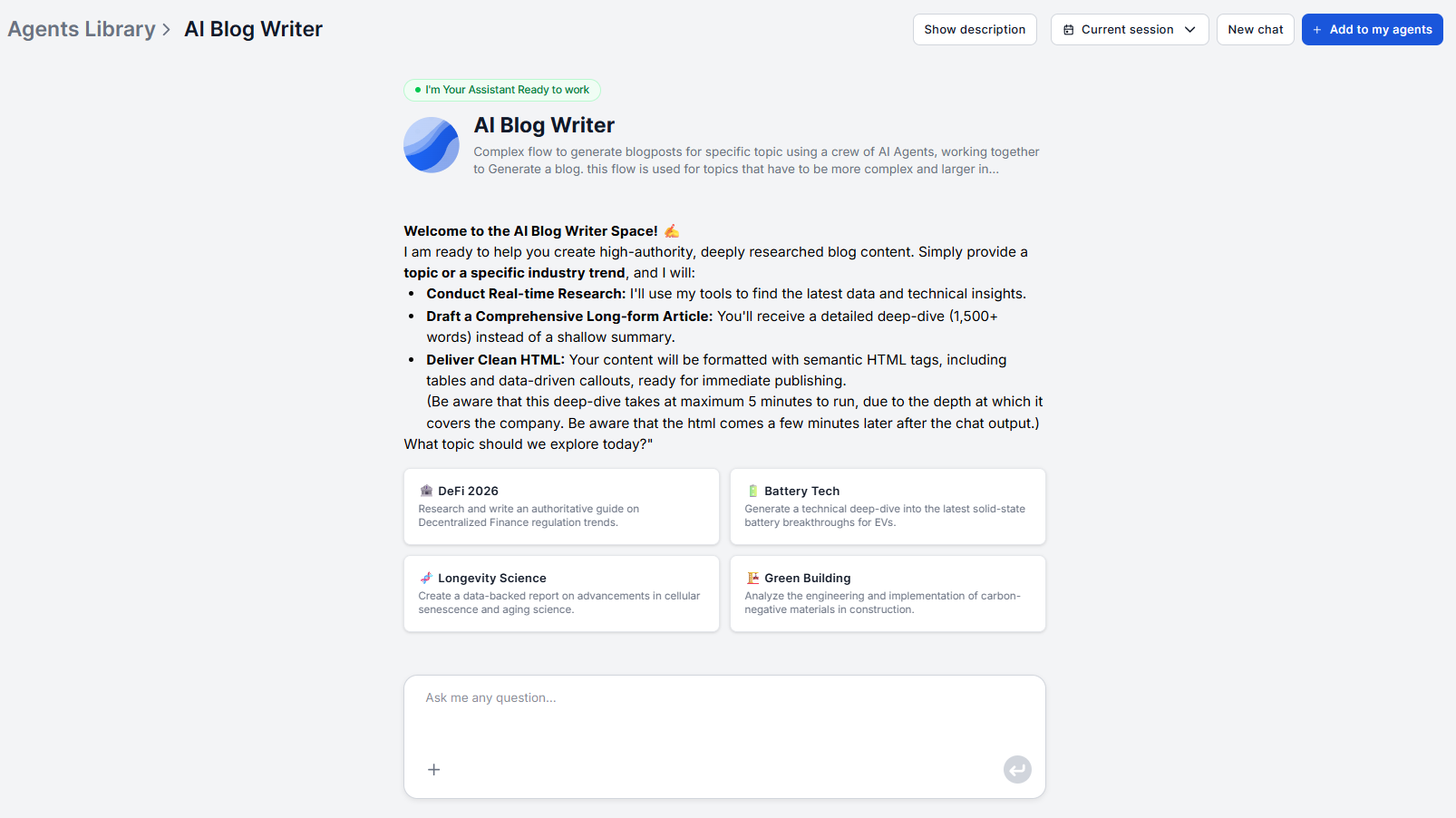
Frequency problem → removed production bottleneck. The reason publishing rates drop is cost per article. When a blog content agent
handles research and drafting, the per-article cost drops to a 20–30 minute editing pass
. An editor who could produce four articles per month, can now review twenty. Publishing three to four times per week
becomes operationally feasible instead of aspirational.
Keyword strategy problem → brief-first workflow. Starting every article from a keyword-driven content brief instead of a topic idea ensures content targets actual search demand. The content brief generator converts any keyword into a structured brief with SEO-optimized title, meta description, and section-level guidance, ready to hand directly to the blog agent. The workflow shifts from “what should we write about?” to “which keyword do we brief next?”
Topical authority problem → systematic cluster buildout. With production friction removed, topic clusters become achievable. A content gap analysis identifies the specific subtopics and angles missing from your current coverage. The blog agent produces each supporting article. A topic that would have taken a year to cover adequately at two posts per month takes four to six weeks at three posts per week.
What a Healthy AI-Assisted Blog Content System Looks Like
When the three problems are addressed together, the blog content workflow has a clear, repeatable structure.
Research and briefing. A keyword is identified from the topic cluster. The content brief generator produces the title, meta description, and outline. The brief is reviewed and any brand-specific angle is added.
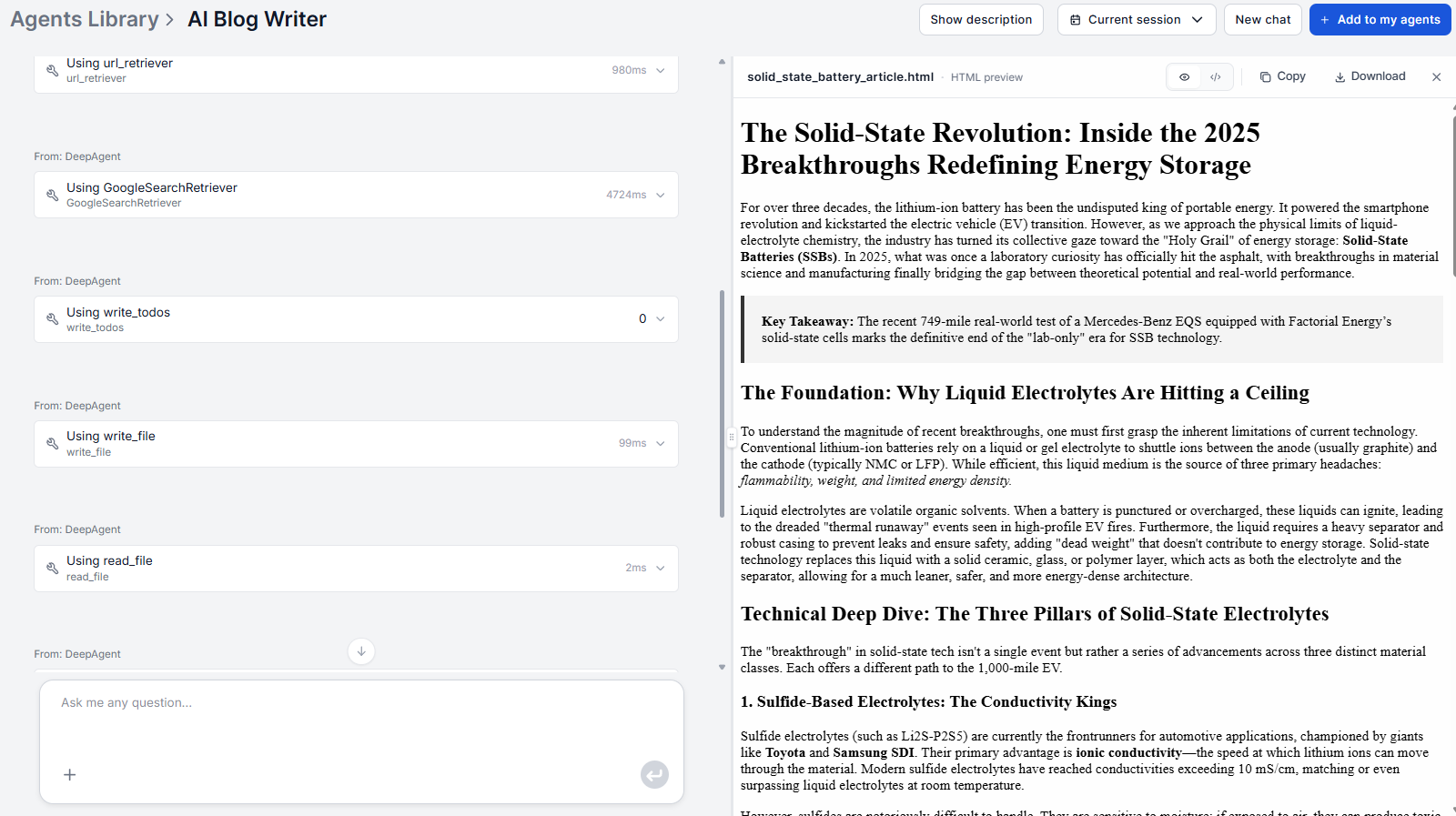
Generation. The brief goes to the blog content agent
. Research, analysis, and draft execution happen automatically. The output is 1,500+ words of structured Markdown, ready for editorial review.
Editorial pass. The editor adds internal links, inserts first-hand examples, verifies statistics, and confirms brand voice. This takes 20–30 minutes, not three hours.
Gap monitoring. Periodically, a content gap analysis is run on the highest-priority pages against top competitors. The output identifies new supporting articles for the cluster and feeds back into the briefing queue.
This loop — brief, generate, edit, analyze, expand — is how to achieve a scalable content operation. Every step is systematic. Nothing depends on a single writer’s motivation on a given week.
From Zero to Topical Authority: A 90-Day Plan
For a blog starting from a thin content library, here’s a realistic structure for the first three months.
Month 1 — Foundation. Identify two to three core topic clusters relevant to your business. For each cluster, define a pillar keyword and four to six supporting keywords. Use the content brief generator to brief all of them. Publish the pillar article for each cluster in the first two weeks, then begin publishing supporting articles at three per week.
Month 2 — Cadence and coverage. Continue publishing against the cluster briefs. By end of month two, each core topic should have five to eight articles covering different angles and supporting queries. This is when indexing momentum builds — crawlers are returning regularly, and the topical signals start accumulating.
Month 3 — Audit and expand. Run a content gap analysis on the top-performing articles from months one and two. Compare against the current top-ranking competitors for those topics. Add the missing subtopics and long-tail angles as new briefs. Simultaneously, use the Blog Content Improver
to refresh any month-one articles where gaps were identified — it takes the post via URL, fills the gaps, updates data, and produces a revised version without a full rewrite.
At the end of 90 days, you have a blog with genuine topical depth, consistent recent publishing signals, and a production system that can sustain the pace indefinitely.
Conclusion
Why your blog isn’t getting traffic is almost never a mystery if you look at the structural inputs. How often you’re publishing? Does the content targets actual search demand? How much coverage depth you’ve built per topic? An AI content agent doesn’t improve prose, it removes the production constraints that prevent you from solving the real problems. Consistent frequency, keyword-driven briefs, and systematic cluster expansion are the mechanics of blog growth. The agent makes all three achievable without proportionally scaling your team.
SEO results from any blog strategy typically take three to six months to materialize in search rankings, regardless of whether the content is AI-assisted or written manually. What AI-assisted publishing changes is how much content you can index in that period. A blog producing one article per month takes years to build topical depth. The same team using an AI content agent can publish weekly, covering an entire topic cluster in a quarter rather than a year.
More publishing helps only when the content covers genuine search demand with adequate depth. Publishing more thin, poorly targeted articles will not improve rankings and may signal low quality to search engines. The frequency benefit comes from consistent, keyword-anchored, substantive content. The best combination to achieve this is coupling a content brief generator and an AI blog agent with a human editor.
Start from keyword research: identify what your target audience is actively searching for, not just what you know or find interesting. Tools like the content brief generator take a keyword and produce a search-demand-driven brief, showing you what structure and angle is likely to rank. For existing content, a content gap analysis against top competitors surfaces the specific topics and subtopics your site is missing. Both together give you a data-driven editorial calendar rather than a guesswork-driven one.
Topical authority is built through coverage breadth and content depth across a subject area. AI content agents can generate the breadth — the cluster of supporting articles, the coverage of related subtopics, the consistent publishing cadence. What they cannot supply is proprietary expertise: original research, first-hand case studies, unique methodology. A topical authority strategy that layers AI-generated foundational content with human-authored insight pieces will outperform either approach used in isolation.
There's no universal threshold, but one substantive, well-targeted article per week is a workable floor for most blogs in competitive niches. Less than that, and topic cluster buildout moves too slowly to accumulate the contextual signals that drive rankings. The practical limit for most teams without AI assistance is two to four posts per month. With an AI blog content agent handling research and drafting, publishing three to four posts per week is achievable for a single editor.
Maria is a copywriter at FlowHunt. A language nerd active in literary communities, she's fully aware that AI is transforming the way we write. Rather than resisting, she seeks to help define the perfect balance between AI workflows and the irreplaceable value of human creativity.
Maria Stasová
Copywriter & Content Strategist
Start Publishing Consistently with the Blog Content Agent
FlowHunt's Blog Content Agent removes the production bottleneck that keeps most blogs stuck — research, structure, and draft in minutes, every time.
How to Improve Existing Blog Posts with AI Without Starting from Scratch
An AI blog content improver finds thin sections, outdated stats, and weak structure in existing posts and fixes them automatically. Here's how it works and how ...
6 Types of Blog Posts That Need AI Improvement Most (With Before/After Examples)
Not every blog post needs the same fix. See the six specific post types where blog content optimization AI delivers the fastest results, with before/after examp...
Why Your Content Doesn't Rank: It Starts with a Bad Brief
Why content doesn't rank usually traces back to the brief, and less often to the actual writer. Wrong intent, shallow content, missing subtopics, or no competit...
7 min read
AI
SEO
+3
Cookie Consent We use cookies to enhance your browsing experience and analyze our traffic. See our privacy policy.