Your Blog Has 500 Posts Sitting on Page 2. Here's How to Fix Them at Scale
AI blog content improvement at scale turns a backlog of page-2 posts into a prioritized, workable roadmap. Here’s how to audit, prioritize, and fix them faster than writing new content.
If your blog has 500 published posts, a meaningful share of them are probably sitting on page two of Google right now or even lower. Blogs that size commonly have somewhere around 80 to 120 posts stuck in positions 11–20. These are the pages Google already trusts enough to index and rank, just not enough to put in front of anyone.
Good news is there’s plenty what you can do about improving it. Even better news is that AI is very good at improving them. Scaling blog content improvement with AI is a realistic way to work through a backlog of 100 posts quick. Not replace experienced writers, but aid them in the arduous task of fixing and refreshing old content. Here’s how to know which posts to fix first, and how.
The Hidden Traffic Opportunity in Your Existing Blog
New content gets the attention because it’s visible. A new post publishes, gets promoted, and shows up in your content calendar as a completed task. A page-2 post just sits there, technically live, generating no discussion because there’s nothing new to discuss. That asymmetry is exactly why the opportunity in existing content goes unaddressed for so long. It never looks urgent, at least not as urgent as producing new content, even when it’s often actually the highest-leverage work available.
The posts worth prioritizing usually fall into a small number of recognizable patterns. It’s the posts that almost-rank, the high-traffic posts that don’t convert, the posts leaning on stale statistics, and pillar content that hasn’t kept pace with its own topic (we cover these in more depth in 6 Types of Blog Posts That Need AI Improvement Most
).
At 500 posts, even a conservative estimate puts dozens of posts into one of these problematic buckets. That kind of scale goes way beyond fixing one post a month by hand, and so it often gets pushed aside. With an AI workflow in your toolbox, the time per article gets cut from one day to 1 hour, enabling you to finally start updating without compromising the speed of new content output.
How to Audit Your Blog for Improvement Opportunities
Before prioritizing anything, you need to run an audit to get a full picture of where every post actually stands. Here’s how to audit existing content and what to focus on.
Export your Google Search Console data for average position, clicks, and impressions per URL, ideally over a 3–6 month window to smooth out normal fluctuation.
Filter for position 11–20 — this is your fastest-win segment, since these pages already have enough authority to rank, just not enough to reach page one.
Cross-reference traffic against conversions in your analytics platform to catch high-traffic posts that don’t convert. At the end of the day, attracting new customers is the number one goal of your blog content, and content that doesn’t do that needs fixing.
Spot-check publish and last-updated dates against how data-dependent each post is. Anything citing statistics or “current” language more than a year or two old is a candidate regardless of its traffic trend.
Flag pillar or cornerstone content separately. These pages usually carry disproportionate internal links and backlinks, so a decline here deserves priority even if the drop looks modest next to your other posts.
The output of this step should be a single spreadsheet one row per post, with position, traffic, conversion signal, data-age flag, and a pillar/ordinary tag. While you need to procure the data manually, feel free to give the spreadsheets to AI to carry out all the analytical steps.
Ready to grow your business?
Start your free trial today and see results within days.
With that spreadsheet in hand, score each candidate on four factors:
Distance to page one — a post at position 13 needs less work to move than one at position 45. Sort your position-11–20 segment to the top.
Commercial value of the keyword — a modest-traffic post on a high-intent keyword can outrank a high-traffic post on a low-value one in priority.
Existing authority — posts with backlinks or a long publish history have more to lose by staying stagnant and more upside once fixed.
Size of the competitive gap — for any post where you know exactly who’s outranking it, run a Webpage Content GAP Analysis
against that specific competitor URL. It compares your page’s heading structure and content directly against theirs and returns a concrete list of what’s missing, which turns “this post needs work” into a scoped, specific task instead of a guess.
Sort the results into three buckets. Quick wins (page-2 posts with a small, well-defined gap), deeper rebuilds (posts needing substantial new sections or a structural overhaul), and consolidation candidates (multiple thin posts competing for the same intent,
addressed in the roadmap below).
If you have all the data at hand, you can save time by just having AI carry out the analytic and sorting tasks.
How AI Makes Bulk Content Improvement Possible
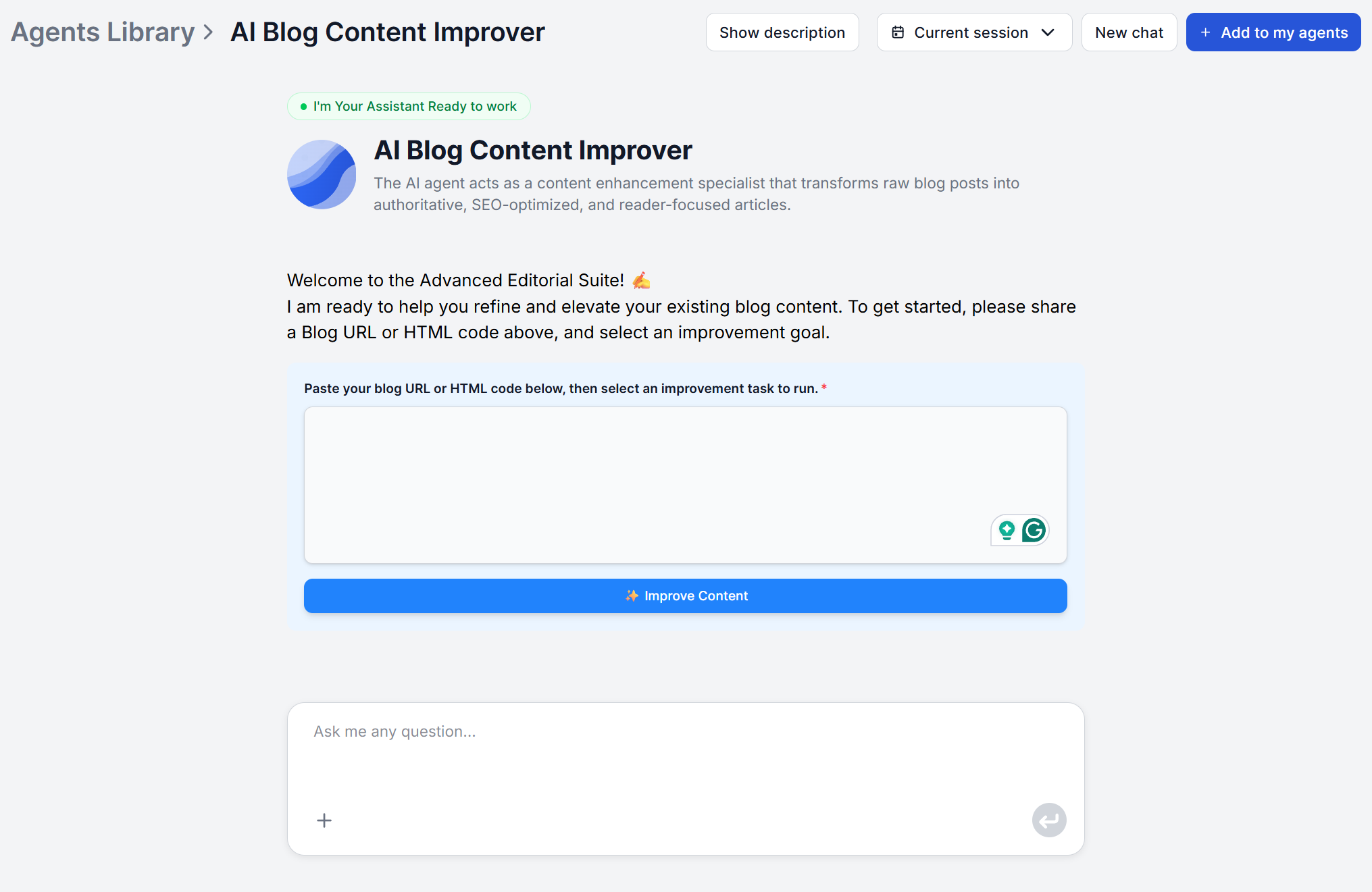
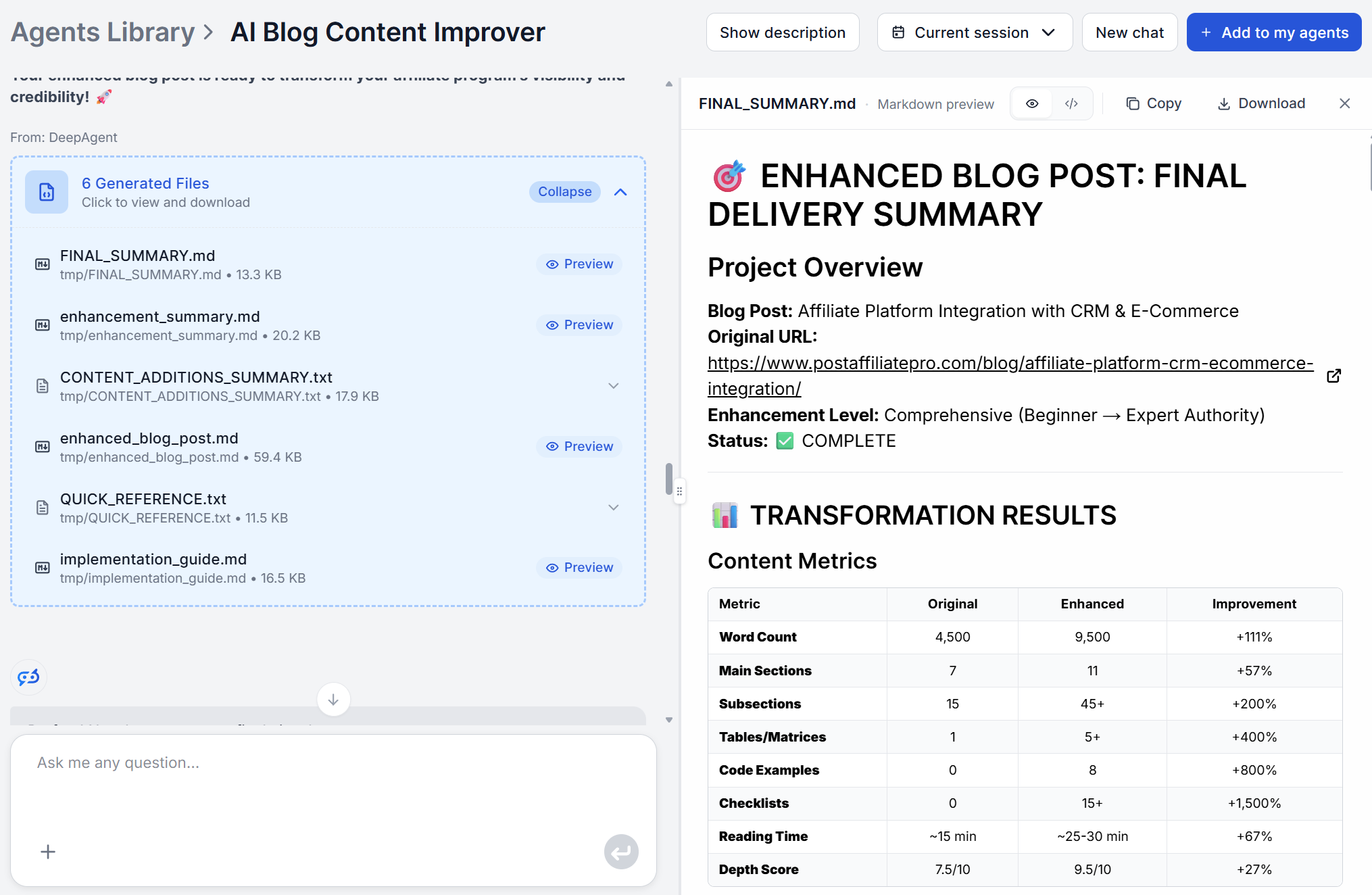
Manual refreshing doesn’t scale because the bottleneck is always the same, and it’s the writer’s attention. There’s only so much of it, and it’s often hijacked by producing new content. What changes isn’t that AI writes better, it’s that the Blog Improver Agent
can offload all the tedious research and formatting, presenting the writer with a finished draft for review.
The AI worfklow runs the same four-step process on every post, regardless of how many you queue up. It retrieves the post via URL or raw text, cross-references it against Google Search to catch outdated data and gaps, rewrites and expands what’s weak, and applies an SEO and formatting pass.
Join our newsletter
Get latest tips, trends, and deals for free.
Building a 90-Day Content Refresh Roadmap
Here’s what an actual content refresh plan could look like:
Days 1–14: Audit and prioritize. Run the audit above, build your scored shortlist, and split it into quick wins, deeper rebuilds, and consolidation candidates.
Weeks 3–6: Clear the quick wins. Run your position-11–20 posts through the Blog Improver Agent first. These need the least work and show movement the fastest. This way you can build momentum and get internal buy-in for the rest of the roadmap.
Weeks 7–10: Tackle deeper rebuilds and consolidations. For posts needing a structural overhaul, the same agent handles more substantial enhancement. For consolidation candidates build one outline with a Content Brief Generator
, write the merged version with the AI Blog Writer
, and redirect the old URLs into the new one instead of improving each separately.
Weeks 11–13: Measure and re-prioritize. Pull fresh Search Console data on everything you’ve touched, confirm what worked, and select the next batch using the same scoring framework.
Measuring Results: What Good Looks Like at 30/60/90 Days
Don’t expect a straight upward line. Search engines need time to recrawl and reassess a changed page, and results compound rather than appearing all at once.
At 30 days: confirm reindexing on the posts you’ve changed and watch for any regressions. Some quick-win posts may already show early position movement, but this is a checkpoint for whether anything broke.
At 60 days: you should see measurable position improvement across a meaningful share of your first batch, particularly the position-11–20 posts, since they had the least distance to travel. This is roughly the timeline where refreshed content starts separating from newly published content, which typically takes much longer to rank (see the ranking-timeline research cited in our AI vs. manual refresh comparison
).
At 90 days: you have enough data to see which categories of fixes performed best, and can weight your next 90-day batch accordingly instead of treating every post type the same way.
Frequently asked questions
There's no fixed number, since the automated run itself only takes a few minutes per post. The real limiting factor is how much review time your team has for the output afterward, and how much are you willing to invest in review a singlepost. Either way, teams moving through a backlog this way typically get through substantially more posts per week than a fully manual process would allow, simply because the drafting and research time drops to near zero.
The core data comes from free sources you likely already have, such as Google Search Console for position, clicks, and impressions per post, and your analytics platform for traffic and conversion trends. A spreadsheet is enough to turn that into a prioritized list. From there, a [Webpage Content GAP Analysis](/ai-tools/webpage-content-gap-analysis/) tool adds the competitive layer by quantifying exactly what a specific outranking competitor covers that your post doesn't.
A simple tracking sheet works better than anything complicated: URL, date improved, position and traffic before, position and traffic after a set check-in period. Reviewing it against a fresh Google Search Console export every few weeks tells you both which posts moved and whether your prioritization framework is picking the right candidates.
Partly. You need to acquire all your analytics data manually. You can then give these reports to AI to analyze and prioritize it into a shortlist. Then you can run each candidate from your shortlist through a Webpage Content GAP Analysis to size up exactly how big the gap is against the competitor beating it, so you're not guessing which posts are worth the effort.
It depends on whether the underperformance is isolated or structural. If one post is simply thin, stale, or outranked on its own, improving it directly is faster and preserves the URL's existing authority. If you find several posts competing for the same intent and cannibalizing each other's rankings, consolidation is the better fix.
Maria is a copywriter at FlowHunt. A language nerd active in literary communities, she's fully aware that AI is transforming the way we write. Rather than resisting, she seeks to help define the perfect balance between AI workflows and the irreplaceable value of human creativity.
Maria Stasová
Copywriter & Content Strategist
Start Improving Your Content at Scale
FlowHunt's Blog Improver Agent applies the same rigorous retrieval, research, and rewrite process to every post you run it on — so your 40th refresh is as thorough as your first.
How to Improve Existing Blog Posts with AI Without Starting from Scratch
An AI blog content improver finds thin sections, outdated stats, and weak structure in existing posts and fixes them automatically. Here's how it works and how ...
6 Types of Blog Posts That Need AI Improvement Most (With Before/After Examples)
Not every blog post needs the same fix. See the six specific post types where blog content optimization AI delivers the fastest results, with before/after examp...
How to Use AI to Generate SEO-Optimized Blog Content Automatically
Discover how to leverage AI tools to automatically generate SEO-optimized blog content that ranks higher, saves time, and drives organic traffic to your website...
16 min read
AI
SEO
+3
Cookie Consent We use cookies to enhance your browsing experience and analyze our traffic. See our privacy policy.