

Hosted MCP Server for Atlassian Jira
The Atlassian Jira MCP Server enables seamless integration between AI tools and Jira, allowing automated workflows to manage issues, projects, and sprints direc...
8 min read
AI
Atlassian Jira
+5

Integrate FlowHunt with Atlassian Confluence via the Confluence MCP Server to automate documentation tasks, manage pages, and connect your AI workflows to real-time Confluence data.
Host MCP Servers using FlowHunt
FlowHunt’s platform lets users create AI Agents for any service without the usual hassles of MCP servers. Host MCP servers for any service, automate workflows, connect with external tools, and use analytics to improve performance. FlowHunt makes AI Agent creation simple and efficient for all users.
Access Atlassian Account: Log in to Atlassian Account .
Create API Token:
Select Create API token with scopes.
Give your API token a descriptive name (e.g., FlowHunt-Confluence-Integration).
Select an expiration date for the token (1 to 365 days).
Click Create.
Select Copy to clipboard and paste the token to a secure location, such as a password manager, for use in FlowHunt.

💡 Pro Tip: Store your API token securely and avoid sharing it publicly. Using environment variables for API token management is recommended for enhanced security.
Access FlowHunt: Log in to your FlowHunt.io dashboard .
Navigate to Integrations: Find the “Integrations” section in the left sidebar.
Select Atlassian Confluence: Click on the Atlassian Confluence integration option to begin the setup process.


Start your free trial today and see results within days.
In the Atlassian Confluence integration setup page, provide the following information:
| Field | Description | Example |
|---|---|---|
| Atlassian Domain | Your Confluence URL | https://your-site.atlassian.net/ |
| API Token | The API token generated in Atlassian | your-secure-api-token |
| Username | Your Atlassian account email | user@yourcompany.com |
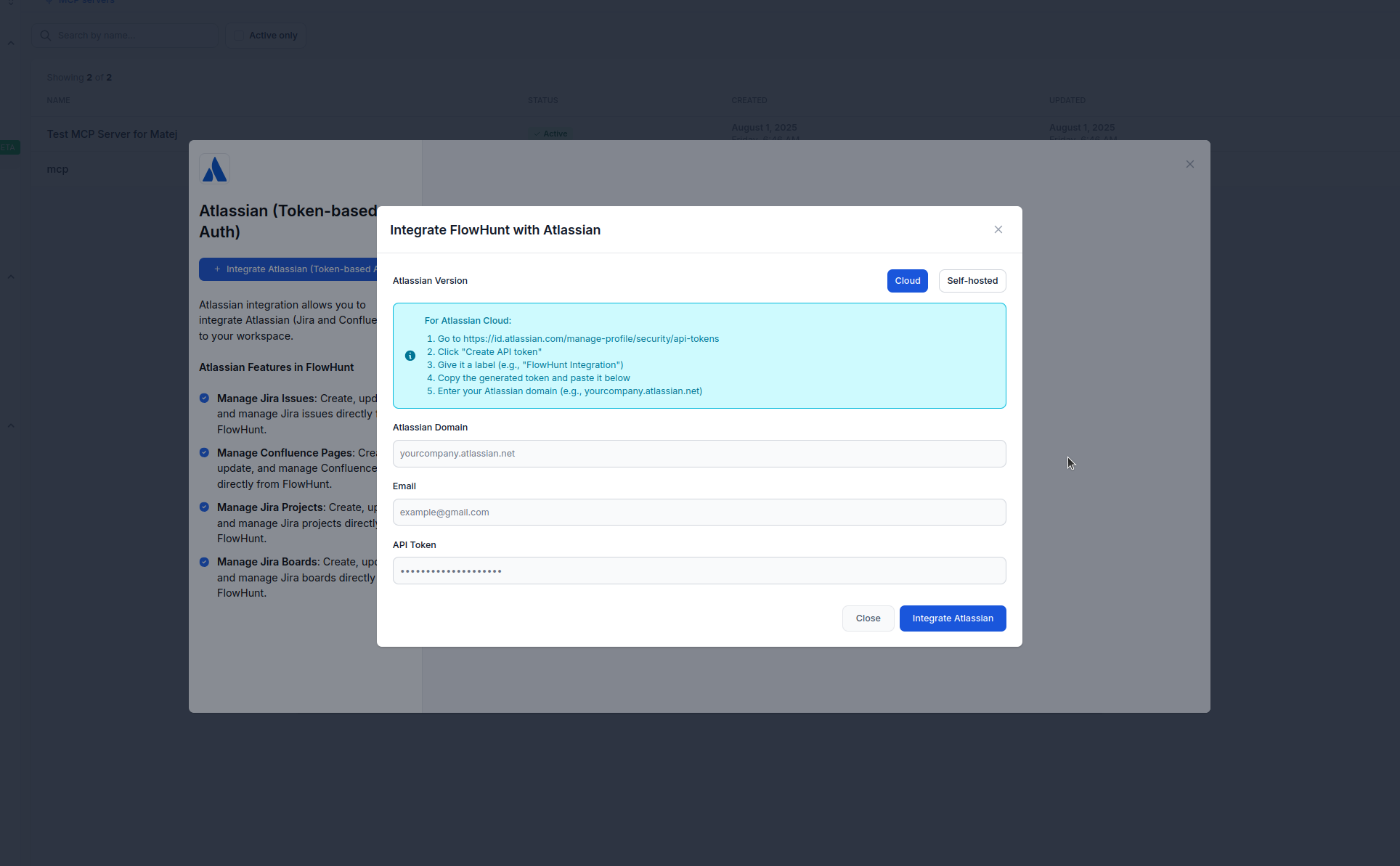
Navigate to MCP Servers: Go to the “MCP Servers” tab in your FlowHunt dashboard.
Add New Server: Click “Add New MCP Server”.
Select Atlassian Confluence: Choose “Atlassian Confluence MCP Server” from the available options.
Enter API Details: Provide the API token and, if required, the API URL and username.
Configure Server Tools: Select the tools you want to enable for your MCP server.
MCP INTEGRATION
The following tools are available as part of the Atlassian Confluence MCP integration:
Search Confluence pages using keywords, space keys, or other filters to locate specific content.
Retrieve detailed information about a specific Confluence page, including content and metadata, by providing the page ID.
Create new pages in a Confluence space with specified content, titles, and parent pages.
Modify existing Confluence pages by updating content, titles, or other attributes.

Finalize Setup: Click “Add MCP Server” to complete the configuration.
📝 Note: You can modify or add tools later based on your evolving automation needs.
Get latest tips, trends, and deals for free.
{
  "mcp": {
    "transport": "streamable_http",
    "url": "https://mcp.flowhunt.io/••••••••"
  }
}
🔒 Important: Treat your MCP server URL as a password. It provides direct access to your Confluence data and server tools. Never share it publicly or commit it to version control.
You have two powerful options for implementing your Atlassian Confluence automation:
Best for: Getting started quickly with proven automation patterns
Generate Flow: In your MCP Server configuration, click “Create Preconfigured Flow”.
Select Template: Choose “AI Agent with MCP” to create a ready-to-use workflow.
Customize Logic: Use FlowHunt’s visual flow builder to tailor the automation:
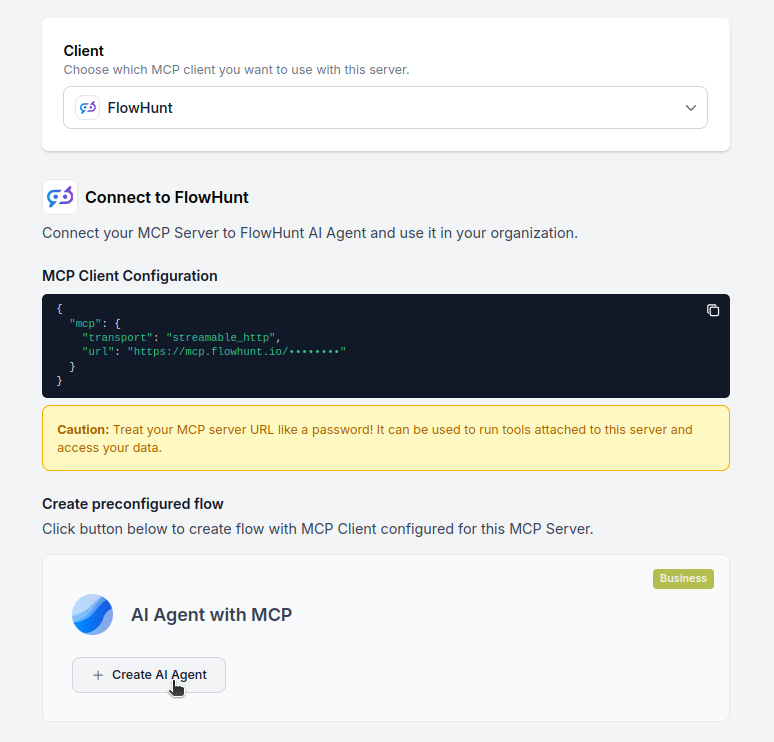
Activate: Save and activate your flow to begin automated operations.
Best for: Specific automation requirements or existing workflow enhancement
{
  "mcp": {
    "transport": "streamable_http",
    "url": "https://mcp.flowhunt.io/••••••••"
  }
}
Design Workflow: Create custom logic that leverages the MCP server tools:
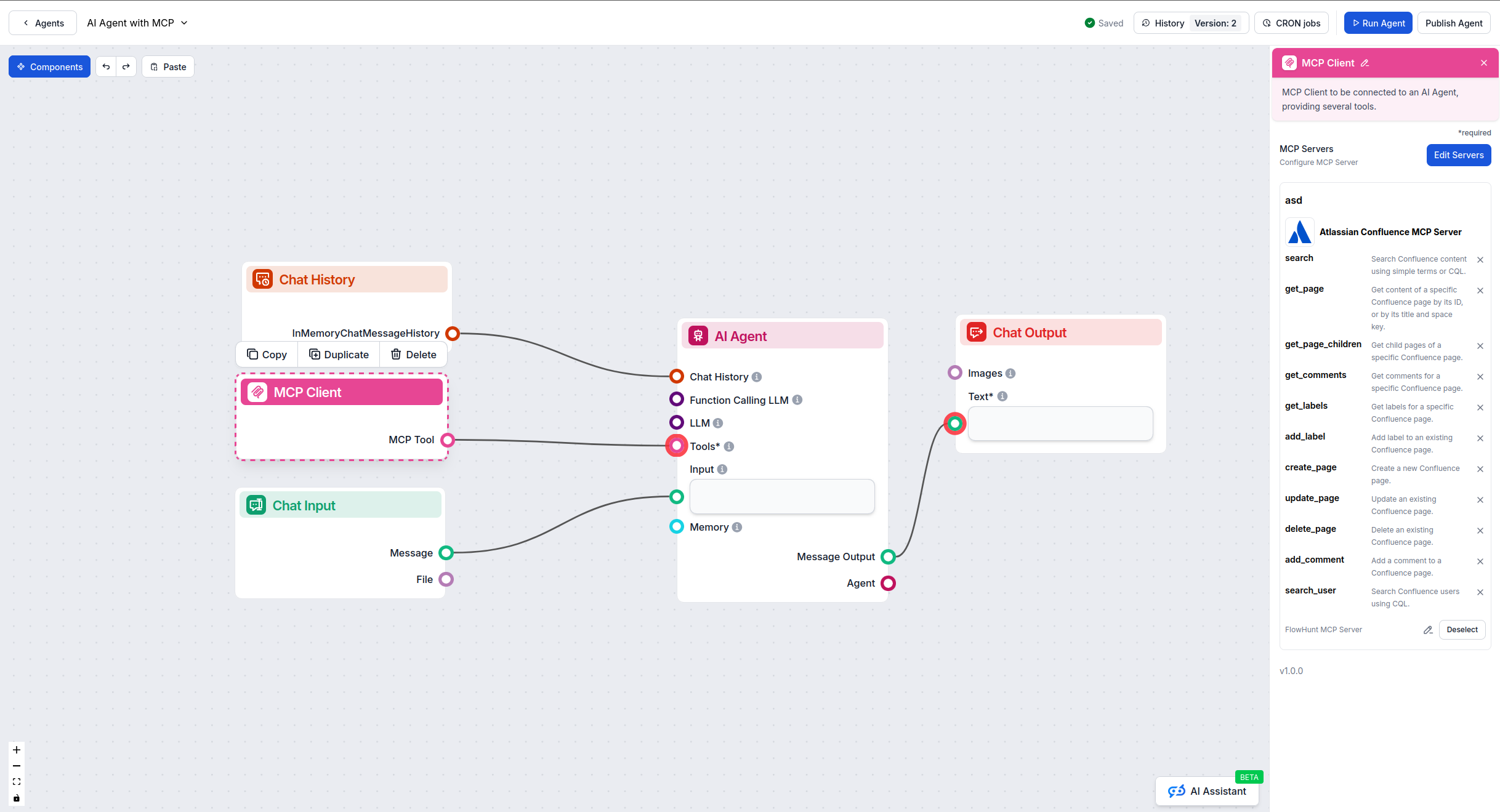
Deploy: Save your configuration and activate the flow.
Here are practical examples demonstrating how to use the Confluence MCP Server with your AI agents. These prompts showcase real-world documentation and knowledge management scenarios:
Search for all pages in the Engineering space that contain 'API documentation' and were updated in the last 30 days
Find all pages created by sarah@company.com in the Product space that have 'roadmap' in the title
Search for meeting notes from Q4 2025 across all spaces
Get the complete content of page ID 123456 including all metadata and formatting
Retrieve the 'Onboarding Guide' page from the HR space and summarize the key steps for new employees
Create a new page in the Engineering space titled 'Q1 2026 Sprint Planning' with a template for sprint goals, team capacity, and key deliverables
Create a meeting notes page for today's standup in the Development space with sections for blockers, completed items, and action items
Generate a new troubleshooting guide page in the Support space for common login issues based on recent support tickets
Update the 'Product Roadmap' page in the Product space to add the new features planned for next quarter
Append this week's engineering highlights to the existing Weekly Updates page in the Engineering space
Update the 'Team Directory' page to add three new team members with their roles and contact information
Create a release notes page for version 2.5.0 in the Product space and populate it with changes from the last sprint
Search for all pages with 'DRAFT' in the title and list them for review
Update the FAQ page in the Customer Support space by adding answers to the 5 most common questions from last month
Create a new troubleshooting article in the IT Support space for VPN connectivity issues with step-by-step resolution steps
Search for outdated documentation by finding all pages in the Technical Docs space that haven't been updated in over 6 months
These prompts demonstrate how Confluence MCP integration streamlines documentation workflows, from content creation and organization to knowledge sharing and team collaboration.
Integrating Atlassian Confluence MCP Server with FlowHunt.io creates a powerful foundation for intelligent documentation automation. Whether you’re streamlining page management, automating content updates, or enhancing knowledge sharing, this integration empowers your AI agents to work seamlessly with your critical Confluence data.
Start with a simple automation and gradually expand your workflows as you become more comfortable with the platform. The combination of Confluence’s robust content management capabilities and FlowHunt’s AI-driven automation will transform how your team collaborates and manages documentation.
Ready to get started? Begin your integration today and unlock the full potential of AI-powered documentation automation!
FlowHunt provides an additional security layer between your internal systems and AI tools, giving you granular control over which tools are accessible from your MCP servers. MCP servers hosted in our infrastructure can be seamlessly integrated with FlowHunt's chatbot as well as popular AI platforms like ChatGPT, Claude, and various AI editors.
Unlock the power of AI-driven automation for your Confluence workspace. Easily manage pages, spaces, and content from within FlowHunt.
The Atlassian Jira MCP Server enables seamless integration between AI tools and Jira, allowing automated workflows to manage issues, projects, and sprints direc...
The API-Sports MCP Server enables seamless integration between AI tools and API-Sports, allowing automated workflows to manage football data, including teams, f...

The GitHub MCP Server enables seamless integration between AI tools and GitHub, allowing automated workflows to manage repositories, issues, and pull requests d...
Cookie Consent
We use cookies to enhance your browsing experience and analyze our traffic. See our privacy policy.