



Azure Data Explorer (ADX) MCP Integration
Integrate FlowHunt with Azure Data Explorer (ADX) via Model Context Protocol (MCP) to automate secure KQL queries, manage schemas, and streamline data explorati...
4 min read
AI
Azure Data Explorer
+4

Connect FlowHunt to Azure Data Explorer for powerful, secure, and automated data exploration, KQL query execution, and schema management—directly within your AI workflows.
The Azure Data Explorer (ADX) MCP Server is a Model Context Protocol (MCP) server that enables AI assistants to seamlessly connect with Azure Data Explorer/Eventhouse clusters and databases. Through standardized MCP interfaces, it empowers AI tools and agents to execute KQL (Kusto Query Language) queries, explore database resources, retrieve table schemas, sample data, and access table statistics. The server supports interactive tools and authentication via Azure credentials, making it possible to securely manage and analyze large-scale data directly from AI-driven workflows. This integration enhances developer productivity by automating data exploration, querying, and management within Azure Data Explorer environments.
No explicit prompt templates are mentioned in the repository.

Start your free trial today and see results within days.
Get latest tips, trends, and deals for free.
{
  "mcpServers": {
    "adx-mcp": {
      "command": "npx",
      "args": ["@adx/mcp-server@latest"]
    }
  }
}
{
  "mcpServers": {
    "adx-mcp": {
      "command": "npx",
      "args": ["@adx/mcp-server@latest"],
      "env": {
        "ADX_CLUSTER_URL": "https://yourcluster.region.kusto.windows.net",
        "ADX_DATABASE": "your_database"
      },
      "inputs": {}
    }
  }
}
{
  "mcpServers": {
    "adx-mcp": {
      "command": "npx",
      "args": ["@adx/mcp-server@latest"]
    }
  }
}
{
  "mcpServers": {
    "adx-mcp": {
      "command": "npx",
      "args": ["@adx/mcp-server@latest"],
      "env": {
        "ADX_CLUSTER_URL": "https://yourcluster.region.kusto.windows.net",
        "ADX_DATABASE": "your_database"
      },
      "inputs": {}
    }
  }
}
{
  "mcpServers": {
    "adx-mcp": {
      "command": "npx",
      "args": ["@adx/mcp-server@latest"]
    }
  }
}
{
  "mcpServers": {
    "adx-mcp": {
      "command": "npx",
      "args": ["@adx/mcp-server@latest"],
      "env": {
        "ADX_CLUSTER_URL": "https://yourcluster.region.kusto.windows.net",
        "ADX_DATABASE": "your_database"
      },
      "inputs": {}
    }
  }
}
{
  "mcpServers": {
    "adx-mcp": {
      "command": "npx",
      "args": ["@adx/mcp-server@latest"]
    }
  }
}
{
  "mcpServers": {
    "adx-mcp": {
      "command": "npx",
      "args": ["@adx/mcp-server@latest"],
      "env": {
        "ADX_CLUSTER_URL": "https://yourcluster.region.kusto.windows.net",
        "ADX_DATABASE": "your_database"
      },
      "inputs": {}
    }
  }
}
Using MCP in FlowHunt
To integrate MCP servers into your FlowHunt workflow, start by adding the MCP component to your flow and connecting it to your AI agent:
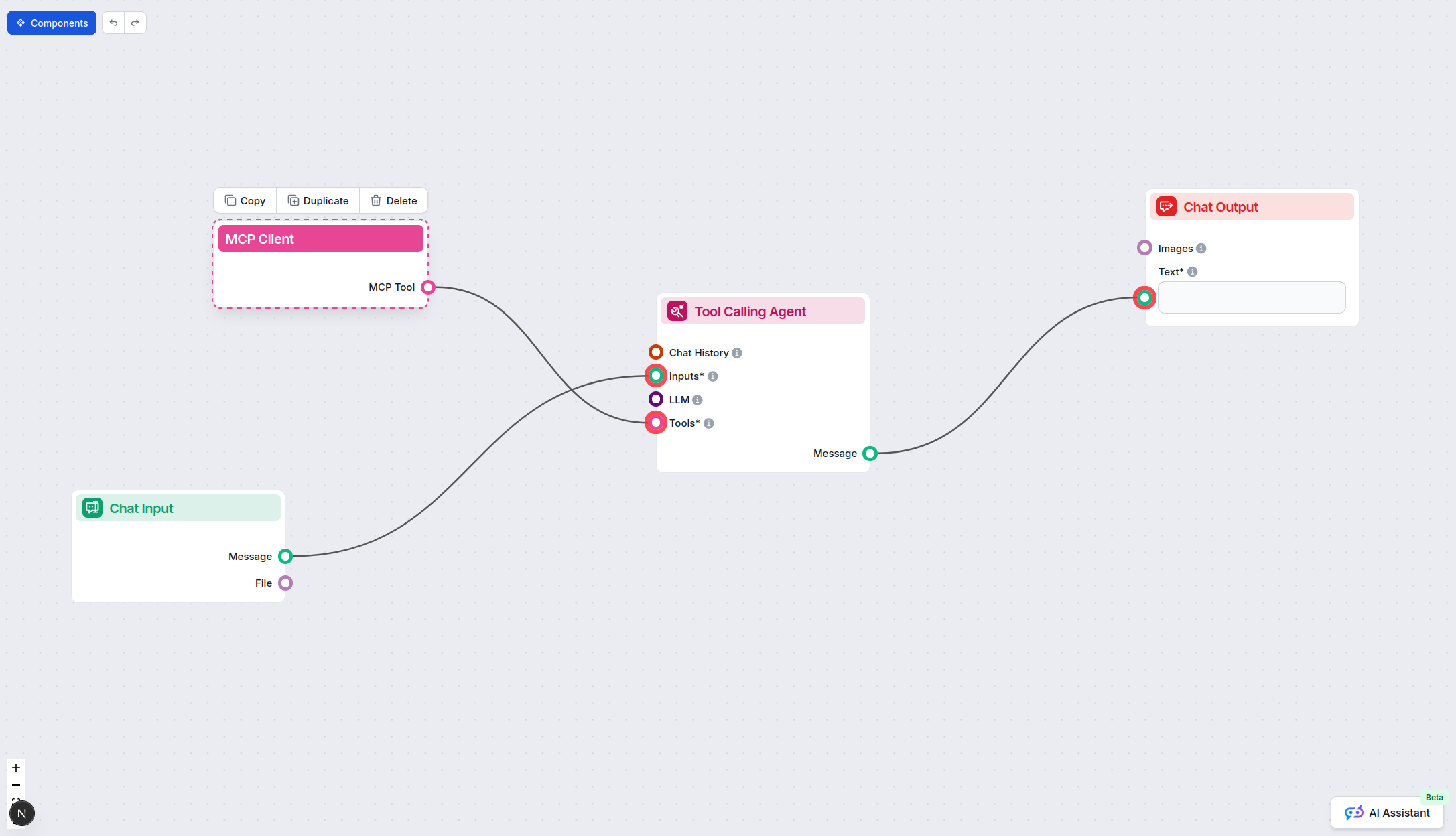
Click on the MCP component to open the configuration panel. In the system MCP configuration section, insert your MCP server details using this JSON format:
{
  "adx-mcp": {
    "transport": "streamable_http",
    "url": "https://yourmcpserver.example/pathtothemcp/url"
  }
}
Once configured, the AI agent is now able to use this MCP as a tool with access to all its functions and capabilities. Remember to change “adx-mcp” to whatever the actual name of your MCP server is and replace the URL with your own MCP server URL.
| Section | Availability | Details/Notes |
|---|---|---|
| Overview | ✅ | |
| List of Prompts | ⛔ | No prompt templates found |
| List of Resources | ✅ | Tables, schema, sampling, statistics |
| List of Tools | ✅ | KQL query, list tables, schema, sample, statistics |
| Securing API Keys | ✅ | .env file and environment variables supported |
| Sampling Support (less important in evaluation) | ✅ | Sampling of table data is supported |
Based on the information provided and its completeness, this MCP server rates around 7/10. It covers all major MCP requirements for Azure Data Explorer, but lacks explicit prompt templates and details about roots support.
| Has a LICENSE | ✅ (MIT) |
|---|---|
| Has at least one tool | ✅ |
| Number of Forks | 20 |
| Number of Stars | 42 |
Supercharge your AI workflows with direct, secure access to Azure Data Explorer. Automate database queries, schema management, and data exploration using the ADX MCP Server.
Integrate FlowHunt with Azure Data Explorer (ADX) via Model Context Protocol (MCP) to automate secure KQL queries, manage schemas, and streamline data explorati...
The MSSQL MCP Server connects AI assistants with Microsoft SQL Server databases, enabling advanced data operations, business intelligence, and workflow automati...
The ClickHouse MCP Server enables AI assistants and language models to securely interact with ClickHouse databases via standardized tools. Execute SQL queries, ...
Cookie Consent
We use cookies to enhance your browsing experience and analyze our traffic. See our privacy policy.