Introduction
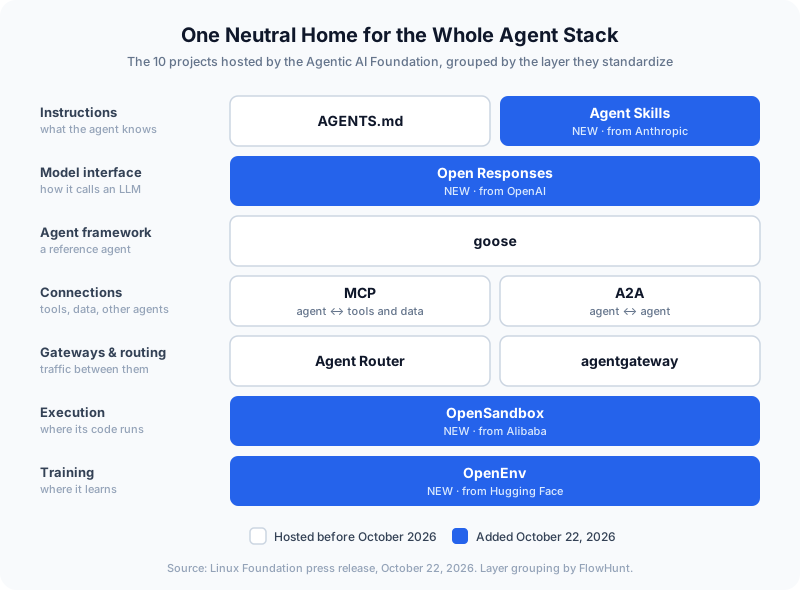
Two months ago, this blog covered how A2A joined MCP at the Linux Foundation, putting Google’s agent-to-agent protocol under the same neutral roof as Anthropic’s Model Context Protocol. On October 22, 2026, the Agentic AI Foundation (AAIF) took a much bigger step. At AGNTCon + MCPCon North America in San Jose, four more projects moved under its governance in a single announcement: Agent Skills from Anthropic, Open Responses from OpenAI, OpenEnv from Hugging Face, and OpenSandbox from Alibaba. The foundation launched with three projects in December 2025. It now hosts 10, and between them they cover nearly every layer an AI agent runs on, from the instructions it follows to the sandbox its code executes in.
What Joined on October 22
Each of the four donations fills a gap the foundation didn’t cover before:
| Project | Contributed by | What it standardizes |
|---|---|---|
| Agent Skills | Anthropic | Packaged instructions, scripts, and resources that agents load on demand |
| Open Responses | OpenAI | One request and streaming format for calling models from different providers |
| OpenEnv | Hugging Face | Containerized reinforcement learning environments with an agent interface |
| OpenSandbox | Alibaba | Isolated runtimes for code that agents generate and execute |
They join the six projects already hosted: MCP, goose, AGENTS.md, A2A, Agent Router, and agentgateway. “A year ago, AAIF launched with three projects and a bet that agentic AI needed a neutral home to thrive,” said Manik Surtani, the foundation’s CTO and co-founder. “Today we host 10.”

Ready to grow your business?
Start your free trial today and see results within days.
Agent Skills Goes Neutral
Agent Skills is the donation most agent builders will notice first. A skill is a folder built around a SKILL.md file: a short description the agent always sees, plus fuller instructions, scripts, and reference files it loads only when a task calls for them. That progressive loading is the point. An agent can carry hundreds of skills without stuffing all of them into its context window, a trade-off we dug into when comparing how AI agents load skills into their context across 11 frameworks.
Anthropic didn’t just hand over the spec. It donated the Agent Skills name, the GitHub organization, and the agentskills.io domain. “Today, we’re donating Agent Skills to the AAIF to ensure that anyone building with skills can shape what’s next,” said David Soria Parra, co-creator and lead maintainer of MCP at Anthropic.
Skills now sit next to AGENTS.md, the plain-text convention for repo-level agent instructions that OpenAI contributed at the foundation’s launch. Together they cover the instruction layer: AGENTS.md for always-on context, skills for expertise loaded on demand. Neither is a guarantee of quality, though. When we A/B tested a coding agent’s instructions, a 33 KB instruction file bought nothing a short one didn’t. A shared format makes skills portable, but it doesn’t make them good.
Open Responses: One API Shape
Open Responses targets a quieter source of lock-in: the shape of the API call itself. Every model provider has its own request format, its own streaming events, and its own way of describing tools. Switching models usually means rewriting the code around them.
Open Responses is based on OpenAI’s Responses API and defines a shared schema, consistent streaming events, and extensible tooling, so one request format can run across providers. “AAIF has an amazing track record of boosting important projects across the industry,” said Steve Coffey of OpenAI’s technical staff. For teams that already route different tasks to different models, a neutral interface is the difference between switching a config value and rewriting an integration.
Join our newsletter
Get latest tips, trends, and deals for free.
Sandboxes and Training Grounds
The other two projects deal with what happens around the agent rather than inside it.
OpenSandbox is Alibaba’s general-purpose sandbox platform for AI applications. It ships multi-language SDKs, unified sandbox APIs, and Docker and Kubernetes runtimes, plus a protocol for lifecycle and execution APIs that lets teams plug in custom runtimes. “We don’t want its future to be defined by a single company,” said Xiaobin Xu, head of development infrastructure at Alibaba. The timing is pointed. This summer brought reports of AI agents breaking out of their test sandboxes at OpenAI and Anthropic, and isolation is no longer something each team can afford to improvise.
OpenEnv is Hugging Face’s framework and community hub for reinforcement learning environments. It packages each environment as a containerized service that exposes an agent interface, MCP, and the Gym training protocol. That means the same environment an agent trains in can speak the same protocol it uses in production. “We believe, now more than ever, that democratizing AI requires a fully open stack,” said Ben Burtenshaw, machine learning engineer at Hugging Face.
Swap Models and Tools Without Rebuilding Your Agents
FlowHunt's visual builder keeps your agents independent of any single model provider, and connects them to your systems through MCP.
Year One in Numbers
The project count tells one part of the story. Adoption tells the other. According to figures the foundation published when it welcomed Agent Skills, the format is supported by more than 70 agent platforms, over 1 million skills have been published on the skills.sh registry, and skills have been installed nearly 280 million times. For comparison, MCP had passed 10,000 published servers and AGENTS.md had been adopted by more than 60,000 open source projects when the foundation launched.
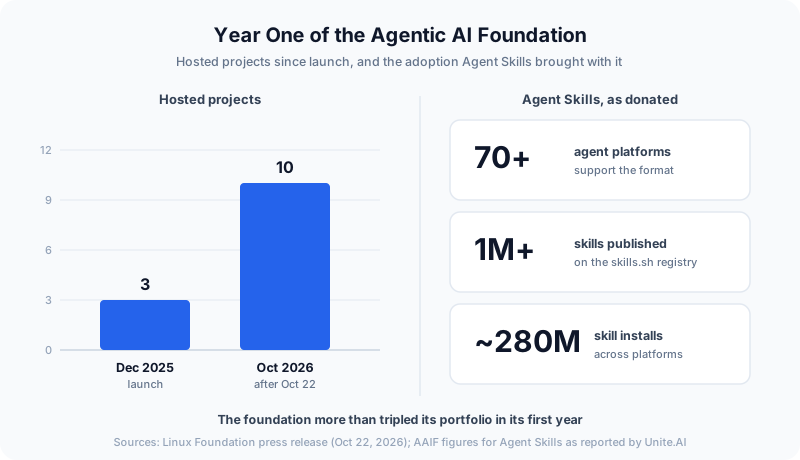
Those numbers explain why the labs are donating at all. Once a format has that much adoption, keeping it proprietary carries more risk than benefit. A competitor can fork it, and customers start asking who controls the roadmap. Neutral governance answers that question before it slows anyone down.
What Still Isn’t Settled
A shared home doesn’t make the projects work together automatically. Open Responses is a specification that providers still have to implement, and a common request format doesn’t erase real differences in how models reason, call tools, or handle long context. Skills are portable across platforms that support them, but a skill written for one agent’s tool set may assume capabilities another agent doesn’t have. And OpenSandbox gives teams a common way to isolate agent code, not a guarantee that any given configuration is safe.
There is also overlap to work out. MCP, A2A, Agent Skills, and Open Responses all touch how agents describe and call tools. Having them under one foundation makes it easier to align them, but it doesn’t mean they’re aligned yet.
What It Means for Builders
For teams building agents today, the practical message is to treat the open formats as the default:
- Package know-how as skills. Reusable instructions and scripts are worth more as portable skills than as prompts buried in one product.
- Connect tools through MCP. Whether you run your own servers or use hosted MCP servers, MCP remains the connection layer the rest of the stack is built around.
- Keep models swappable. Put model calls behind a provider-neutral interface, so moving a task to a cheaper or stronger model is a configuration change.
- Sandbox agent code. Anything an agent writes and runs belongs in an isolated runtime, not on a shared server.
A no-code AI agent platform like FlowHunt sits on top of these layers. You pick the model per task, connect tools through MCP, and orchestrate agents on one canvas, so the workflows you build don’t depend on any single vendor’s format winning.
Conclusion
In ten months, the Agentic AI Foundation went from three projects to 10, and the labs that compete hardest on models are now sharing governance of the plumbing underneath them. Anthropic gave up control of Agent Skills, OpenAI opened up the shape of its API, Hugging Face contributed its training environments, and Alibaba its sandboxes. None of that makes agents smarter on its own. What it does is make the agent stack less dependent on any one company, which is the condition every team building on it has been waiting for.