



Patronus MCP
Integrate FlowHunt with Patronus MCP Server to streamline LLM system optimization, evaluation, and experimentation. Standardize AI model testing, automate exper...
4 min read
AI
Patronus MCP
+4

Patronus MCP Server automates LLM evaluations and experiments, enabling streamlined AI benchmarking and workflow integration for technical teams using FlowHunt.
The Patronus MCP (Model Context Protocol) Server is a standardized server implementation built for the Patronus SDK, designed to facilitate advanced LLM (Large Language Model) system optimizations, evaluations, and experiments. By connecting AI assistants to external data sources and services, Patronus MCP Server enables streamlined workflows for developers and researchers. It allows users to run single or batch evaluations, execute experiments with datasets, and initialize projects with specific API keys and settings. This extensible platform helps automate repetitive evaluation tasks, supports the integration of custom evaluators, and provides a robust interface for managing and analyzing LLM behavior, ultimately enhancing the AI development lifecycle.
No prompt templates are explicitly listed in the repository or documentation.

Start your free trial today and see results within days.
No explicit resources are detailed in the available documentation or repo files.
initialize
Initializes Patronus with API key, project, and application settings. Sets up the system for further evaluations and experiments.
evaluate
Runs a single evaluation using a configurable evaluator on given task inputs, outputs, and context.
batch_evaluate
Executes batch evaluations with multiple evaluators over provided tasks, producing collective results.
run_experiment
Runs experiments using datasets and specified evaluators, useful for benchmarking and comparison.
Get latest tips, trends, and deals for free.
LLM Evaluation Automation
Automate the evaluation of large language models by batching tasks and applying multiple evaluators, reducing manual effort in quality assurance and benchmarking.
Custom Experimentation
Run tailored experiments with custom datasets and evaluators to benchmark new LLM architectures and compare performance across different criteria.
Project Initialization for Teams
Quickly set up and configure evaluation environments for multiple projects using API keys and project settings, streamlining onboarding and collaboration.
Interactive Live Testing
Use the provided scripts to interactively test evaluation endpoints, making it easier for developers to debug and validate their evaluation workflows.
.windsurf or windsurf.json).{
"mcpServers": [
{
"command": "python",
"args": ["src/patronus_mcp/server.py"],
"env": {
"PATRONUS_API_KEY": "your_api_key_here"
}
}
]
}
{
  "mcpServers": [
    {
      "command": "python",
      "args": ["src/patronus_mcp/server.py"],
      "env": {
        "PATRONUS_API_KEY": "your_api_key_here"
      }
    }
  ]
}
{
  "mcpServers": [
    {
      "command": "python",
      "args": ["src/patronus_mcp/server.py"],
      "env": {
        "PATRONUS_API_KEY": "your_api_key_here"
      }
    }
  ]
}
{
  "mcpServers": [
    {
      "command": "python",
      "args": ["src/patronus_mcp/server.py"],
      "env": {
        "PATRONUS_API_KEY": "your_api_key_here"
      }
    }
  ]
}
Securing API Keys:
Place sensitive credentials like PATRONUS_API_KEY in the env object of your configuration. Example:
{
  "command": "python",
  "args": ["src/patronus_mcp/server.py"],
  "env": {
    "PATRONUS_API_KEY": "your_api_key_here"
  },
  "inputs": {}
}
Using MCP in FlowHunt
To integrate MCP servers into your FlowHunt workflow, start by adding the MCP component to your flow and connecting it to your AI agent:
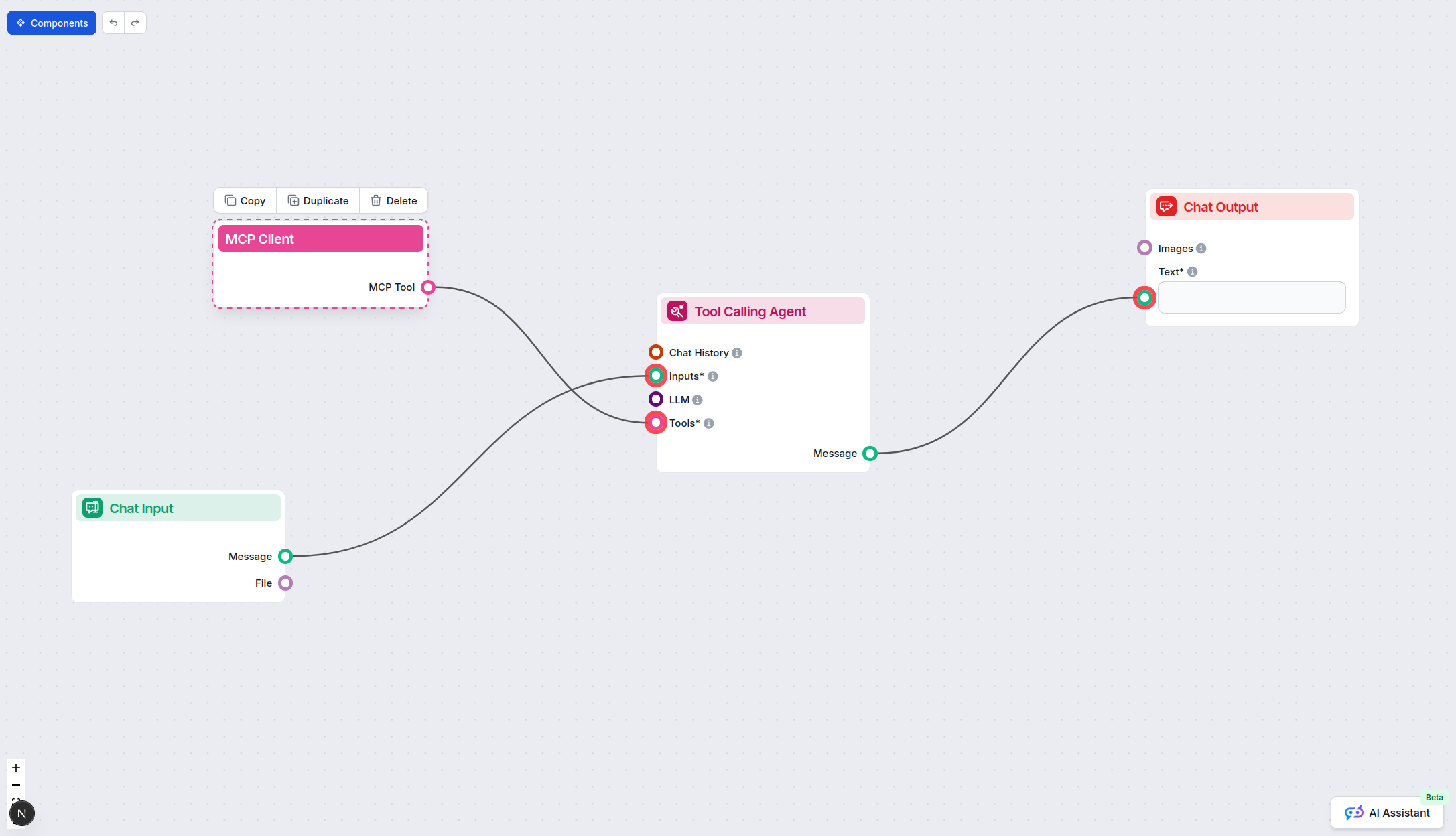
Click on the MCP component to open the configuration panel. In the system MCP configuration section, insert your MCP server details using this JSON format:
{
  "patronus-mcp": {
    "transport": "streamable_http",
    "url": "https://yourmcpserver.example/pathtothemcp/url"
  }
}
Once configured, the AI agent is now able to use this MCP as a tool with access to all its functions and capabilities. Remember to change “patronus-mcp” to whatever the actual name of your MCP server is and replace the URL with your own MCP server URL.
| Section | Availability | Details/Notes |
|---|---|---|
| Overview | ✅ | Clear description in README |
| List of Prompts | ⛔ | No prompt templates found |
| List of Resources | ⛔ | No explicit resources listed |
| List of Tools | ✅ | Found in API usage and README |
| Securing API Keys | ✅ | Described in README and setup instructions |
| Sampling Support (less important in evaluation) | ⛔ | Not referenced |
Roots Support: Not mentioned in the documentation or code.
Based on the information above, Patronus MCP Server provides a solid foundation and essential features for LLM evaluation and experimentation, but lacks documentation or implementation details for prompt templates, resources, and advanced MCP features like Roots and Sampling.
The Patronus MCP Server offers robust evaluation tools and clear setup instructions, but is missing standardized prompts, resource definitions, and some advanced MCP features. It is best suited for technical users focused on LLM evaluation and experimentation. Score: 6/10
| Has a LICENSE | ✅ (Apache-2.0) |
|---|---|
| Has at least one tool | ✅ |
| Number of Forks | 3 |
| Number of Stars | 13 |
Integrate Patronus MCP Server into your FlowHunt workflow for automated, robust, and scalable AI model evaluations and experimentation.
Integrate FlowHunt with Patronus MCP Server to streamline LLM system optimization, evaluation, and experimentation. Standardize AI model testing, automate exper...

The Grafbase MCP Server bridges AI assistants and external data sources or APIs, enabling LLMs to access real-time data, automate workflows, and extend capabili...

The pydanticpydantic-aimcp-run-python MCP Server bridges AI assistants with secure, controlled Python code execution environments. It enables dynamic Python scr...
Cookie Consent
We use cookies to enhance your browsing experience and analyze our traffic. See our privacy policy.